The Angelique, too

if not a schooner
a ketch

Technically, a ketch rather than a schooner.
the Angelique a beautiful ketch

at anchor nearby
rust-colored sails
quite distinctive

yes, ketch that

everyone else went ashore in the yawl
to the boat school etc.

Brooklin

just me and the crew left aboard

someone in a white sweatshirt

jumping rope on the dock
the sound of the slapping rope
across the water
caught my attention

finally wearing my new hoodie
with its kangaroo pocket

learned that phrase yesterday

Joe bought the E.B. White democracy book while ashore
after hearing us discuss the author
(the son became a famed boat builder)

boat school temp tattoos stamped
on other passengers, crew

we’re leaving the Angelique at anchor

Everybody should get a sabbatical

Shortly before finding myself officially unemployed, I engaged a typist to prepare a clean draft of Subway Hitchhikers for submission to literary agents or book editors. At least that would be moving forward.

And then, when the ax fell, I was surprised to find that after arriving in Baltimore, in debt from divorce and selling a house at a loss in a recession, I had saved up a bundle in just two years. Having a company car and an expense account covering my meals during the week added up. Rather than return immediately to the workforce, I decided to give myself some time off, a sabbatical, as it were, to concentrate on the writing I had always wanted to do. The kind that would put my name on the cover and the spine. Something more lasting than a byline on a daily paper or even, more prestigiously, a magazine.

Watching a colleague who was waiting till retirement before he could tackle the children’s book he always wanted to write nagged at me. I had heard a few similar dreams – wait for retirement. Except that a heart attack felled Russ shortly after he got that farewell cake.

In my job-free spree, I hunkered down to hard writing, up to 12 hours a day. By this point, I was pretty proficient with my personal computer and its dot-matrix printer. And so, while she was typing up Hitchhikers, I turned to keyboarding other material.

What I see as I look back on my sabbatical was that I entered the year more prepared than I’ve assumed. It wasn’t like I was sitting down and staring at a blank page and waiting for inspiration to strike. Besides, I had journal notes, correspondence, even maps and photos to draw on.

Every writer works differently, as interviews in the Paris Review demonstrated. The one with Jack Kerouac had inspired to use the end rolls of teletype paper for drafting, freeing me from having to keep inserting new sheets into the typewriter. Using a PC was like that, only instead of having to replace paper I had a 5¼-inch flopping disk that filled up. If only I had an editor waiting, like he had.

As I awaited word on my query letters to agents and publishers, I began examining my life from college to the present through the eyes of fiction. Keyboarding large sections from my journals gave me a foundation for following my moves from the East Coast back to Ohio, on to Indiana, again, and finally the Pacific Northwest, events that included my first marriage. Making it work as fiction, though, was the challenge.

My primitive PC was still a huge advance over typewriters, in my case, an Olivetti Editor 2. And here I had been seeing the ubiquitous IBM Selectric as an enviable sign of a successful writer? The thought is rather amusing today. Gee, and there was no Internet yet, hard as that is to believe now.

In my sabbatical I concentrated on a single manuscript and then put it aside as I awaited feedback from potential agents or publishers or maybe just for a space to season until I could come back to it afresh. That opened a window to start drafting another. I was a fiend, having waited years for this opportunity.

My hunkered down life? I got the deepest tan of my life by taking a midday break at the pool, at least through the summer. And did get out for hikes, especially in nearby pine barrens that had lead mine remains and a waterfall. Spiritually, I was connecting with Plain Quakers, liberal Mennonites, former Amish, and a small circle from the Church of the Brethren – all in the pacifist tradition. There was even a writers’ group that Tom Clancy addressed just as he was on the cusp of celebrity.

What I see now when I look at my earlier writing is that I could never have created those pages later in my life. Too many details would have vanished, along with the urgency and originality and even the voice.

The sabbatical was also a period of heavy reading for me, including the brat pack being edited by Gary Fisketjon at Vintage Contemporaries, Lawrence Durrell’s Alexandria Quartet, and George Eliot’s Middlemarch.

As my savings ran out, I still hadn’t found an agent or publisher. Realizing I’d need at least another year clear to achieve that, I reluctantly headed back to my career in newspaper journalism, this time in New Hampshire. There was a crucial shift, though. The archconservative Union Leader had a unionized newsroom where I could go back into the ranks as an editor and still earn more than most small paper managing editors across the country. I even had job security and a 35-hour workweek that allowed me time for a real life.

I packed up with the first rambling draft of what would become Promise, released via Smashwords in 2013, and two related novels, plus Hometown News and all of the outtakes from the subway project. I could continue to revise those drafts in my free time, but the book publishing world was changing in ways that baffled even the most celebrated literary agents.

Looking back, I must admit how much risk I took in my year off. I had no health insurance, for one thing, and no guarantee I could return to the shrinking ranks of journalism. I was also perceiving the pace I was working at could not be sustained.

I had been appalled in reading interviews with famed authors who boasted that they worked four hours a day – what slackers, I thought. Now I see that as a rather lavish amount of time, considering the additional hours of research, related correspondence, submissions, reading, and basic home-business demands (yes, writing is a business). Gee, how did I overlook all those hours of lunch conferences or cocktail hours in the lives of the literati, which were essentially business? Or even their hours in psychotherapy?

Two years on the road came as a welcome respite

The ‘80s hit me with a couple of hard setbacks. First, Mount St. Helens blew up, as did my job in what I had seen as my Promised Land. I went bouncing back east, first to a stint along the upper Mississippi in Iowa and then three years in the Rust Belt of Ohio, where my shirt-sleeve management position ate up 60 hours or more of my life every week. Shortly after my first marriage fell apart there, my job was eliminated. At least I had a hot love going, with an engagement to be announced once I could relocate to Baltimore, where she had moved for her studies.

Somehow, I landed a field representative job with the Chicago Tribune’s newspaper features syndication service, one that allowed me to move anywhere I wanted within the 14 northeastern states I would be covering. Baltimore was perfect.

Except, once I ensconced in the top floor of an 1840s rowhouse in a gentile in-town neighborhood, my beloved wasn’t. If only I could get a straight answer from her.

Complicating matters was that I was out on the road three weeks out of four, home only to unpack and repack on the weekends. The job introduced me to a world many American men know: frequent flyer lounges, taxis and limos, hotels and motels, expense and mileage reports, quarterly sales meetings, three-piece suits custom made at Joseph Banks, a company car, bonuses. Newspaper management, especially on the smaller papers that I had known, were nothing like that. You might get a nice note from your boss or someone up the ladder thanking you for a particular job well done.

Getting from one sales call to the next gave me a lot of time for thinking as I drove or even reading, if I was flying. The time allowed me to decompress from a decade that had included 11 addresses in seven states. I could journey at ease or read or revise earlier manuscripts at night in my room, whatever its number.

My personal life included some of the loneliest nights ever but also led to my best friendship ever, a Plain Quaker who worked as a supermarket meatcutter when he wasn’t working as a nurse. I also had a circle of Mennonites who introduced me to four-part a cappella part-singing, a step that would lead me to the excellent choirs I would join in Boston and Eastport. I also visited among Friends, aka Quakers, and sometimes managed a few hours for genealogical libraries and archives or walking through cemeteries where my ancestors are buried. I even revisited the ashram and my old stomping grounds in upstate New York.

None of this apart from the newspaper world has entered my fiction directly. I thought she would be a fine character to build on, except in retrospect it turned out all too banal. What these experiences did feed was my poetry later.

Thanks to my best friend from my junior high and high school years, who was now living an hour south – unlike the previous decade, where we kept landing on opposite ends of the country – I obtained my first PC, something some of his buddies were building. It had 5¼-inch floppy disks, which would be ancient history to so many tech-savvy youths today.

In my travels, I saw much industrial wasteland. Not just Pittsburgh and western Pennsylvania or Sparrows Point outside Baltimore, but also around Philadelphia, across upstate New York, in Worcester and Buzzards Bay and the Merrimac/Merrimack River in Massachusetts and New Hampshire.

The newspaper industry was also taking hard hits. As manufacturing jobs disappeared, so did readership for afternoon papers, which were read by people taking the bus home or waiting for dinner. That greatly reduced the opportunity to place new features in their pages. As I was told, only a few years earlier, I would have had no difficulty selling to editors. Now, the challenge was keeping them happy with what they were already buying. I also saw great turnover at the helm of papers. I would curry an editor and have promises for a sale once the new annual budget was approved, only to find that he was no longer there in a year. The position I had aspired to and been groomed for was now revealed to be something less than desirable.

What became clear to the five of us out on the road was that the business was in trouble. One or more of us would be cut. I was the one. Besides, I really never was much of a salesman.

My observations of visiting other papers did augment my actual newsroom experiences that would emerge as the novel Hometown News.

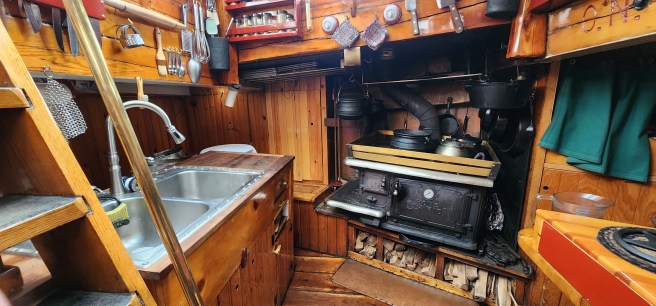
Fire on board

Wooden sailing vessels traditionally had only one fire onboard, the cook’s stove. I can’t imagine how cold sailors, much less passengers, were through most of the year.

Windjammers hew to that tradition.

a wooden sailing vessel
with a wood-fired cook stove
and kerosine lanterns

two iceboxes

Smoke from the cookstove goes
into a T-shaped chimney vent

don’t get too close

“Smokestack,” not “chimney”
maybe “noble Charlie”

How the style and ethics of my journalism career clashed with my literary ambitions

When I sat down to my personal writing, I felt an ongoing tension between the daily grind of newspaper editing that paid my bills, contrasted to my ambitions for something more permanent, more confidential, and more creatively advanced than the anonymous work that went into the next day’s trash. The pejorative “hack writer,” often applied to newspapermen from the early 18th century on, was what I aspired to rise above. The term has haunted me ever since reading Samuel Johnson’s derision.

In my private labor I aimed for something unique, thoughtful, sophisticated, meticulously developed, complex, and even challenging for both me and the reader. If news stories limited attribution for a quote as the neutral “said,” I nearly banished that colorless word from my prose, relying instead on everything from “answered” or “asserted” to “cried” or “swore“ to “wept” or perhaps “whispered,” with a wide range of variants in between. Do note, I’ve come to treasure a thesaurus for ways in can enrichen a text and sharpen the underlying thought and feelings, even though doing so requires additional time and consideration.

My journals, on the other hand, sought mostly to catch up on my life from the previous entry, often in cryptic terms I might get back to and fill in later, though that rarely happened.

~*~

Hemingway could write for a sixth-grade level reader because he was no longer in a newsroom. It could kill you, believe me, if it’s all you got to do.

I needed to foster my literary ambitions simply to keep my editing skills sharp.

It did make for tension in my private work, though. I still love a good 250-word sentence.

~*~

Let me also say something of the ethics. Being told not to wear a politician’s campaign button. No appearance of partisanship. Leonard Downing of the Washington Post even refused to vote in an election for fear it would taint his neutrality or objectivity.

Were we, as one girlfriend taunted me, ethically castrated? My first editor, Glenn Thompson, worked behind the scenes to get progressive things in motion and did urge us interns to have causes.

By the way, I have worked for some very conservative papers and also some very liberal ones. It didn’t affect what I did for them.