When up turns down turns up

For many people, worship – or even spirituality – is a way of escaping everyday life and conflict.

For Friends, in contrast, worship is a place and time to embrace it, face it, transform it, find harmony and appropriate action.

Not that I would have said that before. In fact, for years the high I felt in the hour did provide me a weekly respite.

They weren’t always considered romantic

The 1990 application to include the restored and repurposed Louis R. French in the National Register of Historic Places includes much more than a detailed physical description of the schooner and her history.

The National Park Service document, Louis R. French (Schooner), available online  portrays the two-masted coasting schooner as the most common American vessel type, with tens of thousands of them functioning as the “freight trucks” of their time, carrying coal, bricks, iron ore, grain, oysters, lumber, and even ice between ports.

Yet, at the time of the application, only five of them were surviving in the United States.

In addition, the French was the oldest surviving sailing vessel built in Maine, the center for wooden shipbuilding in the United States after the Civil War.

As the application noted, until the outbreak of World War II, the coasting schooners were so common that nobody paid much attention to them. Designed to run fairly close to shore, the coaster lacked the fishing schooner’s ability to ride out a gale offshore on the fishing grounds. Nor did the coaster approach the scale of the great four-, five-, or six-masted coal schooners that transported coal from southern to northern ports.

Deepwater sailors, who occasionally took a large schooner across the Atlantic, scorned the useful and ubiquitous little coasters, sometimes accusing their skippers of “setting their course by the bark of a dog.”

The application quoted maritime historian Howard I. Chapelle, who observed “the straight fore-and-aft-rigged schooner is decidedly a coastwise vessel, and attempts to use such craft for long voyages have invariably been disappointing and disillusioning, if not disastrous to the adventurers.”

The schooner supplanted the square-riggers in the coasting trade for practical reasons:

Fewer sailors were required to handle the vessel, and a schooner could be worked into and out of harbors and rivers more easily than any square-rigged craft. Her trips could also, as a rule, be made in quicker time, as she could sail closer into the wind, and it was hardly necessary for her to sail from Maine to New York by way of the Bermudas, as some square-rigged vessels have done during baffling winds.

Put another way, they were the errand boys, the short-haul freight droghers, and the passenger buses for many a year, and their contribution to coastal community life, especially in New England, was substantial.

“Without them, the country could hardly have been settled,” as the report quotes one source.

These days, there’s nothing Plain Jane about them, though. Not in my boat – err, book.

Wandering through a personal wilderness without Moses or Miriam

Nothing was holding me Baltimore, as much as I loved it. And so, getting back into the American workforce in my mid-30s, I wound up in New Hampshire with the equivalent of a basket of wet literary laundry on those 5¼-inch floppy diskettes.

Although I had called on newspaper editors throughout the region, New England was largely unfamiliar to me. Apart from one couple in Boston, I knew no one. Beyond that, my love life was in ashes.

Thus, I unpacked in a new life along the Merrimack River in New Hampshire, the first of three addresses I would have in the state, fully intent on revising the lode I had mined and finding a literary agent or publisher once I got settled into my new job on the night shift.

What intrigues me looking back is that nothing in my life after my move to Baltimore prompted new fiction. Some details got woven into the revisions, but my literary output during the next three decades was mostly poetry, a more manageable format considering my hours of paid labor. Writing fiction demands the luxury of immersing yourself fully in the lives of your characters. It takes more than a full day once a week.

Besides, unlike my previous settings, New England has been thoroughly mined as far as fiction goes. What could I add to the picture? It had more layers and nuances than my previous locations, and many of them remained cryptic. Besides, I had enough to contend with in my existing manuscripts and the rapidly changing, increasingly confounding, commercial book world. Fewer publishers were accepting fiction, and those that did kept merging. More ominously, they weren’t nurturing promising authors with the hopes of getting a hit five books down the road but rather expected a blockbuster right out of the starting gate – if you could get in. It felt a lot like I had encountered as a newspaper syndicate field representative.

I was, however, appearing widely in the small-press literary scene, mostly with poetry but also chapter excerpts from the lingering novels. It kept me going.

~*~

My persistence finally paid off. After collecting the proverbial stack of rejections and a more widespread snubbing in which agents didn’t even bother to return the self-addressed-stamped-envelope, I finally got a nibble to co-publish with a Santa Barbara press of some distinction. Three years after my move to New England, Subway Hitchhikers appeared in print, right into what became the worst bookselling season in memory, thanks to the First Iraq War. Just my luck.

I did get one extended – and favorable – review, but that was it, no matter how much I pushed the self-promotion. My job schedule, which included a double-shift on Saturday, didn’t help. I couldn’t go to book fairs or author workshops.

My copies to sell appeared shortly after I had moved to a small townhouse atop the highest point in town. Moving them into the hands of readers and reviewers was the next challenge. As I said about the book market?

What did change was my self-image. Publication, for me, was the equivalent of a Master’s degree. I had something to show for my work. People respected that, even if they didn’t buy a copy. As for my personal life? There was a second Summer of Love! I was back in the euphoria of the early ‘70s, only better.

The swirl also had me thinking I could solve the tangle of my Pacific Northwest tale, so I kept revising, usually on a vacation week or holiday weekend.

And then, in 2005, Adventures on a Yoga Farm was published – as a pioneering ebook at PulpBits in Vermont. Again, it went nowhere as far as recognition, though several incarnations later, it’s Yoga Bootcamp and a much better book. As for timing? The yoga movement hadn’t yet rebounded and PDF books never really caught on. There I was ahead of the curve.

Somewhere in that stretch, my PC’s green screen went dead, already obsolete, meaning forget finding a replacement. Instead, the option was to upgrade to a new computer, one with a hard disk and telephone access to an online browser. Email was still somewhere off in the future. And I had to convert all of my keyboarded material from WordPerfect 4.1 to Microsoft’s Word. I wasn’t happy.

Are you one of the folks who recognizes these steps? Or are they all way before you came along?

And who sez the writing life is glamorous or that it runs along the lines of the movie plot were you’re suddenly rich and famous?

As I look back on this period, I see myself in a kind of wandering in the Sinai without a Moses or his sister Miriam to guide me. At least I developed an active social life, largely through contradancing and Quakers, and I was regularly riding Boston’s Green Line in underground tunnels.

An eclipse too good to be true

Against all odds for this time of the year in Maine, the long awaited full solar-eclipse day delivered ideal weather. Amazingly, especially for April, after a week of gray, rain, and snow, the sky stretched cloudless, the air was crisp, and temperatures edged into the 50s. It felt too good to be true. If I had been a betting man, this was a wager thing I would have lost.

You’ve no doubt heard about the swarm of curiosity seekers who mobbed the narrow band of total eclipse as it moved up from Texas and through the Midwest and eventually through northern New England. I won’t rehash that part of the story. For us, the question came down to finding a place to observe the astronomical event without the carnival congestion and related distractions.

Houlton, 115 miles to the north of us, touted itself as the ultimate destination and publicized accordingly. After a snow-scant winter, they needed to recover from severe winter tourism losses. We wished them well but thought other locales, perhaps Millinocket, might be saner, even though more distant.

Houlton is normally a two-hour, 18-minute drive to the north of us. Narrow, forested, two-lane U.S. 1 the only route for most of the way. For others, it’s at the upper end of Interstate 95, just before Canada. It’s not only the seat of potato-famed Aroostook County, it’s also the principal access point. We had to wonder how widely some of the metropolitan traffic would spill over into Washington County, perhaps once GPS started rerouting traffic to alternate highways. It wouldn’t take much to jam up everything for us and everyone else.

In planning for our adventure, we scoured the maps and settled on Danforth, population 587 spread over 60.46 square miles (6.46 of that being water) at the northern edge of our county, just before Aroostook. Danforth was on the way to Houlton anyway and would receive just about the same timespan of total eclipse. How heavenly, if we could stay out of the mud and muck. We focused on a side road north from the village at the center of town and hoped the route was paved. No guarantees from the map or satellite photos. If not, considering impassable conditions this time of year, we’d need to have plans B, C, and D at hand. We zeroed in on two cemeteries as possible places to set up our folding chairs, and headed off, leaving ourselves a generous margin of time for delays and readjustment.

Too good to be true, we instead had smooth sailing all the way, scouted out our sites and some gorgeous scenery, even noted the possibility of crashing Mike & Kay’s Eclipse Party that a homemade roadside sign presented. But where was everybody? Had we deluded ourselves? What had we overlooked? The scenery, though, was gorgeous.

We decided to head back to the village and stopped at the only restaurant in town, one with fuel service and a single rest room, which had a long line. No surprise. We were, though, surprised by the number of friends and neighbors from Eastport we ran into. Oh, yes, the food was better than most you’d find in a diner and the service was prompt and friendly, despite the throng at the front of the store. I’d stop there again, definitely.

I did have to laugh at the pristine black tee-shirt one woman wore. It featured photos of the cycle of a solar eclipse and the time 4:36. Where we were, totality was set to begin at 3:32. Was I the only one aware that she was running on Atlantic Daylight Savings to the east in Canada?

Beyond that, here’s what we found:
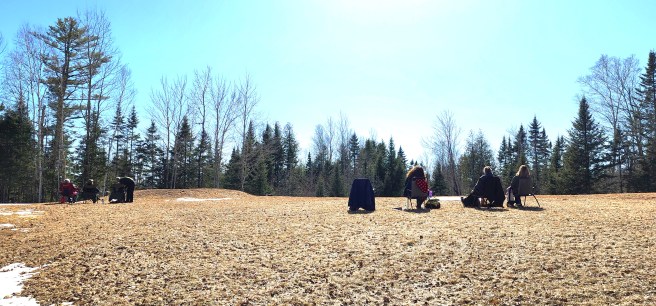
When we returned to the cemetery, which had been No. 2 on our list until we discovered that No. 1 was tiny, wet, and too heavily wooded, we were jolted to see we had unexpected company. A party of three was firmly ensconced. Were they locals? Would they resent our intrusion? Nah, they were from just a few towns down the road from us in Eastport, and their planning paralleled ours. As kindred spirits, they became the perfect associates for our experience, the kind who swapped food with us and had prepared accordingly. Their holiday greetings had even gone out with 200 pairs of eclipse glasses and best wishes for looking ahead in 2024. Yeah, they were a plus.

Maybe this was true, after all.

It may be spring, but there were still patches of fresh snow on the ground, some with large tracks I’ve since identified as wolves. Seems that in this stretch of Maine, wolves range in from neighboring Canada. I was almost disappointed they weren’t bear.

Also almost too good to be true was those flimsy little fold-up solar eclipse glasses, which completely blocked any light except the sun’s. These weren’t Cracker Jack prizes but rather surprisingly effective. My previous full eclipse, the late ’70s in the desert of Washington state, lacked that advance. This was a leap ahead of the smoked glass that made the rounds back then. This time we watched the progression as the overlay of the moon slowly created a crescent sun, eventually resembling the familiar waning or new moon. Well, this was a kind of turnabout as fair play, right?

As we estimated the amount of the sun’s face that was being covered, we were impressed by how much illumination still surrounded us. Even at 90 percent coverage, we could have been convinced this was only a hazy day. Back in the ’90s, I had been in the woods during a partial eclipse and been disconcerted by the eerie monochrome that fell upon us. It wasn’t precisely twilight but a kind of graying, almost like a dry fog. That’s what now happened, around 98 percent coverage, accompanied by the appearance of a flock of confused grackles and a gush of cold air from the direction of the sun rather than the stiff breezes that had been at our backs.

And then the incredible began in a rapid sequence. We could remove our protective film lenses and look at the sun, which was not yet a ring of fire but instead a spotlight of pure white rather than its usual yellows. It was unearthly, eternal, perhaps suggestive of the light proclaimed in the Tibetan Book of the Dead or the words of creation in Genesis and the gospel of John. This platinum brilliance hung over us, out of time and then gone, replaced by the anticipated disc accompanied by Venus and Jupiter.
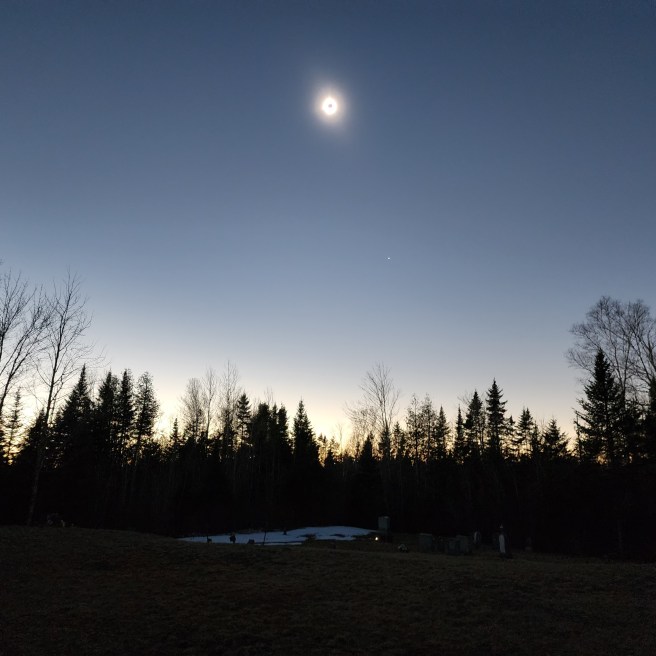
Trying to photograph the distant ring of the sun’s surface with a cell phone was elusive. Instead, enough light still poured forth to fill in most of the orb, leaving only that dark pinhole. We gazed on a small bead just to the left of the bottom of the orb, a spot where the sun would begin to emerge as if being reborn. Somehow, we overlooked the small memorial lamp at a headstone in the cemetery where we were.

And then, once more, that pure white spotlight blasted toward us in utter, aloof majesty, and the regression toward some normality began.

The camera sees in its own way. Somehow, the rainbow is fitting. And the moon still covered most of the sun, despite what you observe here.

Shadows, by the way, are sharpened.

Yes, it was almost too good to be true.

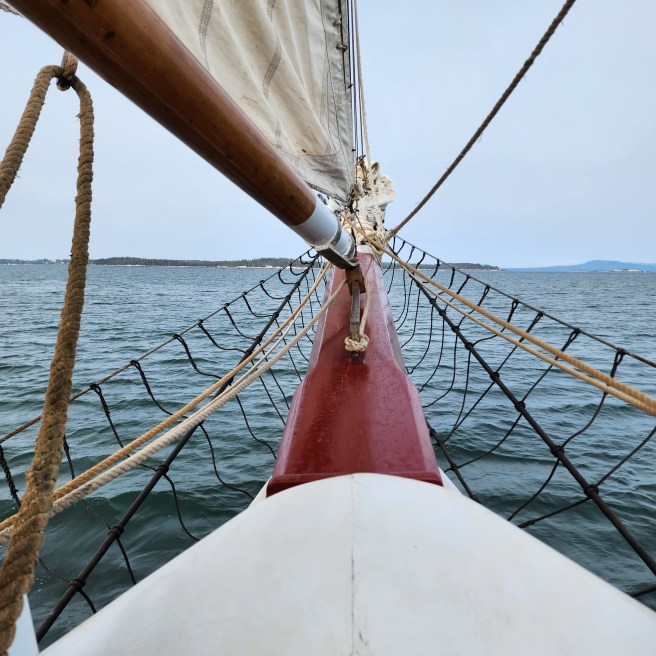
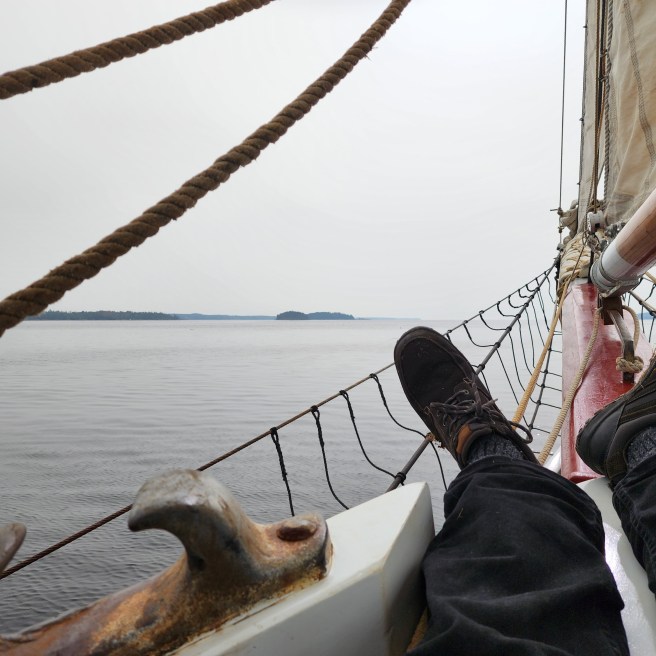
From the bow seat

Finally warm enough to take my cap off
and we’re getting some wind

yes, it’s all atmosphere

haze-infused grays with tinges of green forests
and bluish mountains

pulley block rasping behind me

the advantages of a cloudy day
without sunscreen
for a bald guy

sitting motionless
apart from a slight roll
in a nearly dead wind

how calming

am still surprised the tiny yawl can push this big boat

a porpoise here, a porpoise there
a bald eagle flies past

the chains to even the tension
on the bowsprit with jibs

Was avoiding a genre a mistake?

Introduced to contemporary Inuit art by professor who had been in Alaska as a consultant for the drafting of state constitution, I was told of one artist who never did a similar piece twice. If he carved an image of a standing bear, that was it – not even a painting or print would follow in that vein.

Apart from working in a series, which feels more like developing a single long piece, I’ve tried to avoid any sense of getting stuck in a vein of seeming repetition. I mean, if I do another bear, it’s going to be sitting or stretched out or even nursing cubs.

I have taken the thought to heart. I’ve wanted each of my books to be distinctly different.

Most readers, though, are different. Not just from me, but from art collectors, too. When these readers enter a bookstore, they want to know which way to head and then which shelves are most likely to produce pay dirt. In addition, publishers want to invest in sure-fire hits, even of a modest sort. Beyond that, librarians and literature teachers want to have labels to ease the handling of authors and new books.

And that’s why genres proliferate.

My, how naïve I was, setting out to write fiction. What’s the story? How well is it told? What’s it’s style?

First off, I don’t read in a genre. I’m not shopping for sci fi, per se, or romance or mystery or detective or fantasy or historical of any kind or young adult or even erotica aka pornography. And bestseller status means nothing for me, a veteran of the small-press scene. Nope, I’m fishing in what’s now called literary fiction, especially of the contemporary vein.

And, as I’ve learned, that label can be the kiss of death.

~*~

I object to genre mostly because it leads to stale, cliché ridden cookie-cutter commodities produced for mass consumption. I find them too predictable, formulaic, and jargon-filled. A genre comes with the requisite tropes, after all.

I write and read to discover, to make sense of life as I’ve known it, especially, no matter how far afield that goes. Haven’t I wandered across the Arctic or Sahara in some form, after all? I don’t need to go into interstellar space or an alternate reality to get away from everything. In fact, I doubt I can go anywhere without taking my personal baggage along. How about you?

 ~*~

As for conflict?

When Mrs. Hines, my senior-year high school English teacher, said that all fiction is based on conflict, I piped up, contrarian that I am, “Oh, no it’s not!” To some degree, I’ve been trying to prove my case.

Nor would anything I’ve done fit Kurt Vonnegut’s advice, “Be a sadist. No matter how sweet and innocent your leading characters, make awful things happen to them – in order that the reader may see what they are made of.”

There are no murders or bear attacks or invading armies in my stories. Well, maybe off somewhere in the distance. They never get personal. think most of my characters are nice folks.  Daffodil Uprising and Hometown News have the most outward conflict, I’d say, while Subway Visions has almost none. The most recent revisions have added some layers of darkness but not enough to alter the overall direction.

Stepping back, though, I see something that surprises me alone these lines. Almost all of my novels are countercultural, by definition in conflict with the surrounding society. In addition, the central conflicts are usually internal or small scale. In the Secret Side of Jaya, she sees and hears things others don’t. Tell me that’s not a conflict. Nearly Canaan examines the consequences of times and places a promise falls short, one after another, in the characters’ lives.

~*~

Still, I have to ask if my resistance against genre or commercial publishing has really been another fatal flaw in my ambitions. Would Subway Visions been more successful if I’d recast it as fantasy, for instance?

Was it foolish of me to avoid genre?

My genre, such as it is? Experimental fiction? It fits me but does little to attract a book buyer.

How about “contemporary history,” which is not an oxymoron. So much that’s happened in my lifetime is ancient history to the majority of the population. My daughters listen amazed at the era – did this or that really happen? Yes, I reply, and you take it all for granted. (Or granite, as I prefer.) So much of it runs counter to the mass-media stereotypes. Yes, my focus has been counterculture, as I’ve encountered it.

~*~

I do like the term genre-bending, which I’ve recently encountered. It’s something I was already exploring in the final round of revisions, especially once Cassia went goth.

Fine carpentry, too

Jesus was a carpenter, after all, surrounded by fishermen and their boats. Maybe he built a few to float, too.

the curve of the deck – sheer
ours noticeably higher at the bow
than even the stern

while the crown with its sides
for water runoff

a dutchman
a piece of wood
cut in
to replace a rotten section

ditto in our home

Haunted by a big bad Wolfe in a white suit

“You’ll be the next Tom Wolfe,” one creative writing prof promised me. I loved the guy’s flashy writing and, for the most part, his subject matter.

Where he eventually rubbed me wrong was his consternation that no big novel of the hippie era had appeared. There, he kept ringing as a prompt for me.

Part of his hook for me was the fact that my dream job in the newspaper world would have been as a columnist, especially one like Hub Meeker’s State of the Arts in the Dayton Journal Herald. Arts journalism was, alas, a shrinking field, along with the more general community columnist, like that paper’s Marj Heydock or Binghamton’s Tom Cawley.

Wolfe had briefly been one of those, at the New York Herald Tribune.

The bigger part, of course, was about that novel. He was dismissing Richard Brautigan’s unique voice altogether and others, like Gurney Norman, John Nichols, Tom Robbins, who rode the vibe.

Wolfe was also snidely suggesting that he had been the one exception, with his Electric Acid Kool-Aid Test, which really wasn’t a novel and predated the blossoming of the hippie movement.

His idea of the Big Hippie Novel reeked of the misguided quest for a Great American Novel.

Quite simply, there were too many strands of the movement to fit into a single book. Political or social action, anti-war witness, civil rights, gender equality, environmental awareness, organic and vegetarian foods, intentional community, group housing, alternative education were all part of it, even before the sex, drugs, rock’n’roll, hair, fashion, or slang.

These other factors would come more fully into play when I revised Daffodil Sunrise into Daffodil Uprising, and Hippie Drum and Hippie Love into Pit-a-Pat High Jinks.

I’d like to think of those books as nominees for the Big Hippie Novel distinction.

Wolfe’s charge also overlooks the outstanding nonfiction books that reflected the experience, such as Zen and the Art of Motorcycle Maintenance.

Moreover, I still feel that many of the difficulties in the current political scene arise from a failure to clearly understand the demons raging from the Vietnam conflict, both for those who fought in the army and those who fought the unjustified war itself.

So here we were, struggling through disco without having faced the lessons of either the hippie outbreak or the Vietnam disease. Hippie had become a dirty word, and many who had been happy to be one were no in psychological denial. It was something nobody wanted to relive either, apart from maybe Woodstock.

As others have observed, an ignorance of history carries a heavy price.