Religion and spirituality infuse my novels

This is not the place for me to explain why I feel spirituality and religion are important. but rather to consider how they infused my vision as I drafted and revised my novels.

Church was important to my family when I grew up. We were Evangelical United Brethren, a mainstream Protestant denomination that had originated as two Wesleyan bodies of German-speaking Americans. It claims roots back to 1767, before its official organization in 1800. Until I took up genealogy, I had no idea that some of my grandmother’s roots reach back to its founding. During my childhood, though, I knew none of that, only that were somehow different. It was the center of our social connections, including the Boy Scout troop that was so crucial in my development. And it’s where the United Methodist Church got the “United” after a big merger when I moved on.

During my senior year of high school, I secretly broke with that, rejecting the culture as well as the faith. After five years of floating through degrees of agnosticism and positive-logic philosophy, I found myself practicing yoga and that, in turn, would open me to Quakers (the Society of Friends) for its weekly group meditation.

By the time my big-writing sabbatical got underway, I was deeply immersed in Quaker faith and public ministry and also fellowshipping with Mennonites and Brethren, all in the historic peace churches stream. In addition, one girlfriend introduced me to the evening services of a Pentecostal megachurch, which at first intrigued but ultimately appalled me, though I did gain some fluency in its ways.

And then, moving to New Hampshire, my Quaker activity intensified. At some point after my remarriage and relocation to Dover, where our meetinghouse was, I also got to know the Greek Orthodox community and its strand of Christianity. As a member of the local religious leaders’ monthly gathering and a Sanctuary alliance, I came to a broader understanding of the different bodies of faith in the surrounding society.

For me, then, when I’m addressing religion, I’m not so much interested in theoretical arguments but rather personal experiences and the ways that discipline strengthens them or even harms over time.

While I’ve come to embrace a radical Christianity, I diverge from many of the commonly accepted doctrines while also valuing Jewish, Buddhist, and Native American teachings. In addition, I’m imbued with the Quaker emphasis of faith being how we live rather than what we say we believe.

~*~

In my fiction, religion and spirituality are central elements. In the four hippie-era novels built around Kenzie, they appear as Tibetan Buddhism. When I drafted What’s Left, I finally had enough firsthand observation of Greek-American tradition to enlarge on the concluding flash of inspiration from my subway novel.

In Hometown News, my attitude toward religion was essentially negative. The congregations are ultimately insular and self-serving rivals. I’d say it’s my most secular novel, and the most dystopian.

Yoga Bootcamp is obviously about religion and spirituality, which then continues in Nearly Canaan with Jaya in her moves to the Midwest, Southwest, and Pacific Northwest. Her practice of what I call the DLQ is the embodiment of her faith.

And the Secret Side of Jaya throws in early Bible translator John Wycliffe, a slew of rural Baptists, and Native lore’s Kokopelli.

For me, designating a religious identity clarifies a character’s underpinnings. Sometimes an ethnic outlook, as well.

In my round of big revisions to my previously published fiction, I had fresh insights to weave into Kenzie’s upbringing in Daffodil Uprising, Subway Visions, and What’s Left. His daughter, Cassia, has her own struggles of blending her parents’ Tibetan Buddhism and Greek Orthodox faith together as well as her being subjected to her classmates’ taunting. I also had fresh insights from a friend who was on her way to being ordained as a Tibetan Buddhist nun.

Jaya’s encounters with her husband’s family’s Pentecostal church were significantly expanded in my revisions for What’s Left. Pastor Bob emerges as a more complex figure, and his wife becomes one of my favorites, especially as she and Jaya become close friends.

Later, we have Beulah Miller in the Secret Side of Jaya. I’m really fond of her and her Baptist faith-infused ways. Not that all Baptists would agree with her.

~*~

In my writing, I lean toward the positive side of most people. I idealize. I avoid violence. Hope reigns eternal. People are honest, or at least try to be. I doubt that I could craft a truly evil person or even a skilled liar. My sense of social community revolves around the remarkable people I’ve met in religious circles where I’ve been active. It’s definitely not an army unit or casino or auto dealership. It does shape the adage of writing about what I know. And it does limit my range of perception, even as fiction.

Still, in my latest revisions, I’ve attempted to admit some of the darker undercurrents.

I am wondering, too, how Robert Alter’s descriptions of Biblical poetry, narrative, and translations would apply to my own efforts.
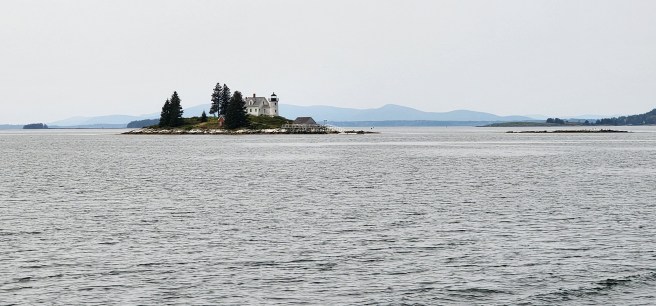
Pumpkin Isle light

marking entry to Eggemoggin Reach
below Castine

the free lighthouse guide I brought along
2013 edition I see now
newsprint
has no mention of Saddleback Ledge light
not to be confused with Saddleback Island
other than a listing
no photo or description
nor does it list Eastport as a harbor
nor Lubec
though Calais somehow counts

buoys: green have flat tops
red, coneheads

‘This wouldn’t work as fiction’

Somebody’s telling of an event that took place – or allegedly did – and I find myself evaluating it through an either/or lens. This wouldn’t fly as fiction (nobody would believe it) or, oh yes, it would. It’s not a matter of factuality but rather whether it would fit into an acceptable mindset.

I can even listen to people’s names along the same line. First names carry an impression, OK? I’m not sure where the dividing line is on this consideration, but it’s there. Stanley is going to have a few obstacles as a lover, right?

Another viewpoint comes in looking at what’s happening through an imaginary cameraman’s lens. Have you ever found yourself framing scenes or even wondering who could be cast as one of your friends? Just look at how they move around in the picture. Cut! And splice to this …

For an artist, reality often clashes with the ideal, I’d say.

~*~

For a journalist, at least, the biggest difference in fiction is the importance of emotions rather than facts. It means asking yourself how you feel about a detail. Warm? Cool? We’d never ask that of a news story.

~*~

Revision is where we, as writers, step back from what we’ve written to view our pages from a distance, the way a film director would or later, the film editor.

Perhaps you’ve heard of how much footage winds up on the cutting room floor. Writing, it’s the same.

For me, the cut pages were rarely wasted. For example, a lode of outtakes regarding my experiences of Bloomington went from my subway novel and on to what now stands as Daffodil Uprising. Many more of those outtakes went into What’s Left somewhere off in the future. Still more relocated to the Ozarks in Nearly Canaan and the Secret Side of Jaya.

They didn’t go exactly straight, as I recall, but underwent thorough embellishment along the way.

My interactions with the Bloomington as a research associate were much different than they had been as an undergraduate. I didn’t go to as many concerts or operas. My new spiritual and writing disciplines had me rising before dawn. I was emerging as a poet, too, and I was, most of all, newly married. And then that blew up, only to land us, hallelujah, in what I thought of as our promised land, only it was in the open desert rather than the wet thick forests of the Pacific Northwest.

How could this not be material for reading? Or, more profitably, something for the Hollywood treatment?

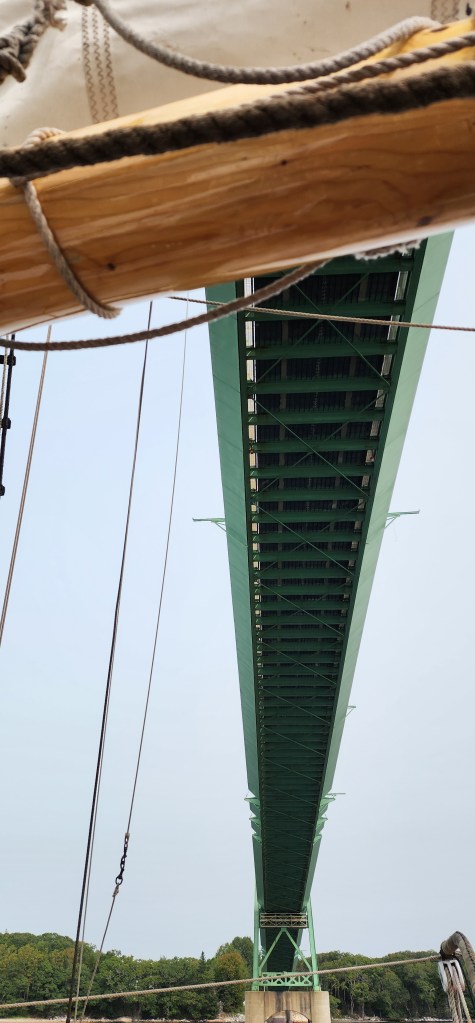
We clear the bridge by a foot and a half, if she’s read the charts right

Eggemoggin Reach
the Deer Isle bridge ahead
we’ll barely clear
six inches or sixty feet, what’s the difference?
other than a margin of error

the electronic gizmo’s
soundings in feet
at mean lower low water

I got to steer today
a feel of command
aiming for the arch of the bridge

Taking forever to get to the span
Deer Isle Bridge, as seen by vehicular traffic
Eggemoggen Reach Bridge from the water

a fixed bridge meaning
it doesn’t draw open
one more detail on the chart
(see Note B)
which I can’t find anywhere
until it’s pointed out in the margin,
same color type as the notice

we’re pushed by Greyhound
the inboard yawl

the motor behind me as a drone note
humming above lapping water

people bundled up this morning muted sun water depth 64
just gone to 72

Eggemoggen Reach broader
than Friar’s Road
where I live

Layer by layer of discovery

In preparing this weekly series about things that were behind my novels, I wasn’t expecting to see how much of what was happening in my own life during a revision could also impact a manuscript based on much earlier events. It’s not something I’ve seen mentioned in author interviews.

One of the writing adages I’ve kept at hand is this: “Steer into the pain.” I’m not sure where I found it or perhaps adapted it, but it has been helpful in reminding me not to take the emotionally easier way out when facing a situation, whether personal history or fictional abstraction. The pain is where the higher-level energy is as well as the revelation.

So add to the advices, “Write about what you’re discovering.”

In a way, it’s a reminder to write about what you don’t want to know but with the added kicker, “What you don’t want to admit.”

For those of you doing the NaNoWriMo challenge this month, may you add that insight to your energizers.

More recently, I would add to that something else that motivates me: The magic!

Or, in my case, pure wonder. Again, what do I know? And celebrate?

I’m finding they’re both essential currents in my life’s work.

~*~

Let me say I rather miss Cassia from my novel What’s Left. After prodding me to that round of big revisions of my previously published fiction, she’s gone off on her own. She was even remote when it came to my nonfiction volume that more recently demanded my fullest attention. Well, she did earn her own category here at the Barn – Cassia’s World, based on the research and many outtakes from her novel’s drafting.

As for the real-life inspiration for many of my characters, let me repeat: Where are they all now? Or more accurately, where did they go? I don’t mean the aging rockers. I can think of social activists who kept the faith and marched on, largely out of the spotlight, though they’re aging, without replacements in line. But as for the others? I’m unsure of most of their names. And let’s forget the boilerplate disclaimer regarding all persons living or dead, even for futuristic space journeys or fantasies deep into the past.

~*~

As I look back on the history underpinning my novels, I have to insist the potential was there. I must also ask, what if we had a more solid social structure and tradition, with something akin to elders? The dorm I lived in, the core of the opening half of the revised Daffodil novel, has today become something of the center I envisioned, without the radical political edge.

I suppose I could have told these stories time after time after work in a bar, but to me they seem to address a different collective experience. Besides, journalists have their own “war stories” to compare.

Just where were we gathering now, anyway? And where have we gone to get here?

A few have found a progressive faith community – church, synagogue, sangha, or perhaps a masonic order or fraternal lodge. But for the others?

Should I point back to the posts on the breakdown of community?

And here we had thought we were creating tribe.

As an extra point of emphasis, I’ll add: I’ve never returned to many of the locations where I’ve lived.

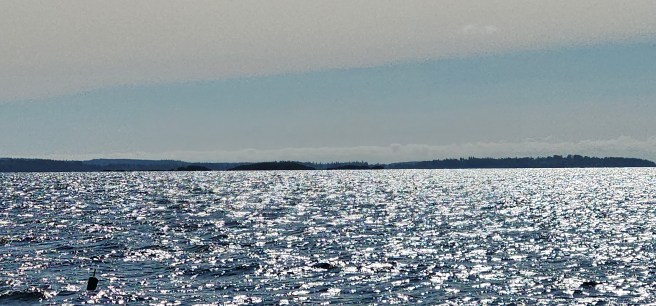
Sparkly, shiny water

this lapping water is a nagging unease
so far from a destination
you can address

do I walk as fast as we’re sailing?

a fathom is essentially an arm span

how far the sound carries
that lawnmower

I think we’re heading the wrong direction
with someone new at the helm
how can they see ahead
from way back there?

I’m freezing
ready on the down haul
island hopping

today’s cold
except in the galley

Make way for ‘The Secret Side of Jaya’

As a third book involving Jaya shaped up, I reflected on ways some people perceive things most folks don’t. The angels everywhere, as Hassidic contend, perhaps matching the dakinis of Tibetan Buddhist circles. Some of my fellow yogis saw auras around people, although I’ve seen just one, quite black, surrounding the Reverend Pat Robertson when he and his handlers walked through the newsroom for a conference with the editor-in-chief and the editorial writer.

Since moving Way Downeast, I know of the small rock people some of the Passamaquoddy observe.

You might add elves or gnomes or other creatures to the list.

The concept did give me a threat to unite the three novellas into one.

~*~

What was needed was a third novella, reflecting the place Jaya lived between Prairie Depot and the Pacific Northwest. It would have With a Passing Freight Train of 119 Cars and Twin Cabooses before it and Along With Kokopelli’s Hornpipe following. It would be like an adagio in a symphony or sonata or the middle panel in a painted triptych.

I decided to draw on a wooded alcove I loved to explore during my return to Bloomington. It was a largely unknown tract that had included a city water reservoir as well as several caves and springs that had fed two gristmills.

In the years since I moved on, the site has been cleaned up into a city park that even has a stairway down one of the steep slopes.

It had inspired a set of Leonard Springs poems you can find as a free chapbook at my Thistle Finch blog. As I revisited those pieces, I realized that the hollow’s scene and history just beyond the duplex my first wife and I rented on my return to Bloomington as a research associate would transport well to the Ozarks. Especially the part about grist mills at the foot of the sharp hillsides slopes where springs poured out from cave formations.

The story took off from there, especially when I chanced upon the woman miller. I must confess being especially fond of the result. Was this Cassia from What’s Left whispering in my ear once again?

Researching details for this story was a delight. Grist mills had run for a while in my ancestry; the Hodgson Mill in the Ozarks, for one, reflects one side of my family – they even spelled their surname for a while without the G, like mine. (They descend from one William while the other William, also a miller, was my umpteen greats-grandfather.)

Caves were another thing the Ozarks had in common with southern Indiana.

And, speaking of things some people see and hear that others don’t, we had the American Shakers whose spirit drawings and writings wandered outside of the normal artistic constraints. That gave me one more element to play with, especially when I turned to the artistic projects that Jaya had relied on to replenish her own soul in her spare time. I didn’t want her to be writing poetry, as I had, but to be creating some blend of art forms beyond that. Think of Joseph Cornell’s boxes or Emily Dickinson’s bits of paper constructions as possibilities. While I touch on Jaya’s legacy on that front toward the ending of Nearly Canaan, I felt freer to explore it here.

Just what was Jaya’s off-hours creative activity and spiritual practice leading to? Or what prompted them?

Miller at the Springs became an ideal forum for their consideration. Here it was, the final piece of writing in my range of fiction, and it was the most joyous to draft, the least ambitious in its art, and perhaps the most down-to-earth.

~*~

These three novellas presented a private Jaya much different from the one in the public eye. Titling the book the Secret Side of Jaya came naturally, along with the subtitle, Three surreal and fantastic encounters.

The book rounded out my Living Dharma series.

I was ready to kick back and relax, intending to enjoy the role of an author.

What makes me mad

Injustice of all sorts. Whiny diatribes and mud-slinging, character assassination.

TV/Rock obsession. Illiteracy. Consumerism.

Loud sound systems in cars. Drivers who think they bought the highway. Drivers who ignore changing lights.

Clutter and pollution.

Senseless regulations, corporate, not just governmental, let’s be fair.

Being put on hold while I’m present in a store.

Presumptuous artists.

The super-rich.