… my great-great-great-great-great-great-grandfather, George Hodgson, to confirm the pirate attack in crossing to America and learn the details, including the names of his parents and siblings and his relationship with Moses Harland, whom I presume to be his uncle.
Category: Personal Journey
Jib sails and rigging
clusters of sails
how do you know how to mix
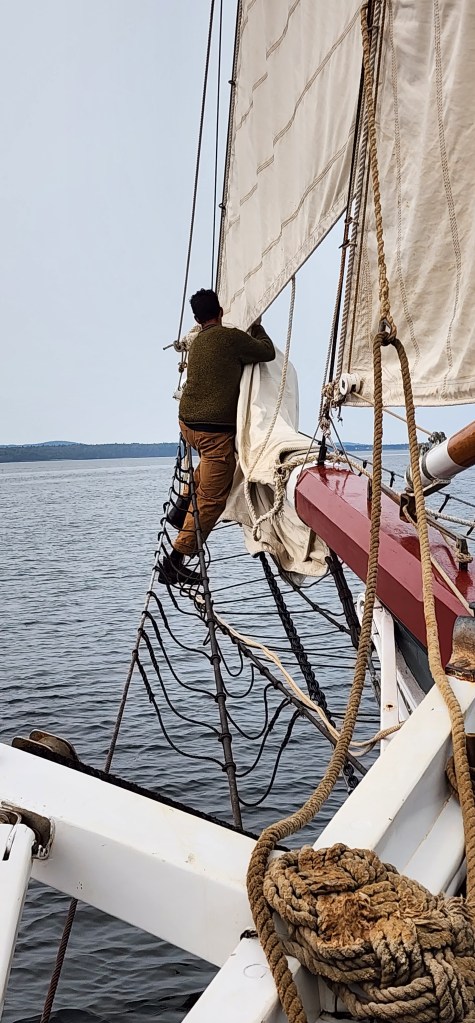
rolling waters as the pulse of the earth
a breathing
we ride
The matter of naming those characters
I’d love to hear other novelists and short story writers discuss their reasons for selecting the names they apply to the figures in their stories.
For that matter, I’d love to hear readers’ reactions. Like what’s your favorite connection there?
I’ve avoided using names of people I’ve known well. Surprisingly, it became a problem especially in my ashram novel where the best Sanskrit names had already been given to my fellow residents. Elsewhere, it eliminates a wide swath of common names, starting with John, James, Robert, Thomas, and William for males. Or Jack, Jimmy, Bobby, Tommy, and Billy, more colorfully.
Had I known they wouldn’t be reading my work anyway, maybe I should have used the names and left people guessing. I’ve tried to be gentle, though, and perhaps that’s a weakness.
Though I’m not one to apply nicknames in everyday life, I have found them useful in my fiction. As examples, I’ll offer “Big Pumpkin” and “Elvis” for the swami in Yoga Bootcamp.
~*~
There’s also the matter of which figures get named and which ones can pass through unnamed. We don’t want to tangle a reader, do we?
A major consideration in revising my output was an attempt to reduce the number of named characters. For a big book, like the five-generation span of What’s Left or the four-year college life of Daffodil Uprising or the burgeoning social life of Kenzie in Pit-a-Pat High Jinks, this was a challenge.
I did find myself shading Greek tradition in What’s Left: repetition of a name within a family is common but would have been utterly confusing here.
As an alternative, I tried to limit some to a single chapter, treating it like a short story; when it was done, so were they.
Fort Point at Stockton Springs
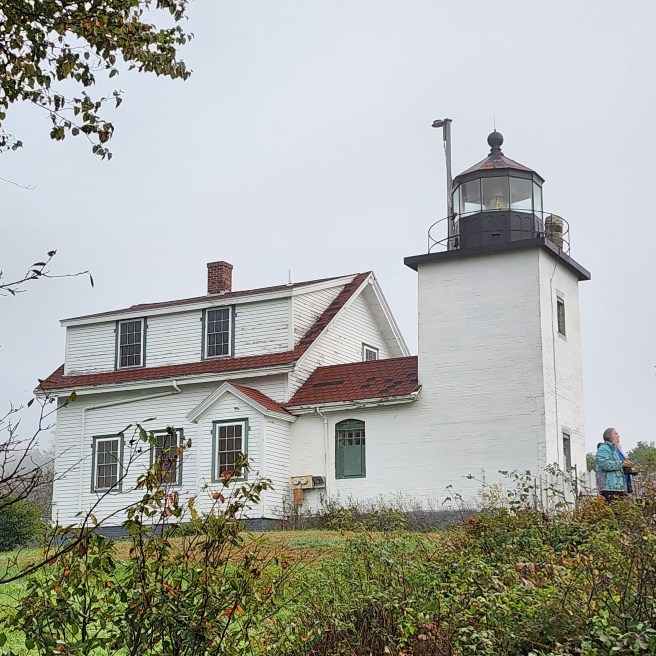 Having passed Searsport and now at anchor in Stockton Springs
Captain Becky’s reading in the galley
from Lincoln Ross Colcord’s Sailing Days on the Penobscot
of the treacherous trip from here,
where the crooked, tricky Penobscot River is said to begin
and the 24 miles to Bangor and Brewer at the first falls
and all the lumber collected from upstream
even the 18 miles from Bucksport was a terror
in the days of sails
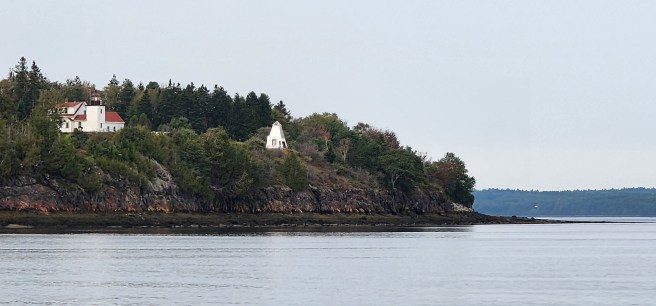 tidewalkers
broken logs along the shoreline
and river
can sink a ship

60 boats a day at Bangor and Brewer

schooners lashed three abreast
for the Bangor stretch
pulled by a steamboat
Make way!
More than my life changed since retiring from the newsroom
It’s been a dozen years since I left full-time employment, but I can say I still don’t know what “retirement” is. Could it be because I don’t play golf or tennis?
After years of hoping to be financially able to leave the newsroom and instead concentrate on a life as an author, I finally made it to freedom. In the years leading up to that, I had put together detailed plans of running on a tight schedule, rising to meditate and pray, do some yoga, attend to correspondence, tackle some heavy new writing, and so on, but that’s not how things turned out. At least guilt hasn’t kicked in. I haven’t exactly been a slacker.
In those earlier schemes, I didn’t envision swimming laps every day at the city’s indoor pool or my weekly trip to Boston to sing in a choir. Nor was self-publishing the novels and poetry or the expanse of blogging or other social media. Photography, even of a digital sort, was an unexpected new hobby. Yearly Meeting responsibilities, however, were on the list and duly enjoyed. I’m embarrassed to admit that many yoga exercises are now beyond me – it’s amazing what 50 years of physical neglect can do.
I’m still trying to discover my natural sleep cycle, too. Eastport is a place where most folks rise early, and that’s generally what I’m doing – often, 3 am in the summer and a bit later in winter. The roads around here are busier at 5:30 in the morning than at 5:30 in the late afternoon or evening. A nap helps but isn’t always a daily option. And I’m spending more time at the keyboard than is probably healthy.
~*~
The most obvious way my life changed my writing life was is in having longer periods where I could concentrate on a given work or project. I wasn’t writing on the fly, like graffiti, as I have quipped, or immersing myself for a vacation week or two and then reluctantly putting the manuscript aside. My attention wasn’t diverted as often, either. I no longer had the daily commutes as time for reflection, but it’s amazing what bubbled up as a swam my half-mile of laps – some of my favorite lines in What’s Left, especially.
No longer writing or revising on the fly apparently made my new work more difficult.
At the beginning of my new life, I took up blogging, first to clear out much of my backlog of writing and small-press first publications, and then the photography came forward. One blog became five. Networking face-to-face with other writers once a month was on my rounds, and there were other events for poets, too. That led to the release of most of my scripted fiction, a huge emotional relief.
Curiously, I haven’t written poetry. The focus has been on prose, especially my one new novel, What’s Left. You’d think in my expanded creative schedule combined with my earlier experience of shaping fiction, this would have been a breeze. Instead, it was the thorniest project. Its purpose was to wrap up the hippie era, drawing together my Kenzie stories. The book kept shifting focus, and even finding an appropriate title was elusive. (A cover image was even more problematic.) It was also the least autobiographical, even with the new Greek-Orthodox circle in my life.
I can’t say which of my novels underwent the most exhaustive transformation from their first published version to the way they stand now, but What’s Left was the most painful as well as the biggest turning point. None of the others changed that drastically from their starting point to what hit print. The changes from first published version to what now stands is another matter.
But What’s Left did prompt that deep reworking of all the earlier ones, as well as the big round of republication.
My other piece of new fiction was perhaps the easiest of all, the middle novella in the Secret Side of Jaya. This was set between two earlier ones that had undergone multiple revisions before I inserted Jaya as a unifying voice.
~*~
If I thought I could kick back after those revisions, I was mistaken. Quaking Dover was on the horizon.
It was the book I didn’t want to write, I was truly tired, but the one that’s carried me the farthest with readers. It wasn’t even fiction.
And it proved as difficult in its revisions as What’s Left had. There was the challenge of fitting myself into the text as the “gently laughing curmudgeon” that one insightful beta reader suggested. It ran counter to all of my journalistic training as a neutral observer and my yoga humility of rendering myself invisible.
When I undertook Quaking Dover, Covid broke out. My laps in the pool ended, as did Revels Singers in Boston. After finishing the first draft, I relocated to Way Downeast Maine in what became an ideal writer’s retreat. It was amazing what I could find online in my research and revision.
As I’ve said, our move was the next step in some necessary downsizing in our life. Over the past decade, I’ve shifted to the Web and am now largely paper-free. I am going to have to face considerably more purging when we get the rest of my book collection out of storage and try to fit what we can (or what I need) into this smaller house. And let’s not forget, there’s no barn here.
~*~
Quaking Dover did lead to live and streamed PowerPoint presentations, a further new skillset for me.
Among other things, my concentration isn’t what it was. I learned in a few months of working as a 2020 Census enumerator that my stamina has also faded – it was an exhausting job. My spelling’s declined. And I’m not as sharp-eyed as an editor, either. In fact, I’m more tolerant.
I’m reading mostly ebooks, avoiding the filled shelves conundrum.
I don’t feel an urgency trying to “understand my problem.”
Even the journaling is slowing.
And there was a round of renewed therapy, ending shortly before the death of my therapist.
Ain’t gonna happen now
AMBITIONS: to develop a widespread readership aka bestseller; also, revive the Society of Friends
ONE DAY: to be influential and famous
Castine from the water
slosh, slosh, slosh, ripple
at the bow
/ bowsprit
one porpoise
then three
approaching Castine
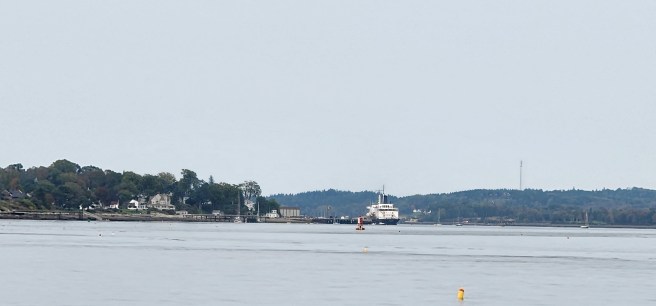
topsail, top’sal
still motoring along
sound of chainsaw from shore
a nasty mosquito
Dice light
The difference a week can make.
Some writing pet peeves
Personal biases do come into play – as a novelist and as a reader. For me, some of them as pet peeves are a reflection of my preferences. Consider those as graded on a scale, one to five or ten.
For example, New York City is way overrepresented in literature – especially Manhattan and Greenwich Village. And so, even though I based one novel on an out-of-towner’s encounters with the subway and then transported part of that to another, setting a book in the Big Apple definitely costs points in my esteem. Harlem, however, is a plus, along with overlooked corners of the boroughs. See Chester Hines, for starters. Something similar happens with Los Angeles, San Francisco, Berkeley, Chicago, and Seattle. Show me someplace way, way out of the usual media spotlight.
Books celebrating novelists, poets, musicians, visual artists, actors, university professors, or celebrities in general also cost points. We aren’t a superhuman clan, OK? And way too often we’re deeply flawed in ways nobody examines. Still, a rare work, like Tar or Maestro, portraying Leonard Bernstein, breaks through my resistance.
Anything that feels contrived, rather than organic, also turns me off. It goes back to what I considered “Found” versus “Invented” when I was evaluating cartoonists and stand-up comics. Real-life discoveries are superior. How well is the author listening to what’s going on around him (or her)? Or observing in the details?
Escapist. This goes for most of the genres, actually. Off somewhere in space? Or back in a medieval court? Or even in romance and pornography. I read and write to better record the history evolving around and within me.
Factual misrepresentations are an instant turnoff. Getting a key date off, for example, often rips apart the rest of the timeline.
That points to cliché, especially in thinking. What happens when you invert it, so that winners become losers? Maybe a story is more about losers than winners, at least the ones that ring true to me.
Purple prose follows up on that. I hate being told what I’m supposed to be feeling. Will somebody please pop that balloon? But flat, conventionally viewed background also fails.
Inconsistent use of punctuation. Yes, God and the devil are both within the details. Hello, are you awake or fully there at the keyboard? Show me that you’ve mastered the basics.
Grammar and syntax mistakes. Inconsistent tenses drive me up a wall. Misuse of commas or more creates a mess. These are lines in the sand between professional writers and the wannabes. It’s quickly signaled by “towards” rather than the American “toward” or “that” where it should be “who.” Beyond that, “whom” seems relegated to those who want to seem British.
Gratuitous violence is another turnoff. It doesn’t connect with life as I’ve known it.
Dialogue is a special high-wire act. When it rings wooden, I’m gone. The attribution proves equally tricky. I long ago tired of “said” but “stated” is equally overdone.
Well, maybe that will do for starters. There’s so much more I need to start collecting. I know it’s out there.
Confessions with a few natural observations in the background
1
My own world was fracturing
when glacier-clad Mount Saint Helens erupted
and sent me in exile
to here
at the easternmost fringe of the nation
forty years later
2
As a friend said
the other day
of piloting a warship
and noting
no seals
on their familiar outcropping
indicating
a shark
on the prowl in the waters
3
In my case
a starched white-shirted shark
had invaded
Maritime Academy garbage barge and tug
is that Belfast?
in this haze
a more realistic day
moving slow
but moving
Peter must be napping
also, the cook
against Islesboro
after Deer Isle
not that I noticed the shift

3:59 and we still haven’t settled for the night
Faint view of the Fort Knox Narrows Bridge spires
the captain stands at the helm no matter the weather
 Jnana's Red Barn