Considering historical accuracy, too  

The two small dormers in the front bedroom were more of a pain to remove than you’d expect. That part was labor intensive, and they weren’t even braced to handle the weight load of the rafters above them. No, those had merely been sawed off. We have no idea how the heavy slate roofing that came later didn’t crush everything beneath it. (I’ll save that history for later.)

The dormers apparently weren’t added until after 1850, anyway. (Again, an explanation that can wait for later.)

The cedar-shake siding came even later, maybe the early 1990s. For a while before that, it was green asphalt siding. Yes, like what you might see on a roof.

The house color by 1830 was yellow, though we haven’t yet found any evidence of that.

All of that gives us more leeway for redesign, no?
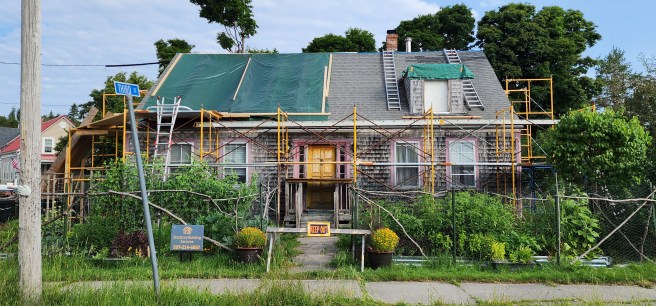
With the front of the house, we’re keeping the outermost panels of the original roofline in recognition of the Cape Cod style. In the renovation, though, we still needed to upgrade the support beneath them, even before replacing the roof covering.

The dormers, by the way, were not identically distanced from the ends of the house. There was a half-foot or so difference. Did they not have tape measures? Make that yardsticks?

The single, big dormer will be a dramatic change, inside and out.

Here it comes!

Away she goes, Act 2

Removing the old asphalt roofing and underlying sheathing and replacing them with standing-seam metal roofing promised to be an encore act of last fall’s drive on the back half of the house. A dustpan, or shed, dormer, connecting what had been two small dormers would be the biggest design difference.

This time the work would be in full view on a central pedestrian-friendly thoroughfare. By now, the renovation is a widespread topic of conversation, year-round residents and summer people alike. Yes, one more aspect of small-town living.

Once again, new rafters would replace the old ones, many of them charred in the 1886 downtown fire as well as a later chimney fire or two. And the new 2-by-12s would be more numerous than the old 3-by-4, 4-by-5, and 5-by-6 beams they were replacing. They would also be up to building code rather than sporadically placed. Better yet, they would be solidly joined to a ridge pole and the four central structural support columns our contractor had inserted last fall. Earlier episodes of this series discuss the intricate work of getting those significant details into place.

Once underway, this phase turned into something more than a quick encore. Removing the two dormers had its own complications, and then a series of rainy day forecasts prompted Adam to concentrate on the south end first rather than the full roof in one sweep.

Further complications came in finding the sheathing was doubled, unlike the back, and a desire to salvage as much of the timber as possible. Some folks in this project are hoping to make a dining room table or some such to recognize the home’s heritage.

Our thinking about this project has definitely changed. Adam is really rebuilding the top half of our house, not merely remodeling it. We’re most impressed. Technically, it’s still post-and-beam aka timber framed.

Would I have gone along with all this if I had known about all this at the outset?

We really didn’t have much choice. As we’ve been discovering, there was so much trouble just waiting to happen. Fortuitously, we’re addressing it all proactively rather than in a panic after an overhead disaster.

We’re no longer tempting fate, are we?

The picture really can change in a day

It was one of those stretches where nothing seemed to be happening. For me, that translates into stuck, or more accurately, an emotional funk.

And then, in a single day, the dumpster arrived, opening way for the big front of the upstairs demo to begin.

The plumber showed up, after a few months on a big project in the Midwest. He made necessary moves preparing the upstairs bathroom and laundry room for walling, lighting, and flooring to be finished before the toilet, bathtub, shower, sinks, and washer and dryer go in.

He also removed our one outdoor faucet, with its leaking pipe in the wall and no indoor shutoff valve, with three new spigots and lines, all of them closer to our gardens. This was a huge quality of life improvement we do enjoy right now.

Three cords of firewood were delivered, about a month after being ordered. It was our first time dealing with them, and while I wasn’t worried that they wouldn’t show up before the first snow fell, this was reassuring and I’m satisfied with the quality of their product. Now I’m spending an hour or so most days stacking it. (Let’s not overdo it, not at my age.)

We heard from the mason, who was slotting us in with other projects around town. He and a helper were on the scene a few days later to repair the top of the chimney. Added to his work were repairs to the facing on the foundation – something noted in the building inspection when we bid on the property – and several future tasks, including moving the wood stove and metal chimney to another part of the front parlor. This was our first time dealing with him, and I can say he takes pride in good work.

Our contractor installed the flooring on the deck, restoring use of the back door to us. The railing is next.

Each of these lifted another obstacle from the horizon. Each one felt quite invigorating. The deck even has us in amazement.

Reshuffling the deck   

The unexpected complication of discovering that all of the dumpsters in town were tied up until after the big Fourth of July events forced our contractor to delay the demolition of the front half of our upstairs. Our attention turned instead to the back of the house, where a wheelchair-ramp and small deck were seriously deteriorating. Think of it as a safety issue.

The project would fit into the interim.

Unlike a previous owner, we didn’t need the ramp. Basic stairs would do in their place, and that would free up more of our small yard. The existing deck, meanwhile, was too small for our needs, and my coconspirators already had dreamed up designs that included a ground-level apron. For now, we would focus on the upper level just outside the mud room door.

The old deck top and ramp walkway were deposited at the far side of the backyard, where they will serve as a platform for stacking our next firewood delivery, keeping the split wood off the soil itself.

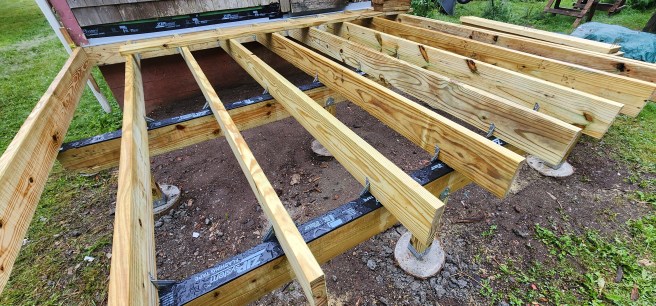
The deck structure itself became more involved than I had imagined. This house renovation is, after all, a vast education for me.

For starters, the new concrete footers were more deeper than the amateur ones and large rocks previously used. Three feet rather than a foot max. No wonder the deck was sagging. I wasn’t surprised there, but I was definitely impressed by seeing the new ones done right.

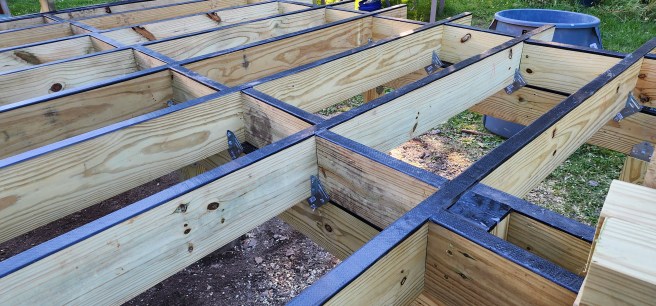
The underpinnings for the new top were another matter. No 2x4s or X-bracing this time. I wondered if Adam was overbuilding this, but he assured me this was according to code and would support a roof, if we decided at some point in the future to turn this into a screened-in porch. OK, I’m on board.

Carpentry really is about building boxes, as I once heard. The framing above became the rigid system below, awaiting the deck top and railing.

The results so far really are redefining our backyard and its uses. Dining out there without having to consider those nasty fire red ants under your chair is a definite step forward.


A few more inches each way add up

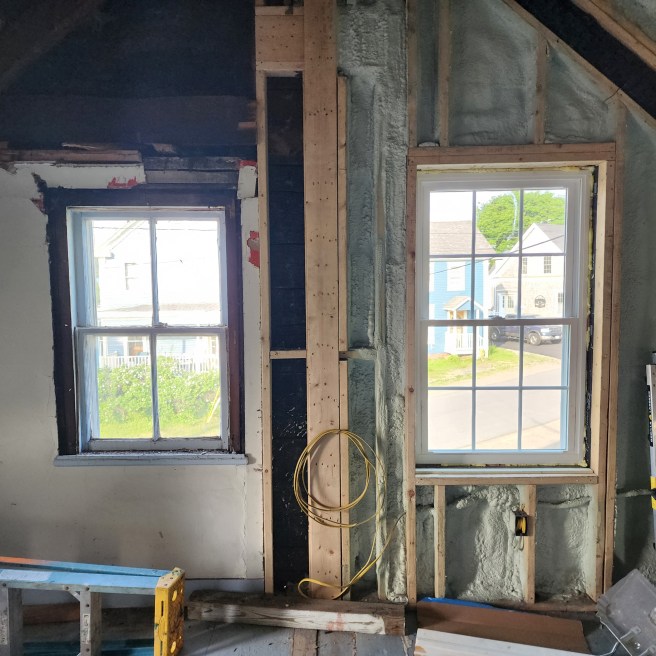
The new window, right, replaced a smaller one like the two-over-two at the left in the gable of our upstairs. The smaller one will soon be upgraded as well, and a closet will be inserted into the space between them to divide the bedrooms. The new double-hung sash windows match the ones downstairs in size. The amount of additional light and the enhanced views already amaze us.

It simply looks right

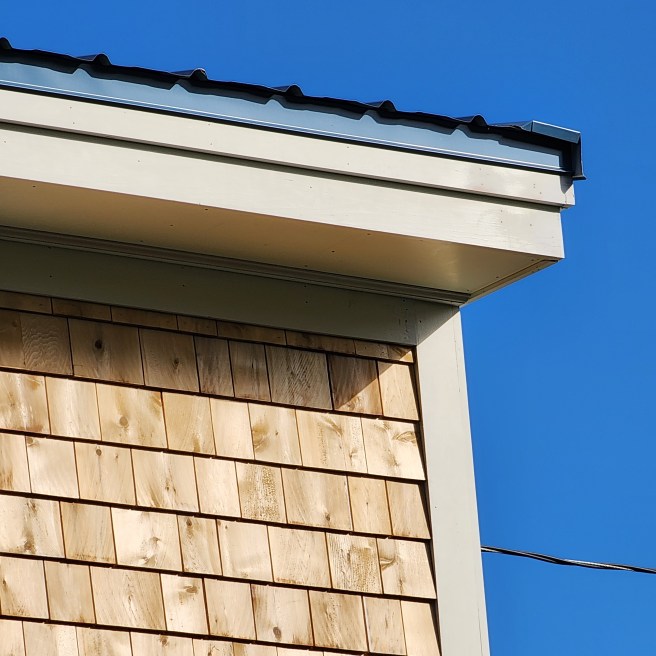
Looking up at the new roof’s overhang and fascia gives me a feeling of satisfaction. Far more labor, care, and skill went into these layers than I would have imagined. Our contractor is not one for shortcuts. He certainly intends for this dwelling to stand erect for another 200 years or more.


At this point, not quite as scheduled

When it comes to the past few months on the house renovation, there hasn’t been much to show.

Our contractor has been trying to align the removal of the front half of the upstairs to some favorable (meaning dry) weather, and that has been tricky. Plus, he has to line up a crew to participate in the most labor-intensive steps.

The electrical work has been continuing details, ultimately leading to rewiring about everything, including the discovery that the house was not grounded – period. Well, that’s been fixed, and a temporary strip for the main line coming into the house has been installed in preparation for the removal of the front roofline itself.

Then there was some work for other clients, including a new metal roof for the neighbor who recommended him to us. We can’t begrudge him that. A few other jobs were essentially trades in time with the carpenter who has been assisting him here in the bigger stuff. You know, I help you on your projects and then you help me on mine. That makes sense, too.

Oh, yes, and he really did get a well-earned week of family vacation in South Carolina.

Now the scaffolding is in place around the front of the house, gutters have been removed, and other obstacles are cleared away. But the demolition phase had to be delayed a couple of weeks when he discovered that all the dumpsters around here have been reserved nearly a year for the vendors and related events at Eastport’s big Fourth of July and homecoming week festival. We are expecting the dumpster on the fifth or sixth or even the following Monday.

Well, that hiccup did create an opening to remove the rickety ramp and accompanying deck at our back door and to start an enlarged new deck and stairs there. Again, not much to show at the moment unless you want the beginning of a step-by-step instruction manual.

The plumber, meanwhile, has been off in Indiana supervising the piping installation in a new lithium factory. He’s back in town and promises to be on our project next week, to our big relief.

Still, it’s hard to believe we’re 30 weeks into this venture.

Somehow that rainbow seen through the scaffolding at the front of the house feels appropriate.


Falling into a time warp

 When Adam came downstairs with this, I felt it was validation for a bit of history I had just come across online.

This was the backside of a baseboard.

He does look like something of a space alien here, adding to the time machine impression. But a full dinner for $1.50 and up? That does seem surreal today.

The sign was one of several he had uncovered while removing baseboard upstairs. The writing had faced the wall. Yankees are notorious for frugality of the sort that wastes nothing, if possible.

I had just started researching the history of our house, starting with the property deed transactions at the courthouse in Machias. One of our predecessors had owned and operated a well-known restaurant. Her obituary also described her as an exacting carpenter, so here was a piece of evidence.

I’ll save her full story and those of the others for later in this series, but let’s just say, the house was beginning to look a lot older than we’d suspected when we bid on it.

For example, hand-split oak lathing like this had gone out of use by 1830, or so we were told. This piece was extracted when carving out space for the toilet and bathtub.

Hand-split oak lathing went out of usage by 1830, I’ve been told. Ours was also charred by a house fire, possibly one from a nearby chimney.

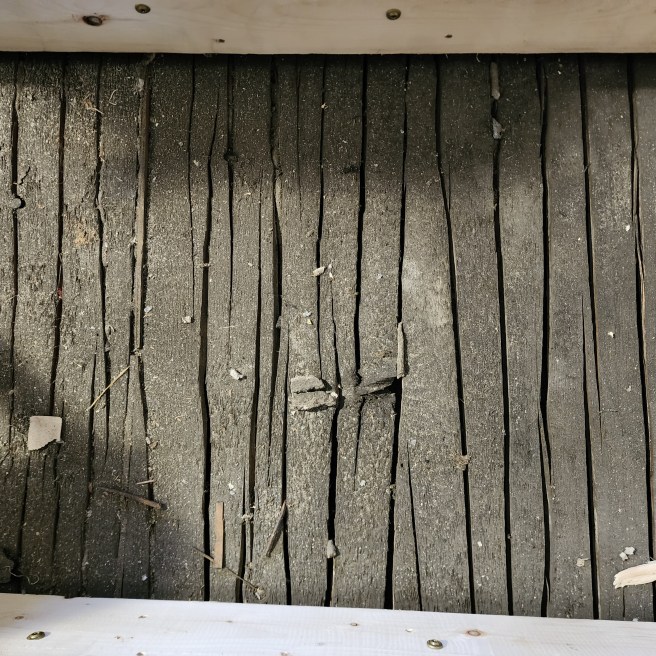
The burn marks on the underside of the flooring also suggested another serious house fire.

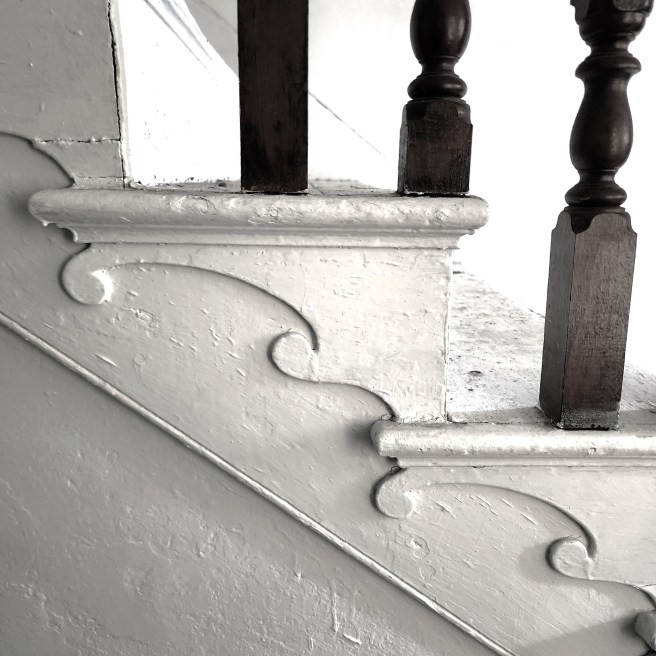
Another detail is the molding on the side of our stairs. The same pattern is found on other houses in town from the 1830s and 1840s.

I’m assuming this was from an update to the house.

And, from a technical point of view, ours wasn’t a post-and-beam house but rather timber framed, meaning wooden pegs held the big pieces together – and the weight of the structure didn’t come down the inside walls.

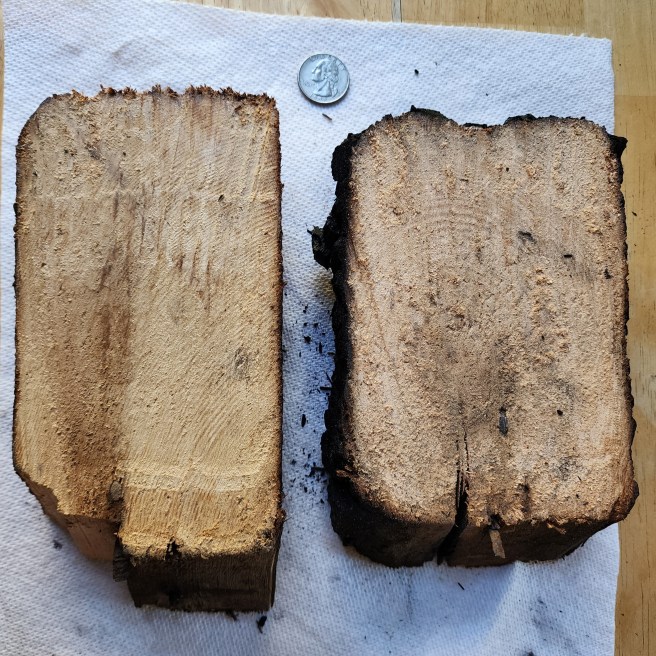
The old wood was denser, too, than what you’d buy today.

Cross-section of our old rafters.

Over the hump?

Any expectation of having the back half of the upstairs finished before starting on the front slowly faded from reality. We definitely wouldn’t be moving goods from downstairs or storage into the new space anytime soon.

Just look at the ridgepole and it was obvious Adam would need to have elbow room to work freely up while attaching the new rafters before any wall could go in.

The rafters and roofing to the right of the new ridge pole are about to come off. It’s a miracle they’ve stayed up as long as they have.

He did have to demolish the drywall and framing that had separated the front and back rooms, and with that came my realization that putting up new drywall any time before the entire upstairs was ready for that phase of work was premature. As would be painting the walls, ceilings, and floors. Duh!

Adam’s big shock came when he exposed the top of the existing dormer and found that there was nothing to speak of holding the descending rafter. What were they thinking?

The rafter was simply cut short when the dormer was added. The plank under it was insufficient for the weight sitting upon it.

It was one more impending disaster that had somehow kept ticking until being defused now.

~*~

The front half promised to be less complex than the previous section. There was no plumbing and only two rooms rather than four. On the other hand, the top of the stairs might add some complications.