Wheeling and dealing with the Greenlaws

Continuing the history of our old house:

Gordon and Calla Greenlaw purchased the house in January 1975 but then sold in in December of that year to Frank and Georgia Miliano.

With the Greenlaws, the plot takes a distinct turn. Gordon received a Purple Heart award in World War II. He died in August 2014 in Florida and was buried at the Maine Veterans Memorial Cemetery in Augusta.

Crucially, this was a second marriage for both of them, sometime before mid-1969.

Greenlaw and its variant, Greenlow, is another surname that goes back in Downeast history, as I’m finding.

He engaged in a string of real estate transactions — 66 in Washington County, from what I found in a quick survey, some of them purchases of properties seized on tax liens.

She predeceased him by a month, and while her obituary dutifully named her as Mrs. Calla R. Greenlaw, she was buried alongside her Magoon kin in her native Crawford, a distance from Augusta. It was noted that she died peacefully in her sleep of natural causes but curiously no location was mentioned. She was 99.

As the obituary observed, “Mrs. Greenlaw lived the greater part of her life in Eastport. She attended school in Crawford and Calais. She was the consummate businesswoman. She worked in the Calais Post Office for many years and later owned and operated the Red Ranch Inn in Eastport and dabbled in real estate.”

Mention of the Red Ranch Inn raises some eyebrows. It still has a reputation as a roughneck bar in its time, the kind where everybody would roll out onto the State Route 190 (the only road into town) for a wild brawl. The kind where the Washington County sheriff would show up with a Thompson submachine gun and fire off a clip in the air to get their attention. Yet, also, the kind where a seasoned waitress could walk between the combatants to calm them down. For others, its appeal was music and dancing, “a lot of fun,” as more than one woman has told me. Usually, the music was from a well-stocked jukebox, though there was the occasional live band. As for the fights? “It did have some action,” as one replied tersely with a sly grin. Do note that “consummate businesswoman” Callie alone is named in the obituary as the owner and operator.

There’s a good reason why. Her first husband, Milton A. Peacock, in partnership with Robert L. Tait, bought the restaurant in June 1963 from its founder, William J. “Bill” Bowen senior. In November 1965, while living in Los Angeles, Tait sold his half-interest to Peacock. That month, Milton and his wife, Calla R. Peacock, sold the restaurant by a warranty deed to Gordon Greenlaw. Yes, her future husband. In a 1967 real estate sale, Gordon was listed as a single man (more accurately, divorced) and that transaction was witnessed by Calla Peacock. By July 1969, though, she was Calla R. Greenlaw in the property dealings.

Did Gordon have any role in running the restaurant or its bar? The picture gets complicated, thanks to the presence of D & V Inc. of Bangor, which somehow concurrently owned the property or the business or both. While Bill was recognized as the restaurant founder, D & V applied for the liquor license in 1969.

A black-and-white photo of the Red Ranch presents an isolated building across the railroad tracks, a kind of diner with huge letters PIZZA emblazoned along the exterior and a two-story farmhouse attached to one side. Another photo found online has the interior with the jukebox and a row of counter stools that were always full, as a comment noted, along with the fact that they were beige, not red.

As for the food? Several women have said, “I couldn’t go there till I was old enough to drink.” Another, though, insists the menu was good.

The Greenlaws apparently exited the scene when D & V sold the Red Ranch to Ernest J. “Ernie” Guay in 1972 — three years before the Greenlaws bought our house. Under Ernie, the restaurant became a bar only. Sometime after that, Jeanette, his wife, used it for an antique shop. In the end, it served as a bottle- and can-deposit redemption center.

The structure was erased from the landscape when their son, Ernest junior, sold it in 2003 and Cornerstone Baptist Church was erected the next year. So much for an overlooked footnote of local history.

Calla’s real estate business involved owning rental properties around town, or so I’m told.

One claim in the obituary especially intrigues us. “Calla missed her calling as a master carpenter. In her heyday she could build anything and was meticulous to a fault. Anything she put together had to be exact, and all work would stop until it met her specifications.”

At first, we didn’t see much evidence of that in our house, but it soon prompted speculation of which ‘70s touches were hers. In our renovations upstairs, the back side of baseboards we removed had the professionally lettered words STEW, and then VACANCY, BOILED LOBSTER, and, my favorite, FULL COURSE DINNERS $1.50 UP. We’re keeping those, though we’re not yet sure where.
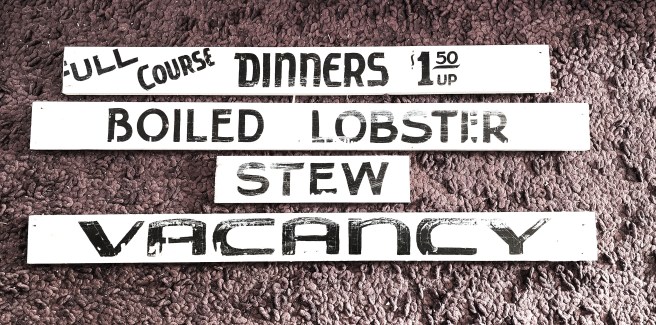
I originally thought they were from the Red Ranch, a reflection of the Yankee frugality that recycles forever, if it can. Do note that no paint was squandered covering the lettering, since it was facing the wall anyway. Or was it intended for future history, the way a time capsule is?

Well, the obituary did insist, “She loved working and was always busy.” Did that include cooking or even gardening? The kitchen wasn’t a master chef’s ideal. Leave it at that.

The obituary also acknowledged, “She raised and adored her poodles. She always had at least two of them running around.” That might account for some of the badly scratched doors and floors. Poodles, I’ve heard, attract a specific fandom, usually not of the Wild West saloon crowd. That would have suggested pit bulls or, dare we venture, mastiffs.

Regardless, “In her later years she wintered in Florida but always called Eastport her home.”

One thing the obituary didn’t mention was an earlier marriage to Milton Peacock, the father of her daughter Sandra R. Stevens. After the divorce, he relocated to South Portland and Sanford, Maine, and is likely buried in Brunswick, Maine, amid Mitchells — perhaps his sister and brother-in-law?

Curiously, Calla and Sandra share a twin-hearts, mother-daughter headstone in Crawford reflecting what I’ll assume was a close emotional bond. The daughter died in Bangor a year before her mother, and, from what I find, had married at 18. That marriage ended in divorce. The second is more nebulous, though he died in 1993 in Newfoundland and Labrador and is buried in Eastport. I still have no clue to how her Stevens surname fits in. Not that it matters in terms of our old house.

Also buried in Crawford is Calla’s grandfather who inspired a 1988 book, George Magoon and the Downeast Game War. He adamantly resisted Maine’s early 1900s’ hunting laws, especially the part about having to buy a license.

That said, what interests me is a sense of a lifestyle for our occupants over the years, along with the many remaining questions. For our Greenlaws, especially, dare we call it colorful?

From what I see in Gordon’s real estate transfers, the Greenlaws didn’t live in the house much, if at all. Their address was soon the house just to the north, as well as properties at the other end of Water Street.
The Tennesseans

Continuing the history of our old house:

In September 1983, Elwood Stackwood Richardson and Mary Blanche Richardson of Smithville, Tennessee, took possession for use as a summer home. They already owned and operated the Dennys River Inn, a B&B in neighboring Dennysville, Maine. A decade later, the house was conveyed to Mary Blanche’s daughter and son-in-law, Wayne Henry and Mary Jo Warner of McMinnville, one county south in Tennessee. The move was essentially to handle the details of selling the site.

This stage of occupancy centers on Mary Blanche, who was born in 1916 in Puyallup, Washington, to a family of transplanted Maine lumbermen. After 1976, she married widower Elwood Richardson, born in 1907 in Bristol, Pennsylvania, and relocated with her daughter, Mary Jo, to Philadelphia. That’s where Wayne Henry Warner, born in 1941, enters the picture. He married Mary Jo, born in 1943, and became a high school football, track, and baseball coach in Tennessee.

Thus, they all would have been adults in their times in Eastport.

For them, Eastport was a summer home, one not rented out in winter, in part because of its rundown physical condition, as Mary Jo told me. Her mother had relatives in Maine, either in Whitney or Whitneyville, neither one far from Eastport. She also loved antiquing. Guests during the family’s summer often liked to tour the Franklin D. Roosevelt estate across the water in Canada, causing her to quip that she visited Campobello more than Eleanor had.

Elwood, meanwhile, enjoyed fishing.

Bicycling and taking nearby ferries were other summer activities.

Mary Blanche was responsible for having the shingles put on the exterior and would have appreciated our raising of the roof upstairs. “It was something she wanted to do,” I was told. The move was apparently inspired by New England author and illustrator Tasha Tudor. Mary Blanche did have a cat named Tasha, reflecting the fondness.

Mary Jo also confirmed that the beams in the front parlor existed at the time, along with the “rather basic” kitchen and its Montgomery Ward stovetop. The property across the street also a house trailer blocking a direct view of the ocean. The modular home came later. And she remembered how small the only bathroom was.

She also asked about the sewage situation in the cellar. What?

And then about our contractor, quite surprised that he shows up on time and sticks to his promises. No comment there.

She was equally delighted to learn that the downtown is no longer boarded up and that the arts scene has emerged. Her stepfather, Elwood, took up painting in his summers in Eastport and was part of a circle that had outdoor shows in town.

Eastport did look quite different that recently. It was a time when the population was sinking and many of the remaining but vacant canneries and their piers lining the downtown were falling into the sea, one by one.

When a vision takes shape

Our home renovation project work continues, but for long stretches it seems like nothing’s happening. Those unseen details are important, all the same.

And then, seemingly in a flash, developments become obvious.

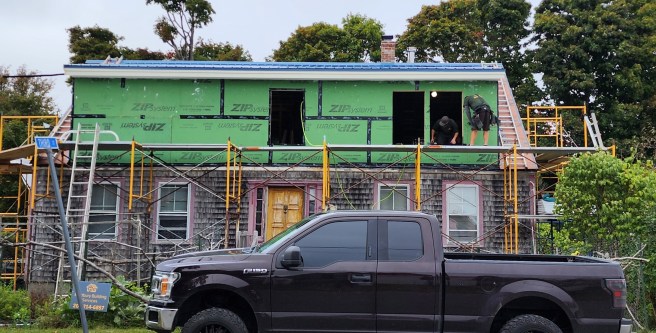
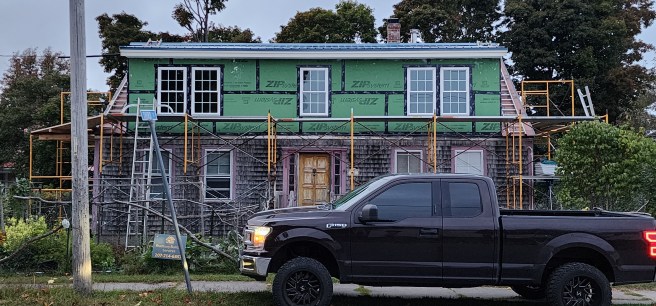
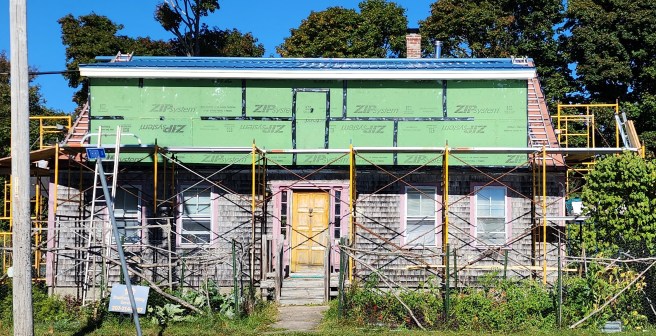
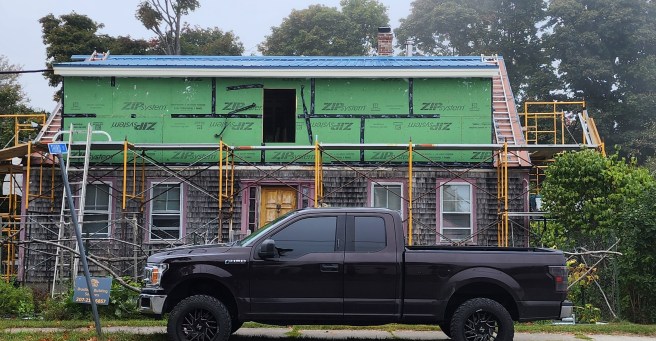
The latest example is on the front upstairs, now that the roof is raised, the top’s covered in standing-seam metal roofing, and the windows are finally obvious.

I must admit being a little nervous about the planning, inside and out, but now that they’re in place, I’m feeling excited and even confirmed. Whew!

Now, for some cedar-shake siding!

Let’s put Moose Island in perspective

Since relocating to Eastport at the close of 2020, I’ve been posting about the place where I now live, but this may be the time to present a slightly broader perspective.

Officially, Eastport is both a small city and an archipelago. It comprises 3.63 square miles of land, mostly on Moose Island, and 8.7 square miles of water. Moose Island is extremely irregular in shape, with multiple inlets, or coves, and corresponding points, or heads, largely lined with a shore of rock walls and scattered pocket beaches. The island is 4½ miles long and no more than a mile and a quarter wide, depending.

You don’t catch much of that from land, even with the zig-zag state highway into town. That is, emphatically, the only route to or from the mainland. Viewed from the water, of course, a much different picture emerges.

Today, the island is connected to the mainland via a causeway. The roadway passes through the tribal reservation at Pleasant Point, or Sipayik. They, too, are a presence.

In an unusual twist, the Passamaquoddy name, Muselenk, is derived from the English “moose island,” so we glean no ancient nuances there. The waters, on the other hand, are varied and rich, as the Native names reveal.

As you’ll see when we peel away the layers of our old Cape, its orientation – like those of the community’s European descendants over the years – gravitates increasingly to the waters, especially the sheltered, ice-free harbor a block from the house.

Moose Island is described as being on Passamaquoddy Bay, which technically borders the island on one side while Cobscook Bay hugs the other, though both are extensions of the famed Bay of Fundy and its extreme tides. Thanks to Fundy Bay, our tides are the largest in the continental United States, as you’ve seen in some of my posts here. We do face Campobello Island, Deer Island, and a few others only a mile or two away in New Brunswick, Canada, and they shelter us from the open Atlantic. Again, you’ve met them here at the Red Barn.

Campobello, in fact, is a mere mile or two away, across the deep channel, and can be seen from our house.

Legalistically, the border between the United States and Canada slash Britain remained somewhat fluid through many of the early years. Earlier conflicts between France and England precluded permanent settlement before the end of the French and Indian wars in 1763 and few others came in until the end of the American Revolution in 1783. There were also four years from the War of 1812 when Eastport was under British jurisdiction – making the city the last location in the continental U.S. to be under foreign rule.

Perhaps that was a factor in making the harbor the second busiest in the U.S. in 1833, much of it smuggling with New Brunswick.

The line between the U.S. (meaning Eastport) and Canada wasn’t fixed until 1842. Canada and Canadian-born people play a significant role in the evolution of the town.

All of this, as I discovered, plays into the history of our house and its inhabitants, too.

What do you know of the history of your home?

When our planned substantial renovations finally began last autumn, our contractor began uncovering particulars that indicated the house might be even older than we had reckoned.

It was enough to prompt me to follow up on friendly banter by more than one person who asked if I’d ever gone to the county courthouse to “run the deeds” back to the original owner.

Quite simply, no, not here or in the previous two homes I’d purchased and later sold as I moved on.

While I’ve done a great deal of genealogy, courthouse records were one line of research I’d never pursued. I had encountered other researchers who specialized in family properties and last wills and testaments, and I was grateful for what those legal documents added to the family picture.

Even so, do accept my disclaimer regarding some of the dates and locations that pop up as I applied that line of inquiry to our old residence. What I’ve gleaned and present here is in an attempt to get a big picture of the lives that have intertwined with the house we purchased and renovated. Some of the connections are admittedly soft and subject to further revision. I am surprised by how many gaps remain.

Keeping that in perspective, I did finally trot off to the Washington County courthouse in Machias, an hour away. Let me say that digitalizing the archived records has made this field much easier and more accessible, and the registrar of deeds and her staff proved to be very helpful and friendly.

The fateful day my curiosity about our house finally led me to the registrar of deeds in Machias came about while I needed something to round out the day while my computer was in the repair shop a mile or so away.

To get the bigger picture, I set forth with a sense of trepidation. Armed with little more than the plot number of our lot, I anticipated technical complications, a tangle of legalese requiring translation, and dark, dusty confines. Instead, I was pleasantly surprised to find the room well lighted and organized the staff both friendly and helpful. Better yet, the transactions have been digitalized in an easily navigated system. The original records were also at hand, should I desire, and I wouldn’t have to interrupt anyone to help me follow these.

Each transaction included a reference to the book and page numbers of the previous purchase, which was all you needed to trace the line of owners.

If only it were that easy.

~*~

Running the deeds means starting with the most recent transaction and working down through time, document by document.

Despite its modest appearance, our house has an unexpected significance, as you will find.

There are good reasons I’m calling my findings a genealogy of an old house. We’re surprised by some of the characters who’ve lived here.

Now, for some background

While we wait for the continuing renovations to catch up with these weekly reports, let’s change the focus to the history of this old house itself. Give us a better idea of what we’re working with, too.

When we bought our full Cape at the end of 2020, the real estate listing dated its origin in the 1860s. As we became familiar with the home’s bones, we saw details suggesting construction as early as the 1830s. While the pedigrees of a few neighboring houses have been catalogued by local historians, ours was not one of them. The dwelling did appear more modest in comparison.

We did have to wonder if the dwelling had been rebuilt after one of the catastrophic fires swept the downtown and its fringes in 1886, 1864, and 1839. Some of our stone foundation is 18 or more inches thick.

The house did appear on a widely reproduced 1879 map of Eastport, one that gave a birds-eye view of the city. The two dormers may have come later – it’s hard to tell from the map.

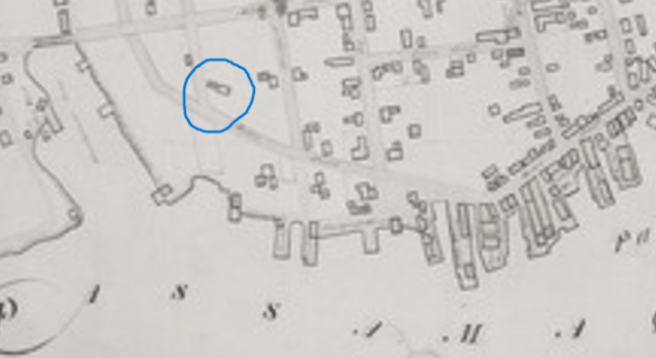
An earlier historic map of 1855 not only had a house fitting the footprint of ours on the lot, but with two wings, accompanied by an identifying script “Shackford Est.” The difficulty came in trying to figure out which Shackford that would have been — the family was prominent and prolific.

An earlier Plan of the Village of Eastport, 1835, by William Anson presented rough designations of the structures in town, including a house where ours is and only a few others in the blocks around.

Thus, we do know the house was here before 1886, as the charred rafters affirm, reflecting the great fire that destroyed the downtown. Local history dean Ruth “Ruthy” McInnis, owner of the Todd House bed and breakfast, had primed us to look for that detail when we were considering whether to bid on the place. Other dwellings, as we’re learning, share similar damage.

What I’ve uncovered is that this house is even older than we suspected, and more historic. In many ways, it tells the story of the town, too.

Sometimes this recalls a recurring and troubling dream

The dream itself isn’t so uncommon, or so I’m told.

In my case, it involves trying to go somewhere or finish a project, as in meeting a deadline, except that interruptions and complications keep popping up.

Quite simply, like Zeno’s Paradox in philosophy, the finish line becomes more and more elusive and then impossible to cross. You can never get all the way there.

So that’s how I sometimes feel looking all that remains to be done on this old-house project, even before I confess to myself that I don’t even know about many of the other items on the list.

List? Where is it? Which one?

Let’s not get too giddy yet

Having the upstairs buttoned up was our original goal.

People on the street can now see our intentions.

The roof is securely covered and we’ve gained more than 400 square feet of usable floor space. (Let’s see, with new home construction averaging $153 a square foot, according to a recent New York Times story, that would cost a bit over $40,000. Renovation, as we’re finding, can run well beyond that. I won’t say how much.)

We’re far from finished, I hate to confess. The front interior still needs to be framed, wired, and spray-foam insulated. Dry wall needs to go up and be painted, the new bathroom and laundry room plumbing fixtures installed, and something done with the flooring. We’re willing to keep the last item on the funky side as a historical touch. We’re still not sure about heating the space, either, though we’ve already found it has been comfortably warmed from downstairs, and perhaps we’ll hold off on a washer and dryer.

As for gutters? There’s more.

Downstairs, we’re looking at replacing the windows – 13 or 14, depending – and the front and back doors. Bigger is a kitchen redo, plus the tiny bathroom. And that leaves the back parlor to be tweaked into a combination dining and crafts room.

As for my remaining life’s savings? We have some difficult discussions ahead.

Touching up the chimney and foundation

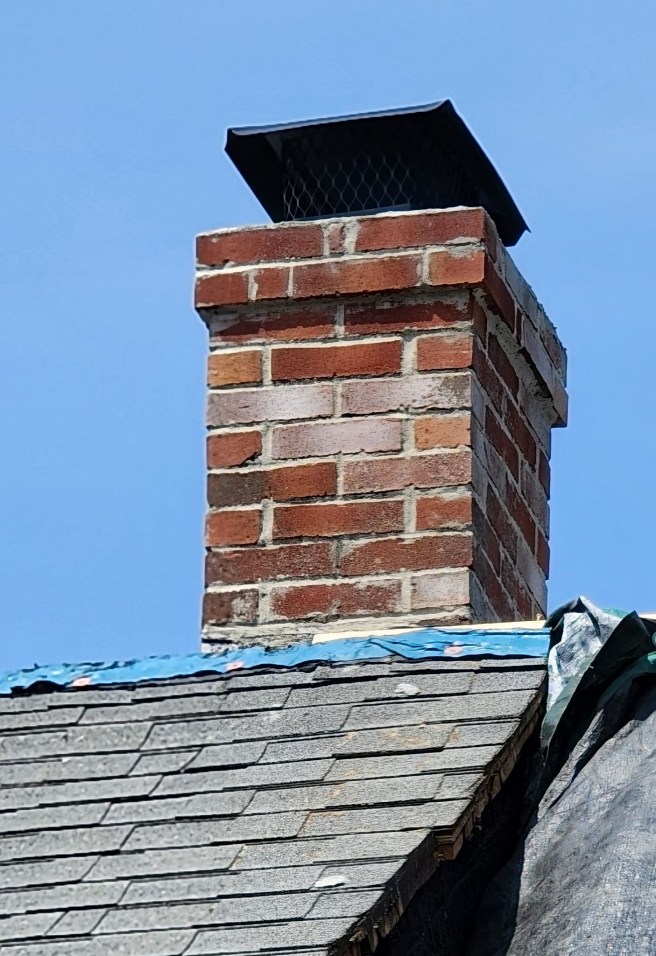
As all of the activity was picking up overhead, a mason our contractor had contacted earlier in the season showed up to touch up the top of our chimney and add a protective cap.

While Jason was at it, the exterior of the foundation could finally get some attention – the foundation itself was in good shape, thank you, despite the appearance from the sidewalk, but the housing inspector we had when bidding on the property suggested this as “something to do down the road.”

And it turned out, Jason the mason and his sidekick, Roger, could also relocate our new wood stove and its metal chimney to the corner of the front parlor. I was outvoted on that one (I hate taking steps backward) but will concede that the position will be safer and the flue will have a straighter shot to the sky, meaning less creosote buildup.

The chimney wound up needing a rebuild from the roofline up, but the results look great.

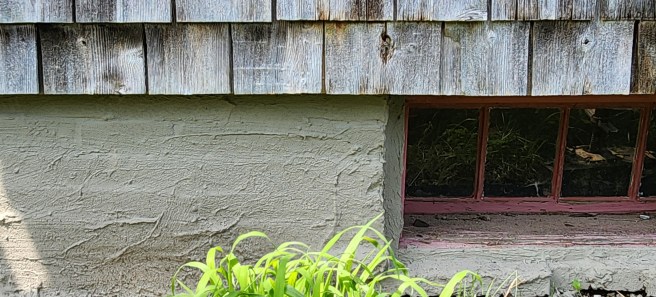
The foundation, meanwhile, got more than new mortar and concrete – it got a coating of Flex-Coat, too, which covered up the pink paint we had planned to replace anyway.

We had considered blue or perhaps gray as the new color, but seeing the gray in place sealed our decision. Somehow, it makes the place look more solid.

We do feel reassured seeing craftsmen who take pride in doing good work, and that includes taking extra steps on details joyfully.

Our new upstairs front half takes shape

Do we need say how excited we’re feeling?

Let’s look at the continuing progress from the inside.

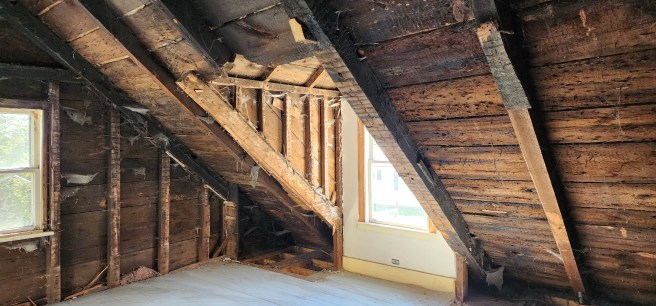
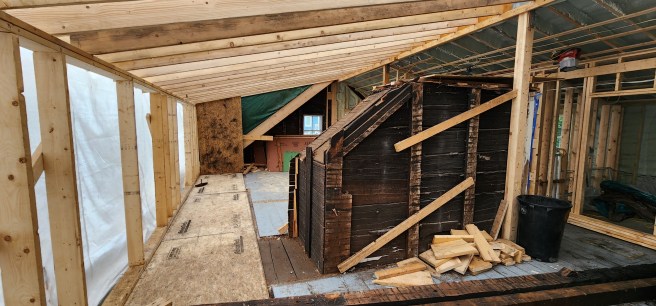
The northern half of our front upstairs with the small dormer still in place but the ceiling already gone.
And then with the plaster, lathing, and drywall gone.
We finally got to see what was between the stairwell and front. No hidden treasures or bodies, as it turned out. But we could finally see from one of the front bedrooms to the other.
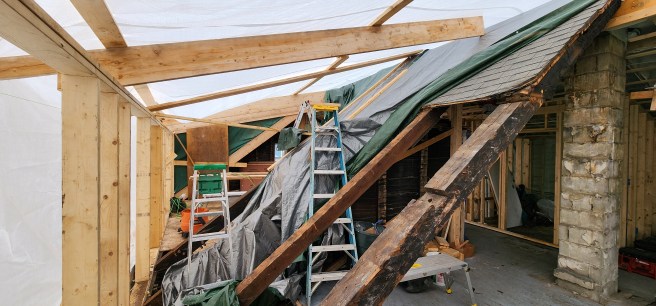
A spate of wet weather presented a challenge on how to proceed with the “dustpan” dormer that was replacing the old roof line. The answer was by working under a large white tarp. Here you can see a new rafter going into place atop the new front exterior wall. The final old rafters and last bit of asphalt roofing are about to removed.
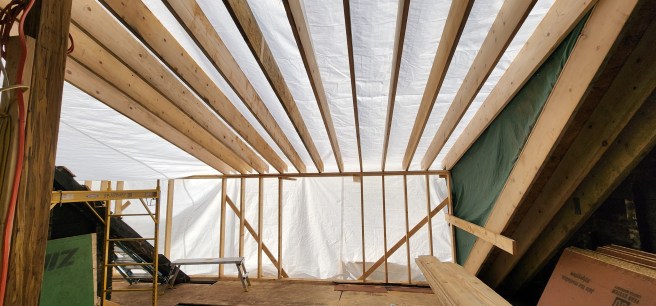
Here the new rafters are in place under the white tarp. Compare this in the south front bedroom to the first photo in this series.
The front upstairs interior stands free of obstruction apart from the old shell around the stairwell.

Next steps will be the roofing, foam insulation, windows, siding, trim, and flooring.

Can this really be happening?