
I do find her enhanced natural style quite comforting.
Even during our briefest of light daytime.

You never know what we'll churn up in cleaning a stall
I do find her enhanced natural style quite comforting.
Even during our briefest of light daytime.
After all of that, I backtracked and realized Commander Albert Buck never owned the house. It had instead passed to Fisher Ames Buck’s daughter, Alice May Buck, who died in August 1955. Presumably, she had no children.
And after that, ownership passed to Arline F. [Fallon] Vaughn (1898-1974), the daughter of George and Fanny (Buck) Fallon — Fisher’s daughter. Arline was employed for many years by Moore-McCormick Shipping Lines in New York. Her obituary listed no husband or children. She was buried at Hillside.
Also named in the proceedings was Rose Lee, presumably the remarried widow. The search goes on.
In short, by 1975 our house had apparently become a summer home or rental property under absentee ownership.
Born in 1837 on Campobello Island, New Brunswick, to Ames and Amy (Creighton) Buck, Fisher and his family were living in Maine by 1843.
In the 1850 Eastport Census, Ames was a blacksmith, 49, born in New Brunswick. His wife was 50; and the children were clerk George, 22; Mary E., 19; Amy, 18; blacksmith Joshua, 17; Abigail, 15; [Fisher] Ames, 13; Anna M., 11; [Adelaide] Sophia A., 10, all born in New Brunswick; and John F., 7, born in Maine.
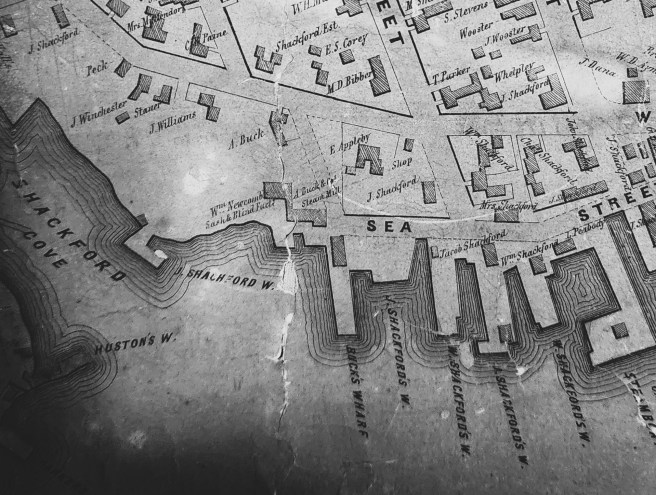
In 1855 Ames owned a house diagonally across Water Street from ours. An alley ran beside their house from Water to Sea Street, providing ready access to the Shackford wharves, as well as one labeled Buck and the A. Buck and Company steam mill attached to the William Newcomb sash and blind factory.
Ames was one of the six sons of Jacob Buck, half-brother of the Bucksport founder. Another son was Eliphalet, who landed in Eastport and is buried in neighboring Robbinston.
In the 1870 U.S. Census, his family included school teachers Mary, 29; and Ada, 25, and fish dealer John, 21. The wharf makes sense. And son Fisher Ames Buck had a household of his own.
The 1879 map shows a J.S. Buck wharf as No. 32 just below the Water Street property, presumably John S. Buck, and nothing for the Shackfords, who had previously owned multiple wharves there.
By the time of his death, Ames was described as both a blacksmith and a machinist.
Incidentally, Ames’ headstone in Hillside Cemetery gives 1796 for his birth and erroneously names daughter Amy Cory (1880-1886) as his wife. The date of his death is a year earlier than some other accounts I’ve seen.
~*~
In turn, Fisher married Clarissa Alice Bailey (1842-1922) in 1865. Their children include twins Frances F. Buck (1872-1934) and Frank Clifford Buck (1872-1950), William Edwin Buck (1875-1935), Alice M. (circa 1879-1955), and two who died in childhood, Harry C. and Jesse B.
Like his father, he was a blacksmith. Later he was an engineer. He was also a freemason, as was son William Edwin, and he served as a town selectman, 1874-1879.
He was among the subscribers underwriting Kilby’s 1888 history, along with a George N. Buck of San Francisco (his brother?).
Fisher died April 5, 1910, of pneumonia. He is buried at Hillside Cemetery in Eastport.
~*~
His son William Edwin Buck was father to Clifford Hilyard Buck (1899-1973). I do wonder whether they lived in the house or whether other family members did or whether it was rented out or even largely vacant during the period.
~*~
The Tides Institute & Museum of Art’s online photo collection of Eastport houses calls ours the Commander Albert Buck house, with the note: “He returned (after World War II) to Eastport with Rose and settled in the family house at the corner of Third and Water Streets.”
Commander Albert Clifford Buck (1886-1951), a U.S. Navy veteran of World War I and World War II, is buried at Hillside. He was 64. The headstone also names Elizabeth E. Lizzie Sears Buck (1851-1907). Who is she, other than born in Woodland, Washington County? Not Rose, obviously.
Albert, it turns out, was born to Fisher’s brother, John, the fish dealer.
So how did he wind up with the house? Forty years passed between Fisher’s death and Albert’s, and family members may have moved elsewhere for employment and other reasons. Perhaps the others simply weren’t interested. Who, in fact, inhabited the house in the interlude?
The neighborhood did have a number of Lebanese families by the early 1900s, attracted to jobs in the sardine canneries that ruled the local economy after the wooden shipbuilding industry collapsed.
Albert’s obituary mentioned that he had maintained a summer home in Eastport since the end of World War II, but neglected to note where his fulltime residence was. It also named a son, Charles S., stationed in Arizona (in 1951,) and brothers Milford in Rowley, Massachusetts, and George of New York City. (Milford R. Buck (-1952) is buried at Hillside. George is another mystery. The obituary also said the funeral service would be at the Washington Street Baptist church and that Albert was a freemason.
Just two years later, Charles, age 40, died of meningitis at the Veterans Administration Hospital in Tucson, Arizona. He was an automotive mechanic and, according to the state certificate of death, was born March 13, 1913, in Massachusetts, to Albert C. Buck, born Maine, and Rose A. Mayer, born Massachusetts. In addition, he was buried in Rowley. What was the family connection there?
I’m guessing it’s where Rose’s family was. Albert was likely at sea for extended periods. In short, he wasn’t in Eastport.
Our home, by the way, had an unobstructed view of the water.
Fishing for the purchase document by the Bucks led to Fisher A. Buck, who bought our Cape from Lucy M. Hooper, Anne Dodge, and Mary Roberts in July 1875, beginning a century of family ownership, the longest span in the property’s history.
Who were the three women? They lived in Boston and Brooklyn, not Eastport. And they weren’t Shackfords, as far as I could tell.
The Bucks, on the other hand, saw many changes in the place.
Sometime after urban mail delivery was established during the Civil War, the stylish front entry, with its vertical mail slot and side panel windows, was added, followed at some point by the downstairs two-over-one sash windows, perhaps larger than the originals. (When we replace them, do note, there was significant rotting.)
The house narrowly averted destruction when the 1886 downtown fire that started in a cannery just below our house and continued northward along the waterfront, destroying 160 homes plus stores and wharves. The rafters in our house were intensely charred, though. The Bucks would have also installed the electrical knob-and-tube wiring, along with indoor plumbing and the small bathroom.
The two large ells shown on the 1855 and 1879 maps were removed, for whatever reasons, eliminating the small courtyard on the back of the house. We can speculate about their uses, a horse shed in one and a kitchen perhaps in the other. Or perhaps one was a cabin that first sheltered the Shackfords while the deep cellar was being dug for the bigger main house. As for a woodshed? Why not?
Over the Bucks’ time, portions of the foundation were replaced or upgraded, and a mudroom was added, slightly smaller than the ell it replaced. The two dormers may have also been added — they’re not obvious in the 1879 map of Eastport though they may be the two white dots and there are none in an 1847 sketch of the windmill where the house appears in the background. (Windmill? We’ll get to that later.)
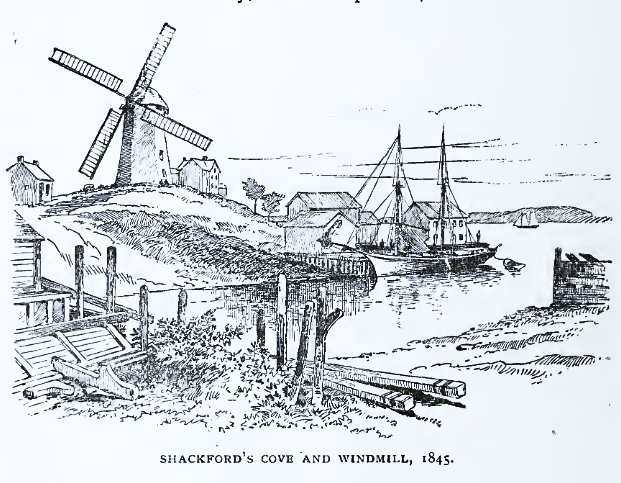
Significantly, there was at least one chimney fire and perhaps one or two additional house fires, as well as the downtown fire of 1886 that charred the rafters.
Quite simply, it was a different house when it left the family than when it had entered it.
The Buck family had its own prominence.
Several branches of the family originating in Haverhill, Massachusetts, arrived early on in Eastport.
The most celebrated and traceable line descends from Revolutionary War Colonel Jonathan Buck (1719-1795), who came to Maine and gave the Penobscot Bay town of Bucksport its name. He is best known through a questionable story of a witch he supposedly sentenced who then cursed him at her execution.
His son, Captain Ebenezer Buck (1752-1824), born in Haverhill, built the first framed house in Bucksport, but because he was captain of the local militia, the British burned it during the Revolutionary War.
So much for broader historical importance.
Ebenezer’s son Jonathan (1796-1843) brought the line to Eastport. He was a member of the Eastport Light Infantry in 1818 during the War of 1812, as was a John Buck.
Beyond that, Jonathan’s “business life was passed at Eastport, where as a merchant, he was associated with a Mr. Pillsbury, of Portland, Maine,” as one account noted, while the Eastport Sentinel in October 1839 reported,
“Died, in this town, on Wednesday last, Jonathan Buck, Esq., aged forty-three years. Mr. Buck belonged to that class of men who may well be called the creators of the wealth of a community. To an untiring energy, which enabled him to accomplish more than most men, he added an enterprise, energy, and intellect well fitted to direct the exertions of others. In every relation of life, he will be missed and lamented. To his family the loss is irreparable. Those whose labor he has for years directed will miss their guide. The community loses one of its leading men and little at this time can it bear the loss. He rests from a life of severe labor, and when such a man dies, we feel that a part of society has gone.”
The account was signed by Seth B. Mitchell, editor.
Another line in the Passamaquoddy area came through Captain Eliphalet Buck. The 1820 Census for Eastport includes an Eliphalet Buck, who wed Mehitable Vose in 1818 in Robbinston, Maine, and drowned in 1836.
None of this, though, pointed toward our house.
Only later, after learning that Fisher Ames Buck had once owned our house, could I sense a different route going back to Jacob Buck, half-brother of the Bucksport founder. Jacob’s wife was Hannah Eames, a surname that evolved into Ames. They had six sons, four of their fates unknown, as far as I can tell.
That line led through Canada and the Loyalists who left the United States at the end of the Revolutionary War. You probably weren’t taught about them in your American history classes, but they were a significant factor around here, as I’ve learned in this project.

Or was it a boneless breast? Cooking for one can still feel luxurious. This wasn’t quite piccata.
Working the line of our old house downward quickly led to a tangle. You’ve been following what I uncovered at the Washington County courthouse, but at this point, an earlier reference was not recorded in the transaction at hand. Zip, zero, nada. Without that, I was stuck at 1975, well within my own lifetime, not exactly historic in my viewpoint.
The sale to the Greenlaws, according to the record, involved Oscar L. Whalen, executor for estate of Arline F. Vaughn, of New York, and someone named Rose Lee. But there was no Book and Page mention to lead me to the next entry.
The best I could do was to try working from the earliest residents and hope to build a line to 1975.

Since the 1855 map labeled our house “Shackford Est,” looking at the Shackford family made sense. Maybe Arlene was one of them.
Revisiting the Tides Institute and Museum of Art’s online survey of the homes of Eastport, I found that they had added a notation to their photo of our house. They quoted the weekly Eastport Sentinel account of U.S. Navy Commander Albert Buck returning home after World War II. Home, of course, is the one where we’re now living.
Buck? That gave me another family to start investigating, especially since they were living across the street in the 1855 map.

With winter fast approaching, what could be more comforting than these, especially on a lazy weekend morning?
Perhaps, even, waking up to the aroma of them still in the oven?
Oh, lucky me!
The Milanos were also short-term owners of our house. They sold the property in June 1978 to Dora and Merrill Lank junior. He was an Eastport native who served a stint as a city police officer and also enjoyed making wreaths. Both of them had grown up in Eastport — he in the north end and she in the south — and had children.
When the Lanks took ownership, our house had a slate roof, one with a pink scalloped pattern worked it. It was sided it what Dora has called ugly blue asphalt shingles. They divided the two big rooms upstairs into four, added the closets at the top of the stairs, and installed the casement window over the kitchen sink and the pass-through to the front parlor before moving in with her mother a few blocks away.
The house was then rented to Mel Soctomah, newly retired from the U.S. Army. He was Passamaquoddy in his late 40s and moved in with his wife, three children, and a dog. At liberty to make renovations, he installed the big wood and oil-fired cook stove that occupied the kitchen when we arrived. He recalled that the flue drew well, an important consideration in a place as windy as Eastport. They then left for a stint in Florida before returning to Eastport and neighboring Sipayik for good.
Dora and Merrill divorced, though, and complications emerged after she moved on. There was a sale from Bangor Savings Bank to the U.S. Department of Housing and Urban Development on October 8, 1982, with a supplementary entry on August 5, 1983. This was during a national recession that included a depressed real estate market and foreclosures. Somehow, Gordon Greenlaw reappears in this sale.
Sometime during this period and the one that followed, puzzling rough-sawn dark ceiling beams were erected in the two front parlors — “pseudo-rustic pop 1970’s kitsch,” in the words of one current resident, or “ye old Lion’s Den tavern,” in the mind of another. Those ceiling beams are distinctive, in that love- it-or-hate-it kind of way. For us, our reaction often depends on the day you might be asking. Looking closer, touches appeared in the kitchen, like the Montgomery Ward electric stovetop that came with the house when we bought it. Monkey Ward, for the record, went out of business in 2000 and probably had no outlet anywhere near Eastport well before that. I am wondering about some of the shelves, though, and considering them her Calla’s. Or now, maybe Mel’s. Nice work, either way. Particle board cabinets that also arrived at now scheduled for replacement, as are the triple-track storm windows.
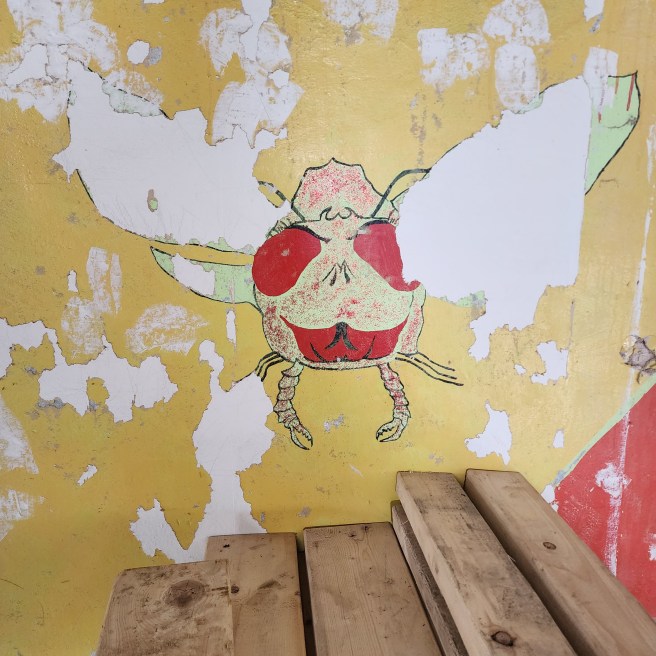
We can still ask who added the knee walls or the cosmic crab wall painting we found under the wallpaper upstairs.

 Jnana's Red Barn