WHEN NOR’EASTERS HIT HOME

New England gets hit by nasty storms called nor’easters. Often, they’re like off-season, slow-moving hurricanes that move up the coastline, spinning wind off the ocean and inward over land. That is, the wet wind comes out of the east. (Although, to be technical, it often arrives out of the south.)

Sometimes, their wallop comes as heavy rain. At other times, it’s tons of snow – even a blizzard. Either way, power outages, falling trees, wind damage to roofs and chimneys, and flooding can follow.

A power outage with flooding knocks the sump pump out, as well, and then there goes the furnace, if there are delays in restoring electrical service. To say nothing of the freezer out in the barn.

~*~

The so-called Perfect Storm, by the way, was one more nor’easter. A reminder to take these things quite seriously.

OH, MY, THAT HONEY!

In the early ’80s, when I lived in the Rust Belt, we chanced upon a small Greek bakery in the middle of a residential area – just five or six blocks from our house, actually.

What an incredible discovery! Along with the realization it made no sense to try to keep anything over an additional day – that honey soaks through the flaky phyllo dough too quickly! But, oh my, before it does!

IN THE FLITTING MOMENT

The delight of watching from our dining room as a hummingbird goes from one bloom to the next in a tithonia beside the window – observing the balanced hovering of what looks like giving each one an injection of a special nectar and then moving on, to repeat the dance figure. And then, it’s gone.

It’s the joy of embracing a rare moment before it’s gone. And then? It’s a lesson in appreciating life itself.

NOT REALLY JUST FOR THE TAKING

The concept of community gardens, where public land is made available to individuals and families to raise produce and flowers, is a noble one. When it works as envisioned, gardeners get to know and respect one another while swapping advice and their harvests, families eat healthier and tastier, and a piece of ground is simply put to good use.

Of course, there are spoilers, as we hear.

One year, for instance, all of the purple cabbage heads kept disappearing from the different families’ sections at one site, at least until a restaurant owner was caught in the act.(The audacity!)

Another year, I think, some of the garlic was raided.

This year, a large blooming tithonia plant was dug up and taken. It’s a big plant!

And more recently, as one man worked his plot, he observed a woman going through the neighboring sections and filling bags. Excuse me, he said, those aren’t yours.

But it’s a community garden, she retorted.

You’re stealing, he said, dialing his cell phone. I’m sure the police are perplexed by this one.

She was well-dressed. Her Audi was full of produce. She’d driven more than 30 miles from her home.

Does she really have no awareness of all the work that goes into ordering seeds, starting them indoors, transplanting, weeding, watering, weeding, watering, weeding, watering, staking some up … oh, well …

I’m waiting for the rest of the story. For now, I just can’t wrap my brain around this one.

DWELLING WITH A GHOST

New Englanders – at least those living in old houses – will occasionally speak of ghosts, and their stories can be compelling, no matter how skeptical the listener.

Of course, the specifics can differ. A dark apparition moving silently through dark hallways – or, in other modes, clumping loudly up and down the staircase. Leave empty junk food wrappers and soda cans and bottles on the counters and coffee table and even in the unmade sheets. Laugh eerily at midnight. Slide in front of you at the bathroom door, close it, lock it.

Drain the wi-fi bandwidth.

Expect steak and lobster and cheese while ignoring lettuce or eggs or peas.

But have you ever heard of a trail of stench that follows its movement? Oh, that detail is so telling. The fear of taking a shower, as well – the soap and washcloth remaining untouched.

They speak of the chill you feel, more than the dense smoky cloud. Or the echoing conversation as it’s twisted with a chortle and thrown back.

One version, in fact, has every intimate conversation accompanied by a Hollywood laugh track. And that, I’ll contend, is the most annoying.

A SIGNATURE FLOURISH

They’ve become a kind of signature for our place every summer, even though it’s been a number of years since we’ve planted any. The neighbors tell us how much they enjoy the sunflowers. They’ve become self-seeded, no doubt enhanced by our bird feeders.

As for all of the goldfinches, now that’s another matter! Just look at that bright yellow on bright yellow …

BOULANGERIES AT THE BASE

Julia Child liked to emphasize technique as the foundation of French cuisine – starting with the ability to create traditional sauces and custards.

But lately I’ve been thinking of something even more basic and yet distinctive – bread. Yes, the transformation of dough into a baguette or croissant. Seemingly simple, yet utterly heavenly when masterfully done – and so often delivered and sold in pale imitations, probably even in France today or more commonly across America. Admittedly, there’s a great deal of technique required in doing these right – along with the unique steam-infused, high temperature ovens designed expressly for the purpose.

Maybe that’s why two of our favorite bakeries – or boulangeries – each share their building with a celebrated New England restaurant, one in Maine, the other in Cape Cod. These restaurants know the importance of bread.

Put simply, let me argue that based on its breads and pastries alone, French cuisine would rank high on any global listing. You can add other categories as you wish – from soups to wines to desserts – but let me return to that moment of sitting on the back porch of the house where we were staying, sipping coffee and white wine and munching on bread and pastries we’d just picked up across the highway before dashing back. We were there, in line, at opening – and when the doors opened a few minutes after the official time, all we got in greeting was cheerful “Bonjour,” sans apologie.

Not that we’re complaining. Definitely not.

We’re both still marveling at the sight we’d caught of a baker transferring the rows of baguette dough from the tray to the rack for the oven. I’ve kneaded hundreds of loaves of bread, and none have ever been so smoothly gorgeous. It was like watching a fisherman with his catch, actually. We can only imagine how each armlike roll feels to the touch or the baker’s gentle caress in lifting it and arranging it anew in its rows for baking.

Coincidentally, my wife’s started reading Bread Alone, Daniel Leader’s eye-opening discoveries as an American who backed into preserving the old ways of French baking artistry. Since then, he’s made a success of it in Upstate New York, of all places. His is a delightful story full of unlikely twists of fate and French characters, along with some definite opinions about flour and approaches and some detailed recipes for the exacting aspirant – or professional baker.

I return to a concept of simplicity as leaving one with no place to hide, no disguises for shoddy workmanship, no excuses. Simplicity instead as a goal of mastery, competence, elegance. In other words, good work.

For now, though, I’ll just savor the delight of what’s fresh, carefully crafted, and unpretentiously good – slices of crusty bread with soft butter and a glass of chilled vinho verde, for instance, to accompany a green salad of lettuce straight from the garden. Well, the homemade vinaigrette might take some finessing.

For me, a perfect summer repast, especially when shared in good company.

LESSONS IN PICKING BERRIES

“You’re a gardener?” I’m occasionally asked, only to reply, “Not really. My wife is. I’m the compost master – and I like to eat.”

Well, I also do a lot of the harvest. The planning, vision, and execution, though, are entirely hers. Along with the shoebox of seed packets.

Each summer, though, one lesson keeps coming back to me when it comes time to pick ripe berries. Well, sugar snap peas, too. It’s a reminder of patience and human imperfection. I like to think of myself as observant, but what I keep noticing is that no matter how thoroughly you think you’ve harvested a particular bit – say a square foot or two – once you move over a step, you’ll see you’ve missed some. Often, more than a few. Someone can come along behind you and find you’ve missed almost as many as you collected. Seriously. Don’t be offended, it’s simply a fact of reality. Call it a lesson in humility. And a lesson in the importance of assuming multiple perspectives — something that definitely applies to the revisions of poetry and fiction or the reading of a good text, even Scripture.

Picking blueberries this morning, I sat in a lawn chair much of the time – one knee has been especially painful if I kneel just so. The chair had nothing to do with laziness. Rather, it allowed me to get under the foliage. To lift each branch and see the ripe berries hiding underneath the thickness of leaves. So another lesson has to do with getting a view from ground level, or as close to it as you can. Too often we like to look at life from the top down, not that it doesn’t help. Rather, it’s only one of several approaches — and in harvesting here, you’ll need a handful.

Another lesson, seen most recently in our raspberries, is an admission you can have them all. Some are in places you just can’t reach, especially when they’re surrounded by prickly stalks. So those we’ll share with the wildlife, once the netting’s off. There’s no need to get greedy. Persistent and careful are another matter.

Which brings up a lesson in defense. You have to remain vigilant. No matter how well you think you’ve secured the netting, a few birds or squirrels (especially) will find a way through. Or just sit on top and glean what’s in reach.

That part has me remembering a detail I never included in my Hippie Trails novels. The farm in front of ours had a commercial blueberry operation with some of the bushes not more than a hundred feet or so away from my bedroom window. Once the berries started to ripen, its water cannon would start booming every few minutes. The sound was supposed to frighten the birds away. I can’t remember if the noise continued 24/7 or ceased for the night, but it did take some getting used to. As for the tranquil countryside? Oh, you city folk, you’re in for a rude awakening there. Unlike our little city farm (huh, should that be our little little-city farm?) that’s delightfully quiet on this Saturday morning. Apart from the joyous birds’ singing.

Oh, yes, there’s the lesson of generosity and sharing. I’m tightfisted by nature, so this always needs practice. But eating them with others rather than alone is essentially far more pleasurable. Or taking the bowl you just collected and handing it to a cook who, after a moment of happy admiration, transforms them into fresh scones and tarts before the whole household has stirred?

Don’t overlook the lesson of discomfort, either. If it’s not mosquitoes, it’s blazing sun or a drizzle. It’s rarely perfect. So be tolerant and grateful. Oh, yes, and when it’s perfect? Appreciate the glorious moment. The King of France never had it so good.

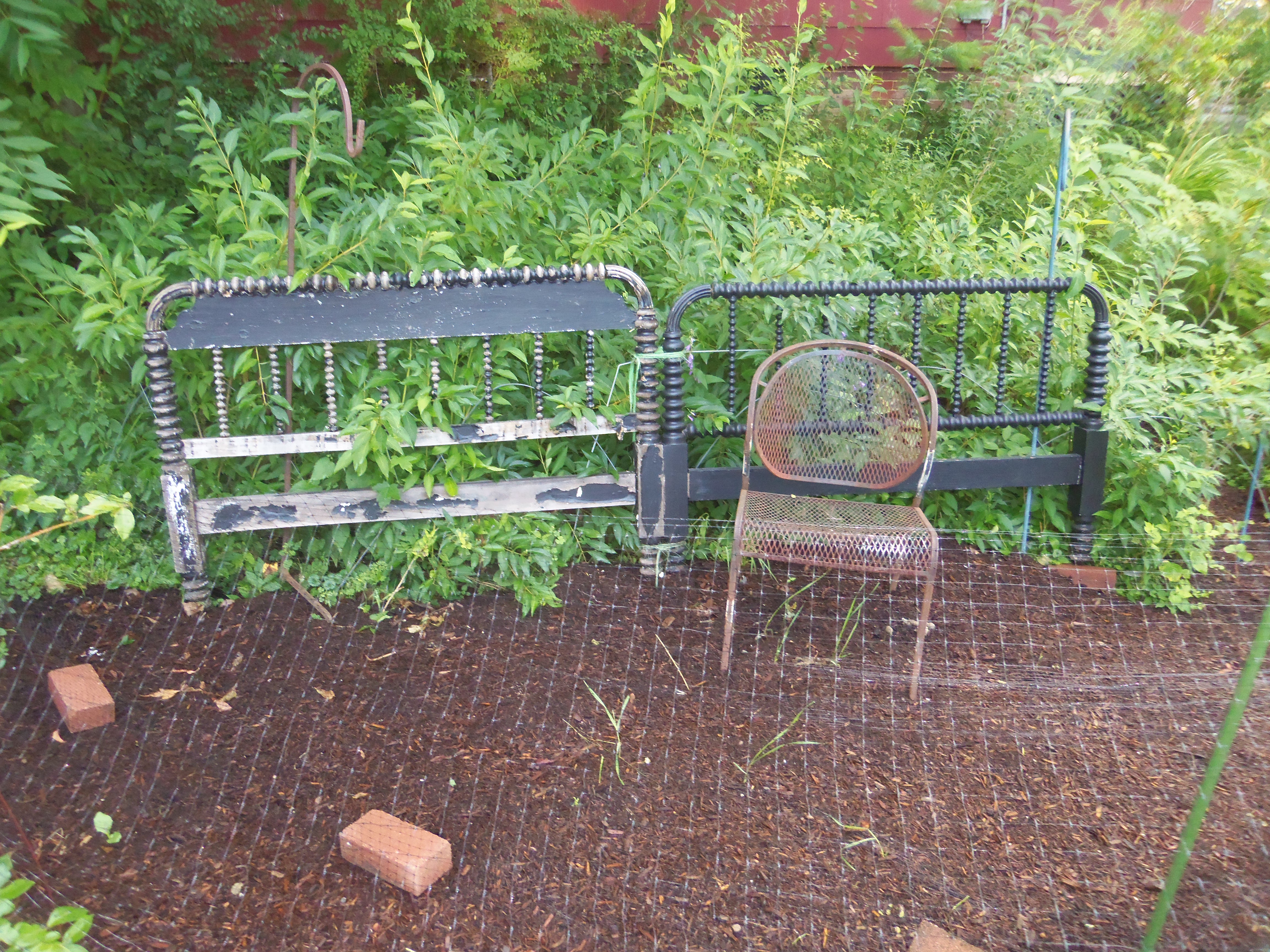
 

GARDEN BED

100_8850The bed stand, salvaged from a roadside, holds forsythia back so the blueberry bushes may thrive. The netting in the foreground is actually on the blueberry bushes, to keep birds and squirrels from picking all the berries, rather than on the ground, where the bricks anchor the netting.