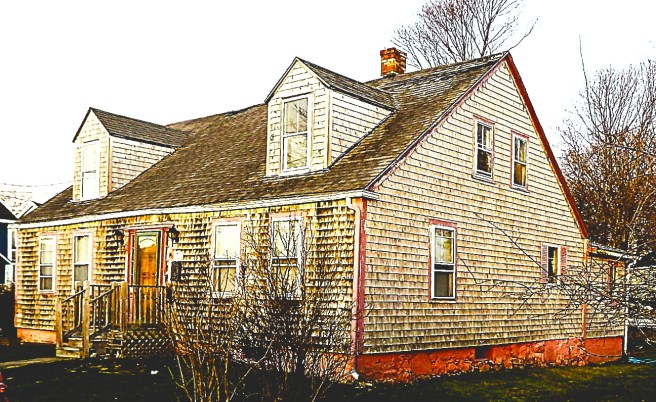
Captain John’s incredible view

As I investigated the history of the rundown house we had bought, I was puzzled by a description that placed it at the corner of Shackford and Water streets, the other end of our block. Only later did I see that as the reality until Captain John Shackford senior sold off two lots a year before his death and the subsequent appearance of Third Street, perhaps the third east/west street in his tract but remaining the only numeral street in the entire city.

I keep trying to imagine his sweeping panoramic view from that time, with the waterfront below and its wharves still in his possession, and then out over the bay and the fields around him. None of the neighboring houses existed through most of that. The lot across Water Street, down to the tides, was steep and the upper part remained attached to our property until the late 1970s or so. My, how we’d love to still have that unobstructed view of Passamaquoddy Bay, the part known as Friar Roads!

As I consider the loss, let me mention it’s what’s too often hailed as the price of progress.

At least we have some great neighbors.

As for some fresh historical perspective

Eastport has an active energy committee, which is good considering how many times we get hit with electrical outages. We live at the edge of the grid, after all, as well as on an island subject to some wild weather.

So while lunching at their Earth Day set of presentations, the man opposite me was asking about our house renovations. This is a small-town, after all, and everybody knows everything – or will.

As I explained the history of our place and some of its makeshift, even shocking, carpentry over the centuries, he interrupted me with an account of a father and son working on a project.

I thought he was talking about John Shackford senior and junior building our place.

As the two were working on the rafters, the son questioned his dad, “That’s six inches off, let me fix it.”

Naw, came the reply: “Just nail it!”

~*~

Sadly, I’m having to admit my realization of how often in my life that’s been the case.

And also, in our home project, how grateful I am that our contractor Adam would never settle for such sloppiness.

We fully intend for this house to last another 239 years.


We’re supposed to be flush with improvements

Naturally, you must be curious about our new bathroom – what we’ve called our real bathroom, in contrast to the water closet on the first floor.

Well, for now, so are we.

As we considered our shrinking funding options, we admitted we didn’t have to finish the upstairs bathroom at this point, though having it done would deliver a definite quality of life improvement.

We wanted a tub that would be deep enough for a real soak – one that I could actually fit into without attempting hatha yoga with water. The tub also had to have a left-hand drain if we were to avoid having the pipe run against the outside wall, where it might freeze and burst in deep winter.

Our original choice, built-in or alcove, switched to a free-standing model after seeing one in a neighbor’s home during a party. We went back a week later to get a second look and measurements.

~*~

The toilet had to be a back-flushing model due to a shallow space in the flooring.

Having lighting above the sink and electrical outlets in the room would be huge advances over the water closet downstairs, as we learned in the 4½ years of its being our only option. Do note that having a carpenter who was also a licensed electrician meant that all of the lines and outlets would be in place before the drywall went up.

As for storage? A large medicine cabinet and a vanity for the sink are considered boffo additions, ones you probably take for granted in your own digs.

~*~

But once the bathroom and laundry room were plumbed, awaiting the next steps, we ran into complications.

First was actually ordering the tub and toilet and getting them delivered to our remote locale. Getting agreement on some of the selections added to our delay. Our plumber kept delaying, too, especially once in took a lucrative gig out in Indiana and then further out in Seattle. A potential replacement wasn’t interested in delivering what we wanted rather than the generic stuff they had it stock. All the while, our available money went to other parts of the renovation. So for, now, alas, this is moved over the next phase, whenever.


Decompression opens refocus

When the upstairs finally became available, we began moving items from the first floor and a few boxes from the storage units.

My new bedroom/studio was the first one to be fully ready for occupancy. It’s the smallest of the four, while the front two rooms were still being used by the carpenters as they worked on the front exterior. They still have some tweaks before coming into their intended use. The fourth, our guestroom, is at the moment mostly storage. This does seem to feel like musical chairs.

Still, things that had long been packed away have finally came out into daylight and become accessible. We’ve even had some more room to stir about in.

Not for long, though. The future dining room aka my former bedroom/studio was quickly designated as a staging area when we cleared out our storage unit at the other end of the state. In time, it will likely be a storage space when we get to renovating the kitchen and downstairs bathroom. Those Ikea kitchen cabinets, for one, will take up a lot of room somewhere before they go up on the wall. As for appliances? Or an extra sawhorse or two?

And we thought we were done with that sense of camping in this house?

Get ready for Phase Two, hopefully still in my lifetime.

A big change in the master plan

Let’s start with the timetable, which fell far behind our goal. Delays included weather, materials (we couldn’t just run down the street when a need popped up, and deliveries were at least a day away, or often more), crew availability, the plumber and fixtures, and our own attempts to make decisions with a key player living at the other end of the state.

By late spring, we were making headway again but were also reaching toward the bottom of the pot when it came to finances.

And then the big whammy came, when Trump and his cronies decided to freeze already approved grant money, meaning my wife would soon be unemployed.

We tapped the brakes, meaning the modest kitchen remake would be on hold, along with the new upstairs bathroom and laundry room and an upgrade of the downstairs bathroom. The lower apron deck in the back, an L around the newly replaced upper deck, was also now on hold.

Drawing on our remaining available funds, we decided to go ahead with new outdoor lighting front and back, some final touches in the front bedrooms and stairway/hallway, insertion of doorhandles upstairs, and a scaled down job on the mudroom, eliminating rainwater leakage, replacing the peeling paneling with drywall, and the addition of electrical outlets and lighting – a revamp of the hip roof with an more efficient shed line, has moved off to the future.

It all adds up. The new freezer in the mudroom is quickly filling with garden produce and marked-down groceries.

A few other projects, especially a heat-pump system to counter our fuel-oil furnace, are now further off on the horizon.

Emotionally, I’m feeling conflicted. I don’t like letting up this far from the finish line. We still have much to do in settling into what’s already been accomplished. We need to empty a storage unit at the other end of the state and fit the contents into our place here – or cull much of the rest.

But I’m also proud of what we’ve accomplished to date, and of our luck in landing the contractor we did.

If you haven’t already looked at the Before/After album at my Thistle Finch site, please do. It’s also available there for printout.

Home, Money, Design, Life, Maine, Downeast, Eastport,

Should you want to compare the before and after

You may have guessed we’ve taken tons of photos of the renovations in our historic home. You’ve been viewing some as progress reports in this weekly series, but those show steps along the way.

Sometimes it’s helpful to skip over those, going straight from how things looked at the beginning and then leaping to what the work delivered in the upstairs phase of renovations.

Should you be interested in that comparison, I’ve assembled a gallery of before-and-after contrasts in a free photo album, one I’m making available to you, should you be interested.

As I’ll explain next week, we’re hardly as far along as we had hoped. So I’m calling the album “Before & Midway After.”

In assembling the photographs, I was emotionally overrun in seeing how dramatic some of the advances have been. It’s helpful in facing the remaining work ahead.

~*~

That said, check out the free tour at Thistle Finch editions.

You’ll also find the history of the house and its previous residents in another booklet, should you be curious.

Finally, something the public could see

When the scaffolding around the front and side of the house came down after more than a year, the public could finally see what we had intended.

The result actually took off in some tweaks that left it looking, well, we hope for the better – things like the double windows upstairs, which I’ve discussed in previous posts.

In a small community like ours, people were bound to gawk and talk, and so far all we’ve heard has been admiration.

As it now stands.
Starting from this.

When we embarked on this project, I quipped that old-house fixes took three times the estimated time and budget, and ours (alas) has been no exception on both fronts.

Actually, more, or maybe less, if you consider the Covid whammy and inflation. Besides, we got into a great deal more than adding space overhead: many of the extra costs addressed items in our home inspection report, things like rot, wiring issues, plumbing, masonry. Oh my, it was a long list in addition to the more pressing roofing situation that concerned our insurance policy.

So much of what we paid for would be unseen: the aforesaid rewiring (throughout the house, cellar to roof), sculptural work to allow the new farming to sit atop the old (how this structure ever survived before this is a miracle), spray-foam insulation, caulking. The interior storage lofts weren’t as simple as promised but they add for architectural drama (and the name of our architect, mainly us and Adam), nor were some of the exterior efforts to preserve the Cape image as seen from the street while drastically altering the reality.

But then, when our new cedar shingling was finally finished and the construction scaffolds were removed after more than a year, how handsome, as one of the coconspirators put it. Or, from my perspective, dramatic.

I’m hoping both Anna Baskerville and Captain John Shackford, as previous residents, would approve. As well as the list of others who have left their imprint here.

Frankly, we treasure all of it.

What do you think about doors?

Most of us, I suspect, seldom think about them at all – they’re just there, open-or-shut as we move on to something else or perhaps seek some privacy. Oh, sometimes they stick or squeak or the knob needs tightening, but for the most part we rarely even see them. As for simply walking into one, BLAM! Sometimes it’s not a joke or only a black eye.

As perspective, when our renovation project began, I was occupying a bedroom that had no door. Ours is an old house, after all, and the back parlor, as we also call the room, sat off the kitchen and our tiny bathroom. At least the bathroom had a door, though it didn’t close fully. As a matter of fact, few of the indoor doors in our house closed fully and the exterior ones were equally suspect.

Adam, our amazing contractor, raised another question about which way each of our upcoming doors would open. I assumed, erroneously, that they would be situated to minimize obstruction of open space. Instead, it seems that doors conventionally open with the right hand. Not the left. From either side, at that. Try it and let me know if I’m wrong.

The discussion thickened, no pun intended, when one of the coconspirators in this renovation declared she wouldn’t have hollow-core doors in the house, not even the bedrooms. My leaning for two of the upstairs bedrooms had been for Japanese-style curtains and for leaving the laundry room open. But then considerations of noise, privacy, and smoke-and-fire emergencies overruled me. A bathroom, of course, needs a solid closure, period. Would ours upstairs have a frosted window, like the one downstairs? As you see, this can get complicated. Those popular flip-this house cable TV programs are so lacking.

But back to topic.

The other coconspirator proposed picking up antique doors salvaged from other renovation projects, and we decided to go that route. They didn’t even have to match, did they?

~*~

Still ahead was what to do with the two exterior doors downstairs.

They were leaky, as far as bad weather went, warped, and rotting. The front door presents a neighborhood impression as well as the challenge of upholding the town’s historical character. Its storm door had already fallen away, due to frame warping.

To see some examples of exterior doors of Eastport homes, take a look at the Doors Fit for a Cape photo album at Thistle Finch editions.

As an added concern: working from home

Thanks to my poetry and fiction enterprises in my supposedly free hours – well, they’ve rarely paid me, unlike my career in the newspaper office – the idea of having workspace at home has been a given all the way back to the mid-‘70s.

For other members of our household, though, it’s something that’s certainly taken hold since, well, before Covid.

When the downstairs became crowded once the renovation overhead got going, we soon felt cramped. That big printer provided by an employer, for instance, took up some prime tabletop real estate and a precious electrical outlet. We still had a smaller one for our own use. Then there were other things, like a traveling table for presentations, a ream of printing paper, hand-out literature, and it all adds up.

The kitchen table typically became overrun with two or three laptops, stacks of documents and notes, and perhaps a few groceries for one coconspirator. Just what would happen when we were joined full-time by the second, who has her own online ventures? We needed to plan for those.

What became obvious was that each of us could use a second room of our own for these labors. Or at least a room that could do dual service. One where we could even close the door on a project without having to pick it up and put it away for the night.

The smaller front parlor, once cleared of “temporary” storage, would return to use as one office and conference room and, as needed, overnight guests.

The back parlor, which had been my bedroom, studio, and laundry room, would become a dining and crafts room, likely also dedicated to the other coconspirator’s business. And, yes, some of those crafts.

The new guestroom upstairs held the potential of also accommodating some of my overflow. It would also need a desk for our son-in-law in his visits. His company had obliterated its own offices long ago, and he was almost always on call.

And you were wondering what we were going to do with all of that new space? Oh, my.

We still had two storage units to empty, too.

As for the clothes washer and dryer

In the original layouts for the upstairs, I thought a laundry room was pushing our limits. On the other hand, I didn’t want a washer and dryer in the bathroom, either. That just would have looked, well, utilitarian. Besides, keeping them separate would avert crowding when competing uses erupted.

So what would be wrong with keeping them downstairs?

That’s when the fact that we would have to carry our laundry up and down stairs was pointed out to me. They’re the bulk of our wash load.

OK, I relented and was willing to go see where the new plan would lead.

I had to admit that no longer having it in my bedroom and studio was going to come as a relief.

~*~

What I’m seeing now is how much this “luxury” really enhances our daily living, starting with the sheets and blankets storage.

I’ve long been a fan of having elbow space as part of my work area. For perspective, I recommend Richard Swenen’s 1992 bestseller, Margin: Restoring Emotional, Physical, Financial, and Time Reserves to Overloaded Lives.

The laundry room – and the slightly wider than normal hallway between it and the stairwell – reflect that thinking.

The laundry tub also fits into that idea of margin, with its deep bowl facilitating household and painting projects cleanup more easily than a bathtub does.

Add to that the ease of ironing.

There’s even thought of running a clothesline out from the window.

Frankly, I’m not so sure about that, though I’m willing to be convinced otherwise.