You’d think those birds would be far more ravenous in the depths of winter

We continue to keep our bird feeders out through the summer (something we wouldn’t do if we had bears in town), but I am surprised by how much more they eat in summertime, when there’s plenty of other food available, than they do in deep cold and snowy conditions when they need more to keep their metabolism up.

Yeah, we know there are more of them now and that they’re also feeding their babies. But on some days they eat as much as they would otherwise consume in two weeks – or more.

On the other hand, we do enjoy watching the variety and drama as they dine right outside the window at our kitchen table throughout the year.

Our old garden has been obliterated

People used to walk down our street in Dover just to admire our garden. They told us how much pleasure and peace it gave them. It also attracted a range of wildlife, including hummingbirds, butterflies, or the occasional turkey or fox.

Throughout the year, the garden also led to many photos you can still find here at the Red Barn.

It was, by many standards, funky. The weeds were never completely controlled, but it was prolific and made good use of what we sometimes called the Swamp, after its mucky clay soil in late spring and early summer. Our pet rabbits delighted in much of what we picked there, too.

The new owners, alas, have bulldozed all that. The strawberries, raspberries, blueberries, currants as well as the raised beds and shrubbery screens – gone. Twenty-years of reclaiming the once tired soil and then dining well as a result – gone. Naturally, we’re lamenting, knowing how much more they must be spending on groceries that won’t be as fresh or tasty.

We have to recognize, of course, that we’ve left all that behind and no longer have a say in the matter.

But we still feel sad or even a tad angry. Ahhh!

An island garden isn’t entirely quaint

I’ve loved the phrase, “island garden,” even before we relocated to Moose Island, Maine.

The resonance comes in a classic book of that title by poet Celia Thaxter from her efforts on Appledore Island at the other end of the state. Her volume is illustrated by the great American Impressionist painter Childe Hassam, an addicted summer visitor. He made some stunning paintings on the island.

My wife and I did make a pilgrimage to the site, which once included a hotel considered by many to be America’s first artists’ colony. Nowadays, you do need permission to land there – we arrived on a research vessel as guests of the University of New Hampshire, which shares a major ornithological center with Cornell in what had been a World War II watchtower and bunkers.

Moose Island, in contrast, connects to the mainland by a causeway – no need for a ferry – but it’s still an island, an element that grows in awareness the longer I’m here.

Celia’s text often laments the arrival of garden slugs on the previously uninfected island, a pestilence we certainly understand, even before relocating from New Hampshire.

Alas, we do have those slimy destructors here. Apparently, Celia was unaware of the advantages of using seaweed as a mulch, one that repels the offenders in both its fresh and dried states. It’s something I’ve previously posted on. And something I need to reapply here.

While her garden was mostly flowers, ours skewers more toward edible items. And that adds a further layer of offenders, as you’ve been seeing here: deer. The ones with voracious appetites.

Finally, a decent seafood selection Way Downeast

Even though we live a block from the ocean, we’ve been perplexed by the selection of local seafood available in the region’s markets. Or more accurately, it’s lack.

The bigger supermarkets have been a disappointment, and the smaller ones, quite limited.

The best overall selection we’ve found, especially for local catch, is Earle’s SUV that shows up on U.S. 1 down in Machias on selected days. That’s an hour away.

For crab, clams, and scallops, it’s Betty’s seasonal shack in Pembroke, about 20 minutes from home.

Other than that, it’s meant going directly to the fishermen, if you know where they are.

Finally, we’re feeling upbeat. The reopening of Quoddy Lobster’s dining operation, just a block from us, includes a fresh seafood counter.

New owner Look Lobster, a fifth-generation family company in Jonesport, has already invested heavily in the Eastport site by rebuilding the pier for straight-from-the-boat deliveries. Last summer it became my go-to place for fresh retail lobster, especially for anything over a pound and a half.

Now that the end-of-the-street site is serving traditional lobster plates for the first time since Covid, it won’t be long before the outdoor picnic tables by the sea are soon packed with devoted fans. The place, a very popular destination both among tourists and locals, was much missed.

Still the talk of the town

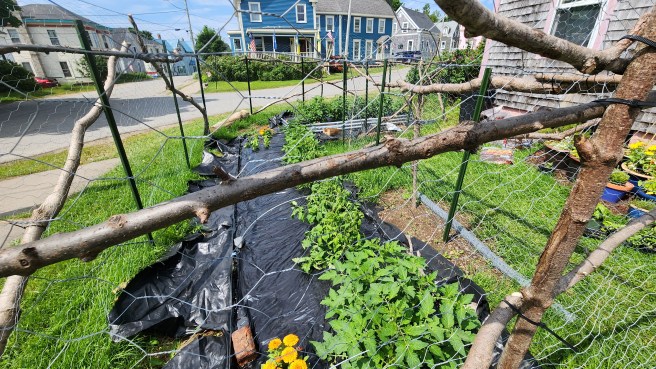
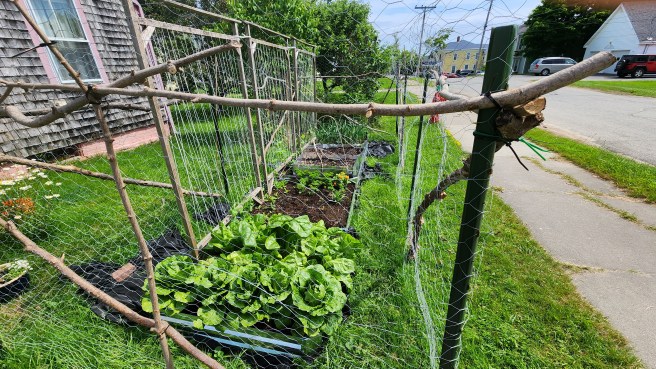
So far, so good. The deer haven’t yet pushed the garden fence over or managed to get in despite the chicken wire.

That, in itself, gets a lot of the locals coming by to take a look at my fortifications and then talk, as well as a number of summer folk. Eastport is a pedestrian-friendly village. Others are in vehicles that slow down and roll down their windows.

Beyond that, many are also avid gardeners who admire what’s growing and then advise us while introducing themselves. Some have even left packets of seeds on our front-door steps.

Strangers have also come up to me downtown to say how much they like what we’re doing. As I acknowledge, my wife deserves most of the credit.

Either way, it’s one more positive small-town aspect of living here. You’re simply engaged with life all around you.

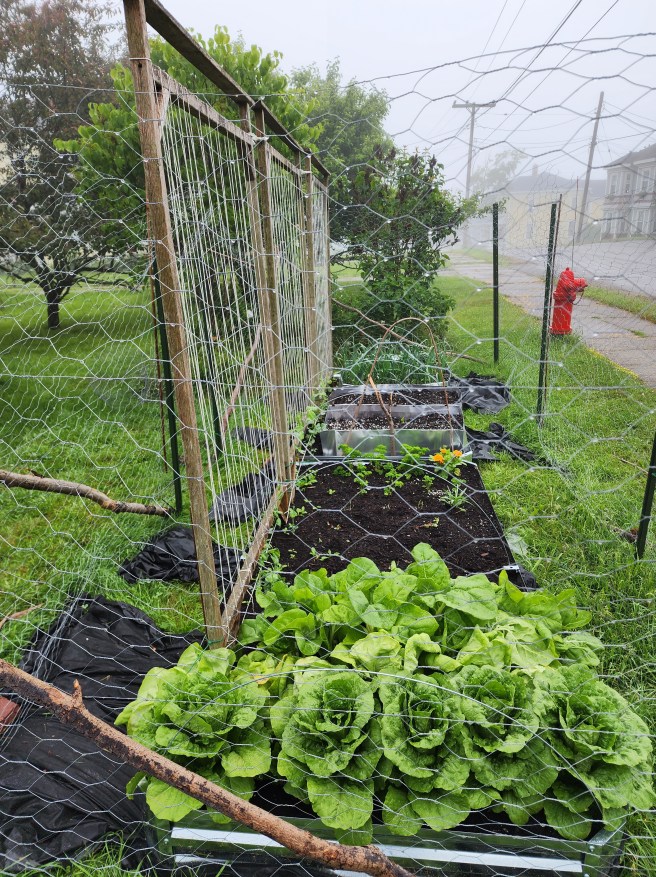
Nor have I mentioned how heavenly the buttery fresh lettuce tastes or how much a sugar-snap pea vine can grow in a day.

The fact that all this is in our front yard does, no doubt, make the garden more public, but it is where our best sunlight falls. Folks around here are practical and take that all in stride.

Speaking of practical? It’s that much less lawn I need to mow.

Making the best of a break in the fog and rain

We’re feeling sorry for vacationers to our end of Maine the past two weeks. Especially those with children in tow.

It’s been cold – our furnace is still on – and very foggy and damp, accompanied by showers and thunderstorms.

It’s not what you’d want to run into on your well-earned summer getaway.

At least we’re getting a break, however brief.

Today’s forecast is for mostly cloudy, followed by two partly cloudy days. And then another solid streak of rainy days resumes.

Glimpses of real sunlight and blue sky will lift spirits, no doubt. I might even stop reminding folks of six straight months or so of this for people living in Seattle. (You know, it could be worse. We might even have to start watching movies in German.)

One thing you can also anticipate is the sound of lawnmowers the moment the grass dries sufficiently. Otherwise, a failure to mow in time can lead to an impossible task, as I remember when I had to learn to scythe back in Dover … and my vow to myself never to do that again.

For us, it also means doing laundry. We have a washer here but not a dryer. So we’re anticipating hanging wet clothes and linens out on the line to dry. There is a backlog to address.

Another must-do is a big round of grilling. Maybe even dining al fresco, if the temperature cooperates.

Well, as we’ve been saying all along, this too will pass.

Now, for the latest installment of our island garden venture

Few of our nights until late as June have stayed above 50 degrees, a detail that will likely surprise fellow gardeners across the rest of the U.S. That’s meant bringing flats of basil and other temperature-sensitive plants indoors overnight, in addition to the plastic tunnels my wife devised to warm the soil and protect our tomato and pepper seedlings outdoors until now.

Our new raised beds, as previously noted here at the Red Barn, are an attempt to work around extremely high lead levels in our soil. Beyond that, the chicken-wire fencing is an attempt to deter Moose Island’s ravenous urban deer. That barrier will be further reinforced in the coming days.

The first night our fencing was up on the first bed, though, a wayward critter wound up bending – not just pulling over – one of the corner posts. The steel post was the stronger, pricier variety. I couldn’t bend it, I’ll tell you – not without an anvil and heavy hammer or maybe some heavy jumping. (Sorry I didn’t get a photo. We were too busy getting that corner repaired against a possible second attack.)

So here’s where we are now, in the midst of about three inches of rain in a week or so.

With a garden, there’s always more to do. Sometimes it even involves eating.

This is a great place to enter the twilight zones

Here in Way Downeast Maine, many dawns would blow you away, at least if you’re awake in time.

It’s not just when our closest star comes into view but also the vast unobstructed sky over the bay and the ways neighboring Campobello Island interact with the growing light.

As I’ve been finding – and you’re seeing in some of the photos here at the Red Barn – much of the glory occurs in what’s officially the twilight zones, defined by how low the sun is below the horizon.

These zones are otherwise known as dawn and dusk, apart from Rod Serling’s once upon a time spooky black-and-white TV episodes.

And these are longer and more pronounced the further away from the equator they are.

I’m on the 45th parallel, halfway to the North Pole and its days of endless summer light or winter darkness. Meaning our twilights are much longer than what happens in most of the rest of the continental U.S.

Checking our local weather forecasts, I’ve noticed a few unfamiliar terms but not looked into them until recently.

The first is astronomical twilight, which I’ll skip over this round. It seems to apply mostly to the Arctic and Antarctic.

The second is nautical twilight, which apparently has its origins in the era when mariners used the stars to navigate the seas. In clear weather, most stars are still visible to the naked eye but also, finally, the horizon. You need artificial light to do much of anything outdoors.

Around here these days, it begins before 3:10  am Daylight time – or what would be 2:10 Standard. The wee hours, no matter how you slice it.

The next stage is civil twilight. It’s brighter, enough to mean artificial light may not be required for outdoor activities. Only the brightest celestial objects can be observed by the naked eye. These days for us, it’s around 4 o’clock. Yeah, 3 Standard time. Still really early for most folks.

And finally sunrise, about a more than quarter to 5.

That’s an hour and a half of magical natural light.

I think it’s why most people around here are up and about early. Even in winter, the roads are busier at 5:30 in the morning than 5:30 in the afternoon.

Of course, the reverse happens every evening.

The shifts also produce what’s called the Golden Hour, when sunlight turns warmer and softer. Or, in my thinking, buttery and magical. I place it mostly as the hour before sunset, especially when the light shoots in horizontally.

As well as the Blue Hour, when only a few stars or planets are visible. Painter Maxfield Parrish exploited it to the hilt.

During the day, much of our sunlight is reflected from the waters back into the sky, something many classic Italian painters explored as well as more modern artists here today.

So how’s the natural light where you are?

The next steps

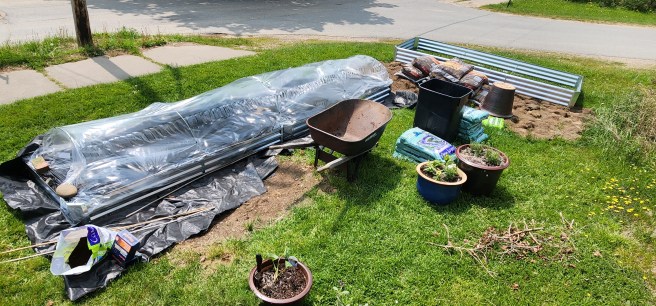
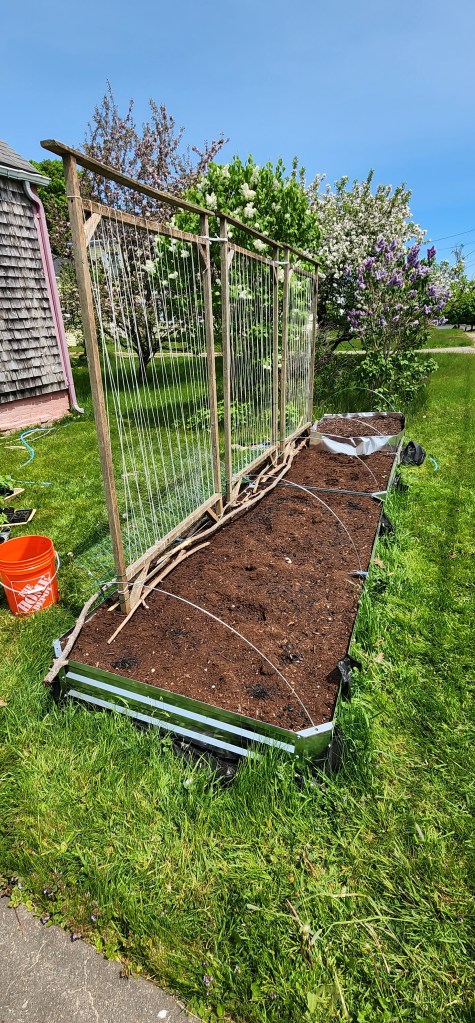
Filling the new beds with clean soil atop a landscape fabric and cardboard barrier against weeds and the tainted ground below takes shape. Our planting season here naturally runs late – early June still had overnight low temperatures in the 40s. So transplanting seedlings is running on schedule.

The plastic is to help warm the soil.

The upright frames are for peas, which will probably continue to produce through the summer, thanks to the cooler temperatures. Tomatoes, though, will be tricky.

The biggest challenge will be deer, as you’ll see.