BARNEY ON THE BURNER

Her uncle Barney undergoes a remarkable awakening in my new novel, What’s Left. Instead of going to college, he stays home and soon finds himself fully responsible for managing the kitchen of the family restaurant.

He has, though, tasted the social upheavals in the wider world and quietly rebelled at the strictures of his parents. The status quo is endangered.

The return of his older brother, Dimitri, changes everything. Barney is pressed to expand the menu into dishes drawn from unfamiliar cuisines, flavors, and ingredients, and that requires mastering more demanding techniques and advancing his ability to taste subtle nuances. All of that puts him at the center of intense debate and experimentation, abetted by his wife, the lively Pia, plus the family circle of Graham, Nita, Yin, and Cassia’s father, even before their business expands into related food fields including a bakery, a brewery, and a natural foods grocery.

It’s a lot to put on his plate, but I know it can be done. Barney has that kind of curiosity, for one thing, and a tongue to match.

As Cassia discovers, in a passage that’s evaporated from the final version:

Barney’s into astrology and palmistry, through the grandmothers. When I ask about drugs, all I’m told is, Not the hard stuff. And even with the Buddhism, for him, hippie is about the music, more than anything else – as you’d hear in Carmichael’s kitchen, night and day.

~*~

Let’s get back to basics. Imagine yourself sitting down with this group for a night off. They’re phoning an order for home delivery. What’s your favorite pizza? Why? Who do you think wants the one with anchovy?

~*~

Kore in Acropolis Museum. (Photo by Ricardo Andre Frantz via Wikimedia Commons.)

Cassia’s roots included inspiration like this.
CHARACTER OR ACTION DRIVEN?

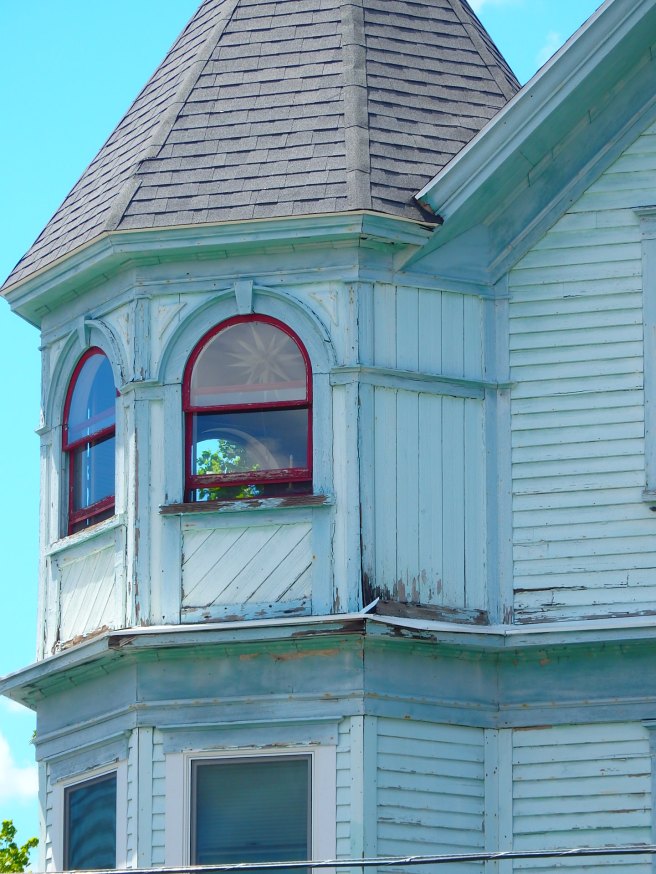
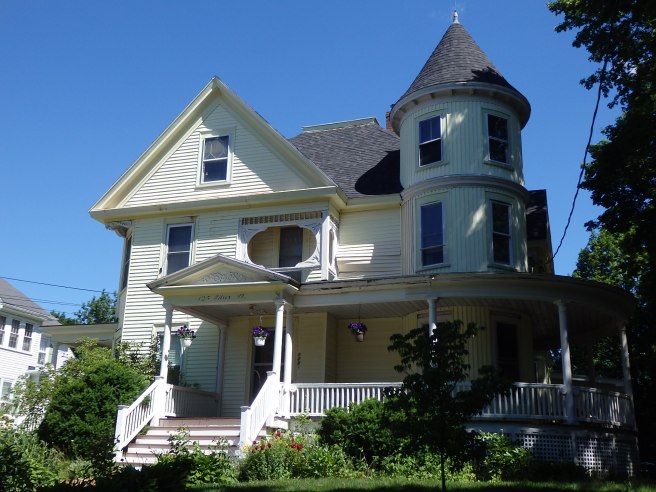
A large Queen Anne-style house with a distinctive witch’s hat tower something like this is the headquarters for Cassia’s extended family in my new novel, What’s Left. If only this one were pink, like hers.

A common question for novelists asks whether their book is driven primarily by the development of its characters or by the actions of its plot. It’s not one that had been front-and-center for me until my newest work began taking shape. For one thing, my previous fiction all falls under the category of Experimental, and, for another, I’ve usually been of a contrarian nature. Maybe the earlier stories were more event or episode driven than action propelled, and characters added whatever they had. As I’ll say, up till now. Or, as I might add, a journalist is more concerned about what’s happened than the motivations of the individuals involved.

My new novel, What’s Left, was initially envisioned as a kind of post-hippie history – an update flowing from the ending of my first published novel, in fact. But then it began turning into a different kind of history, going back further to her immigrant great-grandparents. Well, at that point the story could develop either way, based on the characters or their encounters. What clarified the direction for me was my decision to have her father vanish in an avalanche halfway around the globe, which precipitates her obsession to know just who he really was. And that made it character-driven.

As she discovered more about her father – and her colorful, extended family – I realized I wanted to know more about Cassia herself, starting with her reactions to the clues she was uncovering.  In the end, What’s Left is about her, told in her voice from age 11 into her early 30s. As for the history? It’s bound to be in her blood.

Continue reading “CHARACTER OR ACTION DRIVEN?”

OH, FOR A HOME SO TRULY SWEET HOME

In my new novel, What’s Left, her uncle Dimitri sees qualities in her father-to-be that would fit in with her family – hard worker, loyal to the situation. And so he turns that, in an earlier draft:

You can object all you want, but I know that far down inside, you really don’t love that newspaper or that town.

Frankly, reading that again is personally painful. I’ve done a lot of good work in difficult circumstances. Let’s leave it at that.

~*~

If money – including a job – were no obstacle, where would you really like to be living?

~*~

Mousaka (bottom center), yahni (string beans, top center), pork souvlaki (kebab), and rice pilaf. Photo via Wikimedia Commons.

In the family, Cassia would have had Greek cuisine like this.

WHEN THE STORY GOES WHERE IT WANTS

Carmichael’s, the restaurant her family owns in my new novel, has me looking more closely at others.

Over recent years, I’ve been especially fascinated by the hippie outbreak and its legacy. We had a taste of what society could be and let it slip away, or so the story goes. In reality, nobody ever fit the hippie stereotype, and while the impression is that the movement died out, so many of its concerns continue – from environmental awareness and sustainable economics to racial and sexual equality to social justice activism to Asian and Native spiritual traditions to back-to-the-earth and natural living and so on. It’s a long list, actually.

Continue reading “WHEN THE STORY GOES WHERE IT WANTS”

WHO COULDN’T LOVE GRAHAM?

Her uncle Graham certainly adds depth to my new novel, What’s Left.

For one thing, he’s a sign of the generational changes coming to the family and its business. Dimitri’s father, Stavros, never would have approved of Graham’s presence, had fate not intervened.

For another, he brings a type of gentle male to the story, a balance to Dimitri’s golden boy leadership. As a couple, they also help me narrow the number of cousins Cassia has close at hand – readers can handle only so many names, after all – and Dimitri and Graham weren’t about to adopt, from what I see. (Feel free to argue otherwise.)

I’m happy with the way Graham grows into the story. Like others who voluntarily join in the family – Cassia’s father and her aunts Pia and Yin – he’s crucial to its vitality and flavor. With the hint of 0ld-money comfort in his past compounded by a layer of black-sheep distancing, we find him rich in the social skills he applies as the face everybody in town comes to know in the family’s restaurant.

And then there’s the close friendship he and Cassia’s father build, based on their shared love of opera, especially.

~*~

Here’s how I portrayed him in an early draft of the novel:

Graham is another story. A year older than Dimitri, he’s far more experienced in the wider world. In settling with us, he no doubt gives up many sophisticated pleasures in exchange for small-town ambience and limitations. It’s not that he exactly needs a job, either. He’s free to work whenever and wherever he wants, or not at all, but here he throws himself into long hours just like the rest of us. If anything, he somehow takes what can be seen as our provincial ways as a personal relief from whatever he’s left behind, or even as some kind of cosmic humor.

~*~

I hadn’t thought about this, but about a year after drafting this, I met someone at a weeklong conference who has many of Graham’s comforting qualities, and we’re good friends now. It’s almost eerie.

Which character do you identify with more – Graham or Dimitri? Or should I ask, which one do you prefer more? And why?

~*~

Andy’s Diner (later the third home of Cafe Septième, demolished 2011), Broadway, Seattle, Washington, 1954. Seattle Municipal Archives via Wikimedia Commons.

In my novel, the family restaurant could have been like this.

LET’S CAST AN IMAGINARY MOVIE

In the (imaginary) movie version of my new novel, What’s Left, who would you cast as Cassia’s great-grandmother Dida and her sister Athina?

A large Queen Anne-style house with a distinctive witch’s hat tower something like this is the headquarters for Cassia’s extended family in my new novel, What’s Left. If only this one were pink, like hers.

WHAT MORE COULD HE WANT?

What would Barney have been without the family restaurant? As the middle brother, he seems content to stay put. While still a teen he masters what it takes to run a burger-and-fries joint and could continue with those skills the rest of his working life. Nor does he display the ambition his other two brothers thrive on, either. In short, he’s more or less happy where he is – especially once Pia brightens his existence.

My new novel, What’s Left, won’t let him rest there long. He’s destined for some greatness of his own.

It’s not that there weren’t conflicts. As I noted in a passage since deleted from the novel:

He could have fled, of course, as his elder brother had. But for whatever reasons, Barney chose to stay and serve. Keep his mouth shut, then, and continue sweeping and chopping and composting.

And so he moves up in the restaurant. Still, he’s been active in antiwar protests, which really pissed off Pappa Stavros. In some ways, you might consider Barney the biggest hippie of the lot, maybe even more than Thea Pia.

~*~

Well, I have some second-cousins who took over my great-uncle’s plumbing business, unlike my dad, who became a corporate accountant instead of continuing my grandfather’s shop.

Individual personalities come into play. I don’t see Barney wanting to handle the money-side of the restaurant business, had all the responsibility fallen on him.

What do you think? Could he have become an auto mechanic? Taken an assembly line job? Something else? Would he have still been happy? Just what was a hippie living at home, anyway? Do you know anyone who’s like Barney?

~*~

An ancient Greek sculpture of an old woman, New York’s Metropolitan Museum of Art. (Photo by Marlith via Wikimedia Commons.)

Cassia’s roots included inspiration like this.

PLAYING WITH FIRST NAMES

Carmichael’s, the restaurant her family owns in my new novel, has me looking more closely at others.

Long before I ever anticipated what’s evolved into my newest novel, What’s Left, I ended my first published novel with a young woman named Diana, in part because I liked the two puns it allowed. Her husband-to-be, a student of Tibetan Buddhism, had returned to Indiana – and now he could boast of a love that allowed him to be in Diana as well as in Dhyana, or deep meditation.

Not that you have to understand Sanskrit to read it. Shouldn’t the mere hint of something exotic should suffice?

Continue reading “PLAYING WITH FIRST NAMES”

LEARNING FROM LIFE ITSELF, TOO

In my new novel, What’s Left, her uncle Dimitri holds a Master’s of Business Administration degree from Stanford University but acknowledges the value of hands-on learning. As he argues with her father-to-be in a passage I cut from the final version:

Maybe you haven’t recognized you already received a Master’s Degree, in part, from your experience in that old rambling apartment across town, back before you even graduated. Your Ph.D. came on the rails under the big city. Most universities teach speculation, which is completely different from knowledge. What they teach often changes from day to day and hour to hour.

~*~

You know the expression, “Garbage in, garbage out,” and I want to use it as a nickname for a young adult who shows up around here all too often. When his head’s not stuck up his arse, it’s on the Internet.

Continue reading “LEARNING FROM LIFE ITSELF, TOO”

FRAMED BY TWO BROTHERS AND TWO SISTERS

A large Queen Anne-style house with a distinctive witch’s hat tower something like this is the headquarters for Cassia’s extended family in my new novel, What’s Left. If only this one were pink, like hers.

In my personal genealogy research, I’ve found that brothers in one family wedding sisters in another was a common occurrence in earlier times, especially when marriage fell within a shared religion or ethnic tradition. I’ve been intrigued with the actually functioning within those households, especially when they moved off together to resettle on the frontier. I’ve assumed that each member brought some specialty to the wider relationship.

Thus, in my new novel, What’s Left, having her great-grandparents be one-half of the quartet that founds her family in the New World makes perfect sense. I like being referring to them as brothers/brothers-in-law and sisters/sisters-in-law. It does make for an especially close family.

Having them break so completely with the Old World is another matter altogether, though I’ve heard their argument told by descendants of other immigrant families.

Continue reading “FRAMED BY TWO BROTHERS AND TWO SISTERS”