TEN HIPPIE MOVIES

We’ve already looked at music and literature from the hippie era, but now I’m wondering about movies. Yes, there were some that played straight into the stereotypes. Peter Sellars’ The Guru would head my list there.

But there were also others that took the issues and era seriously, even when they were comedies. Not all of them, I should emphasize, come from the ’60s or ’70s.

For a starter Top Ten list, let me propose:

  • Alice’s Restaurant
  • Putney Swope
  • I Love You, Alice B. Toklas
  • Yellow Submarine
  • Brother Sun, Sister Moon
  • Godspell
  • Hair
  • Jesus Christ Superstar
  • Love Story
  • Zabriske Point

Maybe The Graduate, Swept Away, 10, or Hippie Masala belong on the list. But it’s your turn to weigh in, savvy viewers that you are. What other nominees do you propose?

LISTENING TO A POETRY READING

Sometimes as I listen during an open mic, especially (and oh how I hate that spelling!), I find myself focusing on a particular reader’s moralizing and editorializing or cliche or heavy reliance on simile rather than metaphor, and that soon sends me into a disturbing zone.

What happens is that I begin editing heavily with an imaginary thick black marker, striking through all of the offending words and phrases, and pretty soon I’m tuning into only to the blackened blocks in the air and tuning out everything else.

Admittedly, I edit myself heavily, and this is a central step in the creation of many of my own works. Admittedly, too, I’m projecting myself onto the poor writer onstage. Admittedly, in particular, I’m forgetting to be humble and open here, star that I might imagine myself to be.

Does anyone else experience anything similar?

FACING THE TECHNOLOGY

Shifting to the world of epublishing has stimulated a gentle learning curve for me. Maybe because my to-do list has always been much longer than I can manage or maybe because I felt I already had too much detailed work at hand, I’ve tried to avoid becoming a computer geek who spends all his time in the technical minutia. Actually, it’s the same way with my cars – I don’t want to spend my mornings, afternoons, or weekends under the hood or on my back under the chassis; I just want to get in and drive. As for high tech, I’ll wait for all the bugs to get worked out before I buy the updated version, thank you, especially since I’ve always been on a very limited budget. And for the record, I hate Windows 8, which is always interrupting my work by blowing its apps in my face or requiring me to log on again throughout the day.

On the other hand, keyboarding on a computer has been a vast improvement over a typewriter, at least for klutzes like me, and the ability to correct and revise as I go or rewrite and edit later is, well, divine. Sometimes progress really is progress.

And sometimes it isn’t, as we seemed to discover at the office each time we moved on to a new system whether we wanted to or were instead forced to when our current equipment was declared obsolete. (I’ll let others relate those nights of terror when they pulled the plug on what was finally working as promised.)

Participating in the small-press literary scene has been another matter. When I first ventured into email, thanks largely to my now-wife, well, let’s say broadband’s been a huge improvement over those telephone connections and leave it at that. Still, cutting and pasting poems into the email and having them accepted within hours rather than be rejected months later was quite an eye-opener. These days, with most of the liveliest literary action happening in online journals, the process has taken leaps forward; typically, you use a submissions program, upload your file, insert your cover letter, and follow the pieces through the editorial process, if you wish. For a long time, I tried to maintain two sets of files – one for journals that still used, or even required, submissions via the Postal Service, and those that took them online. This year, finding that too complicated, I decided to drop the postal-only journals altogether. (That move, let me add, was hastened by problems with our computer printer as much as the much higher rejection rate on the envelope entries.)

The 2005 publication of my second novel, Ashram, as an ebook was another eye-opener. I was surprised by how easy its preparation was, how quickly it went from acceptance to general availability, and how pleasurable reading a long work on my computer screen could be (even if the work was issued only in PDF format). Unfortunately, we were also a bit ahead of the ebook reading trend and many would-be readers told me of their difficulties in downloading the volume. The other snag was getting the work reviewed at all – even online critics stuck solely to paper editions.

Blogging has revolutionized much of this world, probably more than we realize. For me, avowed neo-Luddite that I am, WordPress has been heavenly. It’s allowed me to take a model “out of the box” and run with it without modification, even if I do admire the customized tweaks many of the rest of you add apparently without hassle. The Blogs That I Follow, searching by topical tags, and Freshly Pressed streams have introduced me to many wonderful voices around the globe for my daily perusal. In fact, I’m still struck that in its first year, the Red Barn had readers in 72 countries. Amazing.

These days I’m learning again. The opportunity to publish my novels to be distributed across a variety of platforms (as they say) has meant following a new set of directions to strip out all the hidden codes (we hope; some of mine go back to the first versions on WordPerfect4.0) and set up the work to flow smoothly in a reading device. (I started to say “reader,” but for me, that will always be a person, not a machine.) I’ll admit that adjusting to the concept of considering a long work as a continuous text, rather than pages, has been major, as has the matter of inserting hyperlinks. Remember, I’m someone who loves the art of printing from its very origins. (How many Gutenberg Bibles have you seen?)

Even so, I’m excited by the new opportunities and the new visual dimensions.

Here we go, again.

SHOOTING THE SAME SPOT AGAIN

We could be considering writing or painting and drawing as much as the photography that prompts today’s line of thinking. Specifically, I’m reflecting on the tension between trying to capture everything I see everywhere versus the reality that one needs limits.

For starters, I reach a point in shooting where I begin to weary. Push hard enough and everyone hits a wall. When it comes to photography, I just stop seeing images of interest. When I’m writing, my words go flat. Folks in other endeavors can relate their own versions.

A second fact of life comes in trying to arrange and manage what I already have. Accumulate too much and I’ll never find anything when I want or need it.

I find a similar tension in a writing project, where I can hope for a tightly focused, crystalline work even as it begins to expand into a complex baroque construction. Or the other way around.

As I’ve been shooting over the course of the Red Barn, I’ve found myself increasingly resisting an urge to range more widely from my base in Dover. I’m sticking more and more to what’s at hand here and in a few other familiar places like Sandwich, to the north, and Fort Foster in Kittery Point, Maine. We’ll see how that evolves in the future.

For now, what fascinates is seeing how much new keeps appearing to me in our yard or while I’m walking to meeting for worship on Sunday. Perhaps that’s why working on pieces in a series hold so much appeal as more and more keeps surfacing from the depths.

The other aspect of the series is the desire that somewhere in there is the one iconic piece that rises above the rest, can stand on its own, deserves its own place.

Oh, what would Monet say to all this? Or Matisse? Or any of a host of others!

The Cocheco River viewed from the footbridge on the community trail has become a favorite spot for my camera. Here's part of the scene as I was walking to meeting for worship on Sunday morning.
The Cocheco River viewed from the footbridge on the community trail has become a favorite spot for my camera. Here’s part of the scene as I was walking to meeting for worship one Sunday morning.

PHILISTINES AND AMERICAN SOCIETY

Before my graduation from college, back in my social activist period, I wondered how American society could possible afford High Art while so many went hungry and homeless – domestically as well as internationally. Then I began to see everywhere a desire for expressiveness even in every ghetto – for that matter, ranging from ghetto blasters to Playboy. There were murals and blues bands. To say nothing of the infusion of professional sports, to which every poor youth, from the inner city to the mining company towns, seems to aspire. So opera and museums and other “Establishment” operations came to lose their exclusivity in my mind. Indeed, over the years I’ve heard that the real classical music lovers are the ones in the cheaper seats, the ones they can afford. Mankind, after all, has a need to reach to the higher realms of thought and the imagination of the spirit; anything less reduces our existence to nothing more than economics, impoverishing everyone in the society.

Look closely, and you’ll also see that in America, Art has become the state religion, no matter the level of state and federal funding exists. In this country, at least, there’s also been a long recognition of the fine arts as an adjunct to wealth, for whatever reasons. Many sense an abstract “goodness” in the products of art chamber music, art museums, Shakespeare festivals, opera, poetry, the “book” that so many people dream of writing even if the artist himself/herself remains (often with good reason!) somewhat suspect, a shady character. Perhaps that’s why these big institutions stand between us and the rest of ourselves, as artists and audiences. Something abstractly “good” even when they themselves admit they don’t know much about the field. Contrast that to the related state religions in America: collegiate and professional athletics, Hollywood movies, and rock concerts, wherein no one actually advocates any common wealth. (The High Priests are paid handsomely, after all.)

Art as the semi official State Religion of today? Or should that be entertainment and its host of celebrity worship? The stamp of approval. The aspiration.

Art as commodity, too. “How much did it sell for?” What was the box office?

At heart, all art is, primarily, either spiritual/religious or secular/amusement in intent and execution. Take Milton or Pepys. Today, the overwhelming materialism of our society reflects an insatiable hunger.

Even as starving artists we’re enmeshed in materialism, one way or another. It’s so easy to hold the artist up in some idealized light or the product itself as the object of worship, an idolatry, totally forgetting to turn to the Source of All. The worship of living genius, from Beethoven and the Romantic era on. Or the pretty faces of mostly Hollywood celebrity today.

As an editor on newspapers where nearly everyone was giving totally (many unpaid hours of overtime, etc.) in an attempt for excellence, I was always appalled by the charge of “elitism,” which comes to mean “give me mediocrity not the truth” or “mere pleasantry” from the same people who would not accept such standards in their professional football team or new automobile.

The shift in the meaning of “culture” from learning and aspiration to the mundane lowest common denominator of daily life. Culture, as in a petri dish of mold or germs, rather than a rare book library or new opera.

Still, if you want to comprehend the view from the top of the mountain, you need to climb it. And be warned: driving, if a road’s an option, loses a lot in the translation. From a religious point of view, at least, we can’t settle for anything less than the best in the end.

HIGH-TECH CONSTRUCTION

Everything that’s transpired in the 28 years since I first drafted my novel Hometown News has made me feel prophetic.

Now, of course, you have an opportunity to judge for yourself. I just wish it hadn’t taken this many years to become public.

One thing I’d like to point out involves the initial experiment I used in constructing the novel. Quite simply, I wondered if I could build a computer-generated story – no matter how distasteful the premise itself strikes me in my self-identity as a neo-Luddite and fussy literary type. Maybe it was just some of the vestige of the scientist wannabe in me?

So I created a master day-in-the-life chapter, made multiple copies to repeat throughout the story, and included up to 120 variables for search-and-replace functions. And away I went, allowing the S&R efforts to produce their own pace and variations. Not that it quite worked as I’d hoped. I found myself going back over those pages and adding new layers, softening some of the edges, adding shadows and highlights. As they say in the visuals arts, it’s quite “painterly.”

Be that as it may, one thing I’ve observed over the years is how little we typically know of many of our coworkers. There might be a favorite phrase they repeat or a piece of clothing or a distinctive quirk. And that’s it, sometimes year after year. So that part was agreeable to the S&R structuring.

As a technique, though, I’m afraid to report – or maybe more relieved – that the S&R by itself was insufficient. It did provide the core “bones” for the novel, but I did have to paint over much of it to make it more pliant and, well, human.

All the same, I’m feeling vindicated. Maybe it’s a high tech revenge for what high tech is wreaking on the workplace and surrounding community.

To check out my Smashwords ebook story, go to Hometown News.

Hometown News

AN IDEA NOTED EARLY

Not long ago, I came across this note to myself:

“Story idea: paragraph or two, repeated … one or two words changed each time, till the end provides an entirely new view.”

It’s old, probably from the mid-’70s, and yet has become the basis of several series of my poems from the last decade.

In a way, it’s also the basis of my novel Hometown News, although the repeated sections and their variations are much longer than single paragraphs.

Works for me. Wonder what else I’ll turn up.

~*~

To learn more about my novels and poems, go to my page at Smashwords.com.

RIVERSING

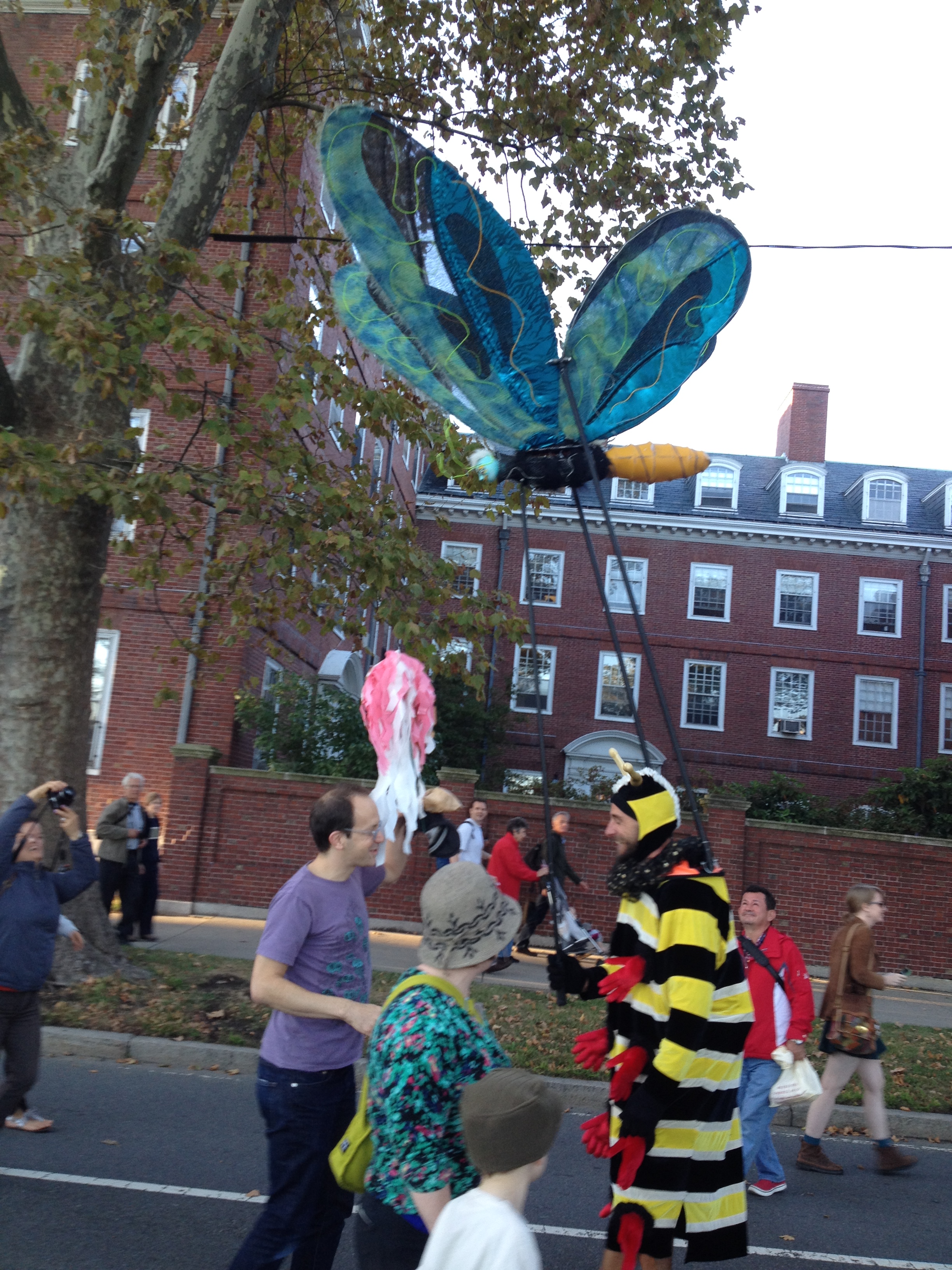
RiverSing was accompanied by large butterflies and other imaginative creations from Moonship Productions and the Puppeteers Cooperative. Here's one by daylight.
RiverSing is accompanied by large butterflies and other imaginative creations from Moonship Productions and the Puppeteers Cooperative. Here’s one by daylight.
And if you've ever wanted to converse with a butterfly, here's your chance.
And if you’ve ever wanted to converse with a butterfly, here’s your chance.
Once the sun goes down, the butterflies take on a new look as they swirl at the margin of the audience.

Best known for its 16 packed shows in Harvard’s Sanders Theatre each Christmas, Boston’s Revels organization also presents many other activities of community-enhancing music, theater, dance, and storytelling for family audiences through the year.

Each autumn, for instance, it welcomes the equinox with a free Sunday evening concert along the Charles River in Cambridge, which takes place tonight with activities beginning at 5 p.m. in Winthrop Park at Harvard Square. A police-escorted street procession leads down to the riverside, where thousands settle in for a two-hour high-energy performance.

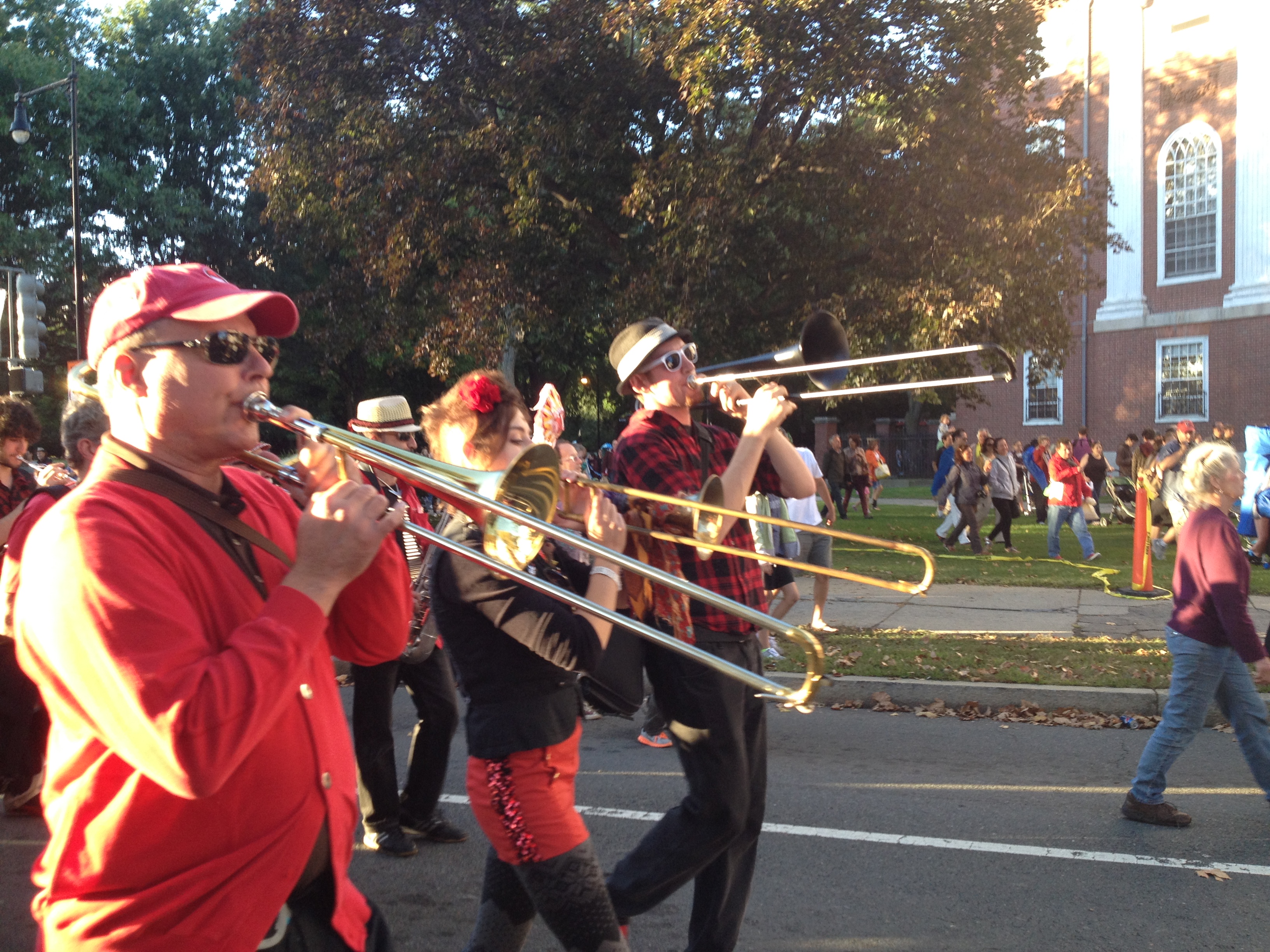
The marvelous Second Line Social Aid and Pleasure Society Brass Band played a lively set in Winthrop Park before escorting a large procession to the Charles River. I'll refrain from telling stories about the trombonist on the right, who I've known long before he even knew about trombones.
The marvelous Second Line Social Aid and Pleasure Society Brass Band plays a lively set in Winthrop Park before it escorts a large procession to the Charles River. I’ll refrain from telling stories about the trombonist on the right, whom I’ve known long before he even knew about trombones.

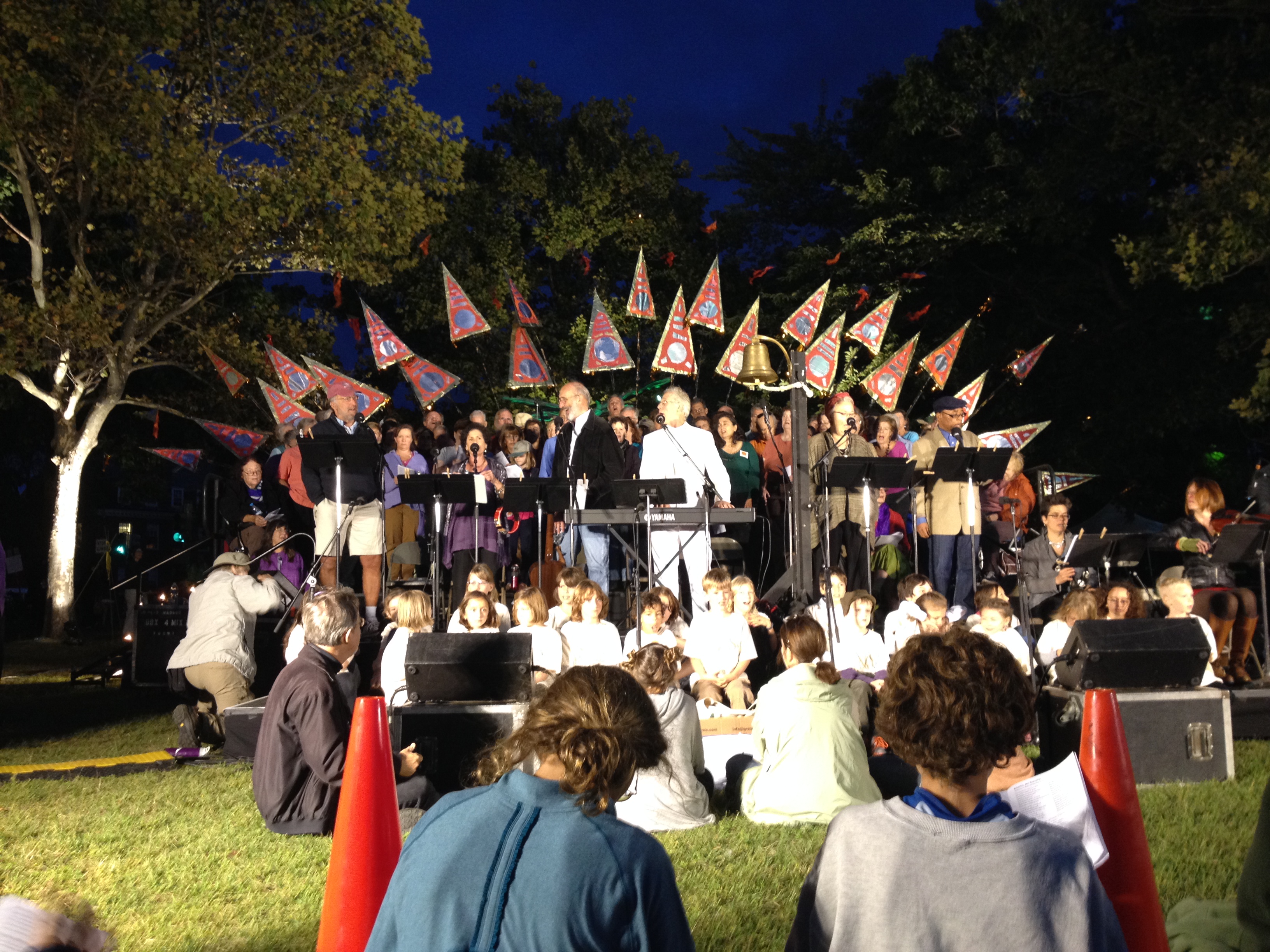
Last year’s concert featured Noel Paul Stookey of Peter, Paul, and Mary fame, and I was part of the chorus of 120 behind him. It was a blast.

Here we are, with Noel Paul Stookey beside conductor, arranger, and master of ceremonies George Emlen in the white tie-and-tails.
After the show, this puppet quickly filled with children.

The stage also provided some great views of the sunset and audience, which was ringed by glowing butterflies. It was a magical experience.

My wife took these photos with her phone. For some showing my face in the choir, though, go to the Revels site.

If you’re in New England, consider showing up tonight. The more, in this case, the merrier.

GEORGE AND MERTIE’S PLACE

As I said at the time …

You asked about my handle, Jnana. In essence, it’s Sanskrit for the spiritual “path of the intellect,” but that knowledge comes into fullness only when it finds harmony with the other forms of devotion – passion and compassion, physical labor, humility, charity, and so on. “Theoretical knowledge” misses the mark; rather, the name was given to me, in the ashram, only when I came to appreciate all the other spiritual gifts people have. Eliade calls it “the knowledge of ultimate realities” as well as “philosophy.” Perhaps “discernment” would be its equivalent in Christian practice. Whatever, I do tend to dwell in the mind and to dance in a field of ideas; I become grateful for those around me who help ground me in everyday applications.

Here it is, two months after hearing of your decision to shutter the place. (Hmm, was it a rooming house, bed-and-breakfast, or mountain inn? – so many possibilities!) Six years is a respectable run and for that, our gratitude and respect.

I once heard that before Caterpillar was launched, its editors had resolved that a journal has only three years of fresh insights to offer, and so they limited its life span to that – truncated, in my opinion, though I have my own theory of being in the public eye, which I first saw when I was pushing new comic strips and text features to newspaper editors: I see the “talent” as having a 10-year creative span – two years for readers to catch on to a new regular feature, and roughly five for a feature to start to take off in popularity; meanwhile, the artist/writer is using up the conceptual reservoir, so at five years the project is going into decline. You can tally your own list of television, radio, newspaper, or magazine projects that continued long after they had gone stale. (Of course, sometimes an individual will catch a second wind, but that’s another story.)

A year-and-a-half ago I stepped down as clerk of Dover Quarterly Meeting after a six-year term. That meant I had been presiding officer of a fellowship that met four times a year, gathering most of the local Quaker congregations in New Hampshire. (New England Yearly Meeting is the parent body, obviously named.) I was really happy to discover in the Book of Faith and Practice that limit to the length of service in any one post! It was long enough – I had initiated all I could.

More recently, I had hoped to be sending off some new material for you to consider. After a number of upheavals, of a positive sort detailed below, I’m back at writing again – got tied up, though, in some heavy-duty theological drafts rather than “creative” stuff. Things like why “Christ” equals Logos or Light more than Jesus, or why God wanted Adam and Eve to eat the fruit and why their expulsion from the Garden was not the cause of Original Sin, contrary to Augustine’s teaching. Who knows what those whackos in your neck of the woods would make of all that.

Your observation about the lack of time really hits home. It’s a disease or unease of today’s America – something that has received a lot of consideration in our Friends Meeting when we look at what we’d like to accomplish as a faith community, and then what we feel we can volunteer. Or when I debate whether to accept some OT shifts, which would help with all the bills, but decide instead to decline.

And your plans to move hit home, too. Guess the best place to catch up is just to cannibalize from the long-draft of my annual Yule letter from this past winter. Maybe some will resonate. If it doesn’t, skip!

BULLETIN TIME

So here I am, looking at a catalogue of “every Sunday bulletin subscription service and other ministry resources.” You’d be surprised by some of the products addressed to a Quaker meetinghouse, and I’m still wondering why church furniture has to be so uniformly ugly. This one, however, catches my imagination.

If you’ve ever been part of a congregation that has ushers, you likely remember how they hand out a leaflet while leading you to a pew. The folded paper would have a colorful image on the front and a meditative reflection on the back. Inside, mimeographed back in the days I remember, was the order of service and an array of announcements. I have to say that the graphics have improved in recent years, and I rather like the format that opens into three leaves, rather than two. For a moment, I consider this as an alternative to our announcements period, at least until I realize that someone would have to type and print them. Still, the thought of ushers revives my meeting’s concern for having greeters at the door.

As I look over the samples, however, I must admit how foreign most of them are to our experience. The one with a large American flag and a kneeling soldier over the words, Lord Jesus, is especially troubling. Others seem superficial with their platitudes or cliché. Maybe there would be shock value in some, with their communion cup and bread or photos of country church spires. One set proclaiming nature’s splendor comes close, if it weren’t for the cutesy texts, while the set I find most acceptable is aimed at black congregations – which isn’t quite us, either. Not with all our blue eyes and master’s and doctorate degrees.

I guess if we ever have a need of weekly bulletins, our best option would be to feature work by our resident artists – Brown, Carolyn, Connie, Edi, Gail, Jane … and, of course, the children. Now that would be inspiring.