THE IMAGE, AFTER ALL, OF A WRITER

As I said at the time:

I suppose every writer will have had an image of what an acclaimed author would look like. Maybe the impression comes down through a tour of one of those great hushed houses of history – Longfellow or Twain or Whittier or James Whitcomb Riley come to mind. Hemingway’s Key West, as well. Or from the book jacket portraits or a magazine interview or critiques. Then there are the novels and movies themselves about literary struggle and the inevitable success. So much for the myth – and myth it is, with the superhuman vision and divine blessing accompanied by the Guide’s intervention and the visitors’ awe. And just where does each of us place ourselves in its manifestations?

My own expectations have changed greatly. When I set forth from college, I still envisioned an urban life – a stylish high-rise or a federal era townhouse or a loft in some variation of Greenwich Village – accompanied by a suitable social circle. Or life in a quaint college town, as an alternative. Within a few years, though, I was willing to swap for a rambling farmhouse in the mountains or on a lake, with my studio set out on a ridge. Shades of Kesey and Kerouac, of course. All the while, however, I was employed full-time and trying to work in serious writing in my off-hours – the evenings and weekends while my colleagues were raising children, picking up overtime (“OT”) to buy the house and car of their dreams, going off to professional ballgames and rock concerts. My frugal sabbatical year changed the vision, and publication of my first novel delivered a hardened sense of reality. Now I realized how many writers with a string of books to their credit still drew their main paycheck elsewhere. When they met for lunch, the discussion was likely centered on mortgages, medical problems, and mutual friends rather than literature. I could still hope that a breakout novel might free me from the newsroom, but there was no guarantee it would suffice. There had to be a crack in the wall, of course, someplace, if I could only find it and break through. None of this has lessened the compulsion to write; if anything, that has intensified as I turned away from the management track and, thanks to Newspaper Guild union membership, could afford to live a modest life away from the basic hours at the office. (No more sixty- and seventy-hour workweeks.)

Now I imagine it intensified in official retirement. At the moment, I do not sense another novel in the works – not with seven or eight still awaiting a publisher, in addition to the volumes of Quaker history and spirituality, the genealogies, and the poems. So there is plenty of revision to do, plus correspondence and submissions. Perhaps there will finally be time to attend conferences and workshops, to travel, to give readings. I see it continuing where I am, in Dover, where I’ve established friends and community. Maybe the loft of the barn will be finished into a year-round space, as I’ve longed dreamed, but even that’s not necessary; now that I can access it via attic stairs, it serves nicely as a three-session rustic retreat with room to spread out papers and manuscripts. Besides, as long as the children are gone, there’s a bit more room in the house.

What has changed is that successful author has become simply an active writer.

~*~

And to that let me add, Thank God for Smashwords! As well as WordPress!


AN ARTS AND LETTERS NIGHT IN THE MEETINGHOUSE

In many Quaker meetings, we have little idea of what other Friends do outside of the meetinghouse. Maybe it’s simply an unfortunate consequence of contemporary life as we live and work at distances from one another and find our schedules anything but simple.

Bridging that gap remains a challenge, especially if we intend, in the words of George Fox, to “know one another in that which is eternal.”

At Dover Monthly Meeting in New Hampshire, we’ve chanced upon what has become an annual event that other members of the Fellowship of Quaker Artists might want to expand on. For four years now, we’ve had an annual Arts and Letters Night – an opportunity for individuals of all ages to share something of their creative lives with the larger faith community. For us, it’s usually come on a Friday or Saturday night in March – a time when we in snowy winter landscapes are ready to start stirring again. (Hopefully, when the worst of the winter weather is behind us.)

While Dover Meeting is large enough to have a number of serious artists of various stripes within its community, other Friends might find the idea to be something more suitable for Quarterly Meeting or a similar occasion. Like Meeting for Worship itself, each gathering has been unique.

Visual artists bring their work into the meetinghouse beforehand. Much of it goes up behind the facing bench (in the “elders’ gallery”), but other pieces have been displayed on easels or even been passed around the gathered circle. Work has ranged from painting to prints to weaving and textile crafts to photography to furniture-making and sculpture – including one child’s Sculpee creations. One year, an attender ran home to bring back examples of commercial designs she was doing for paying customers – and her work was indeed impressive.

We’ve encouraged these pieces to be kept on display through Meeting for Worship the following First-day, so that everyone may have an opportunity to view them – or even revisit them.

The “letters” part of the equation has had Friends reading publicly from their original poems, short stories, or journals – or from pieces they’ve found especially moving.

We’ve also had music – ranging from one violinist’s performance of the “Meditation” from Thais to original songs – as well as children demonstrating their Tae-Kwon-Do martial arts patterns. Lately, we’ve had videos, including one a Friend had made for Public Television showing another Friend doing sculpture – three decades earlier.

Depending on the length of the readings and performances, there may be time to go around the circle, discussing what inspires and motivates us in the work we pursue. Questions seem to arise spontaneously.

And afterward, we’ve enjoyed repairing to the “culinary arts” – a dessert potluck with tea or coffee.

So it’s one idea. An easy program. One Dover Friend has taken on the responsibility for signing others up – and I’ve the pleasure of being emcee and reading a few of my own poems at the end. We arrange it all through our Ministry and Worship Committee, though it could fit under Pastoral Care as well. (We split our Ministry and Counsel several years ago, to lighten the load.) In any event, do what you want with this proposal. As I said, it’s an easy program.

Invite the public. Invite the news media. And then have fun.

Originally published in Types & Shadows:
Journal of the Fellowship of Quakers in the Arts,
No. 34 Fall 2004/Winter 2005


OUT INTO THE WORLD OF READERS

Poking around in the barn, as it were (actually, it was several folders in my computer, if you insist on being accurate), I wound up reopening collections of my poetry – and to say I’m astonished by their range, variety, and depth is not a matter of boasting. You’ve already sampled some of that here in my postings, not all of it “finished” work, either.

At the same time, as I survey the literary scene today and its opportunities, I’ve decided to issue as much of it as I can now (while I’m still ticking) rather than continue to seek piecemeal publication.

The upshot has been the resurrection of Thistle/Flinch editions, my personal imprint, as a free bookstore venture here on WordPress. Each month, it’s offering a new work as a PDF file to read on your computer or print out to paper.

In some ways, it’s like tucking a print shop into a corner of the barn. I rather like that image.

As an introduction, may I suggest:

Returning 1Or the rocky shores of my latest:

Winged Death 1

Hope you enjoy what you find there. And as always, here’s to happy reading.


THERE’S NOTHING EXALTED ABOUT THE ‘WRITERS’ LIFE’

Not infrequently, fellow bloggers will begin a post by apologizing about not writing for a spell. The fact they feel they have to apologize bothers me. Nobody’s obligating any of us to produce, and we all have regular lives to pursue, or at least lives we ought to engage. After all, that’s where so much of the grist for writing originates.

Besides, there’s no shortage of good reading in the blogosphere. Take a rest or catch up, and feel good about. Heavens! If we need anything regarding the written word, it’s more conscientious readers … ones who will encourage a wider audience for deserving work, especially.

Somewhat related, and just as disturbing, are the giddy proclamations of joining in the “writers’ life,” as if it’s some carefree club out there free of everyday obligations and cumbers. Maybe they’re envisioning the legendary Dorothy Parker and her Algonquin Round Table, or even the martini named after her, or some other crossroads in literary history, but let me proclaim that’s largely an illusion or mirage, especially in today’s publishing reality.

It’s one thing to be a casual writer and quite another to be a serious practitioner, and for the latter, the only shared lifestyle I’ve seen is a dedication to hard, daily work that includes not just writing but research, reading, and correspondence as well. It’s not glamorous, for sure, and in the current literary scene, you won’t get famous. Not compared to any of those so-called celebrities.

So if you must, then write. And then, because you must, revise repeatedly.

And if you aren’t so obliged, then read … for pleasure as much as anything. And maybe that’s where you’ll really find the “writers’ life,” one you might even share with others over coffee or cocktails.

Now, for me, it’s back to work. And thanks for listening.

FEED THE BEARS NO MORE THAN YOU MUST … AND THAT GOES FOR MOOSE, TOO

There are good reasons, of course, for the resemblance between bears and people. But it’s smart to respect the difference.

Still, they have their role in the poems of my In a Heartbeat poetry volume. As do moose and whales.

Here's the cover.
Here’s the cover.

This 35-page echapbook is available free from the Barometric Pressures author series at Kind of a Hurricane Press. The trail to your own copy opens here.

JUST PAGES APART

As I said at the time …

For me, writing means watching my own shifting mind while opening myself up to all the living energies around me. It means simplifying, following unexpected leadings and openings, sometimes to dead ends, other times to unanticipated ranges. Some time ago I discovered that to write poetry I had to be sitting in meditation every day. And later, I found once a week would suffice.

If ego is an ever present trap, the practice can introduce repeated humbling. As do the rejection slips.

Detachment: who wrote that! And when? (The surprise of rediscovering your own work five or ten years later. Who wrote that, it is so incredibly fine! Or: Who wrote that piece of tripe? I’m glad it never saw publication. Sometimes only pages apart.)

And then the piece goes its own way: a living organism: readers, editors see it differently from you. What you would cut they love. What you love they see as sore thumb.

What we’re most fond of is likely to be what bothers others the most; what we’re about to toss out in the next revision may be what is most effective with our readers. (Point raised, I believe, by Joyce Carol Oates; true to my experience.)

As critics of others’ work: harshest, at times, on those whose work is most like our own! Too much mirror? Push ourselves as far as we can, coming to a point where we no longer know if a piece is any good or not only that we’ve done everything in its pursuit that we possibly can at this period in our life.

Prophetic practice: light in the wilderness.

The dilemma of arts/responsibility/spirituality brought into focus by looking at something like the Florentine court of the Medici: High Art interwound with brutal political/economic force. (Throw the man out the fourth floor window; nowadays, we have helicopters. How exquisite.)

The dilemma of the news photographer: Should I save the victim and lose the opportunity of taking a great photograph? Or should I be “professional” and observe the world as an outsider? This holds for all artists: at one point are we being selfish in our pursuits? At what point is our solitude essential for the well being of all?

Into solitude / the Silence / the Holy Now, as Thomas Kelley phrased it.

At its core, I write to discover / remember / connect / distill.

In my writing I collect – that is, bring myself back together. More and more, I think on paper. I write to find what is under the words and phrases before me. Go deeper, and then wider. I write to listen. Eventually, I write to sing.

NO NEED TO APOLOGIZE

Whenever I come across a blog that begins as an apology for not posting lately or even being on hiatus for a few months, several thoughts spring to mind.

The first is simply that there’s no need to apologize. We’re not short of reading material here in the WordPress network, for sure. Nobody’s holding you to those deadlines, and we’d certainly rather have you back with something good to report than to have you mindlessly keyboarding.

The second thought, though, has me reflecting on my own approach to blogging. Rather than constantly being fed by current activity, the Red Barn and its sisters draw on my deep files of writing and, more recently, photography. That’s allowed me to plan ahead and schedule their release in a timely manner, sometimes even spiraling pieces from decades ago and now.

But now that has me wondering. Is that cheating?

Or is it just another example of the maxim, “Age and cunning will beat youth and ability every time”?

ENGAGING THE POWERS AND PRINCIPALITIES

Like it or not, practicing an art means wrestling with power, including, in St. Paul’s phrase, the “powers and principalities.” Powers of destruction, on one hand, and sustenance, on the other. Destruction that can, as we’ve seen too many times, include the artist. Hence, the fascination with Faust. With madness. Alcoholism. And on. Self-absorption and inflated self-importance rather than humble service.

We hazard much, often without the slightest awareness of the risks afoot. For the Christian, these involve Satan’s dominion over “the world,” which includes the realm of the arts; in Asian teachings, we can turn to the traps of Maya, that spider web of worldly attraction and deadly illusion. Either way, cause to be wary. Need for disciplined faith. Yes, let’s introduce something we’ll call Satan, just to thicken the drama.

Which raises an ancient point of conflict for a Christian artist: I’m not at all sure art is a proper activity for a Quaker. Through much of Friends’ history, most of the arts were considered superfluous and dishonest engagements taking our attention away from true worship. “We Quakers only read true things” is the way one expressed it while returning an unread novel to a neighbor.

Yes, “we Quakers read only true things,” or used to. The exclusion of not just fiction but theater and paintings and sports as distractions from worship. Traps of the flesh?

And yet: discipline is essential in spiritual growth. Self-discipline, route to true freedom. And where is the mind without imagination? I continue to read and write fiction and poetry. I love symphonies, string quartets, and opera. I’m a baritone or occasional tenor in four-part a cappella singing. When I practice my art, I am fed by this love/compulsion/infusion.

So we’re back to the ways and spirit in which we engage the powers and principalities, and the ways we order our lives.

TIFFANY?

From the pews in the sanctuary, the five stained-glass windows over the altar appear curiously bland in contrast to the two vast arrays to the left or the rear. Only if you cross into the chancel and catch a glint of sunlight might you sense something quite different is at hand before you.

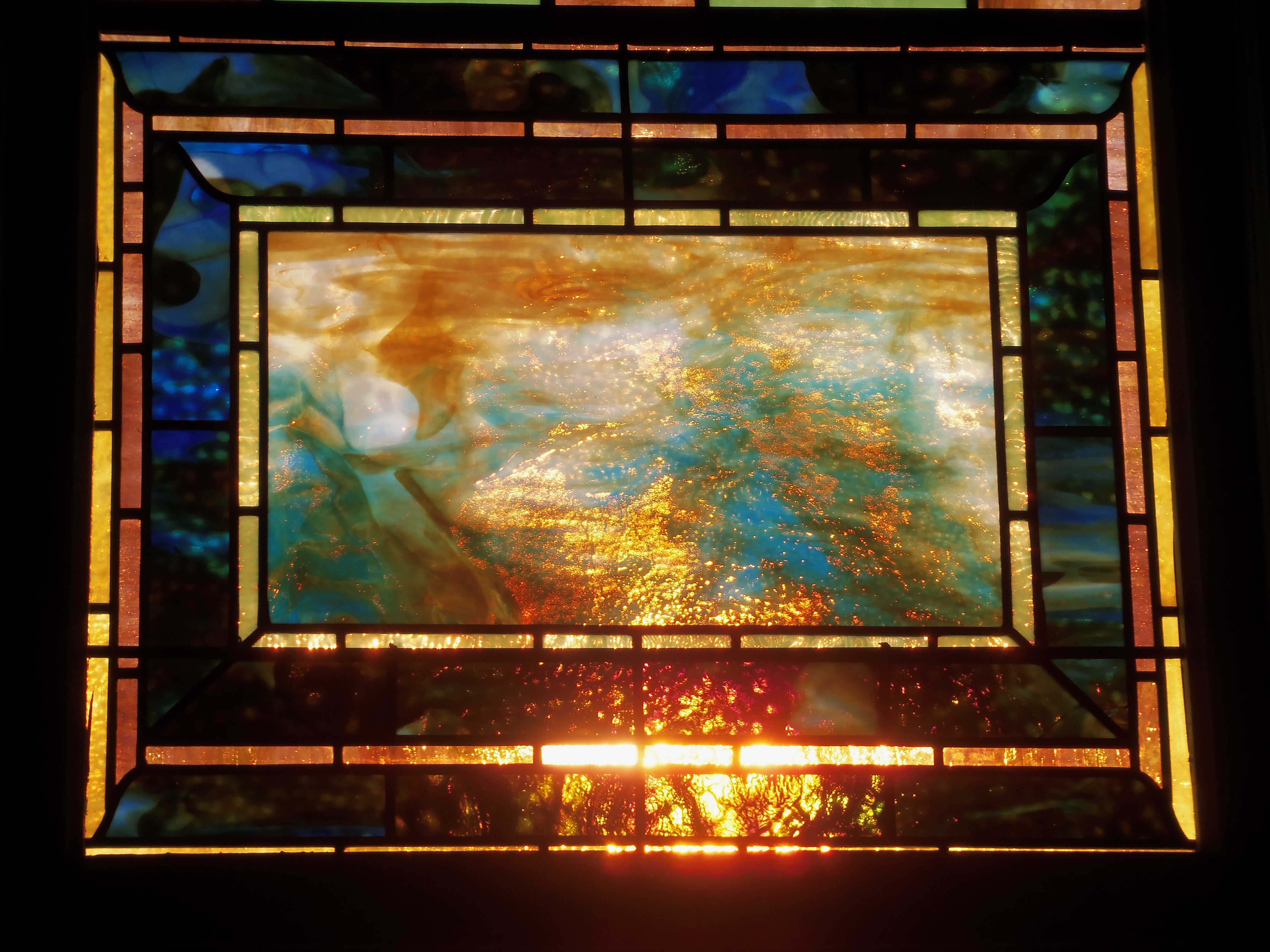
That’s how I first noticed that unlike traditional stained glass, none of this set had been enhanced by paint. All of the color was in the glass itself, yet there were no muddy patches where colors overlapped, as might be expected while mixing pigments. Some of these resembled Impressionist painting or bookmaker marbling. Moreover, when direct sunlight hit some of the pieces, the color blazed with gold or copper or fine jewels.

Look at that gold blazing.


A little context.
A little context.

Could it be? I’d heard that one reason Louis Comfort Tiffany obtained such incredible effects in his work was that he used such materials in his glass. For starters, the only way to get a gold color is to use gold.

As I started to seek documentation, some fascinating connections appear.

As it turns out, the Tiffany Glass Company and its successor, Tiffany Glass and Decorating Company, created thousands of ecclesiastical church windows. Many of these were designed and executed by his studio, rather than Tiffany himself, but they would nonetheless bear his stamp and influence.

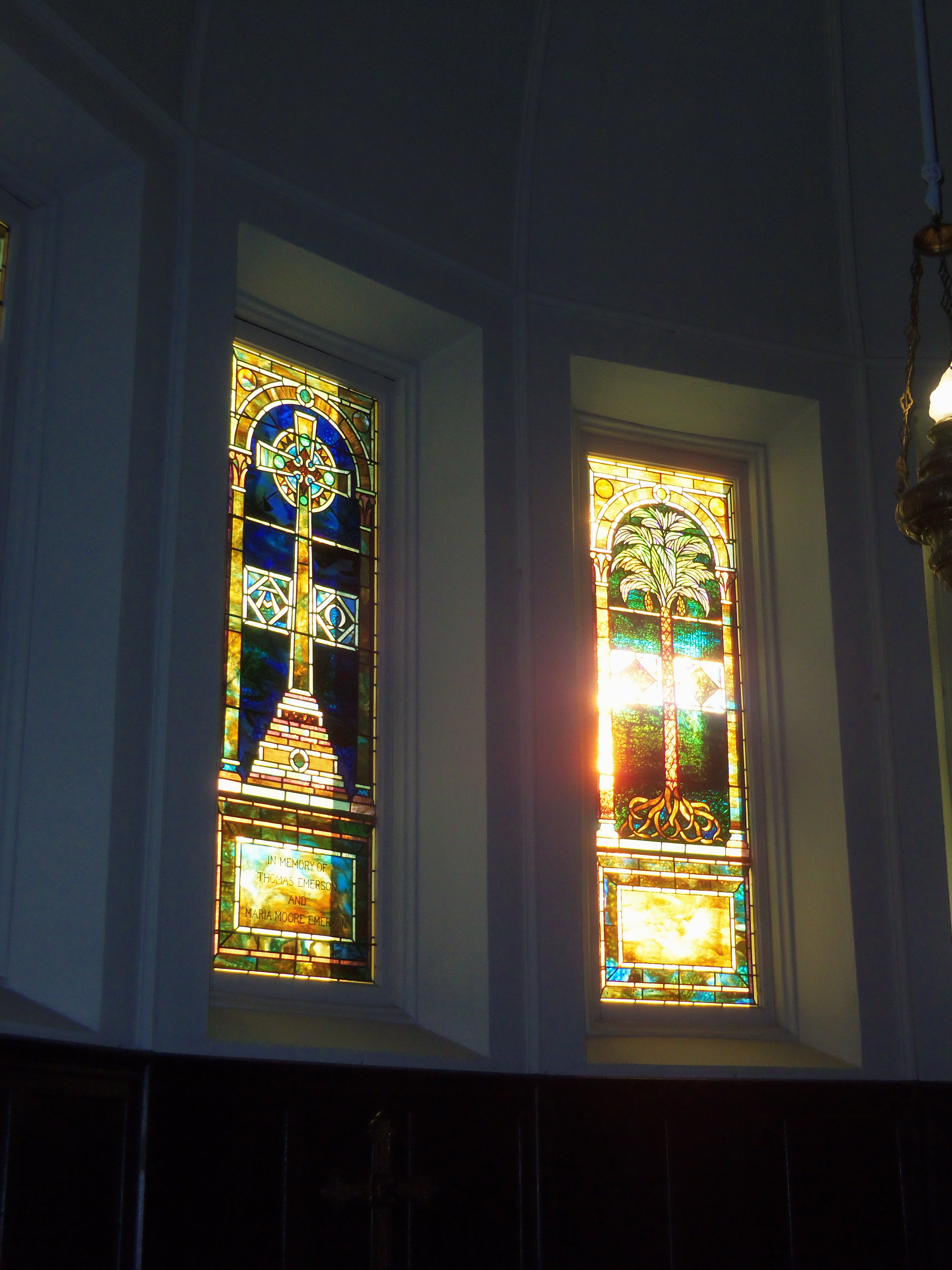
Tiffany’s 1890 Hay Memorial at Emmanuel Episcopal in Pittsburgh presents some striking similarity to the set at the 1895 St. John’s Methodist in Watertown, Massachusetts.

A simple design.
A simple design.
Such a range of colors, shifting with the light.

Both are narrow arched windows with greenish bottom panels ringed in copper tones. The central cross resembles the crosses at Watertown. And the mention of Tiffany’s love of exotic Oriental painting and his travels in northern Africa might explain the two Watertown windows dominated by palm trees.

The Watertown congregation originated in 1836 in the Whitney family home, and they remained active supporters at the time the 1895 stone building was erected. Their David Whitney Jr. relocated to Detroit as a young man, quickly became that city’s wealthiest resident, and built an 1894 mansion that still features its elaborate Tiffany windows.

Finally, I run into the pastor as he’s leaving his office. I pose the question, “Tiffany?”

“Technically, no.”

“His studio, then?”

“Yes.”

Regardless of the creator’s name, these five windows are marvelous, especially when struck by sunlight. Unfortunately, their placement on the west side of the building means the Sunday morning worshipers would not get to view them at their best.

Vespers, anyone?

Three of the five windows around the chancel in late-afternoon sunlight.

CHURCH WINDOWS

I’ve long joked that our Quaker meetinghouse has the prettiest stained-glass windows in town. That’s because they’re clear, looking out to the hardwood trees surrounding the grounds and all of the seasonal changes. The colors are those of snow and ice, spring greening, fog, mist, rainfall, autumn foliage. Admittedly, the new synagogue, with its view over a hillside to forest beyond, and the Methodists, at the edge of a millpond, can make rival cases. I’ll plead to being partial.

Crucially, though, transparent windows remind us of the world beyond the house where we sit in worship, a reflection of our awareness that our faith is a constant part of our various daily life activities. They remind us as well of the powerful rhythms of nature and God’s creation.

On the other hand, most congregations – including the Evangelical United Brethren of my childhood – gather within rooms of filtered light cast by stained-glass designs. I was puzzled by it then, and remain so today. Yes, I know the colored windows of the great medieval cathedrals were illustrated storybooks for the illiterate populace, but what I encountered always felt second-rate and often mildewed. Few individuals, I suspect, could say much of anything about the event being depicted or express any understanding of the decorative filling. Pointedly, the translucent windows cut off any view beyond the room. Perhaps the intention is to create a holy space – one set apart from normal life; perhaps, too, this hints at eternity as a departure from the landscape we know. But a shady or even creepy quality always seemed to lurk in the shadows. This is, I will note, quite different from the icon-based frescoes of Eastern Orthodox custom.

Apart from a few December afternoons at the National Cathedral in Washington, when I finally experienced the dazzling sunlight through the windows and recognized how Rose windows earned their esteem, my encounters with stained glass were few and fleeting. That is, until late one afternoon last year when I arrived early for our weekly chorus session and stepped from the room where we rehearse, crossing into the sanctuary on the other side of the sliding shutters. The square vaulted room is dominated by two imposing displays in traditional style – painting, essentially on pieces of colored glass that are then leaded together. Something about these, though, suggests quality sustained by wealthy donors. The impressive room has demanded closer investigation.

If the late 19th century brought about a flowering of stained glass in America, it was also a time before the spread of public art museums. Windows like these, then, would have been art made available to all for their wonderment.

The south wall of the sanctuary is dominated by this traditional design, which includes a row of named angels along the bottom.
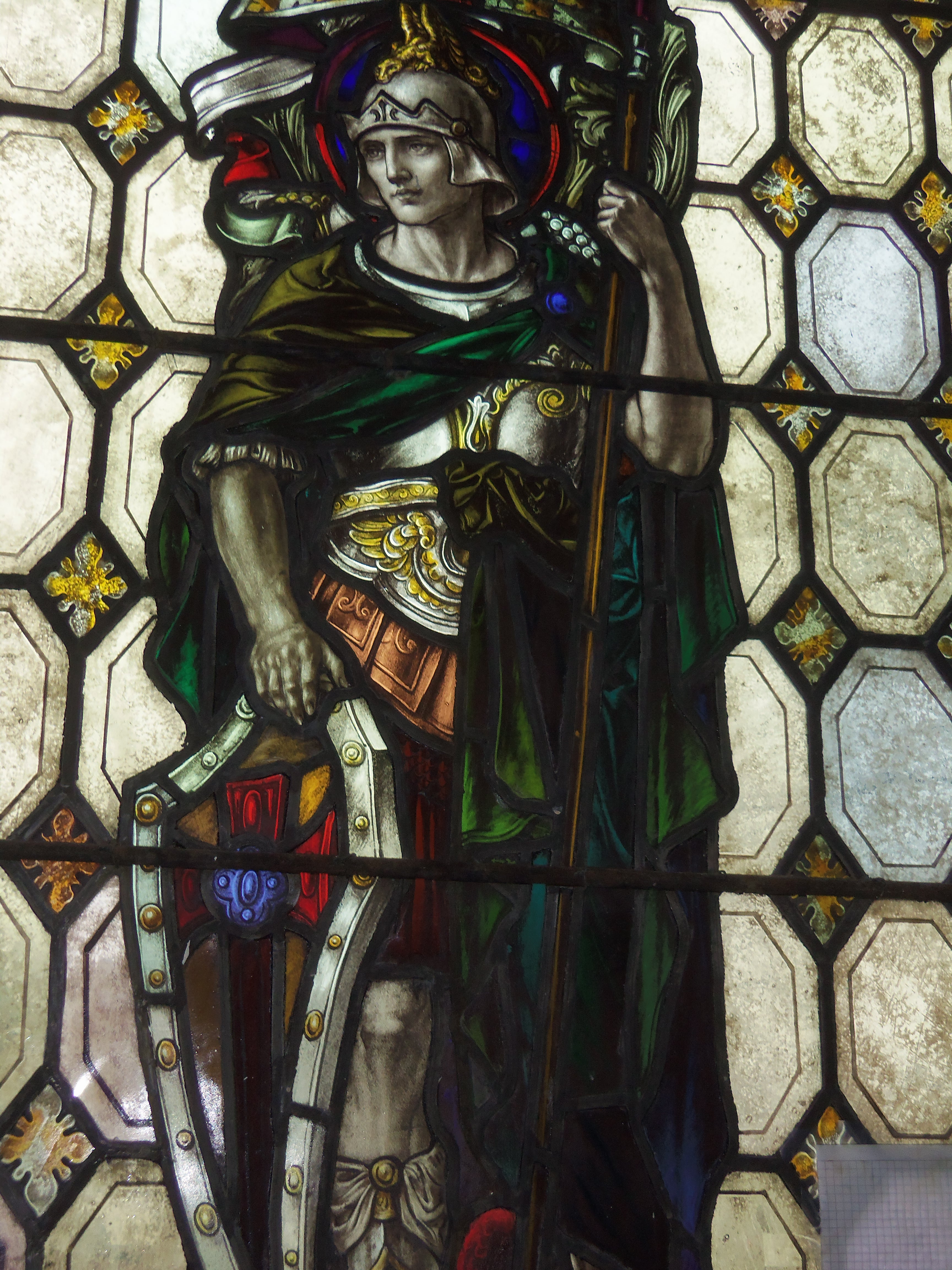
A detail of one of the angels.
A detail of one of the south windows.
Traditional stained-glass style using cut pieces painted with enamel.
A decorative window in a social hall where our chorus rehearses.