Embracing my sunny side

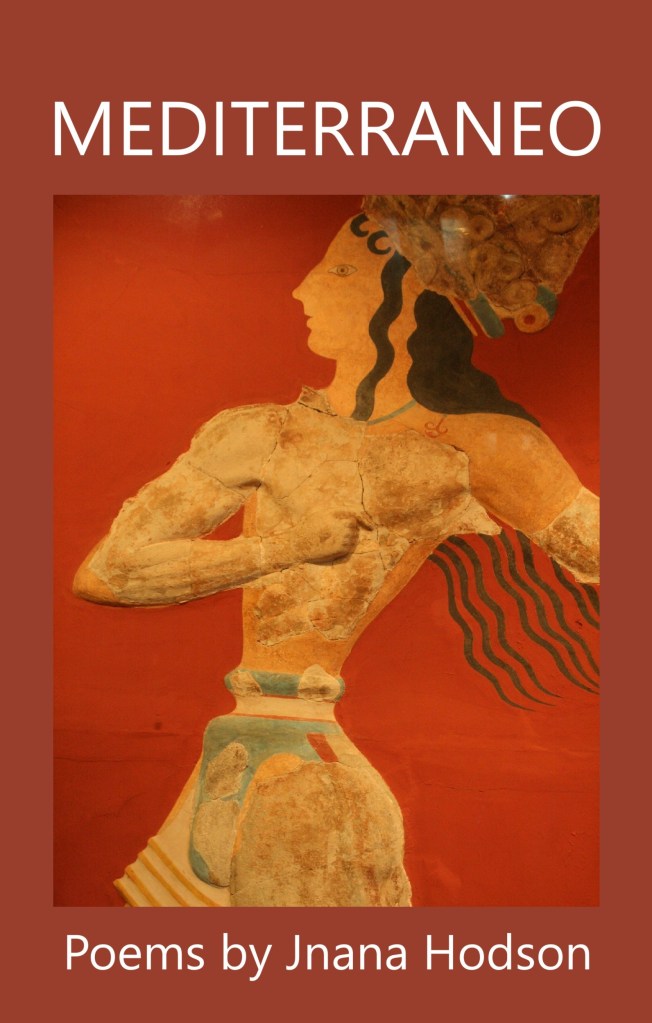
Let’s celebrate the publication of my poetry ebook Mediterraneo this week.

As a series of poems, this book was a turning point for me. My earlier poetry had been mostly of the nature or love genres.

Here I focused on Western culture itself, through places around the Mediterranean Sea. It was someplace I’ve never visited, though it’s had a huge impact on my artistic and spiritual outlook. What I have known comes through artworks, literature, philosophy, operas, insights from my daughter and wife’s travels and those of my goddaughter and friends and even Greek Orthodox dancing and liturgy as well as ancient Hebrew scriptures. Put them all in the mixer, then, and see what we can distill.

It’s quite distinct from my ultimate roots in the British Isles and Germany.

When I created these poems, I had not yet relocated to a remote fishing village on an island in Maine after 20 years in the Seacoast region of New Hampshire. The climate is colder than the Mediterranean’s, for certain, but the light of the sun does reflect off the sea and back into the sky, magnifying the luminance in a way that attracts artists, as it does in many of the locations in this homage to the cradle of notable classic faiths, cultures, and cuisines. I do miss Greek dancing and related dining. The ability to see whales from shore or deer in my small-city yard do offset that.

The Mediterranean is much larger than I had supposed. It would reach from nearly one end of the United States to the other, yet also spans so much more diversity.

While I’ve never been to the Mediterranean, much less Egypt, and never out of the country, for that matter, excepting pockets of Canada, all the same, I’ve flown places in my imagining, and some convey some underlying kinship.

Barcelona is one of those. Seemingly far out of my northern nature, this Latin complex of sensuality, color, and Roman Catholic devotion also harbors a stubborn independence, under its ostensible domination by others. Spanish, but not Spanish. Catholic, and yet in a historic realm of heretical lay movements. A passion for the musical dramas of Wagner, accompanied by industry.

Perhaps my genetic line does run, as a marker suggests, from northern England to the border of Spain. Uncork a red wine, then, and sit in my Smoking Garden on a summer late afternoon. Muse on a line from on friend or other while listening to an opera broadcast.

Consider Pharaoh’s descent, the ways the culture of ancient Egypt anchors one corner of the Mediterranean. Was there another anything like it, in its mindset or visual conception?

Or the pervasive smell of camels with their wave-like gait as they nearly sail from the southern shore of the Mediterranean and on deep into the interior of north Africa. In many ways, it’s their land more than man’s.

Or the continuing influence of Greece and its blinding sunlight, scented with lavender and sage, spills over the the culture we inhabit, sometimes with an air of longing

So much ancient history is filled with brutality and revenge, lusts and conquests. Especially, we would venture, around the Mediterranean and its sea.

The Italian Renaissance, with its lush reds and golden adornments, leaves its mark on the imagination. What would Europe be without it?

As for Minotaur in the Ring, with strokes of Picasso, don’t overlook Barcelona, the fifth most populous metropolitan area in the European Union. Some say the port city was founded by Hercules, which would fit its fierce spirit. It even lives its own language, despite Spanish rule. And then there’s its unique style.

They’re all energies in these poems.

You can obtain the collection in the ebook platform of your choice at Smashwords.com and its affiliated digital bookstore retailers.

What’s left after ‘What’s Left’

Every writer has to face the question of knowing when a particular work is done, as in finished and ready to release.

The problem is that there’s always more that could be added or refined. Writing is, by definition, imperfect. In fact, the vaster the ambitions of a novel, for instance, the more imperfect it will be. Visit the critical examinations of the great novels Huckleberry Finn and Moby-Dick as prime examples.

The decision finally comes down to the line where the work releases the writer. The obsession burns out. You’re exhausted and feel you need to move on. You’ve said all you can say. You’ve discovered just about everything of relevance you can on the subject. For some writers, I suppose, it’s like the end of an affair.

For luckier ones, it’s when the editor or publisher demands the manuscript, ready or not.

~*~

I’ve previously posted on how my novels percolated over time. There was the sabbatical year I gave myself in Baltimore, where I lived off my savings and armed myself with a new personal computer with 5½-floppy disks (for you high-tech geeks with a knowledge of now ancient systems) as I poured myself into keyboarding rambling manuscripts in the search of publication.

When my savings ran out and I returned to the workaday world, I kept picking at those seminal drafts, usually on vacations and holidays. Other efforts at more marketable books also got attention and even a few nibbles, but in the end, none of them panned out. Working full-time, I simply didn’t have the additional open periods required for successful self-promotion.

I’m glad I didn’t wait until retirement, as so many others I’ve known did, to start writing those novels. The details and intensity would have evaporated. Instead, retirement played out in a different way and the novels did finally find publication.

My one fully new book was the one that grew into What’s Left, though it did start with piles of outtakes from the earlier novels as well as other material.

As I’ve also previously posted, it did eventually lead me to thoroughly revise and reissue those earlier novels.

The result is that I have eight books of fiction available today, and I am proud of them, even if they haven’t found wide readership or critical acclaim. Not that I wouldn’t welcome either.

~*~

I am struck by how much has changed for me in the seven years since then, some of it a consequence of the shift to digital writing and publishing. I don’t require as much space for files, for one thing, or for research materials and correspondence. What can be found online with little effort is amazing, as I discovered while writing Quaking Dover. I hate to admit I no longer keep a dictionary or thesaurus at hand.

Downsizing to our remote fishing village at the far end of Maine four years ago meant that I no longer needed a studio in the attic. A corner of a bedroom sufficed for some pretty heaving writing and revision.

It’s a far cry from the dream I once had of remodeling the top of the red barn into a year-‘round studio that included a custom-build semi-circular desk with me sitting in its center – something like the copy desks that were common to many newsrooms.

No need for that now, not even at newspapers.

~*~

The task for me now turns to cleaning out remaining files, both digital and physical, that are no longer needed. I don’t want to leave that mess to my wife and kids later.

One thing I’ll confess is that I doubt I have another novel up my proverbial sleave.

~*~

You can find my novels in the digital platform of your choice at Smashwords, the Apple Store, Barnes & Noble’s Nook, Scribd, Sony’s Kobo, and other fine ebook retailers. They’re also available in paper and Kindle at Amazon, or you can ask your local library to obtain them.

The hardest prompt: a love letter

You’d think these would be the easiest, most natural thing on earth, except that they usually wind up being 99 percent cliché and hot air.

Besides, how many times and ways can you express the dirty stuff, if you dare?

(And be prepared to back it all up in person.)

Really!

In addition, the audience of one can be the world’s most demanding, no matter how fond of you they are.

Even more difficult, add to the assignment something I heard a writing prof say, quoting another one: Never revise a love letter.

Nope, let it gush forth.

~*~

For further humiliation, there was an instance when I was living in the ashram and writing a reply to a beloved’s epistle when several of my fellow yogi residents came up and grabbed my effort, grimaced, and declared, “If I received that, it would be the end of the relationship.”

Those girls were so full of helpful insights, as you’ll find in my novel Yoga Bootcamp.

~*~

Well, I’ve never been good at pickup lines, either.

~*~

About a dozen years ago, I had a spree in the loft of our old barn when I went through the remaining letters to me from girlfriends and lovers over the years.

Earlier ones had been helpful when I was drafting my novels Daffodil Uprising and Nearly Canaan. What jumped out at me in this round was their underlying unhappiness apart from me. It didn’t make for a good give-and-take in a relationship. No wonder things didn’t work out in the long run.

The time for the ritual burning was way overdue. It took longer than I would have guessed.

~*~

More recently I came across some surviving letters written on computer, some of them that were then sent by the postal service and others that went by email.

The ones I wrote now embarrass me. As for theirs? A gentleman won’t say, though they reflect a long search for a fitting relationship that never panned out, like panning for gold. My, all the hours I spent writing those and reading the responses!

Once more, though, a purge is overdue.

We could get into a discussion regarding the intimacy of handwritten letters versus legibly typed ones, though that’s largely moot now that the exchanges have shifted to emails and cell phone texts. That topic deserves its own conversation. For now, let me say that the playful back-and-forth with my now wife via America Online when we were getting to know each other is woven into my Prelude & Fugues poems available at Thistle Finch editions.

~*~

Back to the advice about never revising a love letter. I find it useful as an ideal for other kinds of personal writing, too. Just let it pour out, best as you can. Not that it usually proves so easy.

Yeah, yeah, I fall back heavily on the revise-revise-revise emphasis elsewhere, along with the adage, “Talent goes into the first draft; genius comes in the revisions.”

Still, some of those love letters gave rise to the poems in my collections Braided Double-Cross, Blue Rock, and Long-Stem Roses in a Shattered Mirror (upcoming).

Let me add to that the only time – well, just about – that I face the dreaded writer’s block is when having to come up with something spiffy on, say, a get-well card. Like the ones they used to pass around the office. I know of a truly major writer who agrees with me there. Maybe sympathy cards are even worse. You can’t go with “Miss you” there, and nearly everything else is so trite.

~*~

One final concern I’ll raise while we’re circling around the topic involves what would we say to each other now, all these years later. At one time, I tried to find out, thanks to Facebook. It wasn’t encouraging. Some who had been hot on my end barely remembered me.

And while I had tried to be conscious of their objections or potential feelings of hurt in reading the fictional accounts of our lives, I finally had to realize they never read what I had written after our breakups or differing directions.

Ouch! Most of them I missed more than they did of me.

Sound familiar?

~*~

You can find Braided Double-Cross in the digital platform of your choice at Smashwords, the Apple Store, Barnes & Noble’s Nook, Scribd, Sony’s Kobo, and other fine ebook retailers. You can also ask your local library to obtain it.

Quakers, the New England town meeting, and more

One of the items I wish I had pursued more openly in my history Quaking Dover is the evolution of the iconic New England town meeting from its origins in the Congregational churches of Puritan faith, as a means of collective church governance, and then into a more secular democratic ideal.

The presence of Quakers (Friends), with their unique decision-making that achieved unity without taking a vote, would have been pivotal in this evolutionary step both before and after the Revolutionary War.

A town moderator, presiding over the session, and a Quaker Meeting clerk share a number of commonalities in their efforts to balance the voicing of alternative positions, where all are heard equally and respectfully, at least ideally.

Quakers also realized that a minority position, even a single person, could be closer to the Truth than the majority was. Resolution of the differences could lead to a superior synthesis, done right.

A fuller history would be informative.

I do suffer through public meetings that don’t have that underpinning, especially when it comes down to a clash of egos or power plays or showboating.

Nevertheless, there are clues in my book suggesting that the Quaker minority did temper Dover’s town decisions, sometimes humorously.

~*~

Another point that would welcome further research by a dedicated historian would be the three volumes of Dover Meeting minutes dealing with male Friends who enlisted in the American Revolution, contrary to Quaker pacifism as a matter of faith and faithfulness.

It was a struggle, with no guarantee that the new government would recognize the hard-won religious liberty that Friends were finally enjoying.

~*~

After publication of Quaking Dover, I became aware of the influence of the Scottish prisoners of war who were brought to New England after the battles of Worcester and Dunbar. Like the West Country fishermen who settled before the arrival of the Puritans, the Scots became a subculture in the region, embodying a different culture and set of folkways. It seems to have been a factor in the Bean family of Dover Friends Meeting.

Again, it’s another history that needs fuller treatment.

~*~

Reading a history by someone else dealing with details you’re familiar with can also be disturbing.

For instance, Nathaniel Philbrick’s bestselling Mayflower has no mention of William Hilton and his family, who were instrumental in a scandal involving the Reverend John Lyford, an Anglican priest in the Plymouth Bay colony who baptized a Hilton child contrary to the rules of those we call Pilgrims, or more properly Separatists. The plot thickens with the introduction of John Oldham and events leading up to the Pequot War.

The picture takes on a different perspective when you’re concerned with what was happening north of Boston.

William Hilton headed off to Dover, where his brother Edward had already built in what would become the third oldest permanent settlement in New England.

~*~

Leaping ahead two centuries, I’ve had to ask myself if someone else with Dover Quaker roots, John Greenleaf Whittier, was America’s first great polemic poet.

Not just a forerunner of Robert Frost but Allen Ginsberg, too, in fact?

~*~

Quaking Dover is available in paperback through your favorite bookstore or as an ebook in the digital platform of your choice at Smashwords, the Apple Store, Barnes & Noble’s Nook, Scribd, Sony’s Kobo, and other fine ebook retailers. You can also ask your public library to obtain it.

Let me repeat my fascination with subways

I doubt that I’ll ever get back to New York City in my remaining years. Even Boston seems like a rarity, though far more likely. Yet let me repeat my fascinating with subway trains and their tunnels.

And Manhattan was, after all, the center of publishing, including best-selling novels.

Tackle that from the perspective of where I live now, where the year-round population would fit on a single subway train. Add the flush of summer people and vacationers or even the cruise ships that visit and it still wouldn’t add up much more. Some of the visiting cruise ships would be like three or four trains arriving and totally discharging for a stroll around the village. A hiccup, then, in comparison to a Manhattan underground station.

My playful novel Subway Visions, grew out of my encounters in the Big Apple way back when.

As I once noted, growing up in a Midwestern city that was too small for rail mass transit, or maybe it was from an intellectual awareness of underground as a conduit of counterculture and spiritual wisdom, subways came to define a Big City for me and to symbolize the range of possibilities present therein. A subway transit system separates cosmopolitan from lesser cities. The trains are filled with real people – a cross-section of the populace between many diverse origins and destinations. As an underground, subways also present counterculture and surrealistic currents many of the riders fail to consider. Here, then, were snapshots from that route.

Later, with my wife and kids, came our outings in Boston and its MBTA.

Or my favorite Dover lifeguard’s revulsion and disgust after relocating to Beantown for college and having a drunken passenger vomit on her sandals on a hot, crowded platform.

So much for my perception of a carnival air.

Still, I think of subways the way I think of rollercoasters, even with our small downtown of boutiques, less pressured than the subway station settings of much of Boston.

Just how do those cruise ship passengers view our village, anyway?

You can find Subway Visions in the digital platform of your choice at Smashwords, the Apple Store, Barnes & Noble’s Nook, Scribd, Sony’s Kobo, and other fine ebook retailers. It’s also available in paper and Kindle at Amazon, or you can ask your local library to obtain it.

Dreaming of literary success versus the reality

Working in the thralls of daily newspaper journalism in the heartland was not my dream. Literary fame was. Of the critically acclaimed sort, as if bestseller status would follow.

Whoa, expressing that so boldly feels harsh, yet true. Even so, I did plod away on both fronts.

And now? I’m a survivor wondering what would have resulted if I had narrowed my focus.

I had no idea how crassly market-driven the shrinking book-publishing world was. So much for idealism.

~*~

Still, I pursued, working on my own into the wee hours.

These days, I have the luxury of revisiting my earlier work and wondering just who wrote it. The pages are so unlike what I’d venture today – wilder, for sure, and more profuse, often leading to an Oh-Wow! of admiration. The dross, fortunately, has been stripped away.

That’s been my reaction in presentations at our monthly open mic night here in town even when I’ve veered toward the edge of embarrassment yet still being warmly applauded.

Passages in both my prose and poetry make references I no longer understand but trust to leave untouched, perhaps for others to reconnect.

Writing? It’s like talking to yourself, ‘cept sometimes you have to get up to allow the rest of you to reply.

~*~

Another recent experience has come in assisting a friend to create a remarkable novel, one he finally presented to a literary agent whose thoughtful response seemed quaint, actually – the perspectives of three people in the agency, even though no. Somebody actually has time these days for such reflection?

It really did feel like an earlier era. I was rather envious.

~*~

I’m also recalling another experience after I had returned “back east” and was reading an essay about Snyder, Whalen, and Kerouac in the North Cascades, I felt sharp pain, knowing the lookout stations and High Cascades were so far behind me and the rest of my generation.

~*~

Add to that the fear of being discovered once your early book approaches publication. How strong are you in its potential storm?

Except, that you instead encounter indifference.

~*~

It can lead to bitterness, considering all the years and lost potential.

As for inscriptions at book signings?

Keep the faith!

Share your Light, too!

Like a boat, a book is launched

That image seems especially appropriate as we celebrate the appearance today of my newest collection of poems, Ocean Motion, now available in the ebook platform of your choice. Yes, let’s envision a book floating on the water like a boat.

For much of the first half of my life, the concept of an ocean was incomprehensible, even more so than mountains.

As I’ve noted earlier, I grew up far from the seashore or even craggy ranges like the Rockies or Alps. The Great Smokey and other Southern Appalachian glories were a bit closer. I didn’t encounter the ocean until I’d reached adolescence and we visited Florida on a camping trip with some of Dad’s old Army Air Force buddies. I next saw surf my senior year of college, with my then-girlfriend and her parents. From there, my encounters went to a few times on the Staten Island ferry or other points in New York City or Long Island, and then the ferry rides in Washington state, a few days camping along the Pacific (recorded in my American Olympus book), a jaunt along the Oregon coast, and then Maryland, New Jersey, and ultimately New England, plus a few returns to the Gulf Coast of Florida.

In all of those, I faced an enigma, a recognition that I didn’t quite grasp its appeal. Something was missing. It was like a gray Lake Erie looming with whitecaps I had seen around age seven, except that there was something else called tides. It was water with nothing else but sky on the horizon.

The pace of my encounters picked up, especially once I moved to New England, nearly half of my life ago now. Having a boss who owned a 32-foot sailboat fostered some of that, especially when we ventured forth once or twice each summer from Newburyport, Massachusetts, or once from Portsmouth, New Hampshire – both notoriously treacherous harbors.

As I describe in one poem, my first time of being in a sailboat was also my first time out on the Atlantic and my first time of seeing whales (including a minke that surfaced only feet away from me) and my first time of setting foot on an island, one that was now a Unitarian and Congregationalist churches summer retreat.

Those experiences all infuse these poems.

Moving to Dover, as I remarried, picked up the pace. The tides reached downtown, after all, and Great Bay along one side. Plus, with the kids, we got to visit Maine beaches and Cape Cod at their grandfather’s. And later, picking up one after her work at a coastal motel, I had repeated exposures to the ocean at midnight, another world altogether. I wouldn’t say it was romantic, even with a full moon.

The resulting poems eventually appeared in small-press literary venues around the globe as well as a series of PDF chapbooks at Thistle Finch editions.

As these poems demonstrate, the more I’ve gotten to know ocean as the North Atlantic along New England, the more in awe I am. Other writers can express the ocean from their own locale and nuances.

Still, I have come to love lighthouses and do treasure opportunities to climb up within them to savor the view from the top. But don’t get too romantic, it was a harsh, often dangerous, life for the keeper and his family. I hope these poems reflect that reality and more.

Do note that New England thrived on seafaring, designing and building distinguished vessels along its forested shores and sailing them around the globe to Asia and elsewhere and then back or out to hunt whales. The memories are imprinted in the muscle and soul of its people.

Remember, tides rise and fall dramatically in New England. You learn to be alert, even wary. And, do note, I’ve learned so much more since I first expressed that.

One of the ocean chapbooks included in the final collection was titled “Land Overlaps Sea,” an outlook that still impresses me, considering that it’s actually the other way around. The poems in the collection reflect places close to where I lived at the time and ways they interact with the Atlantic. It has been quite instructive over the years, even for an old landlubber like me.

Meanwhile, bits of sea shanties – the chanted or sung work ditties of sailors over the years – muffled and muted by the wind, flit through background, even if you don’t quite catch their words.

While the poems reflect a period of my life before moving to a remote fishing village at the far end of Maine, what I’ve encountered since confirms my impressions.

Maritime historian and sea chanter Stephen Sanfilippo and his wife, Susan, have definitely added much to my comprehension, as have my new friend, Captain Robert J. Peacock, and my times out on the waters, especially week-long cruises aboard the historic schooner Lewis R. French, as you’ve been seeing here.

~*~

So here we are, with my thought that each new volume is akin to the space within a vessel:

a book launch
rather than release

BOOK
BOAT

the connection floats for me
my experience on the water flows everywhere

For my poems of the sea, check out Ocean Motion at Smashwords.com. You can find also find it at the Apple Store, Barnes & Noble’s Nook, Scribd, Sony’s Kobo, and other fine ebook retailers. Or ask your public library to obtain it.

So why did I write poetry?

A poetry editor a decade or two ago asked why I write poems, and in response I came up with this:

I’ve been writing poetry and fiction for so long the questions of “how” and even “when” and “where” arise long before any consideration of “why.” That is, the practice quickly turns directly to “just sit down, start keyboarding, and see where it goes.” Even so, my “why” quickly turns to a succession of motivations within an evolving exploration that continued to present itself as poetry. So here are some of my primary Whys along the way:

  • Because it sustains expansive dimensions of language and thinking that have been precluded from my employment as a newspaper (and, briefly, social sciences) editor, where expression is intended to convey a single layer of factual presentation.
  • Because it allows me to pursue wordplay, surrealism, ambiguity, innuendo, absurdities, but especially my own emotions and experiences that are forbidden in objective third-person writing. (Intentionally or otherwise, my literary endeavors have worked as a reaction against and counterweight to the strictures of professional journalism, the way a pianist might balance classical and jazz or country-western performance.)
  • Because it has kept my skills as a headline writer sharp and pliant.
  • Because it collects and distills the seemingly random wanderings of my Aquarian mind and my often-obscured impressions and feelings.
  • Because it reflects the intuition and clarity that arise in my practice of meditation.
  • Because revision, a crucial element of writing poetry, pushes me beyond linear narrative to a more mysterious matrix as I looking between the cracks and broken syntax to admit other voices to appear.
  • Because it allows me mythologies for exploring and celebrating places I’ve lived and people I’ve known along the way. (If I’d taken more photos during all those years, would the drive have been lessened?)
  • Because it immerses me in a long stream of poets, troubadours, singers, storytellers, mystics, prophets, and shamans before me.
  • Because it’s a kind of prayer.
  • Because it keeps me looking at the world around me with an awareness of gratitude and wonder.

Well, that’s what I wrote at the time, and the editor fired back with a round of questions I didn’t have time to answer. Way back then. I have no idea how I would answer now. I do hope it would be less ethereal.

What is poetry, anyway?

After a couple dozen or so years that have been focused largely in the revision of fiction and then the roots of Dover Quaker Friends Meeting, itself a challenge to conventional New England history, I’ve found myself revisiting my trove of poetry.

It’s part of a big cleanup project that’s accompanying our downsizing move from New Hampshire to the far end of Maine, and I’m at a point of trying to discard everything I no longer need and put in order anything else I feel is of value.

As a result, several central full-length collections that had been presented piecemeal as chapbooks at my Thistle Finch editions blog are now released as ebooks at Smashwords.com and its affiliated digital bookstores. You’ll be hearing more about those as the year progresses.

In their place in the Thistle Finch lineup are new chapbooks of sets of my more recent poems, meaning ones from this century, though their origins go back further.

The task has come as a revelation, watching the evolution in my style and underlying voice. Each stage, reflecting geographical moves in my life and the upheavals of my closest relationships, edged me away from narrative-driven content to increasingly image and confetti centered clusters. Don’t ask me to explain them, they just are, whatever.

For me, poetry is a kind of mysticism – one foot in the inexplicable wondrous, the other in everyday life. Prose, of course, is more secular.

My newly released chapbook Aquarian Leap leads off the new run at Thistle Finch. Frankly, looking back over these, I’m not sure what to make of them other than the wild energy they inhabit. I certainly wouldn’t – or couldn’t – draft them today.

These poems, in some manner, still reflect the working of my multi-layered, mercurial thought process. (Never mind my heart, all the more elusive and often contradictory!) I love those lucid moments – sharp, brief – when everything, including thought and emotion, is centered, full, and stilled. Rarely, however, does my intellect flow in such a focused narrative. That requires more effort.

More typically, it flashes on something and then leaps to another, seemingly miles away. Some say this is characteristic of my natal sun sign. That is to say, the typical Aquarian will hear one subject and shuffle through fifty-two logical connections in a flash, and then blurt out something that will leave everyone else in the room wondering, “Just where did that come from?” (Except, perhaps, for another Aquarian, to whom it will seem perfectly logical.)

Often, my writing was constructed and amplified and then distilled from notes, many of them scratched out on a daily commute or on a hike in the woods, or sometimes even a twist while journaling. Curiously, when I assembled these into collage-poems, I was conscious of an underlying logic. That is, many snippets did not fit the emerging sense and must be laid aside. But a few others did, leading to what I hope is an internal thesis/antithesis/synthesis that’s ultimately beyond any surface or attempted cleverness. I prefer for my work to discover and uncover rather than invent.

The result in this set and a few ahead feels more like confetti. So there!

Something similar happens in disciplined meditation, such as traditional Quaker worship, where routine thoughts are patiently laid aside while one’s awareness clears and sinks to a more intuitive and integrated state. Perhaps some of that also infects these pieces.

I should confess to a few works by two poets, G.P. Scratz and Aram Saroyan, I’ve long admired, poems that defy explication or understanding yet spring from the intuitive burst that takes us beyond apparent meaning – and closer to a jewel-like condition.

Or even the freedom of dancing, which I find in a similar vein in the work of Philip Whalen, especially.

Consider the linguist’s Wolves and Consonants. (My reading of “Vowels” in a book title my elder daughter was reading.)

The growling of wolves adds a whole new way of following the Voice here.

As for any effort to define poetry itself? I guess I prefer the wilder side. Go figure.

You can find Aquarian Leap at Thistle Finch editions.

On to the Pacific Northwest via the prairie and Ozarks

My second brace of fiction, ultimately three books in all, addressed the dozen years in the aftermath of the hippie outbreak, though I’ve tried to fudge the era precisely. I do think much of it is continuing.

Naturally, for me, they were semi-autobiographical, even though the protagonist is now a woman named Jaya who winds up with a much younger lover who becomes her husband.

The pivotal piece is Yoga Bootcamp, with her now as a central character, along with the guru they sometimes called Elvis or Big Pumpkin. My residency in the ashram was a transformative period in my life, even in the face of details I’ve since learned. We were a rogue outfit in the period when yoga took root in America. This down-to-earth story will probably scandalize your local yoga studio instructor, but the experience did reshape many of our lives, hopefully for the better. I’ve certainly carried many of its lessons far through some other faith traditions.

The central piece is now compressed into Nearly Canaan, originally an ambitious triptych that comprised the hefty novels Promise, Peel: As in Apple, and With St. Helens in the Mix. At the outset, a sense of place was central as Jaya relocated from a small town on the prairie in the American Midwest to the hardscrabble Ozarks to the apple orchard country in the desert of the Pacific Northwest, but the central theme now condenses as the question of how much influence one person can extend over others, hopefully for the better. I can ask now whether it would have been more compelling if she’d been conniving and manipulative.

The third book, The Secret Side of Jaya, is a set of three novellas, each one set in the places she lived after leaving the ashram. Each one, quite different, is premised on hearing and seeing figures in a locale that others don’t. Maybe you encounter them, too, where you are.

You can find these books in the digital platform of your choice at Smashwords, the Apple Store, Barnes & Noble’s Nook, Scribd, Sony’s Kobo, and other fine ebook retailers. They’re also available in paper and Kindle at Amazon, or you can ask your local library to obtain them.