Well, in the right hands.
Category: Arts & Letters
Hey, Figaro!
How is it the young Figaro, in “The Barber of Seville,” is so worldly-wise, especially in the ways of attracting women, while a few years later, in the “Marriage of Figaro,” he’s so confounded by the Count’s moves toward his own beloved? And, oh, yes – what happened to all that business savvy?
Well, it was a French theater comedy series originally. One obviously without a continuity editor.
I’ll give the author, Beaumarchais, some slack, since he was busy on many other fronts. And give him lots of credit for knowing how to cut satirically to the quick.
We make our own
About that feminine point of view in my novels
Why a young female as my protagonist? Fair question. Since my novel What’s Left began as an attempt to answer a younger generation’s questions about the hippie movement, I felt a girl would be more receptive to its issues and sensations. Many girls have, after all, continued the identity, while it appears that boys have largely become more militant or even sullen.
As the novel developed, Cassia’s parents and their values retreated into the background. Far more compelling is Cassia’s own identity, development, and confrontations. Hope you agree.
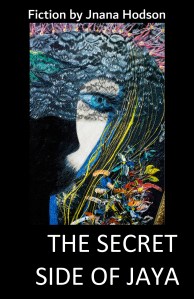
My new series focuses on Jaya and her evolving awareness. Yoga is part of it, along with career issues and close relationships. She has a richer encounter with the events, I’d say, than Joshua does – there are many points where he’s largely a reactive or passive presence. Ultimately, The Secret Side of Jaya has no parallel in his more limited vision or imagination.
I have to confess the story didn’t start out to be told from her side, but it does feel much more fitting this way.
But I am speaking as the author. Readers and critics are open to their own takes.
Care to weigh in?
Looking for a word that means ‘wisdom’
I was trying to find a word in Spanish for “wisdom,” one conveying spiritual depth.
Instead, what I came across in the dictionary related to factual intelligence or knowing. All head, no heart.
Nothing even suggesting common sense or good judgment.
What I wanted went deeper, say to the kind of understanding gained through long experience and discipline. Sometimes, the kind of knowing you feel in your hands.
Better yet, what Merriam-Webster calls “the natural ability to understand things that most other people cannot understand.” To which I would add a sense of calm and patience.
If the word or phrase exists in Spanish, I’d love to know it. Perhaps even with a few other things that get lost in translation.
On the road less traveled
Many know the Robert Frost poem, “The Road Not Taken,” but few know of its underlying Puritan foundation, expressed in Daniel Read’s 1785 shape-note hymn, Windham, based on lyrics by Isaac Watts. As the first stanza proclaims:
Broad is the way that leads to death
And thousands walk together there;
But wisdom shows a narrow path,
With here and there a traveler.
Frost, in contrast, has none of that grim Calvinist view, one that leads the next stanza to open, “Deny thyself and take thy cross,” and builds to a closing plea, “Create my heart entirely new, which hypocrites could ne’er obtain, which false apostates never knew.”
I can say that singing Windham in a choir is a rigorous experience. And, my, it feels incredible to bite on that final phrase, self-righteous though it can be.
Others can debate which piece better expresses New England terroir, but in contrast to Frost and his leisurely stroll in autumn foliage, I’d say the ideal embedded in the hymn remains the road less taken. Winter here is a much, much longer season than the fleeting falling of leaves..
Uncovering alternative takes on real history
Textbook versions of history gloss over a lot of details, especially when it comes to the lives of common people rather than the powerful and rich. The biographies of great figures add to that top-down perspective.
One of the things I love about genealogy, especially in nonconformist traditions or ethnic subcultures, is the way it opens alternative understandings of the hopes, dreams, and struggles of life outside of the spotlight.
I look for it in fiction, too, as well as poetry.
My own novel What’s Left springs from that kind of investigation from a Greek-American experience. My new The Secret Side of Jaya adds three other takes from the agricultural prairie, the Ozarks, and finally Native American strands.
Maybe histories aren’t always told by the victors. Not if you look closer or take a longer timespan.
Are you an ebook reader?
Now that I’ve been posting about some of the ebooks I’ve been reading, I’d like to hear about your experiences in digital browsing.
Are you among those who are books sold in digital formats, which now fill a fifth of the market?
What platform do you use? Kindle, I assume, is most likely, but there are more? What do you like or dislike about the various platforms?
What are your reasons for going digital?
I have to admit I still love paper and typography, but the economy and lack of clutter in ebooks have their appeal. So, yes, how about you?
I’m still fascinated by the potential of stories that come out of subways
Millions of people ride the subways each day, and many of them read English. In fact, you’ll see many of them are deep into books as they’re transported. Yet I’m surprised how little writing reflects this experience. Where else can you see so much humanity sitting right in front of you or dashing past?
Well, my Subway Visions tries to convey my experiences, real and imagined.
Two significant nonfiction books are Jennifer Toth’s 1993 The Mole People, based on her year of reporting on the plight of the homeless people who took to living in the tunnels under Manhattan in the Reagan years, and Jacqueline Cangro’s The Subway Chronicles, a collection of essays by the likes of Jonathan Lethem, Francine Prose, Calvin Trillin, and Lawrence Block. By the way, Block admits a fondness for including subway scenes in his prolific output of novels.
My survey of ebooks at Smashwords has added others to the list, not all of them in New York City. One tells of a year playing music in New York’s stations. Another of collecting umbrellas in Tokyo. There is a fondness for seeing the underground as the gates of hell, with one volume in particular standing out as a masterful fantasy that’s meticulously researched.
To see what I’ve found and my reactions, go to the reviews at my Jnana Hodson at Smashwords page.
Got any related transportation books to recommend? Trains, buses, airplanes? Other?
Now for a rash of Covid novels
Word on the street reports that with all of this downtime, wannabe novelists have turned to the No. 1 topic of conversation as their prompt, and already literary agents and editors are turning off at the first reference to coronavirus.
My take? Besides the fact a reader can devour only so many volumes, even if interested?
I think it’s too early to tell the story. We’re only in the opening round of this affliction, which was supposed to drop off in the face of warmer weather. Only it hasn’t. Let’s see what happens around the corner, likely the real whammer come September.
Though, as one writing buddy suggests, that first book could be the beginning of a series, if you do it right.
 Jnana's Red Barn