Making a public presentation is a two-way affair

Feedback for an author is a vital part of the equation. Reader responses and honest reviews are more than essential feedback, they’re affirmations that others care about the subject and labor. You’re no longer alone. And often, you learn things you might not come upon by mere research.

As I found one more time, to our mutual amusement, when presenting some Maine aspects of my Quaking Dover book as a local writer in town, one early Maine family that’s spelled Treworgy is pronounced TRU-wurjee.

More or less.

Well, it was originally Cornish, by way of Devonshire, and came up to this end of the state from being among the first settlers down at the other end, right across from Dover Point.

Beyond that, writing and reading are ultimately one-on-one, despite the anonymity of the reader, who may be deeply touched personally, all the same.

That’s why it’s so meaningful when you speak up.

Looking forward to another open stage night

Here’s a shoutout to our monthly open stage at the Eastport Arts Center at 6 tonight or, if the weather’s bad, the same time tomorrow.

It’s always a lot of fun, alternating live music and spoken word. I even tried a section from Quaking Dover last month, instead of poetry or fiction, and some found my reading emotionally moving. I did bill the genre as creative non-fiction rather than history. Well, there are no footnotes and I’ve focused on the overall story and people more than mere names and dates. The reaction has me looking at additional opportunities for presenting the work.

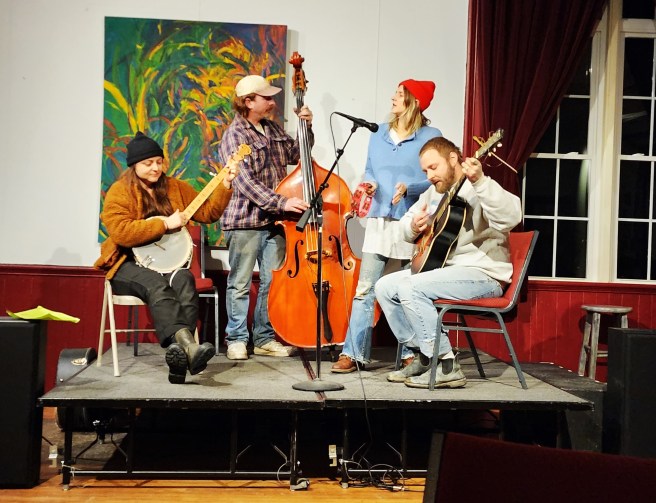
Here’s one band that showed up, and I’m hoping they’re back. They do look quintessentially Maine, and you can imagine their joyful sound.

The free event’s billed as “open mic” but I’ve long hated that spelling of “mike,” even if it’s become too widespread to counter.

Still, we had a fine turnout and went an hour longer than planned. I’d be really surprised if you wouldn’t be wowed by at least something. There’s so much talent around here.

‘It’s all fiction’

As my new book came together in its revisions, I began to feel some parallels to John Baskin’s 1976 New Burlington: The Life and Death of an American Village, a non-fiction opus based on what was then the new field of oral history.

The village he examined was largely Methodist and Quaker, the latter having come en masse from South Carolina as their rejection of living in a slave-holding countryside. In fact, when they relocated as a Quaker Monthly Meeting, they carried their treasured minute book with them and continued their records in Ohio.

His book became something of a classic and was even excerpted as a popular series in the Dayton Daily News.

While relying heavily on quotations from his sources, he did knit the interviews together with some heavy interpretation on his part. And here I was, becoming an active narrator in the action in my own work.

My book, as it stands, is heavily influenced by what I’ve learned writing fiction, in addition to my lifetime career as a newspaper journalist. I view the result as a story.

More to the point, when Quaking Dover came out, one longtime friend asked me if it was another novel. I bristled, I think, “No! It’s a history! Non-fiction!” While also thinking, “Didn’t you read the description? What did you miss?”

~*~

I am trying to remember the first time I mentioned Baskin’s book, probably in a Quaker circle in another part of the state, and hearing the response, “It’s all fiction.”

Huh? It seemed pretty solid to me, and the asides on Quakers were rather informative for a newcomer, as I still was then.

A decade or so later, visiting family back in Ohio, I ventured off to worship at the New Burlington Quaker church, which had rebuilt out by the highway after the village had been flooded by the U.S. Army Corps of Engineers.

At the close of the service, I was asked why I chose them rather than the more silent Friends in nearby Waynesville. Well, I had worshipped in that historic meetinghouse years earlier but, as I replied, I enjoyed visiting other branches of the Quaker world. And then I added, “Besides, I have the book.”

A moment of awkward silence struck the circle around me before the oldest person, a woman perhaps in her early 90s, softly pronounced, “It’s all fiction.” Obviously, they all knew what I meant by “the book.”

Oh? I was in no place to argue and accepted her verdict as literary criticism. In some ways, I took it as advice, not that anyone knew I, too, was a writer. Those of us in the news biz were already treading on thin ice in too many ways.

Still, as I retold the encounter to a reliable bud, he inhaled sharply and noted, “That’s strange. It’s the same thing Aunt Cecille said. Her words, ‘It’s all fiction.’”

Well, she did live in a town only a few miles up the road, one where the local Friends church had recently petered out. She, too, had Quaker roots and community creds.

~*~

As a journalist, I can relay one fine reporter’s observation that he knew he was on course with a controversial issue when he found both sides of the story were upset. Not that I want to go there. Still, I do know that we humans have a hard time accepting our own shortcomings and follies and that we view events through our own lenses.

I should add that Quakers, as a whole, write a lot. It’s a crowded field.

How crowded? The primary Quaker history journal takes this stand: if a book hasn’t been vetted by a peer review panel of historians, it’s taking a pass.

As they did on mine.


I’m not the only one around here hungry for more

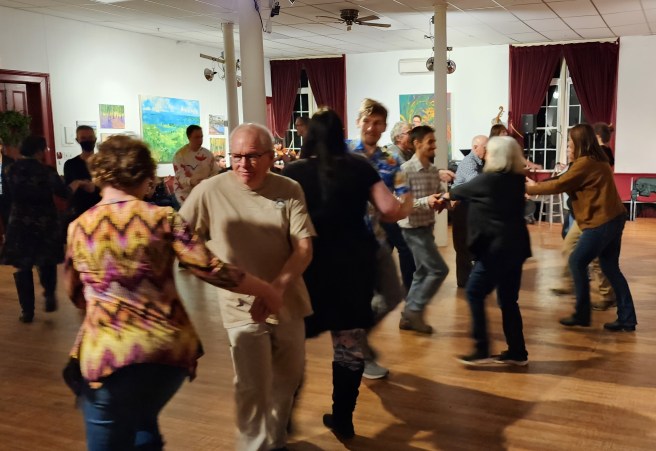
Last month we had our first indoor contradance this far east in Maine since the outbreak of Covid, and it was a blast.

I’ve posted before about the New England tradition from colonial times, which hippies then spread around the globe. Not that you have to identify as one to attend. Let’s just say free spirited?

A typical contradance is something for all ages and abilities, singles and couples alike – you do mix during the evening – and the live music is reason enough to come out for a substance-free environment. As we say, if you can walk, you can dance. Besides, a caller has us practice the figures, as they’re termed, before the music begins. It’s a great community-builder, for sure. A great way to meet neighbors of all kinds, or even a potential mate, if you’re unattached. It’s low-pressure, OK?

The whole point is to have fun, mistakes included. Just keep smiling. As I tell the newbies, we experienced dancers make just as many mistakes, mostly because we’re too busy talking.

Our dance last month had mostly beginner dancers, and they were delightful. I’m hoping and expecting to see them back Saturday night at the Eastport Arts Center, bringing a few friends in tow. Frankly, that’s how we all got addicted to this activity, word of mouth with an invite, or even being dragged, as I was, to show up.

Not that you need that much to enter the door.

Remember, just keep smiling.

Seems the concept is related to rebels

As I drafted a recent post agonizing over the future of Boston Revels – and by implication, other performing arts organizations – I found myself pondering the origin of the reveling tradition itself. I kept mistyping “revel” as “rebel,’ only to learn that the two words share a common origin. Aha!

Surprise?

A online little research soon led to the Inns of the Court in England and Wales – places that were both a kind of law school and a professional association as well as lodging for members – and to their elaborate entertainments and wild parties that included a lord of misrule.

Suddenly, I was connecting to Thomas Morton and his Merrymount settlement in early New England, something I discuss in detail in my Quaking Dover book.

I’ve long been aware of an irony in the Boston Revels esteem, knowing how alien a Christmas or Midwinter celebration would have been to the city’s Puritan founders, even before getting to any riotous misrule. Now the plot thickened through an awareness of the way Morton was persecuted and his colony forcibly destroyed by Myles Standish at the helm of the New World neighbors.

Today’s family-friendly holiday Revels shows are greatly sanitized from their Medieval forerunners that would have been presented any time between Halloween and Groundhog’s Day – Morton’s big celebrations were for May Day, a seasonal stretch adding yet another pagan dimension.

Moreover, their ancient roots reveal ways English law was independent of the church, diverging the church courts that ruled in continental Europe. The Inns of the Court also nurtured Elizabethan theater and their revels are mentioned in Shakespeare.

Could they even be the source of a rebellious thread in our laws and courts? Or at least of what passes for drama and theatricality therein?

Joyfully uncovering a few more musical masters

So much of the classical music scene focuses on revisiting a core repertoire of masterpieces and their composers. Ideally, that leads to deeper understandings and discoveries within the most inspired scores, although superficial repetition and familiarity are more common. Even so, it is exciting when new faces are admitted into that circle. Within my own lifetime I’ve seen that happen with Mahler and Vivaldi, as well as to a lesser extent with Charles Ives.

Adding to the excitement is the reality that the repertoire is no longer exclusively dead white (European) males.

Americans, north and south, are gaining recognition after having long been excluded, though it should be much more. From a more global selection, so are women and people of color.

Sometimes, a composer can embody all three, as is the case for Florence Price (1887-1953). A substantial portion of her surviving work, discovered and recovered in 2009 in her abandoned summer home, is only now gaining an airing and a growing admiration. This Little Rock, Arkansas, native was, it turns out, the first Black American woman to have a symphony performed by a major orchestra – Chicago – and her style has a lightness that blends her own roots, the America of her time, and classical expectations. As a choral singer, I can attest to her unique touch underpinning the scores we’ve performed.

Among other Black composers finally gaining overdue attention, let me mention:

Julius Eastman (1940-1990), an eclectic, genre-crossing American trailblazer whose tragic life included seeing his own works largely scattered to the wind when he was evicted from his apartment and officials threw his possessions out into the street. What remains of this Curtis-trained original is well worth exploring in its large, provocative vision of time, space, classical, jazz, pop, politics, sex, and utter wonder.

Edmond Dede (1827-1903), a New Orleans-born Creole who lived much of his life in France as a successful pianist, conductor, and composer. If he sounds a bit like toe-tapping John Phillip Sousa, remember he came along a generation earlier. He emerged from a lively scene of free Black classical musicians in New Orleans who even had their own symphony orchestras. As far as serious music in America goes, only New York seems to have had more going on in the years before the American Civil War. Don’t overlook this when you’re thinking of the origins of jazz, either.

Joseph Bologne, Chevalier de Saint-Georges (1745-1799), is remembered as a man of many talents in Paris, including his abilities as a fencer and as the French Mozart. Among his many achievements are commissioning and premiering Haydn for what are known as the Paris symphonies. For his own work, I’d start with his 14 violin concertos, especially as championed by soloists Randall Goosby or Rachel Barton Pine.

The one who excites me the most is Vicente Lusitano (roughly 1520 to sometime after 1561). He was the first Black to have his music printed, along with some crucial musical theory texts. A Portuguese-born priest and musician, his sonorous choral pieces are said to equal Palestrina’s. I’d agree with that. After some intense rivalry in Rome, he turned Protestant, married, and moved to Germany, where he disappeared. The little we know of him still redefines the history of Black composers as existing all the way back to the high Renaissance rather than being much more recent and marginal. Oh, my, I am hoping my choir will soon be attempting something of his, no matter the challenge.

~*~

While that’s a sampling of Black masters from the past, a lot is happening now, too. Two living composers of special note I’ll mention are Jessie Montgomery and Terence Blanchard.

That said, keep your ears open!

We’re welcoming the CBC

Longtime regulars to the Red Barn know that I love radio, especially when it involves classical music. Look, I was an avid listener to “educational stations” even before National Public Radio emerged, dialing in marginal ten-watt FM signals from Antioch College or the AM daylight offerings of WOSU from Ohio State University, both of them static laden. And then there was WJR in Detroit, a high-power, clear-channel voice with its own huge staff that included Karl Haas and his “Adventures in Good Music” hour in the morning as well as the Saturday afternoon Metropolitan Opera broadcasts, unless those came during a Redwings hockey game.

Later, living in the interior desert of Washington state, I relied on nighttime AM broadcasts from San Francisco and Calgary, Alberta, not all of it classical. I do remember the Canadian cohosts of one country music show expressing their amazement after a visit to Nashville that folks down there really did speak with “those” accents.

As for what I was saying about static? You came to live with it as part of the show.

Flash ahead, then, to today, when I’m living at the easternmost fringe of the USA. Most of my listening has come from streaming non-commercial stations in Boston and New York or Maine Public Classical. And then, for Christmas, my family gifted me with a Bose sound system to replace my broken components stereo.

As I loaded its radio presets, my otherwise savvy elder daughter confessed her ignorance of AM radio. It ain’t what was, for sure, no matter how much I used to fume at the static resulting when elderly cars came down the street.

Two of the six FM stations I’ve set the Bose to are Canadian Broadcasting Corporation outlets in St. John, New Brunswick, a distance up Fundy Bay from us. I am surprised how clearly their signals come in.

Like National Public Radio in the United States, the CBC is publicly funded and non-commercial. Its main network is primarily news, public affairs, and other talk, while a second is all-music, including classical during the daytime hours.

We’re finding both channels to be refreshing and exceptionally well done.

New York and Washington aren’t the center of their news coverage, for one thing. And the music includes a hefty number of Canadian voices, including a program of contemporary Indigenous music that follows the Metropolitan Opera on Saturdays – the latter with its own host working around what we get in the U.S.

Well, as announcers used to say on TV and radio during the station breaks, “Please stay tuned.”

And we will. There are many varied tastes in this household to match.

Facing some hard publishing decisions

As a commercial book venture, my Dover history would be considered marginal at best.

Quite simply, short of a breakout, it targets a tiny audience.

The city itself is small – a population of slightly more than 30,000. And while the surrounding area runs around a half-million, that’s still small by book publishing markers.

Additionally, my work focuses on the city’s second-oldest congregation, an even tinier potential readership. While that element opens another market of fellow Quakers around the globe, it’s still small.

As for history buffs? They have their niches.

At the outset, at least, any for-profit book publisher would see this as a high-risk, losing bet.

I am, of course, hoping Dover’s 400th anniversary this year will give it a bounce.

And, as a microcosm of a snarky, contrarian New England history, Quaking Dover just might entertain a wider reception.

I mean, how many people do you think would have been interested in covered bridges in Madison County, Iowa?

~*~

One commercial publisher specializing in local histories did take a look but quickly backed off. The editor didn’t like the first-person voice of my book, for starters, and got spooked by the fact this volume hadn’t been vetted by religious authorities.

A few others were simply looking for an author-subsidized co-publishing deal.

That returned me to the self-publishing world I found in ebooks and then, for paper editions, at Amazon’s Kindle Direct Publishing.

As much as I like ebooks, for reasons I’ve previously discussed here at the Barn, I very much felt this was one that needed to be available primarily in a hands-on physical book form.

While Amazon has no upfront costs for an author in its print-on-demand paperbacks, physical bookstores refuse to carry them because they would have to buy the volumes at retail and then add a markup to the price to cover their own costs. They rightly complain it puts them in an unfair position.

But then came the announcement that my ebook flagship, Smashwords.com, was merging with Draft2Digital, which specializes in producing print-on-demand. Both companies have arrangements with distributors and retailers, and both offer their services to writers for free.

The arrangement also gives me more flexibility in marketing and special sales opportunities.

In short, count me in. I’m truly proud of the result.

Check it out through your favorite bricks-and-mortar bookstore.

Whither the Revels?

EARLIER RED BARN POSTS have touted of Revels as a unique Boston-based arts institution that presents joyous performances blending story, theater, music, dance, literature, history, and much else from many varied world peoples into a magical collective experience. Sound amazing? It’s been. Everyone in our family has delighted in these offerings, no matter how eclectic the theme. As the motto proclaims, “Revels creates musical and theatrical events and educational programs that celebrate cultural and seasonal traditions from around the world, for and with the communities we serve.” It’s even spawned similar groups across the country, as I learned while living in Baltimore and had friends active in the neighboring Washington productions.

While many Revels programs are centered on solstices and equinoxes, the most popular one, far and away, leaves most of the public knowing our organization only as the “Boston Christmas Revels” and then being surprised to hear that Revels Inc. also offers workshops, concerts, pub sings, children’s courses, and a harbor cruise or two throughout the year. I know I’m forgetting some others. That successful “Christmas” identity, for what it’s worth, created a branding problem that’s finally being rectified, in part by rebadging the holiday extravaganza as Midwinter Revels. In addition, let me point out that the flagship attraction has always included many decidedly non-Christian and secular elements, as well as some familiar carols sung by the entire audience. Quite simply, these shows are not about baby Jesus front and center.

My family’s treks from New Hampshire to those Yule pageants in Harvard’s Christopher Wren-inspired Sanders Theatre (which seems to come straight out of Shakespeare or Harry Potter) quickly became a highlight of our year. It meant a day exploring the big city itself as well as across the Charles in cosmopolitan Cambridge, where you could find yourself in amazement at the many languages heard along its sidewalks. We’d always stop at the Harvard Coop for new calendars if nothing else. On those outings the family was introduced to subway rides, bowls of Vietnamese Pho in Chinatown, even the coffee and wine isles of Trader Joe’s back before there was one close to home. How could I forget watching our seven-year-old be absolutely enthralled by a Leonardo da Vinci theme full of Renaissance music in Italian and Latin and featuring Revels legendary founder John Langstaff in what turned out to be his final appearances, not that I could have dragged the kid to a concert of the same program. She was hooked.

Once I retired from the newsroom, I became a charter member of the Revels Singers, a marvelous, non-auditioned community chorus, which then gave me something of an insider’s view of the organization itself, as well as of a broader Harvard University outlook, not that everyone in the ensemble had Yard credentials. It was more of what we might call atmosphere, breathe it in. Believe me, I never imagined being able to sing at such a glorious level. The rehearsals were well worth a two-hour commute down and another two hours home each week.

Just seeing others go through the agony of auditioning for the next Yule show and feeling crushed at being rejected or knowing the sacrifices ahead if they were selected was edifying. So this is what Broadway actors go through? At least they get paid.

But then we faced our move much further to the northeast, plus the Covid outbreak.


LIKE OTHER PERFORMING ARTS arts organizations, the company took hard financial hits from Covid. The highly anticipated 50th anniversary show was scrapped, replaced with a shortened virtual retrospective. That had to hurt, financially and creatively. A renewed outbreak of the vicious virus forced the last half of the next year’s run to be cancelled on short notice. Gone was half of the ticket revenue and related sales of CD albums and related goods in the monumental lobby. In addition, seating for that and the most recent run was reduced due to Covid precautions – down from the 1,000 max that the fabulously intimate auditorium normally packs in. Pre-Covid, sold-out dates were the norm.

On the positive side, Revels began offering online video streaming after the live run, something that allowed us to keep up with the latest manifestations from 353 miles away.

From our perspective, though, what’s resulted is two duds. They just didn’t hold our interest, no matter the quality of the video production.

What worries us is the pandering nature of seeking a more diversified or at least younger audience, even as I applaud shifting from “Christmas” to “Midwinter” in labeling the event. It’s like Netflix or Disney took over.

The first theme in response was set in a decrepit London pub that had just been sold to a naïve American couple. I’m still disturbed by the idea of placing a family-friendly show in a bar, OK? Like “Cheers” from the other side of the Big Pond? Besides, there was none of the mystery and majesty that frame the Revels experience. Quite simply, it felt cheap. The musical line introduced commercial pop tunes known to almost everyone, even me, a far cry from Revels’ usual exotic folk and classical foundation that would take us places we’d never previously imagined. Those tunes were merely predictable, cliché, far from Revels’ usual intrepid discoveries or original compositions. There are many other places ticket buyers can go for a secular Christmas experience, high among them the Boston Pops. So far, at least, Revels has avoided anything Santa. Thankfully. Ho-ho-ho.

The latest entry, set in drab Ellis Island a hundred years back, is even more troubling. The storyline tried to mix Irish Catholics and Czech Jews along with Mexicans already in the USA. It felt forced, artificial, ultimately superficial. Actress Carolyn Saxton was squandered in a preachy, stocky, unessential Spirit of Place role. Hers wasn’t the only polemic that told rather than showed. A “Christmas in the Trenches” sequence was a further reach, even with the German carols, which at least were more seasonal than the Irish “Long Way from Tipperary” and “Wild Rover.” The storyline definitely veered away from any Czech winter opportunities.

The show finally burst free of its wooden action after intermission with some hot Mexican dancing and singing, especially Ricardo Holguin’s flying tenor and fluid movement. If anyone should be in line for David Coffin’s jack-of-all-trades MC replacement (should that ever come), Ricky could be the one. But I am left having no idea what those South of the Border flares had to do with Midwinter.

More troubling was the way that so much we anticipate each year is being reduced in size and impact. The words to “Lord of the Dance” were recast to eliminate the Lord Shiva comparison to Jesus, which has always troubled me, yet in universalizing the thought, it wound up greatly diluting the original. The powerful concluding “Sussex Mummers Carol” was reworded and shortened, and the abbreviated mummers’ play unintentionally announced that winter was already over. So why are we here? I didn’t even see any of the traditional morris dancers, unless they were carrying stag horns. The sword dancers, I’m told, are their own discipline. Praise be, even if for most of their scene, they were five rather than the usual six I remember!

Overall, quite simply, where had the enchantment gone?

I believe that points to a bigger problem for Revels and other arts realms today. Let’s call it the tension between artistic expression versus marketing.


AS BACKGROUND, in Revels’ evolution each year’s holiday show went from a British-centered Christmas party to a celebration with a storyline probing selected national, regional, and cultural themes. Acadian/Cajun was a recent one, with Renaissance Venice for another as well as a northwest Spanish hike on the holy pilgrims’ Way, in addition to Scandinavian countries and then American roots. I think back, too, on an engaging Armenian-Georgia Republic production and another from woolly Russia. Ireland, Wales, Scotland, parts of England, and especially Victorian London also delivered profound entertainments.

At its core, though, are what should be some trademarked, let’s call them sacred, scenes – Sidney Carter’s “Lord of the Dance” that leads the audience out into the Civil War memorial lobby in a serpentine line dance at the intermission, as well as the eerie Abbots Bromley horn dance of stag deer in moonlight once we return to our seats. Add to that the seemingly improvised mummers’ play, a showstopping sword dance, Susan Cooper’s dark-night poem “The Shortest Day” that concludes with “Welcome, Yule!” shouted by the entire audience as they burst into the “Sussex Mummers Carol” blessing that also raises tears and goosebumps with its soaring soprano descant and artificial snowflakes falling from above. In that concluding flash, no choir in Greater Boston is more heavenly, not even the Tanglewood Festival’s with the symphony.

Quite simply, we are disturbed by the tinkering we’re seeing in these essentials. Yes, the Revels are ultimately Anglophile, even Elizabethan or Edwardian, saturated in brocaded deep reds and golds, no matter where the storyline ventures. Don’t deny what’s in Revels’ bones and blood. And don’t ever count me as an Anglophile, no matter how much I’m venting in its defense. Remember, when in Rome …


COMPARED TO OTHER Boston-based arts enterprises, Revels has lacked deep-pockets, despite the sumptuousness of its holiday productions. Its passionate core staff is surrounded by many dedicated volunteers, but aging does mean a change at the helm is in the works, especially with the upcoming retirement of its artistic director a year hence. Something similar has already been transitioning with its music director, the other top creative position, though I’m not convinced it’s securely in place.

In the performing arts, after all, not all of the drama transpires on stage. Revels is no doubt already in the early stages of planning next year’s Midwinter plot and accompanying score.

I would hate to think, as the Bard said, “Our revels now are ended.”