A few more candid reader reactions

Despite nearly 60 years of writing, I’m still not accustomed to having readers come up to me in public with enthusiastic reactions.

My book Quaking Dover just may change that.

Here are two recent examples.

“It’s like you’re speaking right to me! It’s not like a history at all!”

That’s from a city councilor far from Dover.

I do hope that doesn’t put off history book addicts, though.

On the other hand, a Dover history buff said this:

“The clearest presentation of George Burdet I’ve read. Usually the histories of him are convoluted and hard to follow.”

When she first mentioned him, I felt some trepidation. Burdet wasn’t a Quaker and in fact predated them. He was one of those side details that could trip up the central argument if I had misread something.

More important than any praise is the confirmation. Or correction, too, for moving forward.

Our feisty orchestra has played its last concert

Last weekend the Passamaquoddy Bay Symphony Orchestra ended its run on a wild note. Our 30-some member ensemble tackled Hector Berlioz’ sprawling, opium-inspired Symphonie Fantastique in a program that also included a world premiere and a Mozart piano concerto.

It was, as usual, a daring combination.

Our sprawling county has a tad over 30,000 residents, many of them seniors, mirrored by a similar demographic in neighboring Canada. And you’re going to draw sufficient skilled musicians from that as well as a supportive audience?

Yet that’s basically what happened.

The amateur band, augmented by professional freelance “ringers,” has largely been an extension of Norwegian virtuoso violinist Trond Saevurud, its highly-charged conductor. What we’ve enjoyed are bracingly refreshing performances where impulsiveness and driving passion overcome any shortcomings in perfection or “the” definitive interpretation. It’s vibrant music-making and thrilling.

But now, after a dozen years at the helm and as the orchestra’s godfather, he’s stepping down to spend more time back home in Scandinavia.

Add to that the lingering impact of Covid, which has impaired all the performing arts. Here, the border closing cut off players and supporters on the Canadian side of the line. So much for the slogan “two countries, one orchestra.” Some musicians refused to be vaccinated and instead declined rehearsals and performances. Some concertgoers avoided live events in the intimate spaces the ensemble called home. It hurt.

A resurgence of local virus outbreaks canceled two of the three performances of a recent set of concerts, and that undoubtedly hit the finances hard. (I really was looking forward to Tchaikovsky’s first symphony, which I’ve never heard live, unlike a dozen or so renditions of his last, but I couldn’t make the remaining slot.)

That leads the PBSO to a crisis. Officially, the full ensemble is going into hiatus. Perhaps the organization can regroup, rebuild, attract a new music director, perhaps redefine itself and its mission. More likely, it will dissolve.

Locally, it’s also emblematic of how fragile our communities are. Sunrise County has high poverty levels. We’re don’t have deep pockets, either, the kind based on global conglomerate headquarters or old money. Fewer people are available for public service, especially as volunteers on city councils, school committees, town select boards, or the like.

Churches, too, are stretched thin.

You can no doubt think of many other civic interactions where you live, too.

So that’s the score for now.

Now for a word from Friends Journal magazine

A classy magazine published 11 times a year in Philadelphia and having a readership in all 50 states and 43 foreign countries has reviewed my book Quaking Dover. Yay!

As Friends Journal critic Marty Grundy asks, “What was it about Dover, N.H., on the Piscataqua River separating it from Maine, that enabled early Friends ministers to establish first a toehold and then to gather a third of the populace into the meeting, in spite of New England’s violent opposition to Quakers?”

Dover, I might venture, is way off the radar of the usual Quaker heritage addicts.

For answers, she notes, “This book offers an alternative history to the usual Puritan-centric stories,” a volume where “history is not just the result of the larger, impersonal scope of folkways, economic and political forces, or social class. It is lived by individuals who are part of families, individuals who make personal choices and influence those with whom they live. So Hodson also traces family connections showing that both a bold embrace of Quakerism and bitter persecution of the disturbers of the status quo tended to run in families.”

Yes, it is about people.

As Grundy also observes, “The book is an artifact of COVID in that it was created using what is available on the web, including secondary sources, much older published accounts, and summaries of meeting minutes … As anyone knows who has tried to do historical research recently, there is a gratifyingly wide variety of materials available electronically. Hodson has done a good job of mining; juxtaposing; and, as he says, ‘connecting the dots’ to produce a somewhat speculative but eminently well-argued and documented account,” one “also filled with verbal asides as the author comments on what he is discovering and sharing with the reader. He offers various versions of events and cheerfully acknowledges when he can’t find facts to fill in gaps.”

For the full review, see the magazine’s March issue.

My, and this was in a periodical going back only to 1827.

There has to be great music

What would you look for in moving to a new community? It’s an interesting mental exercise, even if you’re staying in place.

What we’re seeing when we look at Eastport is the reality of how ephemeral much of what its attraction for us remains. Quite simply, people are a big part of what makes this place so special, and most of the population here skewers toward the gray end of the scale. Who’s in the wings to step up when they move on?

Our young director of Stage East, Mark Macey, for instance, is heading off to London on the theater fellowship. It puts a dent in the scene.

For me, having a Quaker Meeting is a central factor. Ours is small, older, and spread over a wide geographic area. It’s precious while it lasts.

And, as you’ve seen on this blog, natural wonder in the outdoors is important.

Let me add to that music, usually especially in a classical vein. Eastport is especially blessed on that front.

For example, before I had even met John Newell, his influence became a swing factor in my moving to Eastport. Other family members were already on board for relocating, but I was less ready to uproot, no matter the natural wonder of the place. But then, during a visit, I saw a poster for an upcoming Quoddy Voices concert and sensed this was no ordinary community chorus. Its repertoire was much like the one where I was singing in Boston – except that we didn’t yet have a piece in Chinese. Mandarin? (Which our conductor there did speak.) I also appreciate the fact the Down East ensemble is not auditioned and was told, at a small store downtown, that they’d likely really welcome another male voice. (Whew! I can’t imagine auditioning, only the fright.)

Flash ahead to actually living up here.

During the Covid lockdown, I joined the ensemble as it continued to rehearse via Zoom. At least it kept us in shape, and I did see how much fun everyone had together. But how would we sound when the time came?

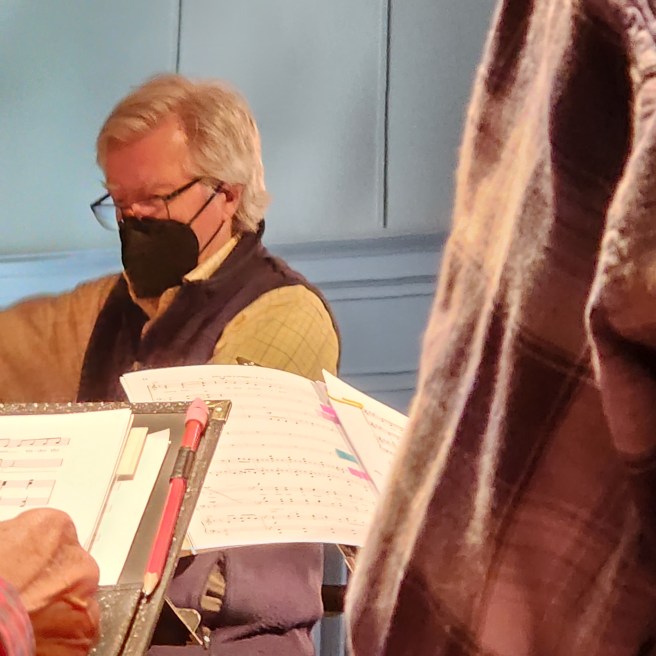
Here’s a surreptitious shot of John Newell rehearsing Quoddy Voices. We were so grateful the masks came off most of us for the actual concerts.

Quite simply, at our first in-person rehearsal post-Covid, I knew from the first two chords out of our mouths in warmup that this was home. After my first concert with the group, I especially appreciated an aside from another bass-section member, “We’re so happy to have you,” or something to that effect. It’s a much smaller chorus than my previous one, and thus more demanding.

Quoddy Voices is, of course, John’s dream and labor of love. Like my previous directors, he’s meticulous yet patient, a published composer, an excellent keyboardist, a clean conductor, and someone with fine senses of humor and delight who also genuinely cares about his singers and colleagues. (George Emlen and Megan Henderson deserve posts of their own. Note to self.)

How perfect!

But, after ten years at the helm of the chorus, he and his wife are relocating to be closer to family for much of the year.

One thing about singing together is the personal warmth people often develop. The right director can be especially admired, for many good reasons.

John will be missed, of course, and warmly remembered. Many thanks to him for all he’s given to us and the wider community.

If you want to see more of our feelings, visit the Eastport Arts Center’s Facebook site.

We do hope he’ll be back often, perhaps even singing under our next director, someone we know is also a Character in his own right.

Meanwhile, from here to September we have a gap in our Monday night schedules.

A writer’s humble request

Reading can be an intimate connection between an anonymous individual and a writer. The action really is one-on-one, even for a bestselling book.

Too often, though, it’s one way, like therapy with no one piping up on the other end.

Authors typically work in isolation on a work of passion and then step forward in a state of exposure. It can be especially tense if you’ve taken risks, knowing they can backfire.

Unless you’ve been there, you have no idea how much a reaction, positive or negative, can feel. There really is a shock and elation when you see that someone else “gets it.” Or even if they don’t, they’ve at least engaged.

Typically, though, there’s silence.

That’s why I’m still astonished by people who tell me they love the tone and content of my new book.

In addition, even a brief review or comment can help a writer sharpen the direction of future work.

Reactions to Quaking Dover are definitely encouraging fresh perspectives for my own public presentations around the work. Remember, one publishing house rejected the book because they detested first-person. Thankfully, I listened to a wise beta reader and reacted accordingly.

I definitely look forward to hearing your reactions. In addition, if you like the book, please leave a brief review plus stars at your retailer’s website or other places. Nothing beats word-of-mouth, either, in the book world.


My, aren’t we feeling precious?

I cringe when I hear someone extolling poets – or anyone else in a given field, say professional athletes – as a somehow superior species.

Even outstanding individuals need to be tempered as imperfect humans rather than extolled as gods.

Not that we shouldn’t keep striving toward excellence.

How do we take pride in our own accomplishments while staying humbly grounded?

A doctoral thesis dilemma

Doctoral hopefuls in English literature are often cautioned against selecting their favorite author as their dissertation subjects. So I’ve heard. Seems they’re quite likely to wind up hating everything about the person by the time their deep-dive project wraps up.

Wonder if that will happen with me and my Quaker history project before I’m done presenting it one way or another.

Not that I’d want to be addressed “Doctor.”

Musically, it’s about time moving on

One of the subtle changes in the world of high culture in my lifetime has been the widespread acceptance of women as both conductors and classical composers.

Long seen as a bastion of Dead White Males, almost exclusively Europeans, the musical bias was deeply engrained. Few of the world’s leading orchestras even had women in their ranks, much less on their programs or as regular guest soloists. That snobbery, by the way, also excluded American conductors and composers, and people of color in general, across the board in the Old World and the New.

When the gender line began to bend, the first women composers to gain significant attention, as far as I remember, were Felix Mendelsohn’s sister, Fanny, and Robert Schumann’s wife, Clara.

More recently, Amy Cheney Beach has come to the fore. New Hampshire-born and then proper Boston society, she was largely self-taught, a piano virtuoso whose hefty piano concerto and symphony are both personal favorites. Her keyboard works have justifiably gained advocates, and a comprehensive retrospective at the University of New Hampshire marking the 150th anniversary of her birth was a revelation. Some of her gorgeous chamber works, moving into a more Impressionistic vein, actually moved me to tears listening in live performance.

Today, talented women composers are showing up everywhere, even winning major prizes like the Pulitzer. Quite simply, it’s hard to keep up.

~*~

Similar advances are being seen on the podium, led by Americans.

Pioneered in the ‘60s and beyond by Sarah Caldwell at her Opera Company of Boston and Margaret Hillis at the Chicago Symphony Chorus, early conductors of note also included Judith Somogi with opera and orchestral roles across the U.S. and then Europe, Eve Queller at her Opera Orchestra of New York, and Fiora Contino, who I remember from opera productions at Indiana University.

Later, as innovative major symphony music directors, we’ve been blessed with Joanne Faletta at the resurrected Buffalo Philharmonic and Marin Alsop in Baltimore.

It’s all opened the doors for a slew of younger conductors who are moving up the ranks and in the running for major positions like heading the Los Angeles Philharmonic, now that Gustavo Dudamel will be moving on to Gotham.

Looking at the 18 conductors being heard on live Metropolitan Opera broadcasts this season, I see four are women, one twice, something that would have been unimaginable at such a conservative institution only a decade ago.

Do note the trend, then. Anyone else find it exciting?

Back to some obsessive binge viewing

The rest of the family keeps trying to get me to spend more time at the digital big screen they put in our parlor. Not that it’s anywhere near the Black Wall of Death I’ve seen elsewhere in our midst. Admittedly, winter can be a long emotional struggle in this remote fishing village, and for much of it, I’ve been alone in our toehold here. Even as a writer’s retreat, those depths can be a challenge.

As an additional aside, let me admit I’ve always been more of a “radio guy” rather than TV, one skewered toward classical, opera, jazz, and folk music at the more esoteric edge of the dial.

Now, as I must confess, their push has led to some binge viewing, as if I even knew the term previously. Being able to stream programming does make a huge difference in the selections. Maybe this is what I get in a remarriage that has made everything (and kept everyone) younger except me.

And yet, I hate to confess, much of what I’ve viewed has even been extraordinarily fine writing, acting, and production.

The latest round they’ve introduced me to, though, might be considered slumming. It’s the so-called reality show Project Runway in its several incarnations.

The appeal is puzzling. I’m anything but a fashionable guy, despite my personal flair. And I’m definitely counter-consumerism, even in the face of the TV series’ shameless appendage to the clothing industry and the lingering impact of “brand placement”.

But I do understand having to work against a deadline, with little or no time for correction. That’s the daily news biz where I made my career, for one thing. The idea of having to create quickly within limits and obstacles also resonates, even or more commonly on a low budget. Oh, yes, do look to newspaper newsrooms for that. Besides, as the series demonstrates, the reasons an editor or a reader or a fashion judge goes for a certain work or rejects it outright is another connection for me. For that reason, I do love the insights into a decision, even when I’m vocally objecting to the outcome.

Many facets of the Project Runway series deeply bother me, even offend. Much of the judging is blatantly biased and a strand of cruelty is engrained in the series, yet overall, what remains is addictive.

I think that the center of that is the fact that within the creative process, fashion creates something that is more concrete on video than say a poem, a dinner, or a string quartet.

As a male, I see that there’s far more to wear than long pants or shorts, or an oxford dress shirt versus a T-shirt. You know, a very limited range. As for neckties? I doubt most young men even know how to tie one today, something that was a requirement for employment in many careers in the past.

There are glimpses into the much wider range of decisions women face, but even that soon hits barriers, as we find in the the show’s focus on women’s wear, still largely in the realm of dresses.

As for the line between “fashion” and “costume” or just “clothes”? Or “youthful” and “juvenile”? If the labels were more definable, this could be educational.

Beyond that, some of the young designers become fascinating characters in their own right.

Fortunately, my binge viewing’s moving out a bit with “Shrinking,” “Community,” or the quirky, original, rough-edged, and hard-to-follow “Reservation Dogs,” which almost puts Oklahoma just one town over from us. Or some other series that should be back soon with more episodes.

Don’t I have better things to do in my “spare” time? Or, for that matter, others in my now scattered family?