What is it that made Bukowski such an unmissable figure in the reading life of young poets and others in the ‘70s and beyond?
You probably wouldn’t want to meet him in person, he seemed to be rather obnoxious, even ugly, even before getting drunk or in a fistfight. He was, from evidence he presents, an abusive lover.
Even so, part of the appeal came, I sense, in his unflinching reflection of life in near-poverty, a world where many of us were also residing. His subjects, though, were everyday poor people, drudging away in marginal jobs when they could, rather than recent college graduates intent on moving on.
Another part of his appeal, though, was his embrace of being a Poet and the ways the daily practice of writing kept saving his miserable life. Black Sparrow Press, with its signature look and literary dedication, was created for his work, and the successful relationship provided a platform that gave exposure to many other poets and novelists – the “bird mob,” as one poet I knew said with outright envy.
Was there even a poetry scene in Los Angeles at the time? The focus in California was almost totally on the Bay Area to the north.
I was especially fond of his short novel, Post Office, but the spare lines of his poetry are unpretentiously masterful and sharp-eyed. He cut the BS, for certain, in a life of squalor that’s a revelation. It’s a life most of us would rather avoid yet somehow touches on our own.
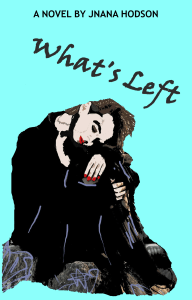
After recently tweaking the cover for my Hometown News novel, I found my eyes zeroing in on another volume and once again questioning its effectiveness.
This design continues at Amazon. While Cassia goes Goth in the plot, I suspect this was a bit extreme for her style.
What’s Left: Within a daughter’s own Greek drama had been especially difficult to develop, as I’ve explained in earlier posts, but ultimately ended up following a girl who lost her father in an avalanche on the other side of the globe when she was only 11. She then continues on into her emotional recovery and growth, rounding out in her mid-30s.
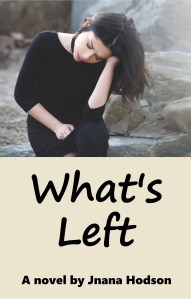
By the time the book appeared in both digital and print-on-demand options at Amazon, the cover image had settled on a photo of a Goth girl.
For technical reasons, she continues at Amazon, while my cover at other digital retailers got updated.
I wanted a better sense of the initial suffering, or even an edginess in her development, but nothing worked perfectly. I am still taken with the daring in her stare at the camera, but is that enough? (I did a post about the earlier covers on December 20, 2019, should you want to explore my archives. I was quite fond of the first cover, the one with its falling egg yoke, but nobody else seemed to get the connection.)
The figure appears more ambiguous in my attempt to do something more in line with some of the Young Adult covers I saw. Ultimately, this was a mistake.
Furthermore, she’s genetically a mix of Greek and American Midwest and a tad on the pudgy side. I hate it when a story follows, say, a brunette but the cover shows an obviously dyed blonde.
Another challenge involved balancing the two words of the title. The second word, “Left,” should have the emphasis, but it’s only half the size of “What’s.” Nothing I tried corrected that. In many of the typefaces I sampled, “Left” simply didn’t read easily, either. It could have been “Lest” or “Lett” on first reading. In making a sales pitch, there’s no time for deciphering the message. “What’s” presented similar challenges in other typefaces.
The text had been difficult enough to nail down in a convincing voice, but the cover was equally problematic – especially finding an appropriate image. How do you summarize all this in a single graphic impression, especially one that works thumbnail size online?
Do note, there’s an ongoing argument about using a facial image on a cover, period. Does it grip a potential reader or does it turn one away? Will it even limit a reader’s impressions of the character at the heart of the book?
At last I had a photo that more or less captures her despair. The title and author presentation never quite matched.
Remember, my budget wasn’t generous enough for a graphic designer, the kind who would create a flowing dust jacket replete with insider clues for a potential reader. I’m not particularly fond of those designs anyway. In general, I think photos pack more punch in a first impression. Just look at magazines at a newsstand. Remember those?
Cassia, or more formally Acacia, goes into mourning after her father’s death and then morphs into Goth dress and appearance through her teenage years, where much of the story develops.
The book doesn’t fall neatly into genres – part of it could be Young Adult, but I’d say the core of it is New Adult and beyond. So how old should she look on the cover?
Finally, in the latest stab at this problem, I decided to run with an image I’d settled on earlier. This time, it would bleed off the cover at both sides for maximum impact. I then decided to run it off the bottom, too. Somehow, that left the photo square, a format her photographer father pursued.
At last, we have this.
My reason for cropping the photo tighter was to give it more depth, putting the focus more fully on the girl and her emotion. I’m now seeing that the rocky background I eliminated had actually suggested another kind of story. No more of that distraction now. An artist might have replace it with her extended family, by the way.
In leaving the top open for author and title, rather than separating those elements with the photo in the middle, she has more presence and gravity.
I’m also glad I stuck with an impulsive decision to not fill in the remaining cover with a background color. A new typeface for me, Yu Gothic Semibold, seemed to work best for the title, though I’m not exactly happy with the single-stroke bar apostrophe. But “Left” carries its own weight in the dance of letters.
Book Antiqua, meanwhile, a fallback for me, does nicely in italic for the author.
That’s all – clean, simple, and somehow daring in its starkness. Without an obvious border, the design declares its independence from paperbook constrictions. It’s also quite contemporary, in a confident way. It even pops out on websites. And there’s no question that it comes together more harmoniously the one it replaces.
This one’s now available on your choice of ebook platforms at Smashwords.com and its affiliated digital retailers. Those outlets include the Apple Store, Barnes & Noble’s Nook, Scribd, and Sony’s Kobo. You may also request the ebook from your local public library.
Although she was known as a poet and story writer, her book that I most value is An Island Garden (published the year she died), with illustrations by Childe Hassam, an Impressionist painter I admire highly. (He hated the term, by the way, and didn’t fit the label neatly, but it gives you an idea.)
The island, in the Isles of Shoals of the shore of Maine and New Hampshire, is a remarkable place, as I found in a visit I posted here on June 14, 2020, “Celia’s garden … on Appledore Island.”
Under her guidance, the hotel her family owned and operated became what can be seen as the nation’s first artists colony every summer, attracting a who’s who of writers, painters, musicians, and more. Her influence can be seen especially in many of New England’s authors of the period.
Reading about her, I’ll confess, can be as pleasurable as reading her work itself.
The newest addition to my list is someone I’ve come to know and admire since moving to Eastport.
Lee, a longtime high school teacher and valued community figure who has written short fiction for most of her life, finally released a collection of 12 stories in 2022, and it’s a treasure. Island Secrets is rife with every-day, blue-collar existence on a remote fishing island in Maine – veiled Eastport – but the secrets are those that lurk unspoken in the open. Consider the trials of harvesting scallops in the dead of winter, which runs through the final story. Few consumers have a clue to the dedicated labor involved in the occupation (I’m tempted to call it a profession, including the fact that it is highly licensed and regulated) or of the domestic tensions that accompany the precarious business.
She’s original, a consequence of digging intuitively into the world in front of her, with her prose infused with the precision of her succinct poems as well.
One of the delights of ebook publishing is the ease with which updates can be made. It’s not like having a warehouse of paper volumes to discard in the process.
Recently, while preparing a new book for release at Smashwords.com, I revisited my novel, Hometown News, and wondered if the cover might work more effectively than it did.
I liked the cleanness of the current design and the graphic impact of the elements but questioned whether it might convey a better sense of being about the news business itself. The typeface on the cover conveys the title but nothing else. The story does play out in a moderately-sized industrial city, which also needs to be hinted at in the design.
The photo delivers on the idea of hot news and impending disaster as well as a working-class, blue-collar neighborhood, but I was curious to see if it might have more punch if it reached both sides of the cover. Or “bled” off the page, as we’d say in the trade.
The previous version of the cover did just that, but cropping the photo to accommodate the title and author type was another matter. Remember, ebook covers are essentially thumbnails to be viewed on a cell phone, laptop, or tablet computer screen.
The photo here is cropped less tightly than on the later cover. Does including a portion of the porch roof below add to the message or does it lessen the immediacy? Does the placement of my name detract from that?
There are good reasons this one went back to the drawing board.
The first cover, below, played on the idea of bucolic small-town America and fit into the series of covers of my other novels, but as you can see, there’s no promise of the coming drama within the book itself. So much for brand identity.
While this one was produced by a professional designer at low cost, I must ask myself what an artist would do as an alternative to a photo as the key graphic element. Perhaps a roll of newspaper reaching out across a steel mill and downtown? Downplaying color might allow for the title and author’s name to float over the artwork and still be readable, something that simply wasn’t working with the house fire photo.
Few newspapers have managed with a feel-good approach to community, no matter what many critics would wish. Everybody hates a fire, right? With a morbid fascination?
Returning to the design challenge, here’s where the book stands now:
The key to the redesign was having the name in a single line, like a newspaper nameplate. Thus, a different serif typeface in the new cover. Admittedly, it is harder to read as a thumbnail, but I am going with the tradeoff. I’m venturing that it will reenforce the type on a Web site’s pitch rather than run alone.
The photo, once again, bleeds off the page, delivering maximum visual impact.
More and more, I’m looking at an ebook cover as a poster than as packaging for a commodity.
My series of polemic political poems – they’re not exactly protest songs, but I wouldn’t complain if they were – has moved from Thistle Finch editions to Smashwords.com, where they’re now available in a range of ebook formats, hopefully for a wider readership.
In the transition, the poems are now presented in a single volume rather than six shorter chapbooks.
These blasts of alarm and rage, 1976-2008, are an emotional mirror of events leading up to today, a not-so-distant past that’s been intensifying toward devastation. Let them stand as a call for personal honesty and engagement, too.
Take heed, if you will.
For me, this also presents the excitement of my first book release since September/October ’22, when Quaking Dover appeared. It comes with an admission that these poems are largely spontaneous, as in combustion, and sometimes sophomoric. I’ll ride with that, considering the fervor of adolescence, including ambitions.
While the poems are rooted in recent history and its headlines, they’re more pertinent than ever.
Having originally appeared as six short chapbooks, this collection is now available on your choice of ebook platforms at Smashwords.com and its affiliated digital retailers. Those outlets include the Apple Store, Barnes & Noble’s Nook, Scribd, and Sony’s Kobo. You may also request the ebook from your local public library.
My introduction was at a multidisciplinary conference at Fort Warden State Park in Port Townsend, Washington, in the late ‘70s. Lopez had just published his celebrated Of Wolves and Men, and this was a weeklong gathering of writers, naturalists, scientists, and a few others.
Three of his smaller, later books have especially held my attention: Desert Notes, Arctic Dreams, and Giving Birth to Thunder, Sleeping with His Daughter, presenting Native American mythology, especially the Trickster figure, Coyote. These volumes are sometimes classified as fiction, but they really straddle genres.
Maybe that’s why I return to Lopez more than to Rachel Carson or Annie Dillard or even Henry David Thoreau.
He did serve as an inspiration for two of the novellas that appear in my book, The Secret Side of Jaya. Well, maybe even the third one, too.
I had already drafted my longpoem, Recovering Olympus, as well as probing Native American lore since my years in the ashram, where Asian mythology also started infusing my awareness.
Lopez, though, had some serious fieldwork to support his visions.
My first encounter with concrete and minimalist poetry came as an art exhibit in the late ‘60s. Maybe I already knew of otherwise traditional verse presented typographically to represent a visual image on a page – a vase or bird, perchance – but this time, the words themselves took on an independent visual wonder. Think of Robert Indiana’s famous LOVE as a cube of giant building blocks.
The writer I most appreciate in this field is Aram Saroyan, the son of a famed Depression-era novelist. Aram came to fame at age 20 with a one-word poem:
lighght
which became a source for right-wing scandal when it won a $750 award from the National Endowment of the Arts. As conservatives charged, it wasn’t spelled right and it wasn’t a real poem anyway. Things got ugly.
Others, me included, find it a vibrating both in the thought and the image. If that silent “gh” adds something to the sense of the word, either as illumination or as featherweight or even carefree, why shouldn’t two intensify the sensation?
It revives that wonder and puzzlement we’ve all felt, but many writers, I think, more keenly, when we first encounter many quirks of the English language but then later glaze past.
In this vein, Saroyan also has a playful
aaple
as another entry.
His small collection, Pages, has traveled from one side of the continent to another with me. A downside of these works is that they don’t work at an open mic or featured reading. They really do belong to the page.
For my own ventures along these lines, check out Sun Spots and Drumming at my Thistle Finch blog as well as the weekly Kinisi entries here at the Red Barn.
Perhaps best known as a cofounder of the Poetry Project at St. Mark’s Church in Manhattan as well as the Jack Kerouac School of Disembodied Poetics each summer at the Tibetan Buddhist Naropa Institute in Boulder Colorado, Waldman has worked with many of the famed Beat poets a generation older in a life of experimental writing and social activism.
In preparing this post, I was surprised to find she’s only a few years old than me. She’s often seemed to be that much further ahead in the history of contemporary literature.
She first impressed me with a few poems in Disembodied Poetics, an annual review she co-edited. I liked the way the disparate elements danced, something in common with much of what I’ve written. Later, in her collected works, I was taken with the ways she employed repetition, something I had avoided as, well, redundant. My Preludes & Fugues, especially, are beholden to her on that front.
Short fiction is something of stepchild when it comes to literary respect in America. Novels get the serious attention, and the bigger royalties, yet as I discovered once I opened a collection by Andre Dubus, “Finding a Girl in America,” a short story can deliver much more than a rambling bigger tale. I quickly devoured two more of his compilations.
I came across his work too late for it to influence the early versions of my novels, but I deeply appreciated his craftsmanship and freshness. Though I’m far from the no bullshit, Cajun/Irish Catholic in a wheelchair in a dilapidated New England mill town character he was, the directness of his writing and his first-hand knowledge of blue-collar life in the Merrimack Valley resonated with me. I lived upstream of Dubus for 13 years and then just to the north, and there’s nothing fictional in his stories, from my perspective.
Before I had read any of his tales, bits of quirky encounters others had with the author, including the sharpness of his teaching had floated my way. Especially telling were the free weekly sessions in his home after an errant car had left him, in his words, a cripple sound much livelier than anything he had probably been doing at the now defunct Bradford College across the street from a friend of mine.
After I started blogging, one follower, an English professor, commented that he liked how much my posts reminded him of Dubus. I won’t go that far but did feel honored, all the same.
I do need to add his son, Andre Dubus III, to my TBR pile.




 These blasts of alarm and rage, 1976-2008, are an emotional mirror of events leading up to today, a not-so-distant past that’s been intensifying toward devastation. Let them stand as a call for personal honesty and engagement, too.
 Jnana's Red Barn