For the history student, I see some doctoral dissertation possibilities

There’s so much more I’d like to know about details related to my Quaking Dover story, but I’m not a professional historian.

Some of these could be fodder for a Ph.D. dissertation.

  • An examination of Dover Friends book of minutes dealing with young men who enlisted in the Revolutionary War would be one.
  • Or of where individuals went in their religious affiliations after leaving Friends.
  • Even Richard Waldron’s full biography.
  • A list of the clerks of the Meeting and another of the recorded ministers and elders would be helpful.
  • Or an examination of the actual functioning of the provincial charters, especially the so-called “proprietary colonies.”
  • And, oh yes, a genealogical index of New England Quakers like William Wade Hinshaw’s encyclopedic indexes of New York, Pennsylvania, Virginia, the Carolinas, and Ohio.
  • I would even like to see an understandable examination of English settlement in Maine in its colonial years. Where, for instance, did the settlers go after watching from sea as smoke and flames rose from what had been their homes and villages in a fateful five-week period of 1676, eradicating all English from east of Casco Bay?
The collapse of NBC

I don’t mean the cracker company, either, the one known as Nabisco, for National Biscuit Company. Or was that Baking?

No, I’m thinking of what was once the broadcasting monolith, first in radio and then in television, the one that projected a peacock logo at the onset of color programming.

The financial struggles for traditional mass media in the digital age are well-known, but broadcasting has been hit perhaps even more drastically than newspapers.

As a child of the ‘50s and ‘60s, I’m still shocked at the disappearance of AM radio, especially its powerhouse clear-channel signals. My daughters, savvy as they are in tech matters, don’t even know what AM is. These were coveted media, and getting a license for even a daytime frequency in a metropolitan market could be a coup. Think of WKRP in Cincinnati for the insider view. Instead, though, owners have allowed many of these to go silent. As for FM? The real competition is from streaming and satellite.

We gave up our TV years ago after realizing that whatever we wanted to watch was available online. Still, I was stunned the other day to discover that NBC no longer has an on-the-air outlet in Boston. That was unthinkable. Nobody would give up a network affiliation and go independent. Yet, as I learned, it isn’t anymore.

The trigger came the other morning when I was gazing at my Yahoo news feed and clicked on the latest Patriots football gossip from NBC Sports Boston, one of the primary regional sources. Wait, I thought. Why isn’t this identifying a station? Or at least a channel?

And that’s when I went down the proverbial online rabbit hole and found out that the once mighty network exists solely on cable in the nation’s tenth largest media market. Even the Tonight Show.

As for its entertainment lineup?

There are good reasons we’re turning to the new seasons at Amazon, Netflix, Hulu, etc. Besides, we can watch those shows at our convenience, not the network’s.

I must admit finding it hard to keep up with all of these changes. How about you?

Sometimes a little curiosity falls into place

You know, you drive past a thousand times and finally decide to explore a side street.

That’s what happened in Dover when I had a half-hour to spare before my presentation at the public library.

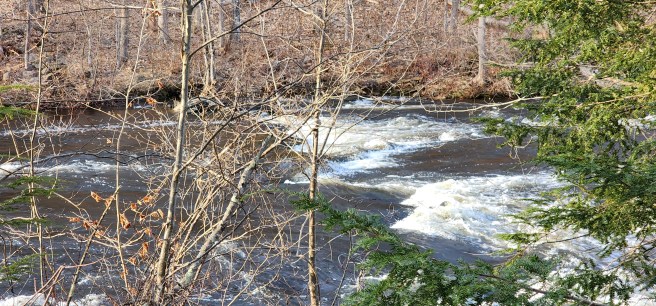
Upper Factory Road off Tollend was the excursion in question, and I was curious to see if I could actually get a glimpse of Kimball Falls in the Cochecho River through somebody’s back yard.

Yeah, suburban-style sprawl.

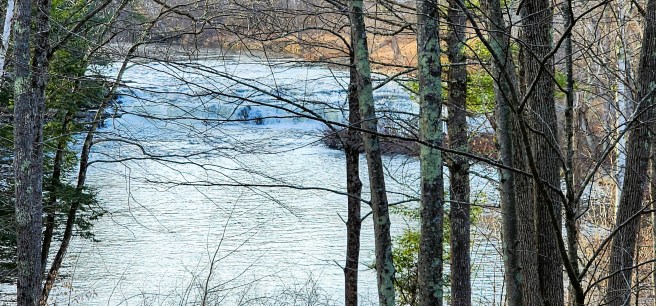
What first appeared was this falls, or rapids, at the foot of the trail. It’s the fourth of six falls as the river runs through Dover, though some of them are more accurately rapids. (I’m guessing there’s a nuance of meaning I hadn’t gotten previously – a waterfall seems to be a more clearly defined kind of “falls,” in contrast to fast-running streams like Jones Falls and Gunpowder Falls in Maryland as well as the Salmon Falls River abutting Dover.)

This one would have been the site of the Dover Cotton Factory, which bought the land before 1820, erected a dam, mills, and housing, and sold it in 1830, when the operation moved downstream to the first falls, now the heart of downtown.

Whittier Falls, which are discussed in my book Quaking Dover, were the second set going upstream.

To my surprise, Upper Factory Road actually leads to a small trail down to the water, along with a twist along the riverbank to a definite waterfall. Alas, that part was too wet to use at the time, but it is on my list for a future trip.

Upstream I could see an actual waterfall, where water pours vertically from a lip into a pool
The water level was up, thanks to recent rain and melting.

Checking the aerial map when I got home, I realized I had frequently passed the falls on the community trail on the other side of the river, but the path had veered too far inland for a direct view. But you can definitely hear them, as I recall.

It’s rather surprising how much you can find in what’s essentially your own back yard when you look. Or, perhaps more accurately, know what you’re looking for. I lived in Dover 21 years and found this 2½ years after I left.

By the way, there’s no Lower Factory Road.

What is it that makes a waterfall so appealing?

Did you know about the war between the U.S. and Canada?

More officially, it’s the Aroostook War a.k.a. the Pork and Beans War or Madawaska War of 1838-39 over the international boundary between Maine and the British province of New Brunswick.

Although militia units were called out, no actual fighting took place.

Well, there was a skirmish between armed lumbermen, the Battle of Caribou, in 1838.

The dispute was settled by negotiations by British diplomat Baron Ashburton and U.S. Secretary of State Daniel Webster in an 1842 treaty.

Without getting into the myriad details, it is how the Aroostook County towns of Fort Kent and Fort Fairfield got their full names. And most but not all of the disputed territory wound up in the USA, with Aroostook County being formed in 1840.

Reported casualties came from accidents and disease rather than actual combat.

Lest we Friends be too proud

From Bowen Alpern’s book, Godless for God’s Sake:

“Much of what we tend to regard as the achievement of Friends as a whole was, in fact, the work of individual Friends, or small groups of Friends, often in the face of opposition or neglect of their monthly meetings. (One of the most positive – if often tedious – aspects of Quaker culture may be its capacity to produce or attract individuals who are willing to stand up to it).”


No index and no footnotes

November is the month many amateur writers set out to draft a full novel within 30 days.

My book Quaking Dover is nonfiction, but with eight published novels, I can still sympathize.

I should have been suspicious when this book seemed to write itself, producing what one beta reader then sensed as not just stream-of-consciousness but a mind-dump.

Ouch!

Revising it, aiming at a more consistent, creative non-fiction tone, was much more torturous and required much more time and attention than I can calculate. Still, I have to admit the result feels satisfying. Just don’t make me do it again.

As a history book, it wound up with no index and no footnotes but instead focused on a community of people over time.

Well, the ebook edition can be easily searched for items. Not so with the paperback.

As for footnotes? Much of my research in the Covid outbreak was conducted online, not exactly a permanent source of information.

The effort did push me far beyond my journalism discipline, pushing me into the story as an active observer, not that I was comfortable with that.

But it seems to work, all the same.

‘There were no yachts!’

That’s what many of the autumn cruise ship passengers have noted on their arrival at the Breakwater here in Eastport. As they were told, that’s because ours is a real working fishermen’s harbor. Even in the height of summer, there are few pleasure boats.

The visitors have been largely charmed by the unspoiled nature of this place, especially in contrast to Bar Harbor, Camden, Portland, or Boston, and to the welcome they’ve received.

It did keep a festive spirit alive before winter kicks in.

Community life around here has definitely hunkered down now, at least until the scalloping season kicks in.

Looking for God in the details

The architect Ludwig Mies van der Rohe is often credited as the origin of the quip, “God is in the details,” but the phrase actually goes back much earlier.

Still, however tedious but essential, details do extend to the minutia of building and sustaining a marriage, a family, and a wider community. You can also apply it to any number of other things, including business, sports, the fine arts, politics.

In researching Quaking Dover, I am left with many gaps in the records of Friends’ godly endeavors. When, for example, did Dover Friends cease to run their own schools?

In addition, in writing a history, the details can drive one mad.

May I suggest the devil’s at work there, too?