Election reflections

These shoulder elections, where nobody’s running for national office, are still important.

In small places like Eastport, getting someone to run even unopposed for local office can be a challenge. We had all the bases covered, although the surprise was when a write-in candidate won one of the two city council seats.

I can’t imagine that happening in a bigger setting, but who knows. A write-in for president? My!

Statewide, a radical proposal to take over the two widely hated electrical utilities failed. Big money is hard to comprehend, even if we’ll be paying it one way or the other. The frequent storm outages won’t be going away, nor will the continuing higher-than-national bills customers here receive. Somehow, I don’t think the issue will be going away, despite the lopsided tallies.

Just how much do those emergency home generators cost altogether, anyway, as insurance against the current setup? It’s not that many households before we’re talking billions.

Otherwise, the initiatives moved in a progressive direction, including the right-to-repair measure.

I am relieve to see opportunities for right and left to come together at a local level, however gingerly.


Maine voters face two hot issues 

The Pine Tree State has a tradition, so I’m told, of placing complex issues on the statewide ballot because many of the elected state representatives and senators are afraid of negative reactions in a controversy.

Normally, public officials are expected to thoroughly investigate the issues and come to a reasoned decision. That’s why we elect them. Instead, shifting this responsibility to a general public that is rarely fully informed can be like rolling the dice.

This year, there are two issues of special note along those lines.

One is the so-call Right to Repair Act, which would prohibit manufacturers from keeping replacement parts and technology from independent repairmen. I’m still bummed by HP’s ink replacements policy – your machine shuts down if you try to use over-the-counter cartridges. Apple computer users have their own experiences. I know the list of big businesses’ proprietary efforts is growing.

The other issue is Pine Tree Power, which would have the state take over Maine’s two largest electrical utilities. Mainers have some of the highest electrical bills in the country accompanied by some of the longest and most frequent outages. Folks are still worked up over being cut off for weeks years ago after some storms before Central Maine Power got the lines working again. Despite the already high rates, CMP and Versant, the utility in our part of the state, both received permission this past summer to hike the bills another 20 percent. The utilities have lined up 15 times as much money for advertising than the grassroots effort has, no surprise there, and the campaign has a lot of emotional scare. What should be obvious is that somebody’s expecting to be repaid handsomely by staying in power (sorry for the pun). They’re not doing the customers any favors there, either.

So, when you’re checking the news reports tomorrow night or the following day, check the Maine results. They could be enlightening. Or, should we venture, shocking.

Oh, grunt

I’ve said it before and I know I’m not the only one.

Changing our clocks back an hour is the real beginning of winter. Everyone will be out of sorts for the next week and have no idea why. It really takes us that long, internally, to readjust.

Even those of us who are officially “retired.”

My genealogical research experience was a plus

In my mid-30s, a decade after I started worshiping in the Society of Friends, I heard that my great-grandfather had been a Quaker who moved from North Carolina to Ohio after the Civil War.

I’d no clue and was shell-shocked, in a good way.

That soon got me into genealogical research with another, older, cousin, which in turn led me to others through correspondence. Many of the results can be found on my Orphan George blog.

Central to that research were Quaker Meeting minutes and learning to interpret those records. For family data, they can provide some of the best information before the census of 1850, the first to name everyone in a family, along with ages and some other facts.

Serving as clerk of Meeting and in other roles also deepened my understanding of the faith and practice.

While I gained some skill navigating this field, other researchers specialized in public records, such as wills, tax filings, and property maps.

Admittedly, working as a census taker in 2020, I did develop a sympathy for lapses and errors in the federal population documents.

When it came to researching Quaking Dover, I found myself returning to others’ genealogical summaries, where one version differed from another, as well as other records. I knew to treat what I saw there as tenuous but still helpful.

Somehow, though, it felt familiar.

We’ve come to appreciate the cruise ship visits

While Eastport has the deepest natural port in the continental U.S., that’s not often led to a lot of big-ship landings.

Cargo shipments, especially, have suffered over the past decade.

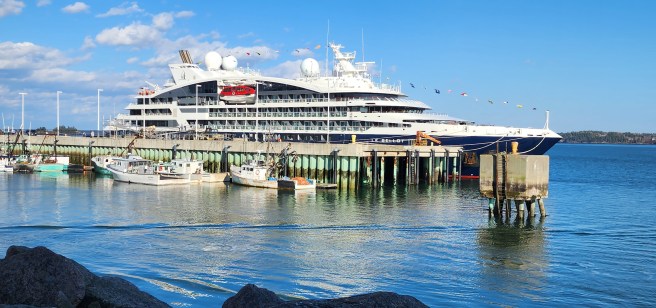
Last month, though, the city saw a record number of cruise ship visits, sometimes running one every other day over two weeks.

We’re getting what’s often termed mid-sized cruises, up to a thousand passengers, in contrast to the floating cities that might deliver five times that. Frankly, mid-size fits us fine.

One factor has been Bar Harbor’s reaction to being overwhelmed, down at the edge of Acadia National Park. And Portland, further down the coast, is a big city in contrast.

As a result, Eastport is being discovered as a place that offers a taste of a quintessential Maine fishing village without the hype.

As one younger woman said while walking past our home, “Today was AMAZING!” Imagine that, in a small town seemingly so far away from anything.

French liner Le Bellot, docked at Eastport’s Breakwater, visited town last week.

So far, these arrivals during the fall foliage season have extended our tourist season. The place typically shuts down by mid-September but these arrivals have extended that into early November. They’ve even given some, but not all, of our galleries and stores their best business days of the year. That’s a huge impact on a fragile, marginal downtown.

The landings also benefit the Breakwater and its workers, and let’s not sleight the purchases of junk food snacks at the IGA and Family Dollar by ships’ crews – sometimes up to another 600 people. They do load up.

We do enjoy seeing happy couples walking around our neighborhood with cameras in hand. Our conversations with them have been upbeat. Others have enjoyed bus tours to the Roosevelt compound on Campobello Island and the West Quoddy Light in Lubec or autumn foliage.

Economically, it’s an alternative to the Airbnb purchases that have been pulling housing away from working families, the very culture that’s a big part of the draw to our city. We do need more jobs that provide benefits, too, though that’s another big issue, one basically at the national level. I’ll save that for another time.

For now, let’s acknowledge what I’m seeing as a positive step, one that might even extend our spring shoulder season.

Living on $10,000 a day. Or even an hour.

The thought crept upon me the other morning as I was pondering simplicity and frugality.

Yeah, look at the flip side.

I remembered reading a recent New York Times piece on a Long Island boutique that catered to billionaires and noted the owner’s insight that they spent differently. I shrugged it off then but come back to it now.

Suppose your after-tax income came to $3½ million a year? That would be nearly $10,000 a day. (I did miscalculate and put that at $100k a day, a more interesting figure. Still!)

For perspective, the median pay for S&P 500 chiefs was $14.5 million last year, in contrast to an average $56,000 earnings for American workers.

The No. 10 guy on the list, Tim Cook at Apple, came in at $99 million in salary, benefits, and bonuses. More than $240,000 a day. That is, $10,000 an hour.

Ahead of him were the CEOs of companies like Alphabet, Peloton, Live Nation, Sarepta Therapeutics, and CS Disco, plus four I recognized. Please, can somebody tell me what the head of Pinterest is doing to make him pocket $123 million for the year? A tad under $337,000 a day?

As one scion of affluence told me a half century ago, there isn’t much real difference between a $20,000 car (today’s prices) and a $200,000 vehicle, as far as everyday performance goes. Let me add, today’s median family car is far superior to the luxury vehicles back then. Air conditioning? Seat warmers? Cruise control?

As I played with the $100,000-a-day figure, nearly twice the yearly earnings of real workers, I realized how little of that was needed for everyday expenses, even at inflated expectations – how many houses does one need, anyway, or how many hotel suites while traveling? What came into focus was the vanity opportunities: collections of antique cars, paintings, sexual playthings, political hobnobbing. Just name it and claim it.

And that’s where it gets scary, even when you scale back to $10,000 a day.

Conservatives like to quote Lord Acton’s “Power tends to corrupt and absolute power corrupts absolutely,” while they pursue the maximization of their personal wealth, which intensifies their power and, thus, corruptedness. Per the logic.

Renting a luxury yacht – $100,000 a week plus expenses, last time I looked – is peanuts in comparison. As is a private jet. They might even be business expenses, paid by the company.

Well, F. Scott Fitzgerald did quip, “Let me tell you about the very rich. They are different from you and me.”

But I am wondering what he’d make of today’s mutations.

What would you do, given that much at hand?


Losing a reclusive neighbor we never really met

Moving to a new community three years ago meant meeting new neighbors, and Eastport, as we’ve found, can be a friendly place, even for us who are “from away.”

But one of our abutting neighbors was very-hard-of-hearing, as my wife discovered in attempting to talk to her, and ignored my attempts of waving in greeting. In many ways, she resembled my late asocial mother-in-law, not only physically but also in a heavy cigarette habit. Don’t know if she rolled her own, though. Still, she seemed to relish her independence and had a support system that included a few handymen I could approach with problems to address. Which they did.

We did worry about her occasional drives to the grocery or doctor or wherever. She could barely see over the steering wheel while puffing away, for one thing. And her backing out of the driveway did appear questionable. Still, she eventually returned home, apparently unscathed. I did see her one day in the IGA parking lot receiving a lot of help packing her trunk with her purchases.

I did wonder about her living in a big house all by herself, though that’s not uncommon in a town that’s largely elderly.

So flash forward to a day before what was left of Hurricane Lee was to hit town and I looked out the kitchen-sink window to see a police officer nosing about, checking her car, knocking on her door (and receiving no answer). No surprise there, her lawn-mowing and snow-removing crews got much the same.

Still, he was persistent, making repeated calls from his cruiser after trying all doors and walking around the house.

The next thing I knew, an hour or two later, was a white glove through her apple trees and the black SUV before the blanketed gurney came into focus.

Even before the obituary, an online search gleaned details that she had been born in Eastport to the manager of the local Newberry’s store and, when it closed, moved by stages to Upstate New York, and then, after college, to San Francisco before the Summer of Love and a career in banking.

And then, in retirement, she returned to her roots – from the City on the Bay, as we say, to the City in the Bay.

Her maternal side ran back to a family of Loyalists who fled to St. Andrews, a neighboring community in New Brunswick, before relocating to Eastport early on, while her paternal line was Pennsylvania Dutch by way of Virginia.

The family’s eventual obituary adds details.

~*~

In the aftermath, masked family and friends have been working steadily over two weeks to collect bags of trash and purge the house, including a colony or two of rats. (The rodents, it turns out, are well established in our end of town today – one more challenge to address.)

This also raises the question of just how much I leave to others after my own passing, and how much I need to clear out before then.

In the meantime, other questions loom, including the meaning of life for each of us.

We do wonder who will be living there next – hopefully not one more Airbnb but a real family with kids.

Onward! As I like to say.

Not that I wouldn’t love hearing the rest of her life story.
Looking for witches among the Quakers

One of the first things the Puritan authorities examined for after arresting women preaching the Quaker message in America was physical proof of their being witches.

I have no idea about the specifics – and am not sure I want to know. Still, their obsession with the naked bodies strikes me as creepy, even pornographic.

After publishing my book Quaking Dover, the thought struck me that the Puritans must have seen Quaker worship as some kind of séance. Not that we were trying to communicate with the dead, but rather be open to the presence of the Holy Spirit, or Christ.

Of course, that Holy Spirit was translated at the time as Holy Ghost. Yipes! Sounds like Halloween, no?

From my perspective, Ghost is way too limiting for that Spirit, especially when Christ is seen along the lines of Logos in Greek philosophy.

It’s far more revolutionary and liberating than you’d think. One way builds religion as a kind of legal system with punishments and rewards. The other builds it as a set of relationships.

Now, to stock up for those little trick-or-treaters who will be knocking on our door. I promise not to put religious tracts in their bags, tempting as the opportunity might be.


There’s much more to Salem than witch hysteria

Through much of the colonial era, Salem was one of America’s ten biggest cities. In addition, it was closer than Boston to Dover, and like Dover it was settled by West Country English fishermen before the Puritan migration flooded into New England.

Salem’s first Quakers suffered some of the most intense persecution for their faith found anywhere, and they were instrumental in bringing that faith to Dover.

What I didn’t realize was that Salem was long the only Quaker Meeting in the Massachusetts Bay colony. The other early Meetings in today’s Massachusetts were actually in the Plymouth colony.

Details on Salem Meeting’s existence were scarce until I was pointed to Carla Gardina Pestana’s Quakers and Baptists in Colonial Massachusetts.

Her study breaks off before the Salem Meeting shifts to Lynn, where it was once the largest or second largest Friends congregation in New England. And then that, too, faded from sight early in the 20th century.

Pestana’s sensitive telling of Friends through the period includes her sense of Quakers as family oriented, communal, even what she calls tribal. I would still like to see the story of what happened to Salem Friends in the industrial era, but she provided consolation for my own conclusions in Quaking Dover.

As for Salem, its unique Peabody-Essex Museum ranks in many categories in the top ten art institutions in America. It’s definitely one of our favorite destinations. Its grounds even include a reproduction of Salem’s first Quaker meetinghouse, built about the same time as Dover’s.

The Maine image versus reality

“Life as it should be,” as the billboards proclaim in welcoming visitors aka tourists, is a slick slogan ignoring the economic realities most working adults in the state face.

The recent death of a new high school graduate in our county who was about to enter the prestigious Maine Maritime Academy is a harsh example.

He was out lobstering, solo, and got caught up in his gear and dragged overboard.

More common is the hobbling together of three or more jobs, mostly part-time and/or seasonal and lacking paid benefits.

~*~

Yes, the state’s landscape can be breathtaking, especially in summer. But much of winter is brutal, as are the black flies come late spring, and we do have more than our share of trash weasels.

Just want you to keep your impression in balance.