An eclipse too good to be true

Against all odds for this time of the year in Maine, the long awaited full solar-eclipse day delivered ideal weather. Amazingly, especially for April, after a week of gray, rain, and snow, the sky stretched cloudless, the air was crisp, and temperatures edged into the 50s. It felt too good to be true. If I had been a betting man, this was a wager thing I would have lost.

You’ve no doubt heard about the swarm of curiosity seekers who mobbed the narrow band of total eclipse as it moved up from Texas and through the Midwest and eventually through northern New England. I won’t rehash that part of the story. For us, the question came down to finding a place to observe the astronomical event without the carnival congestion and related distractions.

Houlton, 115 miles to the north of us, touted itself as the ultimate destination and publicized accordingly. After a snow-scant winter, they needed to recover from severe winter tourism losses. We wished them well but thought other locales, perhaps Millinocket, might be saner, even though more distant.

Houlton is normally a two-hour, 18-minute drive to the north of us. Narrow, forested, two-lane U.S. 1 the only route for most of the way. For others, it’s at the upper end of Interstate 95, just before Canada. It’s not only the seat of potato-famed Aroostook County, it’s also the principal access point. We had to wonder how widely some of the metropolitan traffic would spill over into Washington County, perhaps once GPS started rerouting traffic to alternate highways. It wouldn’t take much to jam up everything for us and everyone else.

In planning for our adventure, we scoured the maps and settled on Danforth, population 587 spread over 60.46 square miles (6.46 of that being water) at the northern edge of our county, just before Aroostook. Danforth was on the way to Houlton anyway and would receive just about the same timespan of total eclipse. How heavenly, if we could stay out of the mud and muck. We focused on a side road north from the village at the center of town and hoped the route was paved. No guarantees from the map or satellite photos. If not, considering impassable conditions this time of year, we’d need to have plans B, C, and D at hand. We zeroed in on two cemeteries as possible places to set up our folding chairs, and headed off, leaving ourselves a generous margin of time for delays and readjustment.

Too good to be true, we instead had smooth sailing all the way, scouted out our sites and some gorgeous scenery, even noted the possibility of crashing Mike & Kay’s Eclipse Party that a homemade roadside sign presented. But where was everybody? Had we deluded ourselves? What had we overlooked? The scenery, though, was gorgeous.

We decided to head back to the village and stopped at the only restaurant in town, one with fuel service and a single rest room, which had a long line. No surprise. We were, though, surprised by the number of friends and neighbors from Eastport we ran into. Oh, yes, the food was better than most you’d find in a diner and the service was prompt and friendly, despite the throng at the front of the store. I’d stop there again, definitely.

I did have to laugh at the pristine black tee-shirt one woman wore. It featured photos of the cycle of a solar eclipse and the time 4:36. Where we were, totality was set to begin at 3:32. Was I the only one aware that she was running on Atlantic Daylight Savings to the east in Canada?

Beyond that, here’s what we found:
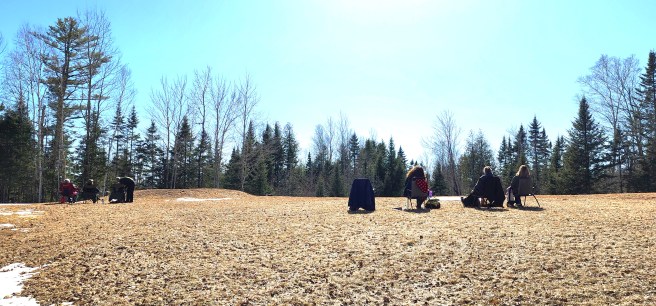
When we returned to the cemetery, which had been No. 2 on our list until we discovered that No. 1 was tiny, wet, and too heavily wooded, we were jolted to see we had unexpected company. A party of three was firmly ensconced. Were they locals? Would they resent our intrusion? Nah, they were from just a few towns down the road from us in Eastport, and their planning paralleled ours. As kindred spirits, they became the perfect associates for our experience, the kind who swapped food with us and had prepared accordingly. Their holiday greetings had even gone out with 200 pairs of eclipse glasses and best wishes for looking ahead in 2024. Yeah, they were a plus.

Maybe this was true, after all.

It may be spring, but there were still patches of fresh snow on the ground, some with large tracks I’ve since identified as wolves. Seems that in this stretch of Maine, wolves range in from neighboring Canada. I was almost disappointed they weren’t bear.

Also almost too good to be true was those flimsy little fold-up solar eclipse glasses, which completely blocked any light except the sun’s. These weren’t Cracker Jack prizes but rather surprisingly effective. My previous full eclipse, the late ’70s in the desert of Washington state, lacked that advance. This was a leap ahead of the smoked glass that made the rounds back then. This time we watched the progression as the overlay of the moon slowly created a crescent sun, eventually resembling the familiar waning or new moon. Well, this was a kind of turnabout as fair play, right?

As we estimated the amount of the sun’s face that was being covered, we were impressed by how much illumination still surrounded us. Even at 90 percent coverage, we could have been convinced this was only a hazy day. Back in the ’90s, I had been in the woods during a partial eclipse and been disconcerted by the eerie monochrome that fell upon us. It wasn’t precisely twilight but a kind of graying, almost like a dry fog. That’s what now happened, around 98 percent coverage, accompanied by the appearance of a flock of confused grackles and a gush of cold air from the direction of the sun rather than the stiff breezes that had been at our backs.

And then the incredible began in a rapid sequence. We could remove our protective film lenses and look at the sun, which was not yet a ring of fire but instead a spotlight of pure white rather than its usual yellows. It was unearthly, eternal, perhaps suggestive of the light proclaimed in the Tibetan Book of the Dead or the words of creation in Genesis and the gospel of John. This platinum brilliance hung over us, out of time and then gone, replaced by the anticipated disc accompanied by Venus and Jupiter.
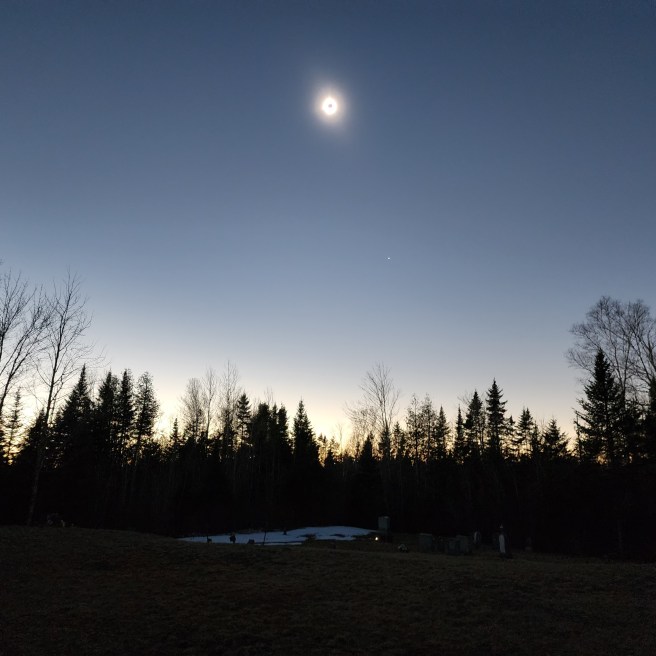
Trying to photograph the distant ring of the sun’s surface with a cell phone was elusive. Instead, enough light still poured forth to fill in most of the orb, leaving only that dark pinhole. We gazed on a small bead just to the left of the bottom of the orb, a spot where the sun would begin to emerge as if being reborn. Somehow, we overlooked the small memorial lamp at a headstone in the cemetery where we were.

And then, once more, that pure white spotlight blasted toward us in utter, aloof majesty, and the regression toward some normality began.

The camera sees in its own way. Somehow, the rainbow is fitting. And the moon still covered most of the sun, despite what you observe here.

Shadows, by the way, are sharpened.

Yes, it was almost too good to be true.

Acid test translator: Everett Fox (1947- )

His gorgeous large volume, The Five Books of Moses, leaves the reader agog that the Hebrew Bible wasn’t written in King James English. Fox’s rendering instead sticks close to the original tongue and has a rough-edged, field-research vividness where many of the characters come in unfamiliar names – Ish  and Isha for Adam and Eve, for starters. Familiar quotations sometimes differ so sharply that they pass unrecognized.

The translation evokes the sounds of reading the text aloud and hews to puns, word play, word repetition, and alliteration – with detailed notes and footnotes, as needed – that give a sense of what’s been stripped away in conventional translations that polish and soften the action.

It’s my go-to version these days, augmented by others to context to my earlier readings. I wish we had more of the Bible rendered along the lines Fox pursues.

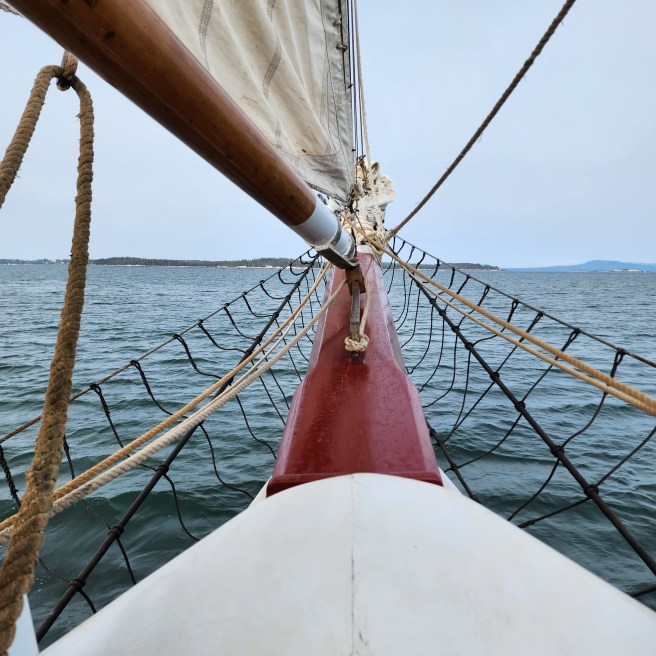
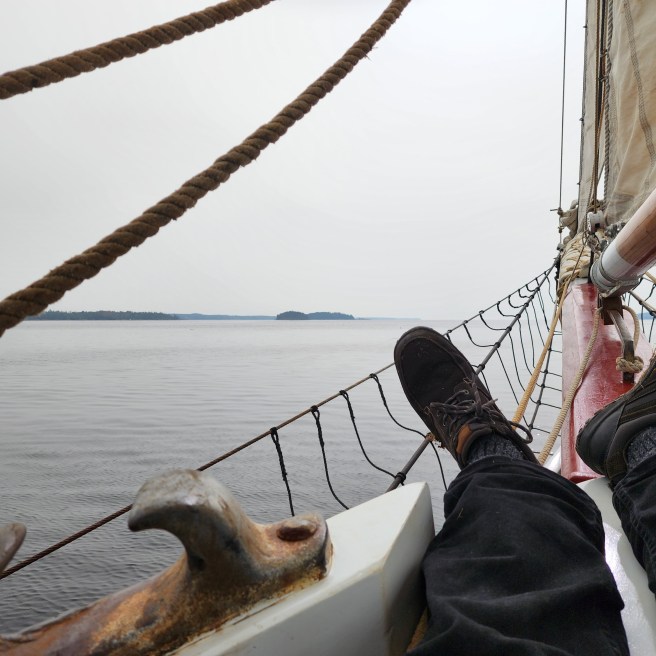
From the bow seat

Finally warm enough to take my cap off
and we’re getting some wind

yes, it’s all atmosphere

haze-infused grays with tinges of green forests
and bluish mountains

pulley block rasping behind me

the advantages of a cloudy day
without sunscreen
for a bald guy

sitting motionless
apart from a slight roll
in a nearly dead wind

how calming

am still surprised the tiny yawl can push this big boat

a porpoise here, a porpoise there
a bald eagle flies past

the chains to even the tension
on the bowsprit with jibs

Next up, a set of chain-reaction decisions

The roofing wasn’t the only thing taking place. We had to make some more key decisions regarding the next steps.

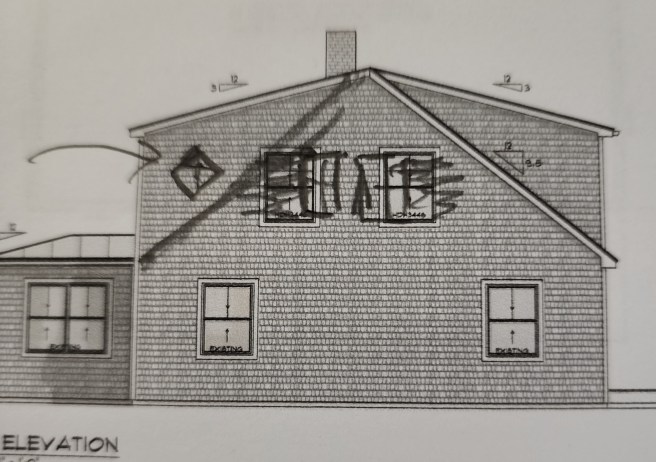
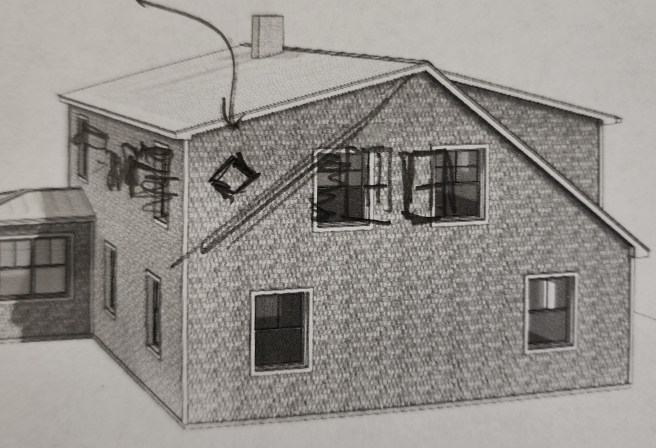
First was settling on the size and shapes and placement of windows in the back half of the house. We’ll examine those later. The glossy catalogues had a wide range of types and sizes, but no prices. For now, Adam needed to know where to frame them.

To do that much, we had to finalize our upstairs layout, at least roughly. A new bathroom and laundry room were part of that, details to come later.

Getting that far included electrical outlet placements along the exterior walls.

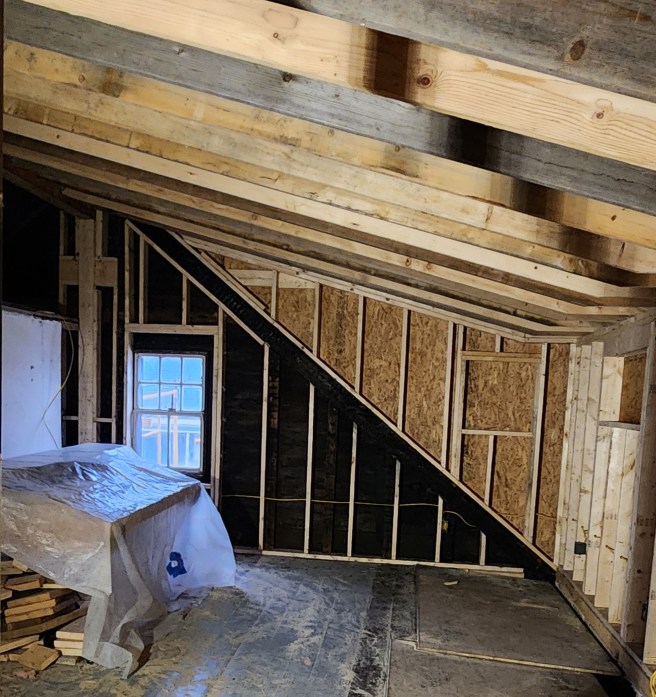
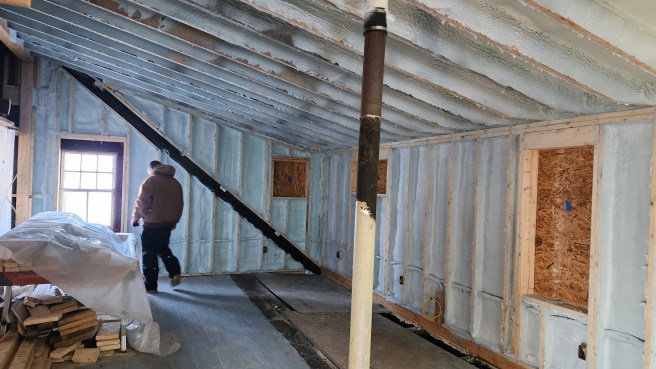
Those were steps that had to be taken before the spray-foam insulation crew showed up – which they did, two days after promised and leaving us with a nonrefundable Airbnb reservation. On top of that, we were required to be out of the house for 24 hours after they finished. Back to the Airbnb reservation. The crew’s deadline here was also contingent on a bigger job they were doing downtown – the two brothers live an hour-and-a-half from Eastport. We were second in line.

Before.

And after. Note that a diamond window in the corner is no longer in the plan.

Was avoiding a genre a mistake?

Introduced to contemporary Inuit art by professor who had been in Alaska as a consultant for the drafting of state constitution, I was told of one artist who never did a similar piece twice. If he carved an image of a standing bear, that was it – not even a painting or print would follow in that vein.

Apart from working in a series, which feels more like developing a single long piece, I’ve tried to avoid any sense of getting stuck in a vein of seeming repetition. I mean, if I do another bear, it’s going to be sitting or stretched out or even nursing cubs.

I have taken the thought to heart. I’ve wanted each of my books to be distinctly different.

Most readers, though, are different. Not just from me, but from art collectors, too. When these readers enter a bookstore, they want to know which way to head and then which shelves are most likely to produce pay dirt. In addition, publishers want to invest in sure-fire hits, even of a modest sort. Beyond that, librarians and literature teachers want to have labels to ease the handling of authors and new books.

And that’s why genres proliferate.

My, how naïve I was, setting out to write fiction. What’s the story? How well is it told? What’s it’s style?

First off, I don’t read in a genre. I’m not shopping for sci fi, per se, or romance or mystery or detective or fantasy or historical of any kind or young adult or even erotica aka pornography. And bestseller status means nothing for me, a veteran of the small-press scene. Nope, I’m fishing in what’s now called literary fiction, especially of the contemporary vein.

And, as I’ve learned, that label can be the kiss of death.

~*~

I object to genre mostly because it leads to stale, cliché ridden cookie-cutter commodities produced for mass consumption. I find them too predictable, formulaic, and jargon-filled. A genre comes with the requisite tropes, after all.

I write and read to discover, to make sense of life as I’ve known it, especially, no matter how far afield that goes. Haven’t I wandered across the Arctic or Sahara in some form, after all? I don’t need to go into interstellar space or an alternate reality to get away from everything. In fact, I doubt I can go anywhere without taking my personal baggage along. How about you?

 ~*~

As for conflict?

When Mrs. Hines, my senior-year high school English teacher, said that all fiction is based on conflict, I piped up, contrarian that I am, “Oh, no it’s not!” To some degree, I’ve been trying to prove my case.

Nor would anything I’ve done fit Kurt Vonnegut’s advice, “Be a sadist. No matter how sweet and innocent your leading characters, make awful things happen to them – in order that the reader may see what they are made of.”

There are no murders or bear attacks or invading armies in my stories. Well, maybe off somewhere in the distance. They never get personal. think most of my characters are nice folks.  Daffodil Uprising and Hometown News have the most outward conflict, I’d say, while Subway Visions has almost none. The most recent revisions have added some layers of darkness but not enough to alter the overall direction.

Stepping back, though, I see something that surprises me alone these lines. Almost all of my novels are countercultural, by definition in conflict with the surrounding society. In addition, the central conflicts are usually internal or small scale. In the Secret Side of Jaya, she sees and hears things others don’t. Tell me that’s not a conflict. Nearly Canaan examines the consequences of times and places a promise falls short, one after another, in the characters’ lives.

~*~

Still, I have to ask if my resistance against genre or commercial publishing has really been another fatal flaw in my ambitions. Would Subway Visions been more successful if I’d recast it as fantasy, for instance?

Was it foolish of me to avoid genre?

My genre, such as it is? Experimental fiction? It fits me but does little to attract a book buyer.

How about “contemporary history,” which is not an oxymoron. So much that’s happened in my lifetime is ancient history to the majority of the population. My daughters listen amazed at the era – did this or that really happen? Yes, I reply, and you take it all for granted. (Or granite, as I prefer.) So much of it runs counter to the mass-media stereotypes. Yes, my focus has been counterculture, as I’ve encountered it.

~*~

I do like the term genre-bending, which I’ve recently encountered. It’s something I was already exploring in the final round of revisions, especially once Cassia went goth.

A few things to do in Dayton

The Gem City of Ohio has taken some hard hits since I left for other points as an adult. Even then, many folks said there was nothing to do or see, but that’s not what I find in return visits. Here are some things I’ll recommend.

  1. Carillon Park: This charming 65-acre historical park, originating with support from the National Cash Register company and designed by the famed Olmstead brothers, is somewhat like Henry Ford’s Dearborn Village but much smaller and less crowded. Settled in the shadow of a limestone carillon tower donated by engineer and industrialist Edward Deeds and his wife, the campus of small, often historic buildings at the foot of a wooded hillside showcases the region’s industrial innovations and contributions to world progress. One pavilion displays an early Wright Brothers’ airplane, while other buildings feature the automotive self-starter (launching the Delco division of General Motors) and indoor refrigeration (leading to Frigidaire), among the many contributions inventor Charles F. Kettering that advanced the lives of Americans and the rest of the world. John Henry Patterson’s development of the cash register changed retailing from cigar-box accounting while pioneering modern marketing and creating demand where none had existed. The displays have grown and become more diverse, and there’s even brewpub and festivals now. Still, it used to be free admission.
  2. Air Force Museum: My, this trove at the edge of Wright-Patterson Air Force Base has come a long way from the old hangars it occupied inside the base when I was a teen. You can get lost in what’s billed as the world’s oldest and largest military aviation museum. Some of the Wright Brothers’ earliest work in human flight took place in this locale. Free admission.
  3. Cox Arboretum: New to me is this botanical delight on the former estate of newspaper publisher, governor, and U.S. Democratic presidential nominee James M. Cox. The floral displays and gardens at this 174-acre park can be stunning, the trails are gentle, and there’s even a butterfly house. Thank goodness it was spared from development.
  4. Dayton Art Institute: Some astute collecting over the years has resulted in a wide-ranging collection of masterpieces from both the Old World and the Americas. While others were bidding up prices on third-rate pieces by famed signatures, Dayton was acquiring first-rate works by lesser-known hands or rare pieces from Inca and Aztec traditions, among others. Now it even has extensive Asian galleries.    
  5. Paul Lawrence Dunbar home: The Black American poet is finally getting due attention. His neighborhood on the West Side, which he roamed with friends Orville and Wilbur Wright, is now restored and open to the public.
  6. America’s Packard Museum: New to me is the world’s largest public collection of Packard automobiles and memorabilia – more than 50 classic cars, thousands of parts, and a research library in a 60,000 square-foot facility that was built in 1917 as an art deco Packard dealership, the Citizens Motorcar Company.
  7. Miamisburg Mound and Fort Ancient: Many of my favorite memories involved hiking in the neighboring landscape. These two sites – one in neighboring Miamisburg, the other further south along the Little Miami River, give a clue to the wonders of the ancient peoples who constructed intricate earthworks we’re only beginning to comprehend – think Stonehenge, for an English parallel, only vaster. Miamisburg’s, for instance, rises 65 feet, has a circumference of 800 feet, and contains 54,000 cubic yards of earth, all built by hand.
  8. Clifton Gorge, John Bryan State Park, and Glen Helen: Upstream on the scenic Little Miami River, these three sites connect into one for the ambitious stroller. The gorge, or limestone canyon, was largely unknown when I explored it but is now more available to the public. The river then meanders through the state park and its trails. Glen Helen, in Yellow Springs, was part of Antioch College.
  9. Englewood dam: The largest of the five passive flood-control dams erected in the Great Miami River watershed after floodwaters in 1913 devasted the valley, Englewood’s is 4,716 feet long and 110.5 feet high, part of an innovative civic district and remarkable engineering feat that became a model for the federal Tennessee Valley Authority during the Great Depression. Here, as well as at the Taylorsville, Huffman, Germantown, and Lockington dams, the retarding basins on the upstream side and the wooded hillsides now form the Five Rivers Metroparks system. And downstream has never been inundated since.     
  10. Aullwood Audubon Center and Farm: Adjacent to Englewood dam is one more relief from the suburban sprawl that has overtaken much of Greater Dayton. This 200-acre sanctuary includes a nature center and educational farm, along with eight miles of walking trails.