Skillsets that became useful in my non-fiction book

Returning to that adage, “Write about what you know,” I realize how some work experience from my past gave me a unique edge in drafting Quaker Dover.

For instance:

  1. My journalism career included an early gig of pure research for a daily Action Line column. (We had an editor/writer, a secretary, and two researchers – big time!) Writing and editing, of course, were the staples of the rest of those years.
  2. From writing and then revising the novels, of course, I had explored the dynamics of building a large book and then the distinguishing qualities of fiction in contrast to journalism. I even learned to excise a hundred or more pages from a manuscript and not weep.
  3. My long service in Quaker meetings, as presiding clerk in addition to committee work and visitation, steeped me in the decision-making process and culture of the Society of Friends, past and present. Along the way, I gained familiarity with our peculiar customs and historic language, ranging from liberal “unprogrammed” worship at one end and old-order conservatives at another to pastor-led evangelical at the other extreme.
  4. Genealogy research accompanied much of those discoveries, especially as I gleaned the old minute books and journals. (Many of my findings appear on my blog, Orphan George.)
  5. Triangulation of three or more differing versions of an event, as I encountered especially in material and correspondence regarding my grandparents, became helpful in considering Colonial history in New England. I could live with the ambiguity while letting the conflicting accounts still add to the bigger picture.
  6. My long interest in geography – maps, especially – came to play in placing Dover in perspective with the rest of New England as well as Devonshire in England itself.
  7. My training as an artist in high school and my work with photojournalists in the years after came in handy in examining portraits of Quakers (once those were permitted) as well as related locations. Sometimes I could see where an individual was in regard to changes affecting Quaker practice and the world around them.
  8. Online sleuthing, rather than archives (which I had explored in the genealogy), came to the fore during the Covid-19 lockdowns. Somehow, I think my experience in formatting my novels as ebooks, fed into this, but I had already devoured many digital texts by the time I became amazed at the number of rare old, arcane books I could download for free.
  9. Despite the fact that Quaking Dover is a history involving political conflict, I was surprised to find that my political science degree didn’t add that much, though the way Vincent Ostrom had taught us to closely read an argument came in handy, especially in looking at a system from the ground up rather than top-down.
  10. Moving to Maine before the final revision and publication also added to my perspective as I settled in. Dover, like much of New Hampshire, gravitates toward Boston, as did much of the Dover Quaker history. Little did I suspect just how much Dover Friends and the broader community influenced the growth of Maine to the east and northeast once the territory reopened to English settlement once the conflicts with the French and their Native allies wound down – earlier than I had presumed, in fact.

Acid test poet: Frederico Garcia Lorca (1898-1936)

When surrealism hits the mark for me, there’s something natural rather than forced about it. The juxtaposition of images connects organically, without need for the intervening steps.

That’s why Lorca is among the writers who serve as a touchstone for me. Besides, I can more or less follow his Spanish in the original, not a given with other Spanish masters I’ve admired and enjoyed – Jorge Borges, Garbriel Marquez Garcia, Pablo Neruda, Octavio Paz, for instance. His volumes are the first I pull from the shelf in that direction.

I love the way he saw New York, by the way – did it influence my novel Subway Visions?

Add to that the tragedy of his life being cut short by Nationalists at the outbreak of the Spanish civil war.

They weren’t always considered romantic

The 1990 application to include the restored and repurposed Louis R. French in the National Register of Historic Places includes much more than a detailed physical description of the schooner and her history.

The National Park Service document, Louis R. French (Schooner), available online  portrays the two-masted coasting schooner as the most common American vessel type, with tens of thousands of them functioning as the “freight trucks” of their time, carrying coal, bricks, iron ore, grain, oysters, lumber, and even ice between ports.

Yet, at the time of the application, only five of them were surviving in the United States.

In addition, the French was the oldest surviving sailing vessel built in Maine, the center for wooden shipbuilding in the United States after the Civil War.

As the application noted, until the outbreak of World War II, the coasting schooners were so common that nobody paid much attention to them. Designed to run fairly close to shore, the coaster lacked the fishing schooner’s ability to ride out a gale offshore on the fishing grounds. Nor did the coaster approach the scale of the great four-, five-, or six-masted coal schooners that transported coal from southern to northern ports.

Deepwater sailors, who occasionally took a large schooner across the Atlantic, scorned the useful and ubiquitous little coasters, sometimes accusing their skippers of “setting their course by the bark of a dog.”

The application quoted maritime historian Howard I. Chapelle, who observed “the straight fore-and-aft-rigged schooner is decidedly a coastwise vessel, and attempts to use such craft for long voyages have invariably been disappointing and disillusioning, if not disastrous to the adventurers.”

The schooner supplanted the square-riggers in the coasting trade for practical reasons:

Fewer sailors were required to handle the vessel, and a schooner could be worked into and out of harbors and rivers more easily than any square-rigged craft. Her trips could also, as a rule, be made in quicker time, as she could sail closer into the wind, and it was hardly necessary for her to sail from Maine to New York by way of the Bermudas, as some square-rigged vessels have done during baffling winds.

Put another way, they were the errand boys, the short-haul freight droghers, and the passenger buses for many a year, and their contribution to coastal community life, especially in New England, was substantial.

“Without them, the country could hardly have been settled,” as the report quotes one source.

These days, there’s nothing Plain Jane about them, though. Not in my boat – err, book.

As an added complication, we were getting a woodburning stove

Considering the frequency and length of electrical outages in Maine, having an emergency heat source in place was a high priority. I’ll explain later what derailed us from going directly from an emergency generator. Wood heat was the more obvious answer for us, but the big obstacle was that we didn’t have a usable chimney. We couldn’t just run up to Tractor Supply or Tru-Value, pick out a cast-iron stove, plug it in, and breathe a sigh of comforting relief.

Instead, we needed some professional advice, and that’s where we were stymied. Local inquiries led nowhere. The nearest wood stove and fireplace dealers were 2½-hour drives away.

Since Ellsworth has two, that’s where we headed. The smaller dealership was far more helpful than the other – and it referred us to a nearby chimneysweep who, after we approached him, did agree to install a stove for us as well as, more crucially, addressing the chimney situation.

While a previous woodburning cook stove in the kitchen had vented into the same flue that the furnace uses, that’s now contrary to building code.

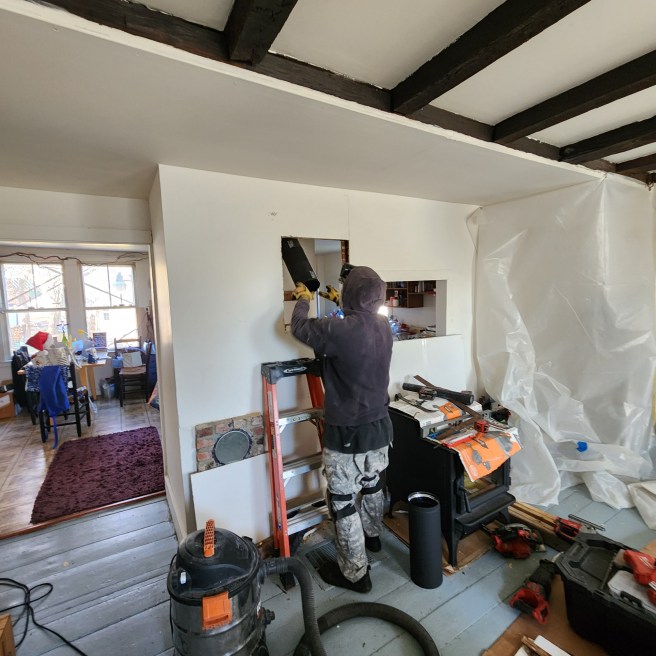
Tim confirmed that our best smoke-venting option was to run an insulated metal chimney pipe straight up next to the existing brick one. At this point, with our upstairs about to be torn apart and the rafters exposed, we wouldn’t be disrupting anything there. Our ultimate placement of the stove itself would require moving a water heater and a cold-air vent in the floor. Not that big of an issue, now that we had a contractor. Glory be!

As for the existing but inefficient hot water heater? That advanced our planned acquisition of a heat-exchange water heating unit, but just where?

That’s when Adam, our contractor, lined up a license plumber, Thomas. You’ll be meeting more of him later.

~*~

Back to the central decision, which stove?

From my days in the Pacific Northwest, I was impressed with the pioneering Norway’s Jotul brand, a view reenforced by our purchase and intensive use of a small model in New Hampshire two decades ago.

Still, looking for maximum efficiency of our new stove, I was pressed to research other available options. After all, a lot has happened in the interim. And how, as I discovered.

Since our stove was also for a power-outage alternative and not just supplemental heat, wood pellets were out of the question. Alas, perhaps. A pellet fire isn’t quite the same when it comes to simple repose.

Two new considerations for me were cast-iron versus straight metal. The former takes longer to warm up but holds longer. The latter, the opposite.

Since much of our usage Way Downeast involves offseason chilly mornings and evenings in spring and autumn, the metal models gained an advantage over cast iron. We’ll see how that holds.

A complicating factor was catalysts, which would require attention every few years – and, more critically, by whom? By this point, Jotul slipped from the picture.

From my book Quaking Dover, I knew that soapstone and other heat sustainers worked as efficiency boosters, but in this round, the added cost and weight didn’t fit our setting.

Vermont Castings, which had been our principal rival to Jotul, fell from consideration over quality control issues, as other, newer, brands came to the fore: Ambiance, Blaze King, and HearthStone, among them.

We did have to quibble about how our stove would look and function in our situation, but in the end, after a thorough review of the efficiency specs, sizes, and prices, we went with a Lopi model, one from an enterprising Pacific Northwest outfit.

Alleluia. We even got it installed before deep winter kicked in.

Second floor.

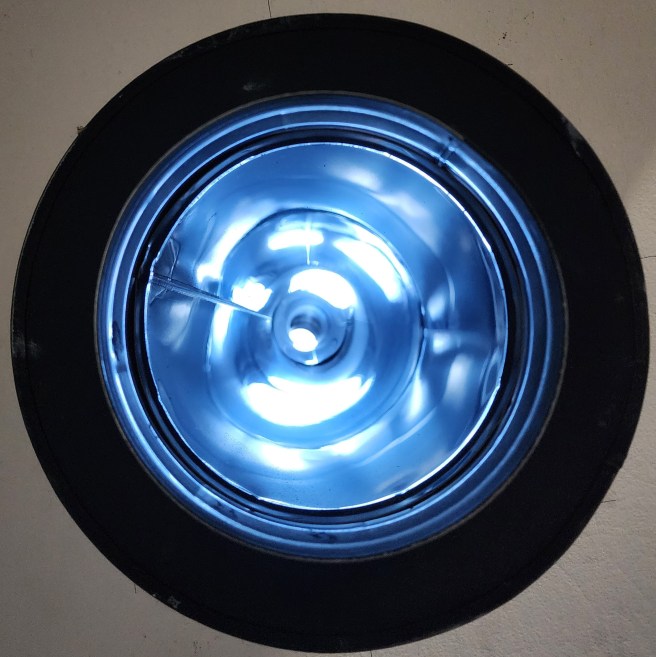
A view up the pipe before it was capped.

Meanwhile, on the ground floor.

And there it was, just in time for Christmas.

~*~

Let’s be honest. The new stove wasn’t entirely about emergency heating. It was mostly about having the utter pleasure of wood warmth. It was even about reducing our onerous fuel oil bills, even before we add heat-exchange units upstairs.

After waiting three years to get the renovations underway, the unfolding events sometimes felt chaotic. So much happened at once.

Still, looking at the glossy brochures, I’m left thinking there’s a much bigger picture left to be presented. Sitting back against the unrivaled comfort of a wood fire and reading in my favorite chair is an unsurpassed pleasure in my book. This was a definite improvement over our previous winters.

As a slide flash, as a writer I’m reminded about the adage, “Write only about what you know.” Is there anything like this in a novel? Or even a movie? Maybe the bearskin rug in front of a fire as a photo?

By the way, we never heard back from the other stove dealership. The bigger one. We do have an affinity for smaller is beautiful, especially when it’s family-centered.

Wandering through a personal wilderness without Moses or Miriam

Nothing was holding me Baltimore, as much as I loved it. And so, getting back into the American workforce in my mid-30s, I wound up in New Hampshire with the equivalent of a basket of wet literary laundry on those 5¼-inch floppy diskettes.

Although I had called on newspaper editors throughout the region, New England was largely unfamiliar to me. Apart from one couple in Boston, I knew no one. Beyond that, my love life was in ashes.

Thus, I unpacked in a new life along the Merrimack River in New Hampshire, the first of three addresses I would have in the state, fully intent on revising the lode I had mined and finding a literary agent or publisher once I got settled into my new job on the night shift.

What intrigues me looking back is that nothing in my life after my move to Baltimore prompted new fiction. Some details got woven into the revisions, but my literary output during the next three decades was mostly poetry, a more manageable format considering my hours of paid labor. Writing fiction demands the luxury of immersing yourself fully in the lives of your characters. It takes more than a full day once a week.

Besides, unlike my previous settings, New England has been thoroughly mined as far as fiction goes. What could I add to the picture? It had more layers and nuances than my previous locations, and many of them remained cryptic. Besides, I had enough to contend with in my existing manuscripts and the rapidly changing, increasingly confounding, commercial book world. Fewer publishers were accepting fiction, and those that did kept merging. More ominously, they weren’t nurturing promising authors with the hopes of getting a hit five books down the road but rather expected a blockbuster right out of the starting gate – if you could get in. It felt a lot like I had encountered as a newspaper syndicate field representative.

I was, however, appearing widely in the small-press literary scene, mostly with poetry but also chapter excerpts from the lingering novels. It kept me going.

~*~

My persistence finally paid off. After collecting the proverbial stack of rejections and a more widespread snubbing in which agents didn’t even bother to return the self-addressed-stamped-envelope, I finally got a nibble to co-publish with a Santa Barbara press of some distinction. Three years after my move to New England, Subway Hitchhikers appeared in print, right into what became the worst bookselling season in memory, thanks to the First Iraq War. Just my luck.

I did get one extended – and favorable – review, but that was it, no matter how much I pushed the self-promotion. My job schedule, which included a double-shift on Saturday, didn’t help. I couldn’t go to book fairs or author workshops.

My copies to sell appeared shortly after I had moved to a small townhouse atop the highest point in town. Moving them into the hands of readers and reviewers was the next challenge. As I said about the book market?

What did change was my self-image. Publication, for me, was the equivalent of a Master’s degree. I had something to show for my work. People respected that, even if they didn’t buy a copy. As for my personal life? There was a second Summer of Love! I was back in the euphoria of the early ‘70s, only better.

The swirl also had me thinking I could solve the tangle of my Pacific Northwest tale, so I kept revising, usually on a vacation week or holiday weekend.

And then, in 2005, Adventures on a Yoga Farm was published – as a pioneering ebook at PulpBits in Vermont. Again, it went nowhere as far as recognition, though several incarnations later, it’s Yoga Bootcamp and a much better book. As for timing? The yoga movement hadn’t yet rebounded and PDF books never really caught on. There I was ahead of the curve.

Somewhere in that stretch, my PC’s green screen went dead, already obsolete, meaning forget finding a replacement. Instead, the option was to upgrade to a new computer, one with a hard disk and telephone access to an online browser. Email was still somewhere off in the future. And I had to convert all of my keyboarded material from WordPerfect 4.1 to Microsoft’s Word. I wasn’t happy.

Are you one of the folks who recognizes these steps? Or are they all way before you came along?

And who sez the writing life is glamorous or that it runs along the lines of the movie plot were you’re suddenly rich and famous?

As I look back on this period, I see myself in a kind of wandering in the Sinai without a Moses or his sister Miriam to guide me. At least I developed an active social life, largely through contradancing and Quakers, and I was regularly riding Boston’s Green Line in underground tunnels.

A gross, invidious possibility

… who can think it possible that the president and two-thirds of the senate will ever be capable of such unworthy conduct. The idea is too gross and invidious to be entertained. But in such a case, if it should ever happen, the [ruling] so obtained … would, like all other fraudulent contracts, be null and void by the laws of the nations.

John Jay in Federalist No. 64

An eclipse too good to be true

Against all odds for this time of the year in Maine, the long awaited full solar-eclipse day delivered ideal weather. Amazingly, especially for April, after a week of gray, rain, and snow, the sky stretched cloudless, the air was crisp, and temperatures edged into the 50s. It felt too good to be true. If I had been a betting man, this was a wager thing I would have lost.

You’ve no doubt heard about the swarm of curiosity seekers who mobbed the narrow band of total eclipse as it moved up from Texas and through the Midwest and eventually through northern New England. I won’t rehash that part of the story. For us, the question came down to finding a place to observe the astronomical event without the carnival congestion and related distractions.

Houlton, 115 miles to the north of us, touted itself as the ultimate destination and publicized accordingly. After a snow-scant winter, they needed to recover from severe winter tourism losses. We wished them well but thought other locales, perhaps Millinocket, might be saner, even though more distant.

Houlton is normally a two-hour, 18-minute drive to the north of us. Narrow, forested, two-lane U.S. 1 the only route for most of the way. For others, it’s at the upper end of Interstate 95, just before Canada. It’s not only the seat of potato-famed Aroostook County, it’s also the principal access point. We had to wonder how widely some of the metropolitan traffic would spill over into Washington County, perhaps once GPS started rerouting traffic to alternate highways. It wouldn’t take much to jam up everything for us and everyone else.

In planning for our adventure, we scoured the maps and settled on Danforth, population 587 spread over 60.46 square miles (6.46 of that being water) at the northern edge of our county, just before Aroostook. Danforth was on the way to Houlton anyway and would receive just about the same timespan of total eclipse. How heavenly, if we could stay out of the mud and muck. We focused on a side road north from the village at the center of town and hoped the route was paved. No guarantees from the map or satellite photos. If not, considering impassable conditions this time of year, we’d need to have plans B, C, and D at hand. We zeroed in on two cemeteries as possible places to set up our folding chairs, and headed off, leaving ourselves a generous margin of time for delays and readjustment.

Too good to be true, we instead had smooth sailing all the way, scouted out our sites and some gorgeous scenery, even noted the possibility of crashing Mike & Kay’s Eclipse Party that a homemade roadside sign presented. But where was everybody? Had we deluded ourselves? What had we overlooked? The scenery, though, was gorgeous.

We decided to head back to the village and stopped at the only restaurant in town, one with fuel service and a single rest room, which had a long line. No surprise. We were, though, surprised by the number of friends and neighbors from Eastport we ran into. Oh, yes, the food was better than most you’d find in a diner and the service was prompt and friendly, despite the throng at the front of the store. I’d stop there again, definitely.

I did have to laugh at the pristine black tee-shirt one woman wore. It featured photos of the cycle of a solar eclipse and the time 4:36. Where we were, totality was set to begin at 3:32. Was I the only one aware that she was running on Atlantic Daylight Savings to the east in Canada?

Beyond that, here’s what we found:
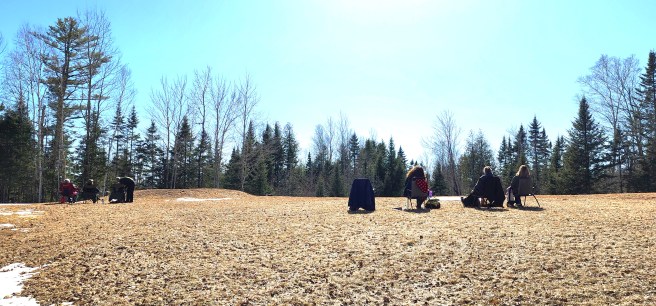
When we returned to the cemetery, which had been No. 2 on our list until we discovered that No. 1 was tiny, wet, and too heavily wooded, we were jolted to see we had unexpected company. A party of three was firmly ensconced. Were they locals? Would they resent our intrusion? Nah, they were from just a few towns down the road from us in Eastport, and their planning paralleled ours. As kindred spirits, they became the perfect associates for our experience, the kind who swapped food with us and had prepared accordingly. Their holiday greetings had even gone out with 200 pairs of eclipse glasses and best wishes for looking ahead in 2024. Yeah, they were a plus.

Maybe this was true, after all.

It may be spring, but there were still patches of fresh snow on the ground, some with large tracks I’ve since identified as wolves. Seems that in this stretch of Maine, wolves range in from neighboring Canada. I was almost disappointed they weren’t bear.

Also almost too good to be true was those flimsy little fold-up solar eclipse glasses, which completely blocked any light except the sun’s. These weren’t Cracker Jack prizes but rather surprisingly effective. My previous full eclipse, the late ’70s in the desert of Washington state, lacked that advance. This was a leap ahead of the smoked glass that made the rounds back then. This time we watched the progression as the overlay of the moon slowly created a crescent sun, eventually resembling the familiar waning or new moon. Well, this was a kind of turnabout as fair play, right?

As we estimated the amount of the sun’s face that was being covered, we were impressed by how much illumination still surrounded us. Even at 90 percent coverage, we could have been convinced this was only a hazy day. Back in the ’90s, I had been in the woods during a partial eclipse and been disconcerted by the eerie monochrome that fell upon us. It wasn’t precisely twilight but a kind of graying, almost like a dry fog. That’s what now happened, around 98 percent coverage, accompanied by the appearance of a flock of confused grackles and a gush of cold air from the direction of the sun rather than the stiff breezes that had been at our backs.

And then the incredible began in a rapid sequence. We could remove our protective film lenses and look at the sun, which was not yet a ring of fire but instead a spotlight of pure white rather than its usual yellows. It was unearthly, eternal, perhaps suggestive of the light proclaimed in the Tibetan Book of the Dead or the words of creation in Genesis and the gospel of John. This platinum brilliance hung over us, out of time and then gone, replaced by the anticipated disc accompanied by Venus and Jupiter.
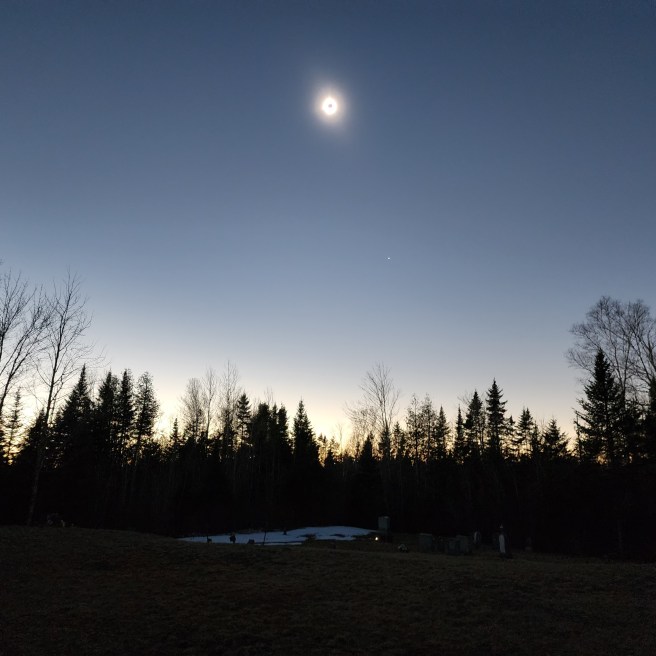
Trying to photograph the distant ring of the sun’s surface with a cell phone was elusive. Instead, enough light still poured forth to fill in most of the orb, leaving only that dark pinhole. We gazed on a small bead just to the left of the bottom of the orb, a spot where the sun would begin to emerge as if being reborn. Somehow, we overlooked the small memorial lamp at a headstone in the cemetery where we were.

And then, once more, that pure white spotlight blasted toward us in utter, aloof majesty, and the regression toward some normality began.

The camera sees in its own way. Somehow, the rainbow is fitting. And the moon still covered most of the sun, despite what you observe here.

Shadows, by the way, are sharpened.

Yes, it was almost too good to be true.