My first nights out on the water

sleeping with the ocean
a mere foot from my head

the ship at port / anchored creaks, lines grinding / groaning
I hear the neighbors either side
Intimately

have you read
a common topic so uncommon
elsewhere

“I’m dying to be a better reader”

like digging a hole
I like going to bed
or lying on a beach

back below, in my berth
I hear steady breathing a few feet away
only a thin wall separating our heads

her boyfriend’s in crab school

yep, they giggle
unlike the couple with Southern accents
from Florida

the knitting picked up again

I’m going to sleep
[I’m falling asleep]
and so is most of the rest

finally

how many times will I be up
in the middle of the night
the head’s up on deck

I’m glad it’s not raining
or heavily foggy

though we’re sleeping at sea
it’s calmer than a water bed

creaking and thumps
more likely my neighbors
than the interplay of planks and sea

yes, somebody’s bones

now, for that damned mosquito
or some scratching overhead

who just dropped what
on the deck above me?

a shutting door
with a latch
and shuffling

who’s securing the gear
in the dusk?

what a still, calm spot she’s chosen
for the night

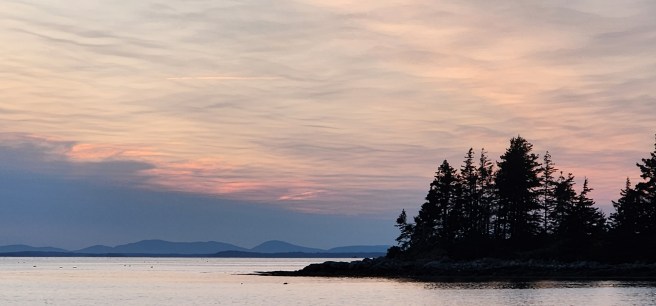
3:30 am, a nearly full moon
scattering sound of steady traffic
the other side of Isle au Haut
(the south)
may simply be the water motion

there’s definitely surf other side,
slight breeze, 1 mph?
to the west

can barely see Polaris
light cloud cover

only one plane overhead
on the European flight way

and the flash of a fishing boat
light array
in the gap of Deer Isle

what’s all the noise around me tonight
besides a stray cough
or zipper
are we really that restless

I have no idea what the Patriots
or Sox
did over the weekend
though they’ve been spiraling downward

light snoring in my ear last night

I had the most erotic dream
of someone who in reality was almost well

This could become obsessive.
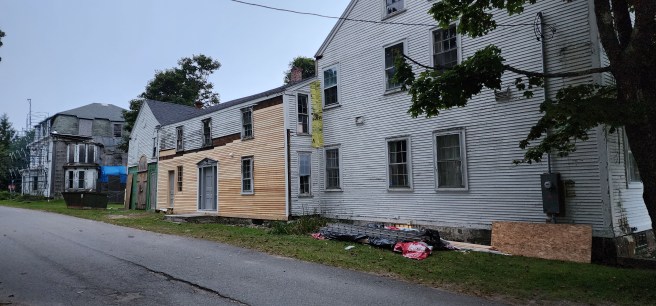
It’s not like our project’s so unusual in the bigger picture

Those of you who have constructed a house from scratch must be looking at our renovation like it’s peanuts. And, in many ways, it is. We weren’t starting with talks with an architect or even inspecting an undeveloped site beforehand. No, that must be truly thrilling. There’d be none of the frustration of trying to retrofit your dream into what others had done before you, either.

For the record, we did look seriously at a couple of undeveloped sites in town and played with the challenges, but they were beyond our means, leaving us to always lament the spectacular views that others now enjoy while also wondering how we would have managed the timing.

Still, to be fully honest, I have to say what’s unfolded before us is truly exciting, at least from our end. That kinda brings me back to that adage about writing about what you know, or at least what you find most fascinating at the moment.

But it’s also humbling. Just consider how much of daily existence we take for granted, at least in the so-called developed world.

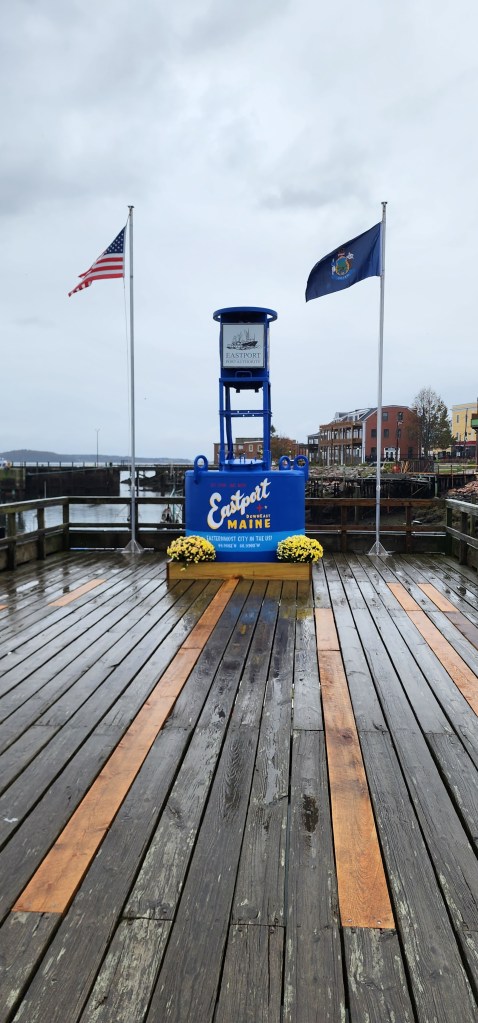
The Isaac Hobbs mansion, off to the far corner of our block, is undergoing a thorough restoration. Half of it was about to cave in when we bought our property, but that’s no longer the case. The new owner wants to be historically accurate, as far as possible. In contrast, we want ours to be more livable. Besides, most of the period detail was ripped out decades ago.

A further block up the street, a more spectacular upgrade is being given to the circa 1807 federal house Aaron Hayden built and General Samuel D. Leavitt transformed into mansard mansion in the 1880s. It had fallen into foreclosure before its bold new owners came to town on the heels of Covid.

Leavitt was also Eastport’s first mayor.

Reader, beware, if you must.

What do you mean, how do I write?

Isn’t it obvious, one word at a time? Except it’s more complicated than that, and every writer approaches the deed differently.

I would like to approach a writing project the way Neal Welliver did his large-scale paintings, starting in the upper left-hand corner and finishing in the lower right. He worked with a tightly defined palate, too. Instead, I wind up more like Mark Rothko, painting over earlier parts, adding or scraping off layers – what’s known as “painterly.”

For novelists, the difference is posed as “outliner,” meaning someone who starts out with an outline and pretty much sticks with it, versus a “pantser,” going by the seat-of-the-pants with perhaps a vague sense of a destination, which may very well change en route.

You can guess which camp I’m in. As another artist put it, what’s the point of putting all that work in if you already know the ending?

For the record, I hated outlining when it was assigned as school homework. It seemed redundant.

~*~

I don’t like formal prompts, by the way. Instead, I often start with something that keeps nagging at me, the way the flash of a trackside worker in Brooklyn – a gandy dancer – turned into a subway line hitchhiker. (Maybe that third element, the unique word, turned the trick.)

As a project percolates, so do related ideas during the rest of my day, leading to piles of scribbled notes to weave in. When I lived in New Hampshire’s seacoast region and worked in Manchester, I had an hour commute in each direction, largely through rural country. I kept a notebook and pen at hand as I drove. Likewise, some of my favorite lines in What’s Left came to mind while swimming laps in the city’s indoor pool. As soon as I was back in the locker room, I was scribbling. Getting up from the keyboard every hour or so, sometimes adding a short walk, also works wonders. As a journalist, some of my best headlines came on my way to the men’s room or back.

Much of my writing then becomes the way of connecting two thoughts or flashes.

Outtakes from other projects also get recycled, though they rarely wind up quite how they began. I’ve drawn heavily from correspondence, maps, and photos as well, as well as silent meditation. As has been said, some of the best barns in New England were designed in Quaker Meeting, and it is amazing how many problems get worked out by stepping away from them.

~*~

As much as I’ve longed for an editor or a partner truly in sync with what I’m about, that hasn’t been the case, not since my first lover, back in college. Instead, I’ve been a lone ranger. It’s meant putting big projects aside for several months or even years before coming back to them afresh.

~*~

There are also the epiphanies when a character starts dictating the story, as well as the times of slogging through mud.

I should also mention learning from other writers, especially by example.

~*~

Determining when a work is finished is usually a mystery. My high school art teacher used to say I either stopped too so or else overworked a piece. I’d prefer too soon, since my usual taste leans toward austere. Think Quaker, Shaker, or Zen.

Another answer would be that I stop when I have nothing more to say on the project, for now. Or, as I’ve heard elsewhere, when the writer just gets tired of it.

As a newsman, a more common answer was the arrival of a deadline.

No time for extended deliberation

Of all the cares or concerns of government, the direction of war most particularly demands those qualities which distinguish the exercise of power by a single hand. The direction of war implies the direction of the common strength; and the power of directing and employing the common strength, forms an unusual and essential part in the definition of the executive authority.

Alexander Hamilton in Federalist No. 74

In making public presentations about my book

I came to love the question-and-answer period, but there would typically be one that threw me for a loop. Yes, the ones I wish I had answered better.

For example:

How could you sleep after writing some of the sections?

I did quip that a martini before bedtime helped. I could have mentioned the realities of working as a newspaper editor and having to face daily atrocities abroad and close at hand.

You developed ways of putting it behind a plexiglass shield, so to speak. Not that it always worked.

What was it about Quakers coming back for more trouble?

They had a lot more in common with the Puritans than we’d like to admit and no doubt saw them as falling far short of the goal they proclaimed.

The Puritans of Massachusetts Bay and Connecticut weren’t the worst, by the way. Historian John Carroll suggests colonial Virginia may have been even more severe but undocumented.

I wish I had mentioned that the concept of a loyal opposition springs from the Quaker Peace Testimony, and that the two-party system originated in Pennsylvania.

Do you need to be a protester to be a Quaker?

Nope.

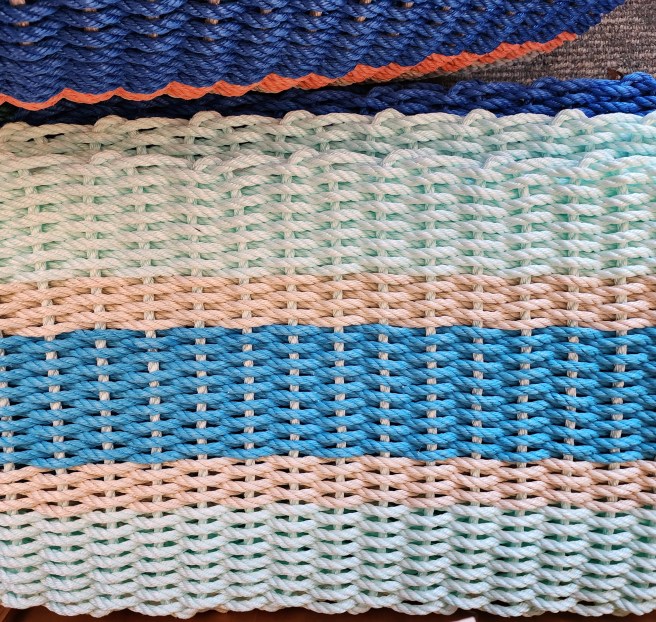
Lobster rope doormat

Colorful, hardy, distinct, and local. I am surprised by how much they’re going for online, compared to what our galleries and boutiques are charging here.

Once used to tether lobster traps to their buoys, the polypropylene or polysteel rope has many other nautical uses, where it’s touted as “marine-grade commercial fishing line.”

It shows up in creative baskets and other woven items, too.

Some disturbing trends about suicides

In my March 19 post noting the arrival of spring, I noted that the months of April, May, and June are generally the leading time of the year for suicides.

Among other trends in the United States, consider:

  1. Males are almost four times more likely to kill themselves than are females.
  2. Guns are the most common form of suicide, accounting for more than half of the deaths. Suffocation is second, at one-quarter, and poisoning at 12 percent.
  3. Between 2001-2020, suicide rates rose roughly 36 percent.
  4. It’s the tenth leading cause of death overall.
  5. By age groupings, people 85 and older have the highest rate (22.4 per 100,00), followed by 75-84 (19.6) and 25-34 (19.4). For 35- to 54-year-olds, it’s the fourth leading cause of death; for 10- to-34-year-olds, it’s the second highest cause.
  6. It’s now the leading cause of death for 13- and 14-year-olds, having doubled in the decade of 2008 to 2018. Bullying, school stress, and use of social media are considered potential causes. Higher rates are also reported among young people who identify as lesbian, gay, or bisexual compared to their peers who identify as heterosexual.
  7. Among racial/ethnic groupings, non-Hispanic American Indian/Alaska natives have the highest rate (28.1), followed by non-Hispanic white (17.4). Non-Hispanic Asian has the lowest (6.8).
  8. The American Psychological Association notes that suicides have increased most sharply in rural communities, where loss of farming and manufacturing jobs has led to economic declines over the past quarter century. Economists Anne Case and Angus Deaton, examining the steep rise in deaths from suicide, drugs and alcohol among white, middle-aged Americans in that period, argue these “deaths of despair” are linked to a deterioration of economic and social well-being among the white working class.
  9. Others with higher-than-average rates of suicide are veterans as well as workers in certain industries and occupations like mining and construction.
  10. For every suicide death, there were another three hospitalizations, eight emergency room visits, and 38 self-reported suicide attempts.