Scratch that, add this

Back when I was a summer camp counselor, I had one of Phil Donahue’s kids among my assigned campers. On parents’ night, he advised me to revise, revise, revise, as he was doing as a newscaster. And then he turned into a hot syndicated talk-show host.

It took me a while to appreciate his counsel, along with the adage, “Talent goes into the first draft, genius goes into the revision.”

Originally, my feelings about revision were like those regarding playing musical scales, relegating the practice to a secondary status nay nuisance. It took me a long time to appreciate doing it as a practice in itself rather than as a prelude to the primary action.

Indeed, more than once I’ve discovered a better novel buried under the first draft. Or perhaps lurking in its bones, waiting for release, akin to Michaelangelo’s block of marble.

It’s never easy, though. Thorough revision takes longer than the draft did, and that’s for each sweep. The fact remains that multiple deep revisions will be required.

One of the places it engages me is the use of synonyms. I’ve come to rely on a thesaurus more than some other writers, and doing so comes with a caution. While it increases the vocabulary count and possibly adds words a reader doesn’t know, I feel it allows me to unpack dimensions of a central word or phrase that keeps repeating in a long work. In my case, there are usually 20 or so in each piece, and I find them cloying. Take the term “revision,” which turns out to include amendment, reconsideration, modification, adjustment, alteration, change, correction, improvement as its shadings. It’s much more thorough than typical editing.

In some of my manuscripts, the revisions demanded I change the tense throughout, as well as the point of view – third person to first to second, for example. The genders of key characters even flipped.

With ebooks, I’ve even replaced the titles and characters’ names.

~*~

While I had done major revisions on Subway Hitchhikers from its inception to the breakthrough publication, the manuscript had also grown blubbery with backstory and detail in the in-between stages. My revisions occurred in sweeps in my moves from Ohio to Indiana to Washington state back to Iowa and another corner of Ohio and finally Baltimore, adding backstory and explanation before landing on the butcher block that produced a lacy, playful ride through the imagination.

Still, that process was nothing like what happened after my move to New Hampshire and had a computer to work from. I can’t imagine trying to retype so many pages on paper, nor did I have the funds to hire a typist for the pile of drafts in front of me. Remember the poor starving artist image?

When Hitchhikers came out, I had been in New Hampshire three years.

I had all that excess from its intervening years and saw promise for several new books in those pages. I took them back to the drawing board.

Emotionally, I was going through a long recovery period, including therapy – self-induced depression, as I quipped. In the process, I was learning to take feelings more seriously, and that extended to my revisions. What was the underlying feeling in a particular line or scene, rather than simply the action or physical detail? That sort of thing.

At least I once again had mountains at hand, abetted this time by the Atlantic, and even a boss with a sailboat for some of my initial outings.

With a pile of drafts already keyboarded, I could pick up a section in any available time and work away to make it somehow better.

This was when I really began to appreciate the importance of deep revision. Not just the superficial polishing to make a story read more clearly, but transformations to probe into underlying events. I was examining much that I had experienced in my life without fully seeing what was happening at the time. Some of these were shared by many in my generation. Some by kindred spirits who were simply somewhere out of the spotlight. And some were essential unique and personal.

~*~

As I reflect on the revision process here, I ask about what was going on in the background. Remarrying grounded me, for certain, and gave me a sounding board for troubling passages. As I’ve joked, everything before that now became ancient history, including the substance of the lingering novels.

What, if anything, was playing in the background as I worked in the top-floor next, my not-quite Fortress of Solitude? Kronos Quartet, late Miles Davis, or the Shostakovich preludes and fugues might give me a different ambiance than Bach organ works or Beethoven – some inclination for edginess or gravity, depending. If someone was in the bedroom on the other half of the top floor could have an impact, too, if only by limiting by space to pace within.

The view outside, the weather, even the season of the year?

So far, I haven’t heard any discussions about the practice of revising, certainly not along the scale of drafting. I’m coming to think of it as living with a project, the way you would with a kid in the household, knowing vaguely that at some point they’re going to grow up and leave.

All politics is local

Measures will too often be decided according to their probable effect, not on the national prosperity and happiness, but on the prejudices, interests and pursuits of the governments and people of the individual States. … The great interests of the nation have suffered … from an undue attention to the local prejudices, interests and views of the particular States.

James Madison in Federalist No. 46

How I slowly became aware of Greek-Americans

Back in high school, my best friend’s mom was buddies with a Greek neighbor who used to proclaim, “Athens! She is beautiful! The rest of the country?” A spitting sound I could never ever spell out accompanied by the open palms of both hands coming down side by side from overhead.

His other best friend was Greek, too. A kind of philosopher, in fact.

My civics teacher was Greek, as was the drama and debate coach.

In college, a landmark restaurant just off campus passed into a new generation much the way the one in my fictional Daffodil did. Somehow, the details stayed vaguely with me.

Off in the Pacific Northwest, I became fond of souvlaki and spanakopita on our forays to the University District of Seattle.

On my return to Ohio, there was a delightful Greek bakery in a small storefront on a quiet residential street six or seven blocks east of our house.

In Baltimore, “All the pizza’s made by Greeks,” seemed wrong – where were the Italians? And out on the road, “All the diners are owned by Greeks.” Little did I know about flatbreads.

In New Hampshire, the Athens restaurant in downtown Manchester – popular but, to my senses, bland and tired – in contrast to one of my favorite takeout places where we ordered for the office – the menu that introduced me to gyros.

Add to that the cathedral’s big Glendi, which sent food to the newsroom in gratitude for our coverage, or the little frame St. Nicholas I’d pass on one route to and from the paper.

One of our older coworkers, a photo lab tech, was Greek – kind and smiling, though I got to know little else.

A sharp-tongued but very competent colleague in the composing room was also Greek. Named Pericles after his grandfather, though it was shortened for us.

All of this was fleeting and fragmentary but came together in Dover and its annual, free-admission Greek festival.

And then confirmed at Davos in Watertown Square, Massachusetts, a block down the street from our weekly choir practice. The food was great, though run by Hispanics.

Now I can tell you there are Greek-Americans almost everywhere. Opa!

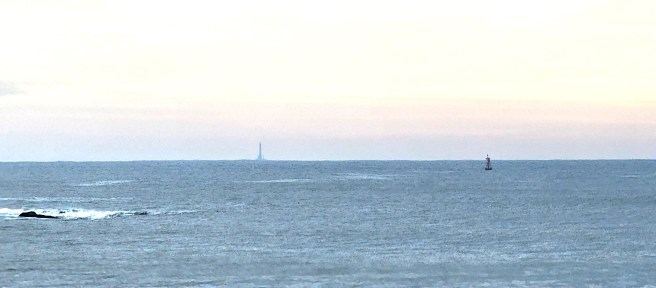
Boon Island lighthouse


The 135-foot-high lighthouse, the tallest in New England, sits remotely on a treacherous, tiny island seven miles off the coast in York, Maine.

The rocky outcropping was the site of a 1710 shipwreck that left the stranded sailors resorting to cannibalism to survive the winter before their rescue.

The current cylindrical tower was built in 1855 after earlier ones had been washed away.

As one of the most remote lighthouses in New England, it has a wild history.

No, tomatoes don’t all taste the same

The first year I witnessed the gardener in our household sprout and then transplant a dozen or so varieties of tomatoes, I was perplexed. Foolish me, I thought tomatoes were pretty interchangeable. Not so by the end of summer, when I had discovered how much each variety had its own identity. Some ripened earlier than others, a major consideration in our short growing season. Some were firmer while others were juicier. Each variety matured in its own size and shape. Trying to describe the range of flavors could soon sound like a wine tasting commentary. So far, we’ve had nothing that has delivered a hint of slightly warm asphalt, which seemed to be a plus for one wine critic. We’ll save you our own take.

Also important to us is disease and blight resistance. New England can be a difficult region for tomato growers.

Here’s a sampling of what we’ve cultivated, eaten, and even dried, canned, or bagged frozen.

  1. Goldie: A large, deep orange, slicing beefsteak fruit. “The perfect tomato,” as I blogged back on August 26, 2021, touting it for its starring role on my beloved sandwiches. This heirloom variety is one of the last to blossom and bear harvest for us, but it’s definitely worth the wait.
  2. Pruden’s Purple: Valued as being one of the first large tomatoes to mature (72 days), this firm wonder has a distinctive deep pink, ridged appearance. It also contains few seeds. The flavor is described as nicely balanced between sweet and tart.
  3. Brandywine: A very popular large heirloom, this one generally matures in 80 to 90 days. Many folks consider it the tastiest of the lot. Its leaves resemble potato plants more than tomatoes, and the heavy fruit means the plants need a lot of support.
  4. Yellow Brandywine: A gold-yellow variation created in 1991 from the famed Brandywine heirloom, this beefsteak weighs in at up to two whopping pounds a globe.
  5. Sungold: These tangy sweet golden orange cherry-size tomatoes are among the earliest to arrive for us – within two months, supposedly, though for us that meant early August last year – yet continued to deliver through September. Harvesting at peak can be tricky, though: a shade too early misses the glory, but a shade too late and they start to spoil. Their flavor is described as intense and sugary-sweet, a delightful addition to salads. They form in clusters of ten to 20 tomatoes on a vine. Add to it the red Glacier, another cherry tomato that arrives early and continues valiantly into autumn.
  6. Juliet: This small, elongated, prolific paste tomato has been a true workhorse for us. It freezes well, providing a foundation for soup and sauces throughout the winter. Lately, we’ve augmented this one with Plum Regal, primed for the end of the season; Amish Paste, a larger elongated plum tomato that also works well for soup and sauces; and Roma, an egg-shaped three-incher prized for making paste and sauces.
  7. Opalka: At the larger end of the paste tomatoes, this Polish entry grows up to five feet tall and has irregularly-shaped fruit up to six inches long. Tasters at Fedco Seeds described it as “an oasis of flavor in a desert of tomato hell,” “a pleasing texture and good aftertaste lingers,” “round and mellow flavor… full-bodied.” As I was saying about critical taste analysis?
  8. Cosmonaut Volkov: Back to the one-pounders I love for tomato-and-mayo sandwiches, this slightly flattened beefsteak is named for a Russian astronaut who died returning from space. It can go mushy if overripe, though.
  9. Omar: Or more accurately, Omar’s Lebanese, which was introduced in 1996 via a Lebanese college student named Omar Saab. Typically weighing in at up to 1½ pounds apiece, the fruit sometimes ambitiously reaches three or four pounds. The flavor is described as “multidimensional sweet.”
  10. Copper Beauty: An elongated and very tasty small tomato, this one still has lots of green in its skin when ripe, augmented by orange streaks, along with a dark red interior when sliced.

And we haven’t even touched on some fine “black” tomatoes.


Acid test novelist: Grace Metalious (1924-1964)

One of my colleagues at the New Hampshire Sunday News insisted that Metalious was a much better writer than the tabloid image that plagued her and her notorious book.

After reading Peyton Place, I have to agree. The realities it exposed are no longer scandalous but widely acknowledged. The novel, meanwhile, is skillfully accomplished and hints at more that could have been accomplished under other conditions. She certainly understood the unspoken skeletons of northern New England as well as anyone else I could mention, and she took the risks of admitting the dark undercurrents of survival in a small town anywhere in the country.

Her personal life, on the other hand, is an American tragedy.

My first nights out on the water

sleeping with the ocean
a mere foot from my head

the ship at port / anchored creaks, lines grinding / groaning
I hear the neighbors either side
Intimately

have you read
a common topic so uncommon
elsewhere

“I’m dying to be a better reader”

like digging a hole
I like going to bed
or lying on a beach

back below, in my berth
I hear steady breathing a few feet away
only a thin wall separating our heads

her boyfriend’s in crab school

yep, they giggle
unlike the couple with Southern accents
from Florida

the knitting picked up again

I’m going to sleep
[I’m falling asleep]
and so is most of the rest

finally

how many times will I be up
in the middle of the night
the head’s up on deck

I’m glad it’s not raining
or heavily foggy

though we’re sleeping at sea
it’s calmer than a water bed

creaking and thumps
more likely my neighbors
than the interplay of planks and sea

yes, somebody’s bones

now, for that damned mosquito
or some scratching overhead

who just dropped what
on the deck above me?

a shutting door
with a latch
and shuffling

who’s securing the gear
in the dusk?

what a still, calm spot she’s chosen
for the night

3:30 am, a nearly full moon
scattering sound of steady traffic
the other side of Isle au Haut
(the south)
may simply be the water motion

there’s definitely surf other side,
slight breeze, 1 mph?
to the west

can barely see Polaris
light cloud cover

only one plane overhead
on the European flight way

and the flash of a fishing boat
light array
in the gap of Deer Isle

what’s all the noise around me tonight
besides a stray cough
or zipper

are we really that restless

I have no idea what the Patriots
or Sox
did over the weekend
though they’ve been spiraling downward

light snoring in my ear last night

I had the most erotic dream
of someone who in reality was almost well

This could become obsessive.