
Yes, spring is finally breaking out around here. Whiting, Maine.
You never know what we'll churn up in cleaning a stall
Yes, spring is finally breaking out around here. Whiting, Maine.
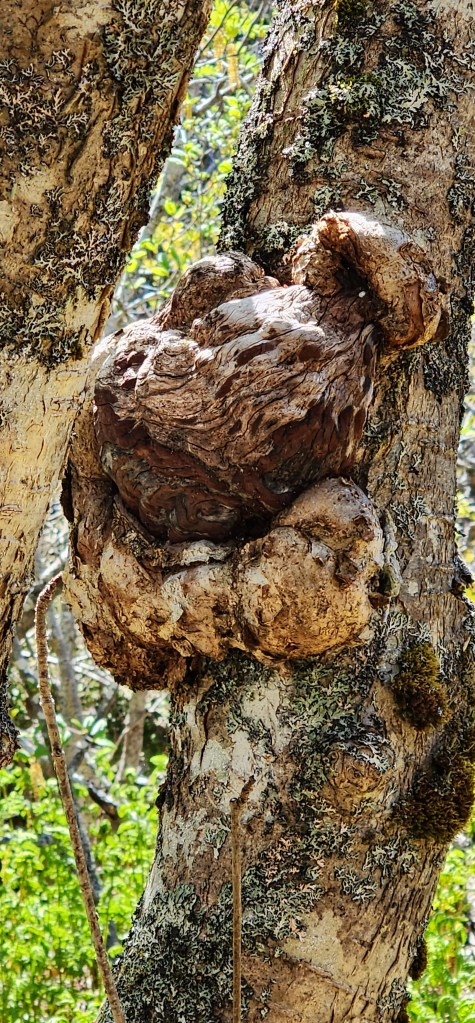
Gnarled trunk on a trail at West Quoddy looks like a living gargoyle.
One place I was appearing as a writer was in the small-press realm. Largely unseen and at the fringe of the literary world, its prolific, low-circulation reviews, quarterlies, ‘zines, chapbooks, and even full-sized books reflected a passion for literature, an intense mission, or outright ambition rather than an accountant’s commercial motivation. Many were marginally funded, mimeographed or photocopied, while others had more traditional printers, perhaps even typesetters, and a few of the biggest even had paid staff. Most were edited by dedicated individuals or partnerships; others by an institution or circle; and still others by college English departments, with either students or faculty as the team.
It’s where the action was – and remains.
Among the book publishers, Black Sparrow and Copper Canyon stand out, along with Shambala for a Buddhist focus.
In general, university book presses garnered more respect and financial backing and weren’t open to those of us who weren’t in a professorial track.
In college, I had been told of a widely recognized poet who averaged 20 rejections for every poem he had accepted in one of these journals. That was meant as inspiration to keep us lesser voices from despair.
Well, a few years later, I was getting about 20 rejections for every batch of five poems I mailed out. Still, I got more than a thousand acceptances. They usually paid me with two contributor’s copies, or did before the action shifted online. There are some fine online sites, by the way, if you look.
The track was how you were supposed to build a reputation and even entice an agent or editor. I think they were all too busy to notice.
A newspaper career was usually supposed to grow the same way: start out on a small daily somewhere out in the sticks, one with next to nothing pay, and work your way up. Or as one critic warned publishers, this was a process of eating your young. Or your seed corn, in another version.
(The highest income I ever reached, by the way, was the national median. And that was thanks to our Newspaper Guild contract, unlike most of our rivals.)
~*~
Acceptances created another challenge, drafting a contributor’s note.
I noticed that many of the writers listed their most recent book or two, but I really didn’t have that much. Others went with where they were teaching or working on an advanced degree. With my name distancing myself from the more common tag I used in the newsroom, naming the newspaper wasn’t really an option – and not that wise, anyway, if the content was of a controversial nature, as many still saw the hippie movement.
The solution, then, was to look for some bit that would make me more human. Do try it, if you’re asked to come up with something similar. Even be flip, if you can.
~*~
The World Wide Web has taken all of this in a new dimension, of course.
We bloggers are essentially producing ‘zines or similar small journals. We even have photography as a regular option, not a given back in the day.
I’ve even gathered my published poems along with newer ones and published them as free PDF chapbooks at my own online imprint, Thistle Finch, a sister to this Red Barn. Do look it up.
More crucial has been the growth of ebooks and on-demand print publishing, which I’ll discuss in an upcoming post.

At the lower fish ladder.
The accumulation of all powers legislative, executive, and judiciary in the same hands, whether of one, a few or many, and whether hereditary, self-appointed, or elective, may justly be pronounced the very definition of tyranny.
James Madison in Federalist No. 47
Let me explain. After showing my tech-savvy elder daughter a few things about Facebook during a visit, I had one of those “whatever happened to?” moments and chanced upon my first lover’s FB site. That led to what we call falling down the rabbit hole, in this instance this one where her photos and posts made me happy to see what appeared to be a good life … at least until getting to the point where she related that her husband had passed. Forty years together? Impressive. How was she holding up after the loss?
As I continued:
A lot has transpired since we last communicated, but I can say on my end much of it wouldn’t have happened had you not been so much a central part of my life way back when. You really did change my direction. Thank you for the positive things that followed because of that.
Should you want to know more or to just chat, fire back. Or peruse my profile or my blog for a sampling of what’s really been – and continues to be – a rich life, maybe more than ever. Yours, of course, is likely to be more fascinating. Best regards, all the same. Peace …
Of course, I haven’t heard diddly.

Sometimes food is even better the second or even third time around. In this case, Brussels sprouts with homemade croutons and grated cheese form a main luncheon course.
Some realities and trends I find disturbing, as gleaned from Harper’s Index over the past few years:

Returning to Tom Wolfe’s charge that no great novel sprang from the hippie counterculture, it’s clear that he overlooked Divine Right’s Trip, which originally appeared in the margins of the Last Whole Earth Catalog. (Far out, indeed.)
Rather than taking place in any of the celebrated hippie havens, Norman’s pilgrim figure finds himself in Cincinnati, a largely redneck habitation I’ve heard described as a place of perpetual Lent, before heading on into the strip-mined mountains of eastern Kentucky. Yes, hippie did indeed take place in seemingly unlikely locales. It was also often drab and lonely. And then, as Norman illustrates, it also drew nurture from some very unlikely sources.
If anything, there’s widespread lament that Norman didn’t write more. Divine Right’s Trip is humbly beautiful.
 Jnana's Red Barn