… the most productive system of finance will always be the least burthensome.
Alexander Hamilton in Federalist No. 35
You never know what we'll churn up in cleaning a stall
… the most productive system of finance will always be the least burthensome.
Alexander Hamilton in Federalist No. 35
Snoring.
Aversion to shopping.
Fire-building skills.
Sense of direction.
Love of the outdoors.
Immersion in single projects from start to finish.
Closing doors, turning off lights.
Trapping and transporting squirrels.
A readiness to catch bugs and crush them with my fingers on a daughter’s behalf.

When the blooming finally hits New England, it can catch our breath.
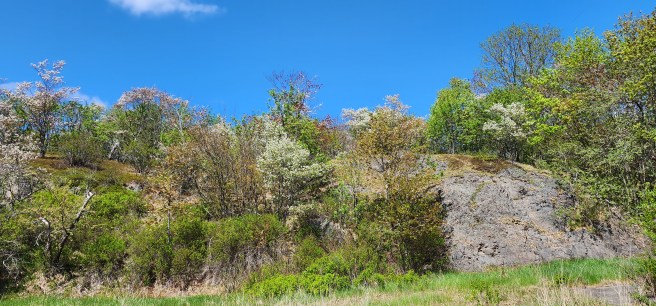
Even when you step back.
Informal racing out on the open waters was already a longstanding tradition when the Maine Lobster Boat Racing Association formed and launched its first races in 1964.
Fishing is a dangerous occupation, one luring a gnarly but dedicated gang into its ranks. It’s said they have salt water in their veins, or as I’ve heard them say of themselves, they’re either crazy or dumb – or both.
It should be no surprise, then, that here in Maine, lobstermen come together on summer weekends to race their boats. They have a pick of at least one every weekend.
Yup, race. Lobster boats don’t exactly look sleek or graceful – they’re built to work in all kinds of weather and take a beating. But they also have powerful engines. I had no idea just how powerful.
Besides, guys being guys, lobstermen have long boasted about their beloved boats – many are named after sweethearts and children, after all. Comparing theirs against their peers’ meant putting their words to the test.
All of that has led to a circuit of races starting in Boothbay and ending in Portland, with ten or so other sites along the way.
With that in mind, here are ten more bits to consider.

At low tide, the remains of the four-masted ship are fully exposed. Built in Shackford Cove, she had returned for maintenance when she caught fire and sank.

Here’s another perspective.
Unlike many of the early Quaker voices, Penington was well educated and respectable, the eldest son of a Lord Mayor of London. He even became William Penn’s father-in-law. But his joining with Quakers led to harsh persecution, including imprisonment six times, as well as intense spiritual experiences he described in various writings, including his letters.
A critical reader will recognize that articulating what is ultimately non-physical or confirmable is a difficult challenge. What Penington achieves remains insightful, personal, yet universal. There’s nothing dogmatic or doctrinaire or theoretical or speculative, not when grounded in personal practice.
His style fascinates me, long sentences that coil around and around as they move toward a core. Pulling a short quotation from them proves difficult without losing the wider field of wonder. As an example, “Give over thine own willing, give over thy own running, give over thine own desiring to know or be anything and sink down to the seed which God sows in the heart, and let that grow in thee and be in thee and breathe in thee and act in thee; and thou shalt find by sweet experience that the Lord knows that and loves and owns that, and will lead it to the inheritance of Life, which is its portion.” Eighty words, in all – typical.
Somehow, I find myself contrasting him to the Muggletonian William Blake a century and a half later, who struggled with similar challenges for a much different result.
do we
do what
.
what do
we do
brought latest Paris Review and Harper’s
as reading along with Vincent Katz pages
maybe stimulation
didn’t read anything, really, apart from some entries
in the free guide to lighthouses I had picked up
nearly a decade earlier


So here’s the official advice before setting forth:
We are very relaxed and informal on board, so bring comfortable outdoor clothes. If possible, use a duffel or collapsible bag to pack your gear. Hard suitcases are sometimes difficult to store in the cabins.
The weather may be cool or warm, so include pants, shorts, long and short sleeve shirts, a sweater or sweatshirt and a jacket. When the wind picks up, things cool off, so think layers when you pack.
Don’t forget your bathing suit, either for sunbathing or a quick plunge in the ocean.
Soft soled shoes are best, and an extra pair may come in handy. Sandals also work well on board or on the beaches we visit.
If you have a rain slicker, bring it along just in case. We do have extra rain gear on board if you can’t bring your own.
Also, if you can, check the weather for Camden, Maine online before you pack. It may give you an idea of the specific weather for your trip. But remember that it is always slightly cooler out on the water.
We provide towels, linens, blankets, pillows, and all the food and non-alcoholic drinks. We have an icebox on board for passengers to use if they would like to bring along their own beer, wine, etc.
Bring a camera with extra batteries, sunglasses, lots of sunscreen, a good book, binoculars, a journal, and your musical talents/instruments (if they are transportable!). If you want to sleep on deck under the stars, bring along a sleeping bag. Some folks bring charts or GPS’s to keep up with our route.
Once we leave the dock, we operate on 12 volt DC power. There are USB outlets for charging phones – please bring your own USB cord. We do have limited 110 volt AC power (like in your house) that can be used for medical machines and for occasional charging of batteries. Please let us know when you book if you will be needing 110 volt AC power to operate a medical machine.
There was a seasonal correspondence with the renovation project and the winter season.
In a clime like ours, weeks pass when everything outdoors seems dead. Outside our vision, though, things are preparing for rebirth. Maple sap starts running, for instance, as the syrup makers know. And then the first flowers pop up.
Something similar was happening with the house work.
I mentioned the wiring. Here’s another look as it developed.
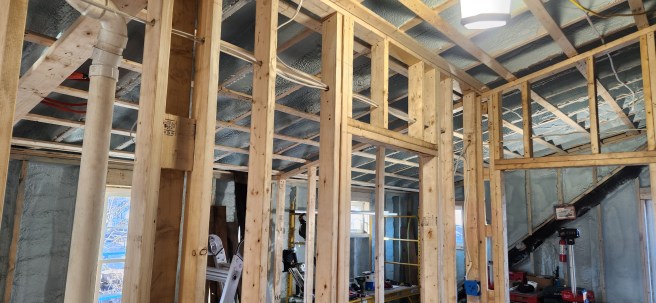
And then the plumbing.
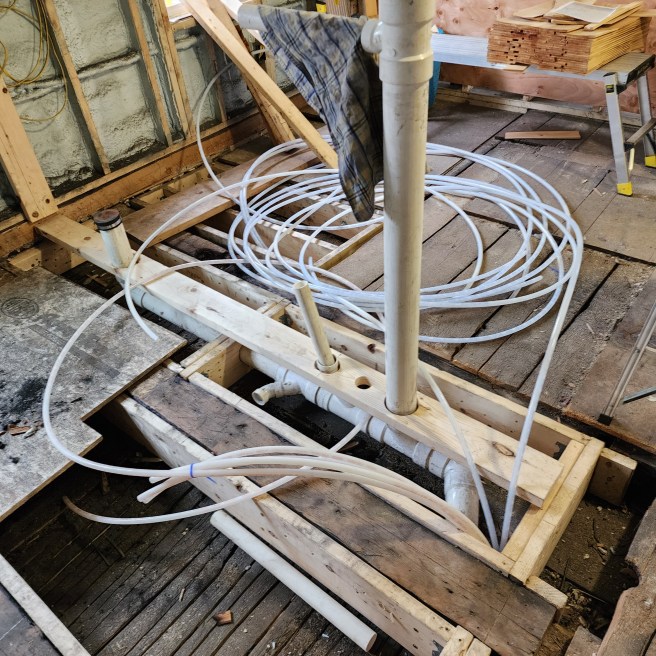
Selecting the toilet, tub, shower, and so on took more time than anticipated, especially when two separate trips to Bangor – a full day each – turned up nothing at Lowe’s, Home Depot, or Frank W. Webb.

I am looking forward to finally being able to take a bath without feeling like a pretzel. It’s been four years, in fact.
Visible progress was even appearing on the new exterior on the gable ends.
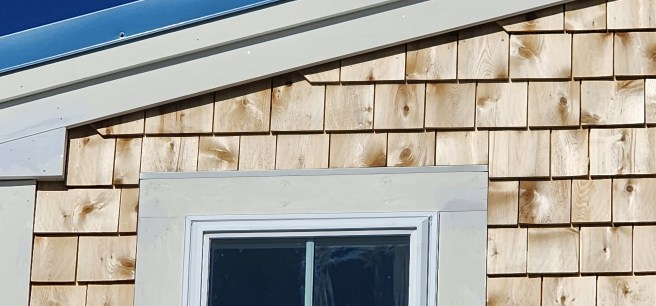
And the dividing walls along the center started coming down.
Do I sound impatient?

Yes, spring is finally breaking out around here. Whiting, Maine.
 Jnana's Red Barn