
Growing up in Ohio, this would have blown my mind. Now I almost take it for granted.
You never know what we'll churn up in cleaning a stall
Growing up in Ohio, this would have blown my mind. Now I almost take it for granted.
The Pine Tree State has long inspired painters and other visual artists, most of them attracted from elsewhere.
Here’s a sampling:
What would your obituary say about you? What would you say there, if asked? Before you reply, pay attention to everyday stuff and your aspirations, especially what you love. Note as well how others see you. Besides, how do you fit into your neighborhood or wider community? Feel free to exaggerate, reflecting everyone else.
As a human, you assume a cluster of identities – some of them chosen and changeable, others immutable. My grandfather, for example, proclaimed himself Dayton’s Leading Republican Plumber, invoking a host of other identities as well: Protestant, Freemason, middle-class, married. “Grandfather” wasn’t high up in his awareness, from my perspective. Being male or female or teenaged or elderly, on the other hand, are simply givens. And the history of what we’ve done or failed to do cannot be altered, except in our own perceptions and retelling.
The range of identities is astounding. They include but are not limited to race, religion, nationality and locality, occupation, family (household and near kin to genealogy itself), education and educational institutions, athletics, hobbies and interests, actions and emotions, even other individuals we admire, from actors and authors to athletes, politicians, and historic figures. They soon extend to the people we associate with – family, friends, coworkers, neighbors. And, pointedly, our phobias and possessions.
Curiously, it becomes easier to say what we are not than what we are specifically. That is, set out to define yourself in the positive and you’ll find the list rapidly dwindling, while an inexplicable core remains untouched. Turn to the oppositions, however, and the list becomes endless. I am not, for instance, a monkey. At least, most of the time.
Sometimes, moreover, a specified negative becomes truly revealing: “I am not a crook,” for instance, as the classic revelation.
Behind the masks of public life – our occupations, religious affiliations, social status, economic positions, family connections, educational accomplishments, and so on – each of us engages in another struggle, an attempt to find inner balance and direction for our own life. As we do so, we soon face a plethora of interior and exterior forces that must be reconciled. We get glimmers into this struggle – both within ourselves and within others – in statements that begin “I am” and “I am not,” as well as “I have been,” which recognizes the history and habits we accumulate and carry with us. There are also the voices – “he remembers” or “she insists” – that also recur in our lives, defining and redefining ourselves both within, as conscience or the angel or devil on our shoulders, and without, as any of a host of authority figures and friends or family members.
All that brings us around to my latest poetry collection, Hamlet: A Village of Gargoyles. There, many of the imaginary individuals profiled are identified by occupation while their confessions typically reflect the more intimate concerns of their lives – relationships, activities, even the weather. These are, then, overheard snippets more than public proclamations.

Hamlet, of course, is a small town or a village as well as a famed play. In this collection, the inhabitants are profiled in five acts of two scenes each, plus intermissions and intermezzos. They’re even exaggerated, the way a stone carver would in creating gargoyles and grotesques.
Listen carefully – especially when others talk of their romantic problems or other troubles – and another portion of a mosaic appears. This collection of poems builds on such moments, constructing a community as a web of each its members. Sometimes, a place appears; sometimes, a contradiction; sometimes, a flavor or sound or color. Even so, in this crossfire, we may be more alike than any of us wishes to admit. We may even be more like the part we deny. Our defenses wither. Our commonality, and our essential loneliness, are revealed.
Just think.
Having originally appeared in literary journals around the globe and then as chapbooks at Thistle Finch editions, this collection of poems is now available in your choice of ebook platforms at Smashwords.com and its affiliated digital retailers. Those outlets include the Apple Store, Barnes & Noble’s Nook, Scribd, and Sony’s Kobo. You may also request the ebook from your local public library.
The move unites the poems in a single volume, rather than a series of ten smaller chapbooks and ten broadsides, and makes them available to a wider range of readers worldwide.
Welcome to town, clown.
Assigned as part of a contemporary novels course in the spring of 1970, Yellow Back Radio Broke-Down was unlike anything I had previously encountered. The lively tone and style were a kind of pre-rap, I suppose, as were the content. He was amusing in a way Leroi Jones wasn’t and also an example that we can be free of having to “write like cultivated Englishmen of a century or more ago,” as Kurt Vonnegut put it.
He certainly introduced a new world to my essentially suburban Midwestern nature.
Reed was, as critic Anita Felicelli wrote of a later novel, a firebrand, crackling, overflowing, pugnacious, “someone who doesn’t care about genre boundaries any more than he cares about historical boundaries, but who does care deeply about innovating.” In other words, right up my alley.
The novel Mumbo Jumbo confirmed my impression, but, somehow, I haven’t encountered him since, even though he’s written and published prolifically. Note to self: Rectify ASAP.
Airbus
Symphony
Airbrush
how would square-riggers look on these waters?
Lost behind a small island

finally, a shadow
and a tinge of warmth
 On what was the Asa Austin farm, the oldest part contains unmarked graves of Quakers, in contrast to the newer headstones.
For more, go to my book Quaking Dover, available in both paperback and ebook editions online or at your favorite bricks-and-mortar bookstore. Or ask your local library.
In our big renovation project, I kept returning to the criticism of architecture as “boxes with holes punched in them.” I think the objection was by master Ludwig Mies van der Rohe – and yet I also return to the rigidity of Frank Lloyd Wright, who left nowhere for a building to grow. His houses could be like living in a tomb, or at least a temple to his visionary and snake-oil-charmer ego. And here we were with a classic New England Cape undergoing a bid for survival in the 21st century.
Well, as Mies van der Rohe, a celebrated pioneering 20th century architect, also said, “God is in the details.” Nowhere, perhaps, is that more apparent than with windows. He created whole walls of them before that style became cliché. Besides, how else, do we admit natural light and its reflection on the passing seasons into our interior existences?
In coastal Maine, where we’re renovating our full Cape, discretion is more the rule, especially considering our frequently fierce winds off the ocean. As I’ve said earlier, we love the light in this house and, for that matter, the whole town that emerged after the American Revolution.
Even so, art as we know it now was nowhere in their conscious thinking.
A Cape is a relatively economical house, but it has some drawbacks. The upstairs is cramped, cold in winter, and stuffy in summer. As you’re seeing in this series, the necessity of replacing our roof covering disclosed some serious structural problems that would have required redress even if we weren’t intent on maximizing the usable space on the second floor.
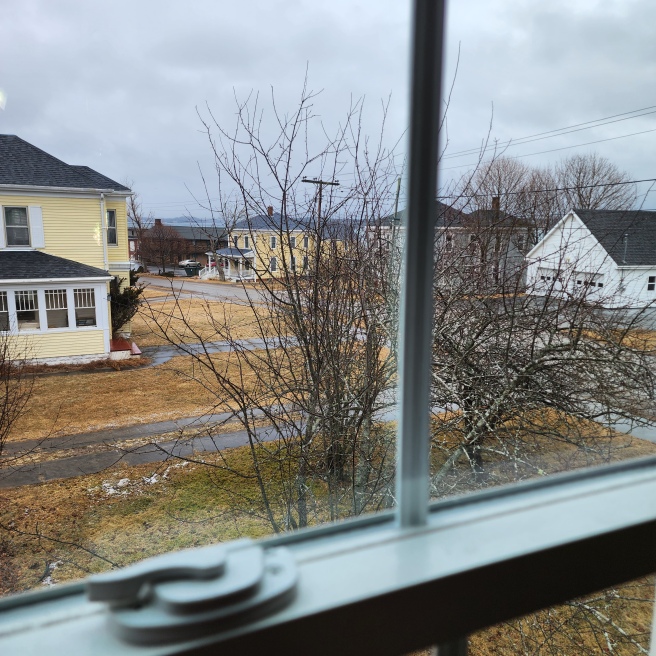
Now, for the window details.
Upstairs, we could have gone for the same-sized windows that we have downstairs, but the back half of our second floor – facing northwest – also presented additional considerations.
One was the relatively low height of the back wall – 82 inches, just shy of seven feet. The downstairs windows wouldn’t have fit the room quite same here as they did downstairs.
Another was the fact that in the two expanded bedrooms, I wanted to maximize the wall space. I had a lot of books and recordings coming out of storage, so shelving came at a premium. Above that, I was hoping for decent opportunities to display visual art. Eastport is an artists’ mecca, and the natural light is spectacular. Oh, let me apologize for being repetitive.
That led me to consider windows that are horizontally broad but vertically short. You know, a band, rather than a drop. The first ones I found are called transom or shed windows, but, as the details mentioned, they don’t open for ventilation. Eventually, I determined that awning windows would do the trick. You really do have to learn the vocabulary.
The existing gable-end windows would be replaced with larger on the size of the double-hung sashes downstairs. No problem. I’m actually amazed at the expanded view that creates, along with the boldness in contrast to the timid existing windows. Yeah, these look great, from inside and from the street.
The back interior corners, though, promised to be darker (that is, dismal) than I desired. A small diamond window – a common architectural touch around here – would be perfect – the only problem was that those panes would have to be custom-made, and we decided the additional cost wasn’t for us at this time. A small casement window in a conventional flat framing came in at a third of the price. Plus, it would open for additional ventilation.
I would have preferred continuing the awning windows across the back, but the two coconspirators in this project instead convinced me to use two smaller double-hung windows for the bathroom and laundry room.
I’m psyched to see how these parts play out.

~*~
The technical aspects of windows can be quite daunting. They could inform another post or more, but let’s skip that.
Our contractor expressed a preference for two brands – one nationally known, the other locally made and reasonably priced. We went with Mathews Brothers’ Spencer Walcott style.
As for sizes? Their lower-end style offers 134 standard sizes of double-hung windows alone. Beyond that, custom sizes are available.
The fun choice will the window that goes over the front doorway, but that was still off in the future.
~*~
By the way, I do love another Mies van der Rohe quote: “Architecture is a language. When you are very good, you get to be a poet.”
Seeing the detailed work going into our old house, I’m coming to see how they fit.
As you’ve probably noticed in other posts here this year, I’ve been trying to recall some of the authors and books having an influence on the earliest drafts and later revisions of my novels. As I’m writing this, most of my personal library is still in storage – or other volumes, purged long ago to make room on my shelves for more – and my journals under wraps during the house renovations. I’m having to rely on memory, faulty though it may be.
Look, I don’t want these posts to be about some poor neglected novelist blah-blah-blah, but rather as one account of surviving in a writer’s life, maybe as a bit of advice or even encouragement for the next generation or two.
That said, I can state that my subway project sprang from Richard Brautigan’s Trout Fishing in America as its model. Think short, playful, imaginative with an image slash idea as its central character, like a children’s story for Woodstock reaching young adulthood. William R. Burroughs’ Naked Lunch also cast a spell as a free-floating state of mind.
For me, hitchhiking in subway tunnels was a fantasy symbolizing the hippie experience as I encountered it during my time living in upstate New York. You know, underground with urban roots yet flourishing out in the countryside where you could stick out your thumb and go about anywhere. Yes, though I didn’t fully comprehend it then, that Woodstock crowd was mostly from New York City and its suburbs.
The symbol even implied a degree of freeloading rather than responsibility.
While awaiting publication, the manuscript kept growing from its 1973 first draft, typed while sitting cross-legged at my beloved Olivetti 32 typewriter, through a revision shortly after that and probably another in 1976 before I packed up for the Pacific Northwest, where yet more would be added to the text with quite a backstory in addition to a superstructure out in the foothills somewhere north of Gotham.
This was well beyond the initial Brautigan flash. What I had was, in fact, unwieldy, and nodding toward Brautigan’s other fiction and a lot more. Unlike me, he kept most of his volumes short.
And then, somewhere before reaching my sabbatical in the Baltimore suburb of Owings Mills in 1986, the manuscript was greatly slimmed down, leaving many pages of outtakes I couldn’t trash outright. There was enough to create more novels, or so my inner trash picker insisted.
We’ll look at those as they took shape during my furious year of keyboarding on my new personal computer, however primitive the machine and process appear now.
In that sabbatical, I must say I was highly disciplined, keyboarding for four hours or so before taking a break, eating, even napping, and then returning to the work until two or so in the early morning. I had lived my adult life up to this point awaiting this moment, if it was far from what I had envisioned. Suburbs? Without a wife or soulmate? Heartbroken, in fact?
What drives an artist, anyway?
Beyond the yellow BMW 1600 oil-burning coup I was bopping around in – the one that was older than any of the women I was seeing.
A great deal of material and energy was there to be released, and I sensed this was my make-it-or-lose-it moment. As you’ll see.
Baltimore even had its own subway line under construction, reaching all the way out to where I was encamped.
Not that I would be there when it opened.
~*~
My first hick outpost, the one upstate, wasn’t as small as it seemed. Yes, it was a backwater, but the core was more populous than six of the places I would subsequently live in, if you didn’t count the university students in what I would dub Daffodil.
What my first actual job in journalism did have, though, was proximity to New York City, a mere 3½- to four-hour drive away. Despite the distance, the connection was vital, even vibrant. All of my new friends were from the Big Apple, and many of them were Jewish, as my college girlfriend was, even though she had by now oozed away from my presence, off on what I saw as troubling new places. At least none of them were Jonestown.
Starting with a summer internship before my senior year of college and picking up again after my graduation, a time of great emotional upheaval, exploration, and redirection. As I said, this was in the high hippie outbreak.
I presented the image that flashed before me, the gandy dancer who could have been a hitchhiker, but I should also acknowledge a freaky cartoon a housemate had created and handed me, with a face at a sewer grate mumbling “Duma luma, duma luma.” Those were the two prompts for the manuscript, seriously.
~*~
The inspiration also came from my first jaunts into New York City while living upstate, and later to the west in the Pocono mountains of Pennsylvania. Most of my buds and girlfriends had been from the City, as they called it. My early experiences turned into fascination during a period of great personal upheaval and growth for me.
Hippies seemed to be trying to go in two directions at once: back to the big city while hitchhiking out in the sticks. The original version was, in fact, published as Subway Hitchhikers in 1990 – the worst bookselling season in the memory of many publishers, thanks to the first Iraq war.
As I’ve ready described, in the 17 years between the first draft and the story’s first publication, the manuscript underwent a considerable metamorphosis as I moved across the continent in my day job. While living in the desert of Washington state, I even picked up a 1915 engineering book on the building of the New York subway system while browsing in a very small, small-town bookstore. (How did it ever land there?) Much of my expanding text was backstory on the central character, while the urban transit episodes shifted into something akin to an appendix. The result was an unwieldy epic. But I kept the outtakes, which took on their own life later.
How would you answer the question, “Who are you?”
It can be harder than you think, especially when it comes to getting past the superficial answers.
Now, look in the mirror and try to imagine yourself carved in stone. Some features will be exaggerated, of course, but at some point, an angel or other truth may also be released.
This is prompted by the release of my collection, Hamlet: A Village of Gargoyles, which can be found in the digital platform of your choice at Smashwords, the Apple Store, Barnes & Noble’s Nook, Scribd, Sony’s Kobo, and other fine ebook retailers. You can also ask your public library to obtain it.
In the meantime, a wonderful gallery is available for your viewing at the fine New England-based blog Gargoyles and Grotesques.
There you’ll see that these sculpted images aren’t confined to cathedrals or Gothic castles. In fact, they’re all around us.
They could even inspire another set of poems.
 Jnana's Red Barn