What are the chief sources of expense in every Government? … The answer, plainly is, war and rebellions – the support of those institutions which are necessary to guard the body politic, against those two most mortal diseases of society.
I’ve long been fascinated by major metropolises, or at least the concept of a downtown as a pulsing power center buzzing with fashionable activity. My hometown, while a thriving city at the time, never struck me as “big.” As for glitz? Forget it.
In the list I’ve assembled, each of the cities has at least one professional baseball team, and today also an NFL team, not that sports were a big factor for me. Great symphony orchestras and art museums, however, definitely were. And later, I came to see subway systems as another measure; the majority of the cities here have them.
All but one of these locations is somewhere I’ve been more than once, and we’re not even counting connecting flights at the airport. While I’ve resided inside only one of these hubs, I’ve lived within the gravitational orb of another seven.
That said, here goes, presented more or less in the order in which I experienced them.
Cincinnati: I grew up about an hour away, and once I got my driver’s license, I got to know the place much better than just Crosley Field, riverboat rides, the zoo, or the observation deck atop the Carew Tower, destinations of family outings or school field trips. I’ll save the details for later.
Chicago: The Loop, with its narrow canyons between skyscrapers, and the walkway along the Chicago River still embody the visceral excitement I identify as big city. An initial visit as a teen followed by visits to friends and lovers later culminated when I worked for the media syndicate of the Chicago Tribune and was whisked up high in its tower overlooking Lake Michigan.
New York: I didn’t get to the Big Apple until the summer between my junior and senior year of college. I was living in a boarding house and working an internship about four hours Upstate, but after graduation I returned and had housemates and friends from The City. Visiting the place with them was delightful. Later, living in the ashram about two hours away or in Baltimore to the south, I got in for even more exposure.
Seattle: During my four years in the desert of Washington state, an escape to “the wet side” of the Cascade mountains was a regular part of our existence. I’m not sure how much I’d recognize the place now, but we did have friends who’d put us up. Even then, people were worried the city would lose its charm, the way San Francisco had.
San Francisco: In my one visit, there was still some charm left. Especially the affordable ethnic restaurants out in the neighborhood where we were staying, with our sleeping bags on the floor. The hippies had long gone to greener pastures, but City Lights bookstore was still packed.
Cleveland: Living about two hours away, I got to know the city on Lake Erie mostly as University Circle, with its extraordinary art museum (free admission), famed concert hall, genealogical library, and Quaker Meeting. The downtown still hadn’t rebounded. I’ll also include the famed orchestra’s summer home south of town as part of the experience.
Pittsburgh: Two hours in the other direction, we spent more time in Squirrel Hill and the university neighborhood than downtown. The steel mills were long gone, but major corporate headquarters still flavored the core, much more than they did Cleveland.
Baltimore: Oh, how I loved the place. My first apartment was the top floor of a rowhouse within walking distance of symphony hall. The gentrified neighborhood was something like Boston’s Beacon Hill but pre-Civil War era rather than Colonial. Even when I relocated to a suburb, I spent a lot of time in Roland Park and a few other neighborhoods. The Inner Harbor was always a delight.
Washington: Living about an hour to the north in my Baltimore sojourn meant I could head down easily, usually to visit friends in the Maryland suburbs. What surprises me on reflection is how little I made of the opportunity to do more. Yes, I did use the National Archive and Library of Congress a few times for genealogical research, and visited the imposing National Gallery and the Phillips more collegial collection, but I never got to the Smithsonian or White House tour or any of the monuments, really. Besides, there was nothing much of a downtown – charming Georgetown seemed to fill that function.
Boston: It took me a while to warm up to Boston, but once I was living an hour to the north, my attitude changed. For more than 30 years, then, I turned to its museums, theaters, concert venues, bookstores, record stores, restaurants, and more, even contradancing two or so times a week, and that was before having a girlfriend or two in the suburbs or joining a suburb community choir just beyond Cambridge. In the end, though, I was still an outsider.
I realize how much the experience of most of these places is based on walking. Pedestrian-friendly was a key element separating them from others.
Honorable mentions: Worcester, Saint Louis, Toronto, Philadelphia, Montreal, Detroit, Providence.
The most powerful of the public ministers in the early Quaker movement, Nayler remains unjustly tarnished by what I see as a street theater event that erupted into scandal and his conviction by Parliament (not court) on blasphemy. His shameful treatment by Quaker leader George Fox afterward furthered the sleight.
He’s seen as the most systematic theologian of the emerging movement, as I’ve written elsewhere. What fascinates me the most, though, is his articulation of the Light, as early Quakers experienced Christ. Nobody has written more insightfully in its wide-ranging appearances.
One difficulty is that the experience isn’t “like” anything else. What, for instance, is light itself like? Or the color green? Nayler’s writing, then, can make full sense only to others who have experienced a spiritual Light inwardly. Logically, we’re stuck in a tautology.
His text, though, works and sounds more like contemporary poetry than you’d expect from 17th century English prose. Well, Ezra Pound did describe literature as “news that stays news,” which I think fits here.
When Adam came downstairs with this, I felt it was validation for a bit of history I had just come across online.
This was the backside of a baseboard.
He does look like something of a space alien here, adding to the time machine impression. But a full dinner for $1.50 and up? That does seem surreal today.
The sign was one of several he had uncovered while removing baseboard upstairs. The writing had faced the wall. Yankees are notorious for frugality of the sort that wastes nothing, if possible.
I had just started researching the history of our house, starting with the property deed transactions at the courthouse in Machias. One of our predecessors had owned and operated a well-known restaurant. Her obituary also described her as an exacting carpenter, so here was a piece of evidence.
I’ll save her full story and those of the others for later in this series, but let’s just say, the house was beginning to look a lot older than we’d suspected when we bid on it.
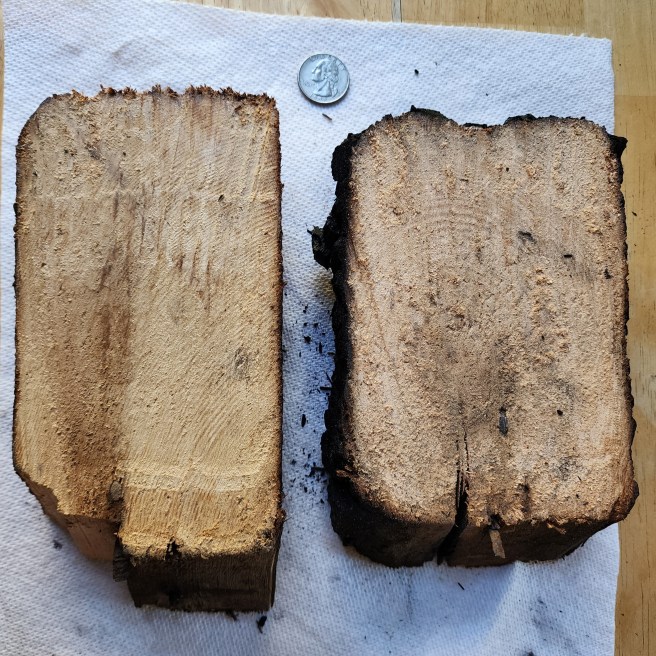
For example, hand-split oak lathing like this had gone out of use by 1830, or so we were told. This piece was extracted when carving out space for the toilet and bathtub.
Hand-split oak lathing went out of usage by 1830, I’ve been told. Ours was also charred by a house fire, possibly one from a nearby chimney.
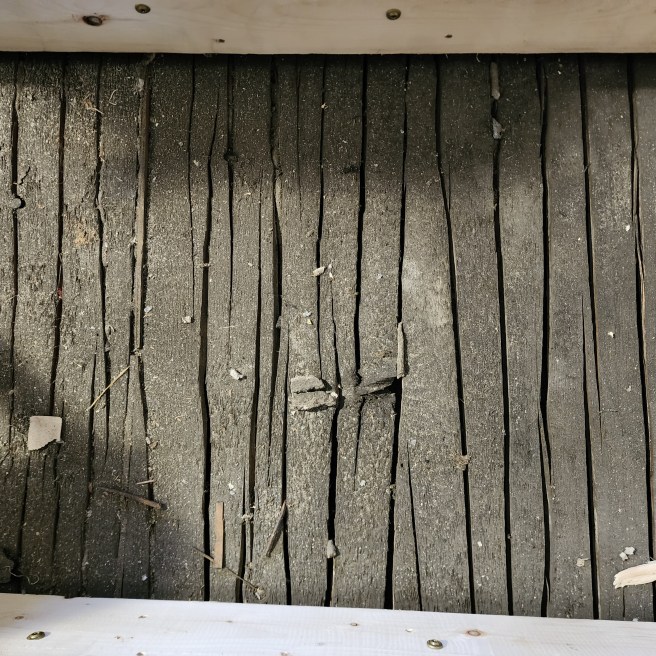
The burn marks on the underside of the flooring also suggested another serious house fire.
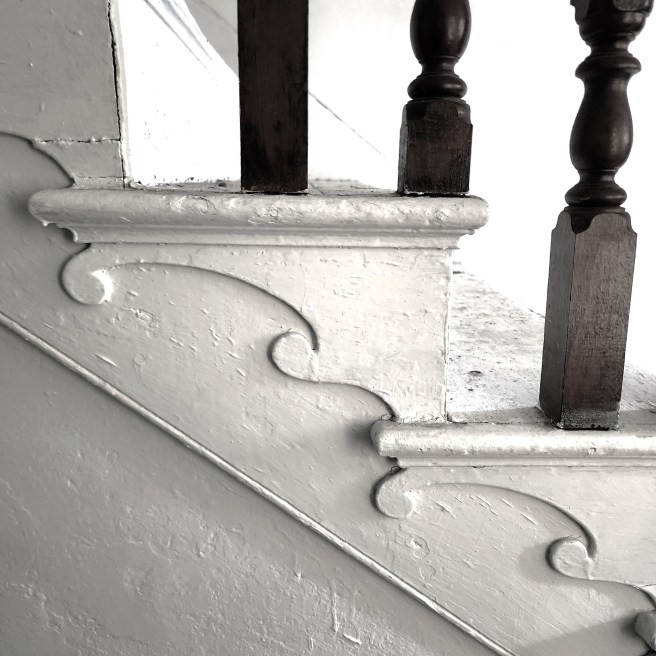
Another detail is the molding on the side of our stairs. The same pattern is found on other houses in town from the 1830s and 1840s.
I’m assuming this was from an update to the house.
And, from a technical point of view, ours wasn’t a post-and-beam house but rather timber framed, meaning wooden pegs held the big pieces together – and the weight of the structure didn’t come down the inside walls.
The old wood was denser, too, than what you’d buy today.






 Jnana's Red Barn