Letters from a retired hippie

I’m sorry about what you’re inheriting. I’m sorry about the parts we’ve messed up.

It’s not all our fault. We were too trusting, for one thing. And so green, as in naive.

Looking around, we see too many old losers and the sense of hippie as essentially a girl thing.

A sense of betrayal, futility.

It was a youth movement. That’s what you need to know about it.

As for the other options?

What makes someone a ‘character’?

Often, it’s a flip comment and everybody nods as if knowing exactly what’s meant. Except, if you look closer, the actual definition gets fuzzy.

Calling someone a “character” falls in that vein.

The term itself reminds me of an older Quaker I knew. At the time, her mobility had been confined to a wheelchair for a decade or more. Members of the Quaker Meeting out in Ohio, where we both maintained our affiliation, always said, “Oh, that Anna! She’s a character!” But they would never tell me why.

Finally, when I had charge of her memorial service in New Jersey, I popped the question. And it was a rich experience.

Among the examples was from the days when she was still driving but relying on that wheelchair. She rolled up beside the passenger door, crawled into the seat, folded up the wheelchair and tossed it into the back, and then somersaulted into the driver’s seat. I can’t imagine, much less what was involved when she arrived.

What I did realize, on my drive back to New Hampshire, is that each of us has our first 40 years to get our act together and the next 40 to be a character.

So, back to matter at hand – sharpening our definition of a character.

Aided by responses from another circle of friends, here are ten things to consider.

A “character” is in at least several of these:

  1. True to self: Authentically themselves regardless of the opinions of others; comfortable in their own skin; possessing strong backbone.
  2. One of a kind: Standing a step apart from social norms; a nonconformist, unconventional. By definition, exceptional or original.
  3. Attuned to a lofty goal: Religion, art, social action, or so on.
  4. Faithful to moral values: It’s more than having character – integrity, honesty, loyalty, compassion, for instance – but of actually embodying them. This can manifest as courage, perseverance, and confidence to move through difficult situations.
  5. Eccentric: I’m guessing this goes beyond everyday preferences and habits of a mundane nature, like how we have tea or coffee. But it can mean something more than just one-of-a-kind. Maybe colorful? Quirky? A streak of ornery, in many cases, but not too much – like fresh ground pepper on a meal. Or even stubbornness.
  6. Seen in a positive light: Likeable, funny, interesting, amusing, a bit of a charmer, willing to do or say what we shy away from but would secretly consider. “I see it as a good thing … a positive thing.”
  7. Or in a negative sense: Nuts, weirdo, strange; annoying; rubs people the wrong way. “I hear it as snide, not meant to be flattering.” A slang thesaurus comes up with Soup Nazi and Ron Paul as synonyms. The matter of intonation does not show up in the definitions, but hearing a voice would certainly thicken the plot. (Did I put those two synonyms in the wrong spot? Some folks might see those individuals in a positive light.)
  8. Open to praise or ridicule: “They often have no idea they’re not conforming.”
  9. Willing to make self-sacrifices: Back to that lofty goal. Or at least not squander time and money on less worthy items.
  10. Sometimes even a big personality: In this case, being the center of attention, almost like they’re always performing. Well, an actor does play a character, but that’s just make-believe. This goes beyond that.

Acid test novelist: Jeffrey Eugenides (1960- )

As the 21st century got underway, I was baffled that all of the published contemporary novelists and many of its poets I admired were in place by the time I graduated from college at the beginning of the ‘70s. Where were those my own age or younger?

Yes, the publishing world was in turmoil, but that couldn’t have been the entire problem.

I was also recognizing that my native Midwest, especially as I experienced it in industrial Ohio, went unrepresented – something missing largely from Hollywood presentations as well.

And then, as I discovered Greek-American culture, I was amazed to find how little of that culture, too, existed in public awareness.

The one exception who came to light was Detroit-born Eugenides. And how!

His three novels, each one a unique take on the novel itself, address the previous blanks. For large stretches of the Virgin Suicides and Middlesex, I thought he was talking about Dayton, including the race riots of ’68. The Marriage Plot, meanwhile, looked at Quaker practice in ways that gave me confidence in the Greek-American dimension of my own novel What’s Left.

The man is a master, for sure.

A schooner is not a sloop, pay attention

A sloop has only one mast, for starters.

There’s a whole new vocabulary to learn.

It’s a way of looking through the eyes of others.

Those things on the ropes, er, lines are called baggy wrinkles. They protect the lines and sheets, i.e. sails, from harmful rubbing. That is, they’re a furry cover for rope sphering.

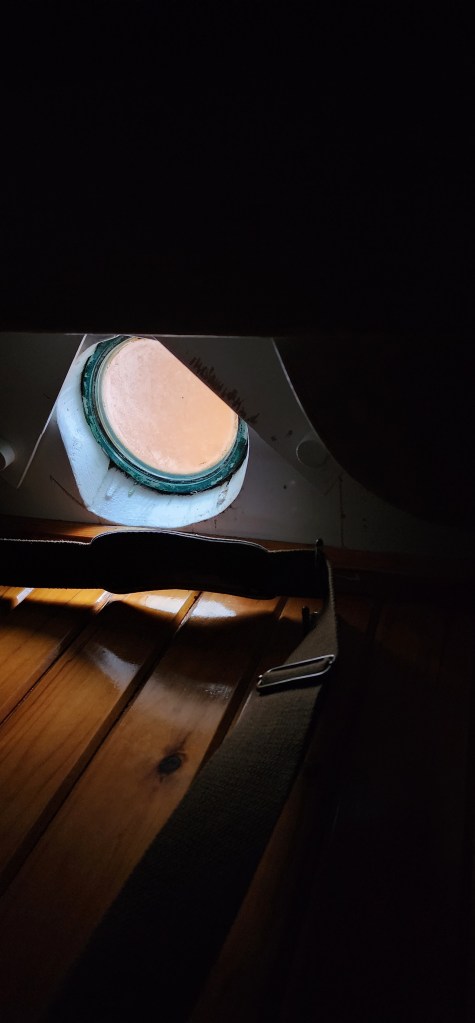
Deck prism is another term. It’s a small round window. Here’s how it looked from my bunk. Overhead, people were walking on it.

Hatch is the opening between the deck and the hold below. This one connects by a ladder (not stairs) to cabins (aka staterooms).

Another leads to the galley, which includes what others would call a kitchen.

How ‘Pit-a-Pat High Jinks’ came into play

Indiana wasn’t the only thing bogging down my original subway manuscript. The dude’s life off in the countryside after college was another big complication.

Well, that and my grounding as a journalist, meaning focusing on facts as I observed them, in contrast to writing as a novelist, meaning putting feelings and some imagination first.

Head for the hills, then, as I did by default to upstate New York. I didn’t get there quite as I describe Kenzie’s journey, but the route wasn’t that far off, either. In the story, I’ve kept the location rather vague. It could as easily be pockets of western Connecticut or the Berkshires in Massachusetts or even southern Vermont. Let them blend together.

I was pretty lost in my first year-and-a-half after college, the period leading up to my embrace of yoga. It was a wild ride for me, at the margin of general society; my highs punctuated deep depression. Most of my friends – including housemates and girlfriends – were from The City or its wider orb, and that included short trips with them when my work schedule permitted. (I rarely had two days off in a row, much less three.) And, my, was I green.

For much of that period, my own journalism slash writing career and dreams were going nowhere and paid next to nothing. More troubling, my love life was non-existent, even considering how I had a housemate who came back every night with a different bedmate, all of them delectable in my sight. What was my problem? What was wrong with me? What was I missing?

And then I found yoga and everything changed. Even the romance.

What could possibly be wrong with that story?

Well, it had fed into Subway Hitchhikers, but most of what I had drafted there was eventually excised to focus on the urban dimension of the story.

~*~

During this period, my social life revolved around two locations.

The first was a once luxurious apartment building turned slum at the edge of downtown. I later moved it to Daffodil along the Ohio River far to the west for the college-years novel. Well, many but not all of the renters were college students.

The second encampment was what many people would consider a hippie commune out in the hills, a very rundown farm high in the hillsides along the state line. As I explain in what’s now Pit-a-Pat High Jinks, we shared the expenses but not our incomes. I now think there were some freeloaders anyway.

Both dwellings, from what I see in satellite photos, have been torn down.

And I still believe my two-ring circus there (three, if you include the newspaper where I was employed) was a richer source of characters than, say, Bonanza or the Friends sitcom.

~*~

I’ll have to revisit my journals for clues about how the lode from this period evolved during revisions. When I heard about Smashwords a dozen years after the subway novel had been published, I must have already had two versions of the experience in hand, both drawn from the earlier outtakes augmented by journal entries and correspondence.

They differed sharply in tone and focus.

Hippie Drum was closer to a memoir that focused on the general hippie scene around me. Hippie Love paralleled the chronology but focused on its erotic encounters, with the added twist that our protagonist had far more success in the love department. One was gritty; the other, free-wheelin’ trippy.

In these parallel accounts of the same story line, the first focused on Kenzie’s overall adjustments to being out on his own, adapting to the workplace and his new housemates and a wider underground, freaky community. He was desperate for love but rarely connected. Frankly, much of the hippie life was drab and impoverished. The other, an R- or X-rated version, was more fanciful, examining what could have been if he had possessed a bit more finesse. Both books ended at the same point.

Making sense of what happened in my outwardly dull life in goofy counter-culture times included what happened out in the sticks were nobody seemed to be looking, that is, where I had landed or even taken refuge. It was just up the road from Woodstock, only on the far side of the Big Apple.

~*~

I originally envisioned the two books kind of like the three-show play The Norman Conquests, where a line of conversation starts in one room and of finishes a night or two later on the other side of door he had passed through. Not that I was that meticulous in my crafting. I was just trying to run with the material at hand.

Alas, the “love” book was wisely deemed “adult” content, invisible unless you checked your filter.

~*~

As for related input? Leonard Cohen’s Beautiful Losers, Jack Kerouac’s spree narratives, Anais Nin’s sexual frontiers, Robert Crumb’s stoned cartoons, and Arlo Guthrie’s “Alice’s Restaurant” can be seen as touchstones for what finally came back together as a single volume, Pit-a-Pat High Jinks, in its current incarnation. There may even be some Hunter Thompson in the mix.

~*~

Hippie Drum was the first book I published at Smashwords.

Hippie Love came out the next month.

Both, in the autumn of 2013.