
Cony Park, Eastport, Maine
You never know what we'll churn up in cleaning a stall
Cony Park, Eastport, Maine
With my training as an artist, I have some strong feelings about book covers. Most of the ones I see leave me cold. I think they’re too cluttered, and most of them lack a strong graphic element – I prefer a good photograph though am coming around on the painted image argument – and I like a clean, easy to read impression. Some of the typefaces used for the title or the author are nearly impossible to make out.
I did have a friend who was a professional illustrator for a Fortune 500 corporation. CAD (computer assisted design) was overtaking the field, and he felt it was destroying his artist’s hand, the one with the Rhode Island School of Design sharpened skills. His aspiration was to design old-fashioned book jackets, and while his style there wasn’t my cup of tea, I could see its appeal. Fortunately, he conceived a children’s book that took off, in part because it was based on a Pete Seeger song, which did get buyers’ attention. And led to many more all on his own.
I still don’t understand all the nuance, though. Is it true that a certain strand of fantasy is supposed to have a specific element woven into the cover to alert a potential reader that this is the subgenre she’s looking for? You know, maybe a touch of moonlight or a small bat in flight or a golden glimmer in someone’s eye?
I am learning, though. A cover makes a promise with a reader, so I’ve heard at Smashwords.
My thoughts on cover design and some of my favorites appear in earlier posts here at the Red Barn.
Self-publishing requires much more than merely producing a compelling text.
Naming a book is hard enough. For the record, I found naming What’s Left to be my most difficult, as I’ll explain in a future post.
In the world of books, and not just ebooks, a strong cover is crucial.
If you can afford to hire an illustrator or graphic artist to design yours great. I’m envious.
My first novel, in paper, wound up with an “art designer” misfire. Rather than respecting the black-and-white photo of passengers in a subway car, a flat yellow lotus shape was cut into the image with the title and author credits inside that field. It didn’t fly. In addition, my name wasn’t left as simply Jnana, as I desired. It was the full yoga version, an additional five syllables or 14 letters. Well, it kinda has a 1950s feel, even with some graffiti on its walls, but the action was all high hippie ‘60s and early ‘70s. I’m now wondering if getting a tagger to do the cover would have been a more successful alternative. I’m sensing it would have been a more in-your-face result. Buy me now!
For my first round at Smashwords, I hired a book designer who was, I seem to recall, living in the Czech Republic. Emailing made everything easier, including paying him via PayPal, which was new to me. Since he had a deal with a stock agency for low-cost photos, I rifled through its online pages filled with shots that might fit my need.
It’s harder than you’d think.
A good cover isn’t a poster. It’s more like a billboard on a much smaller scale. And your potential readers are zipping by.
The right photo turns out to be a rarity. It has to somehow reflect the story and still attract a buyer.
Even when you find a good fit, there can be problems. For instance, the photo I settled on for Hippie Drum was a black-and-white portrait of a shirtless young male playing a set of Conga drums. It even looked a lot like me at the time of the story. Little did I know how many viewers it repulsed.
There is debate over showing a person’s face on the cover. It can limit a reader’s perception of your central character, for one thing, and one reader’s ideal can be an instant rejection from another.
If you’re going the human face route, you may find the perfect photo with one slight flaw. She’s a redhead while your character’s brunette. It may be easier to tweak the book to fit the cover.
The experience of tweaking a character to fit the cover image.
There’s also a debate over a painted or drawn artwork versus a photograph.
When I got around to designing my own covers, I came upon a drawn image of a single daffodil bloom. How perfect and I still love it. And within the title I inserted a peace emblem for an “O” in DAFFODIL SUNRISE.
A few years later, when I changed the title, that cover went out of circulation. That peace emblem just didn’t work with the new version’s Kindle print-on-demand cover, either.
I have to admit a special fondness to the ones on Subway Visions, Yoga Bootcamp, and the Secret Side of Jaya – none of them photos.
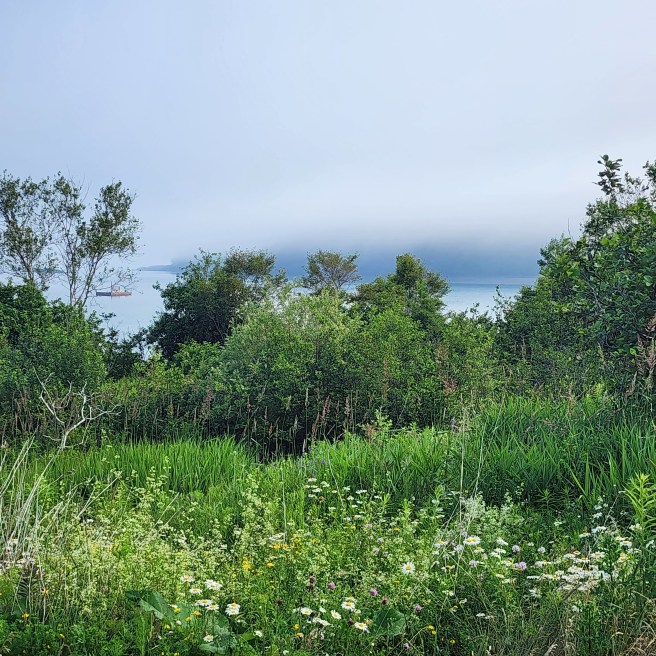
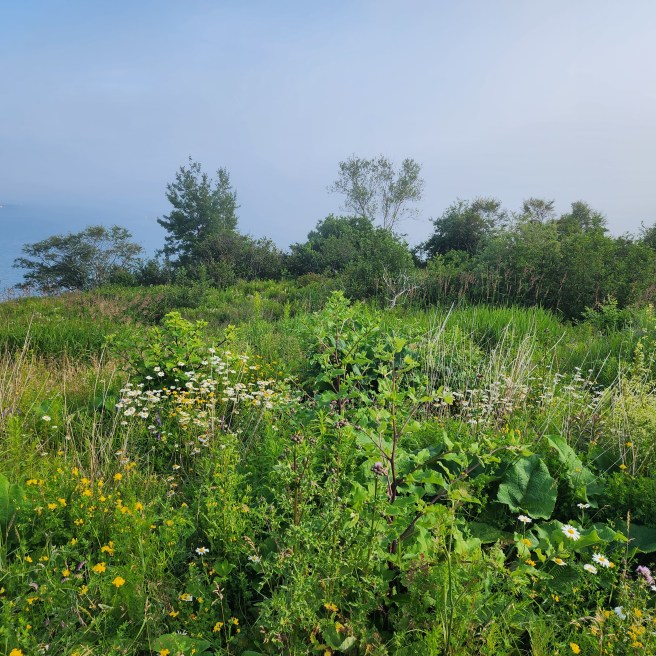
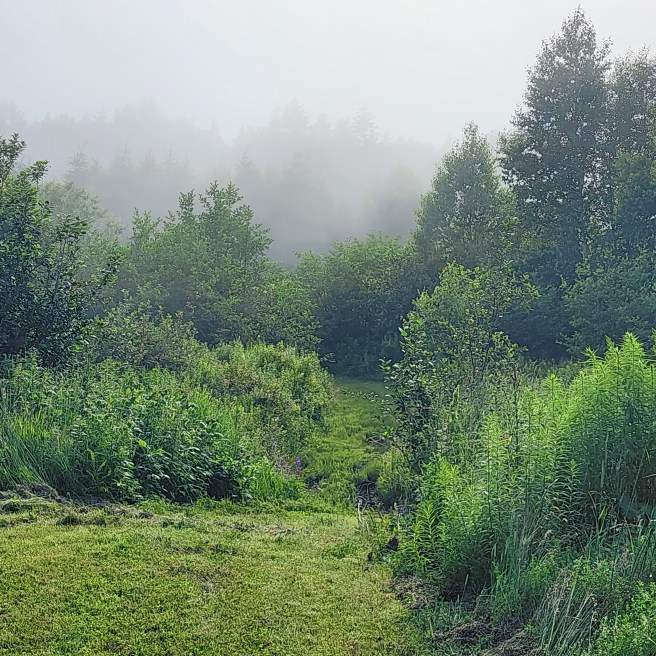
Late afternoon, Cony Park, Eastport, Maine, as the fog rolls in.
It will be no alleviation that these powers will be exercised by a plurality of hands, and not by a single one, 173 despots would surely be as oppressive as one. Let those who doubt it turn their eyes on the republic of Venice.
James Madison in Federalist No. 48
The golden hour of late afternoon sunlight adds to the wonder.

Normally, Eastport’s waterfront would be visible from here.

Back in my wildly ambitious youth, shortly after graduating from college, I envisioned writing a genre-bending novel blending politics and science fiction. Well, my degree was in political science and sci fi was one category of literature that had a growing readership.
My premise was space aliens dropping a young male off in an older suburb of Cincinnati, as in Ohio, where he would be groomed to run for president of the United States. With a nod toward what we now classify as AI, he would be perfectly programmed to fit the market surveys. And with another nod toward what is so-inaccurately called “reality television,” he would be given a fictional past and identity.
The working title was The Cowboy from Mars, and this was back in the early ‘70s.
~*~
I hate to admit that getting from there to an acutal campaign narrative required much more development than I was equipped to produce as an aspiring novelist, and a race for the White House could have been its own War and Peace in terms of characters and pages. Should I add that comedy is very hard to write?
Was I wrong to assume the project had potential?
Is what we’re facing today some kind of weird acid trip?
I mean, the man who presumptuously eliminated the periods from his initials for some kind of marketing vanity but grew up not that far south of me in what looks like far more privileged economic conditions now appears weirdly, well, like a silicon boob. I do hope that doesn’t offend anyone but it is the best I can do.
~*~
Looking at the current political situation has me seeing what would have been unimaginable in its absurdities. It really does seem fictional, outrageous, even tragic. It’s enough to make me wonder which candidate came from Mars or beyond.
As for those of you viewing this from outside of the USA? What are you making of it?
From what I’ve seen of the Founding Fathers of my country, I can say that they believed in rational thought. I hate to think they were wrong there.
Maybe that’s why I couldn’t write that novel.
I’ve mentioned a few others, such as the art museum, in other posts here. Now, to add a few more, in no particular order. Again, I’m looking at Greater Dayton rather than strictly inside the city limits.
My, all that was a world ago in my life.
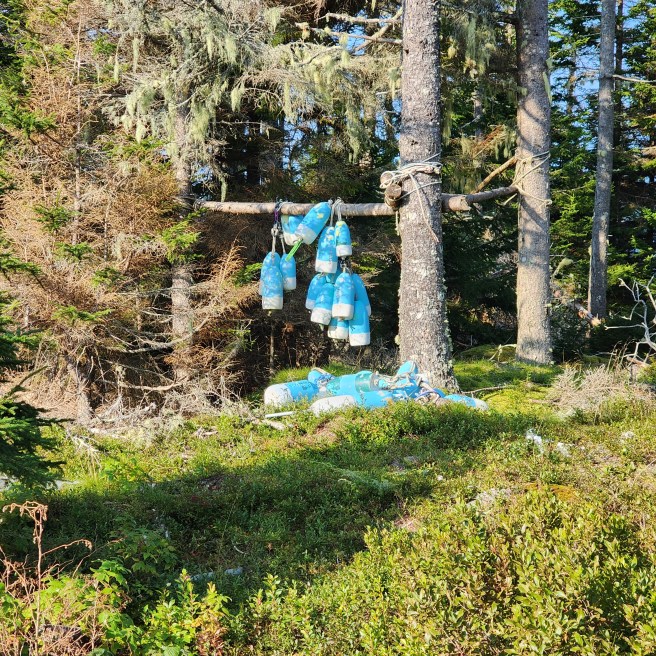
Isle au Haut, Maine.
The Dakotas, as I encountered them driving a U-Haul to Washington state, are a starkly open, even disturbing space that contrasts sharply to the expanses on either side of them. Much of my writing has included unique places as an essential element, sometimes approaching the role of an actual character.
Norris’ Dakota: A Spiritual Journey came to my attention after I had relocated to northern New England and was attempting to comprehend its unique landscapes and peoples. Her insights, with all of the directness of Midwest expression, proved helpful.
The friend who recommended – or perhaps even gifted – Dakota to me had lived as an Episcopal nun, and my ashram residency was a monastic experience, so Norris’ The Cloister Walk, following up on her introduction to a Benedictine community, was more like a dialogue. Yes, monks and nuns can be prankish and have a sense of humor, and as mystics, they’re often unexpectedly practical.
Norris was welcomed as an active Presbyterian to participate in the Roman Catholic convent without any pressure of conversion. Rather, her exchanges were mutually enhancing, akin to what both my friend and I repeatedly encountered in our own religious streams.
Building on that, Amazing Grace: A Vocabulary of Faith has been a helpful guide in translating key Christian words and expressions – jargon, if you will – in ways a wider contemporary audience might more clearly understand. I find it helpful to have at hand when writing directly about Biblical terms and thoughts.
Poets do make some of the finest prose writers, in my humble observation.
the worst of two ideas
yes, more than worse
you forker
 Jnana's Red Barn