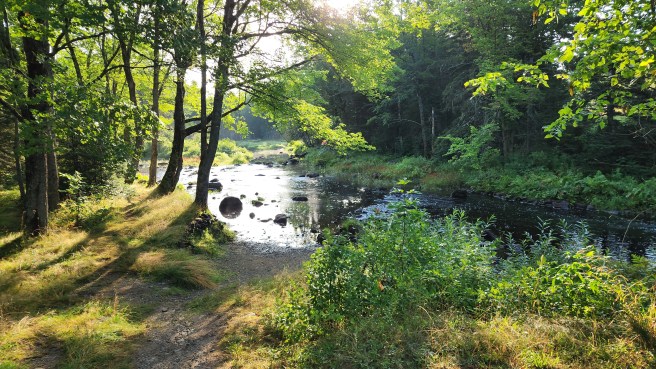
Come along on a funky little camping trip with me

Maybe if I had a camera at the time, the trip would have wound up as photos rather than a poem. The weeklong camping trip was a turning point in my life, though, and the poem that emerged from the experience was initially accepted by a prestigious Northwest literary press but then declined – they’d lost a grant, they said.

Had it appeared at the time, my path as a poet would have advanced, definitely more securely than it did. But the effort definitely solidified my growth in the craft.

Poem? It’s my attempt at what William Carlos Williams advocated as a longpoem, where the challenge is “to find an image large enough to embody the whole knowable world about me.” About, in this case, having meanings as both the immediate world around the poet and his own autobiographical revelations. In his case, the image was the Paterson, New Jersey, the river city where he practiced medicine and lived.

For me, it became about the Olympic Peninsula of the Pacific Northwest, bugged, perhaps, by Basho’s wanderings in ancient Japan.

Having originally appeared in Thistle Finch editions, this collection is now available on your choice of ebook platforms at Smashwords.com and its affiliated digital retailers. Those outlets include the Apple Store, Barnes & Noble’s Nook, Scribd, and Sony’s Kobo. You may also request the ebook from your local public library.

Do take a look.

Burger loaded

Confession. I rarely eat hamburger. Maybe it’s a vestige of my stretches of being vegetarian or even the tasteless rock-hard patties we had when growing up. If I eat beef, give me a thick medium-rare steak or juicy roast, at least.

But once or twice a year, I’ll definitely go for something like this. Especially while traveling.

Searsport, famed for sea captains

Hard to believe, driving on U.S. Route 1 along Penobscot Bay, that one rather quaint village was once a thriving maritime center of significance.

These days, Searsport, population 2,649, is eclipsed by Belfast, Camden, and Rockland on the waters to the south

But it is worth a second look. Here’s why.

  1. A taste of the past. Settled in the 1670s, Searsport retains the federal-style brick downtown of a century-and-a-half ago as well as magnificent sea captain’s mansions now operated as bed-and-breakfast inns.
  2. Penobscot Marine Museum. Anchoring the downtown in its 13 historic and modern buildings, the museum displays treasures from the region’s seafaring riches, including a large collection of boats, in addition to displays reflecting Penobscot life over the years. For researchers, its library and archives offer historic and genealogical depth.
  3. Historic harbor. Maine’s second largest deep-water port once had 17 shipyards that constructed 200 ships.
  4. Rail connection. The waterfront further flourished when the Bangor and Aroostook Railroad opened a terminus in 1905, bypassing the Central Maine Railroad for shipping potatoes, timber, and ice by water and importing coal for its locomotives and points north.
  5. Shipmasters. At one point, one-tenth of the U.S. merchant marine deep-water captains were from Searsport, nearly 300 in all, many of them sailing as far as India and China. The majority came from just two extended families, or so I’ve heard.  
  6. Joanna Colcord. Among the prized possessions of the marine museum are nearly 700 glass and cellulose photographic negatives taken by the daughter of a famed Searsport sea captain. Joanna Colcord was born in 1882 in the South Seas aboard the bark Charlotte A. Littlefield. She grew up mostly at sea on the ships her father commanded, but was well educated, earning a Master’s in chemistry was she had moved ashore. The museum also has an annotated scrapbook and postcards she sent from abroad. In addition, she’s valued as an essential collector of historic chanteys and other seafaring songs.
  7. Lincoln Colcord: Her father had married a year before her birth. On his wedding night, his bride, Jane, set sail with him for China. Having captain’s wives and children accompany long voyages was not uncommon, as his daughter documented. Also born on the journey was son Lincoln, who would become a prolific author. The Colcord family had deep roots in northern New England’s coast, going back to Edward Colcord, a signer of the Dover Combination in 1640 in New Hampshire. (I finally connected the surname to my research for Quaking Dover – yay!) From what I see looking at the genealogies, it produced a preponderance of males who wound up in Searsport.
  8. Phineas Banning Blanchard. Here’s another example of an old Searsport family that produced generations of sea captains. Phineas Blanchard was born in 1879 aboard the bark the Wealthy Pendleton, which at the time was grounded on a mud flat in southern California. He grew up to become one of the last masters of tall ships. His first command came when he was just 19. His final voyage aboard a masted ship was with the Bangalore in 1906, made with his newlywed wife, Georgia Maria Gilkey, which was chronicled in several books and articles. As I was saying about wives at sea? He was also a master woodworker who created dozens of fine model ships. And he became wealthy, spending most of his adult years in New York City.
  9. John C. Blanchard. As a further taste of the museum’s archives and the town’s prominence of sea captains across generations of families, I’ll cite the surviving letters of Captain John Clifford Blanchard, 1811-1887, reflecting his voyages, family, and business interests. He emerged as prominent in the lucrative sugar trade from Cuba. The letters detail many of the hardships, including illnesses, that plagued the captains and their crews. Among the subjects tagged in these letters, ship captains’ spouses fuels further interest.
  10. The antique capital of Maine. Or so the town claims. Who am I to argue? Maybe it all started with the estates of those wealthy seafarers.

Acid test novelist: Ken Kesey (1935-2001)

Although my classmates in a contemporary novel course rhapsodized over One Flew Over the Cuckoo’s Nest and the author’s later role as a Merry Prankster advocating LSD use, I was fonder of Sometimes a Great Nation, which I read while living not all that far from its setting in the coastal mountains of Oregon. Sections from the unfinished Seven Prayers of Grandma Whittier were also tantalizing. Now I am wondering about his naming of the grandmother, as a nod to … Quaker?

Kesey is fascinating as a forceful, larger-than-life counterculture celebrity, even notoriety, from the Beat movement on. How could anyone begin to compress his activities into prose, either fiction or nonfiction?

Both of his novels were published by the time he was 30. Maybe he was just too busy living to continue.

Cruise ships on way

Eastport is preparing to welcome eight cruise ships for visits after Labor Day. That’s about half as many as last year’s record but could top it in the number of passengers. Four others were slated to visit but had to change plans when Customs could not provide agents to clear passengers and crews into the United States.

So far, I’ve found seven of the expected ships.

  • September 3: Enchanted Princess, 1,083 feet length, 18 decks, 4,500 maximum passengers, 1,346 crew.
  • September 17: Roald Amundsen, 459 feet, 530 maximum passengers, 160 crew.
  • October 5: Zuiderdam, 936 feet, 1,964 maximum passengers, 817 crew.
  • October 13: Volendam, 778 feet, 1,718 maximum passengers, 647 crew.
  • October 14: Azamara Journey, 594 feet, 781 maximum passengers, 408 crew.
  • October 15: Viking Mars, 748 feet, 938 maximum passengers, 465 crew.
  • October 27: Le Champlain, 430 feet, 264 maximum passengers, 112 crew.
  • Next year is already shaping up to be more active.

The visits have boosted the local retail season for many merchants, especially after the Summer People have retreated to their usual haunts.


Away she goes, Act 2

Removing the old asphalt roofing and underlying sheathing and replacing them with standing-seam metal roofing promised to be an encore act of last fall’s drive on the back half of the house. A dustpan, or shed, dormer, connecting what had been two small dormers would be the biggest design difference.

This time the work would be in full view on a central pedestrian-friendly thoroughfare. By now, the renovation is a widespread topic of conversation, year-round residents and summer people alike. Yes, one more aspect of small-town living.

Once again, new rafters would replace the old ones, many of them charred in the 1886 downtown fire as well as a later chimney fire or two. And the new 2-by-12s would be more numerous than the old 3-by-4, 4-by-5, and 5-by-6 beams they were replacing. They would also be up to building code rather than sporadically placed. Better yet, they would be solidly joined to a ridge pole and the four central structural support columns our contractor had inserted last fall. Earlier episodes of this series discuss the intricate work of getting those significant details into place.

Once underway, this phase turned into something more than a quick encore. Removing the two dormers had its own complications, and then a series of rainy day forecasts prompted Adam to concentrate on the south end first rather than the full roof in one sweep.

Further complications came in finding the sheathing was doubled, unlike the back, and a desire to salvage as much of the timber as possible. Some folks in this project are hoping to make a dining room table or some such to recognize the home’s heritage.

Our thinking about this project has definitely changed. Adam is really rebuilding the top half of our house, not merely remodeling it. We’re most impressed. Technically, it’s still post-and-beam aka timber framed.

Would I have gone along with all this if I had known about all this at the outset?

We really didn’t have much choice. As we’ve been discovering, there was so much trouble just waiting to happen. Fortuitously, we’re addressing it all proactively rather than in a panic after an overhead disaster.

We’re no longer tempting fate, are we?