A spree of reading this Peruvian winner of a Nobel Prize was highlighted by the novels Aunt Julia and the Scriptwriter and In Praise of the Stepmother, but what I value more is his nonfiction A Writer’s Reality, especially his sense that Spanish literature veers toward its unique lines of fantasy surrealism rather than fact as a consequence of the Inquisition.
Author: Jnana Hodson
In downsizing to a remote fishing village in Downeast Maine, this eclectic writer feels everything's coming together.
Kinisi 225
HISTORIES
MYSTERIES
what more will you say
As long as we were on uninhabited Babson Island
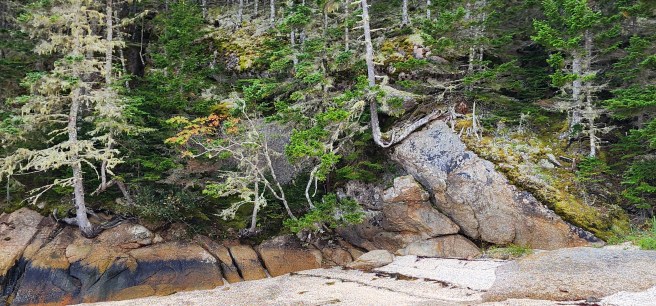

Maine Coastal Heritage Trust
Greek Revival bones
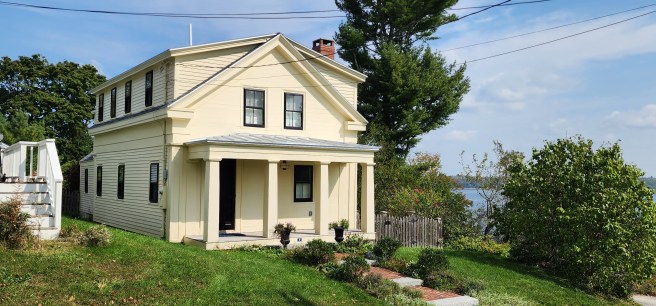
This pristine 1820’s home on Green Street overlooks Castine Bay.
Let’s not get too giddy yet
Having the upstairs buttoned up was our original goal.
People on the street can now see our intentions.
The roof is securely covered and we’ve gained more than 400 square feet of usable floor space. (Let’s see, with new home construction averaging $153 a square foot, according to a recent New York Times story, that would cost a bit over $40,000. Renovation, as we’re finding, can run well beyond that. I won’t say how much.)
We’re far from finished, I hate to confess. The front interior still needs to be framed, wired, and spray-foam insulated. Dry wall needs to go up and be painted, the new bathroom and laundry room plumbing fixtures installed, and something done with the flooring. We’re willing to keep the last item on the funky side as a historical touch. We’re still not sure about heating the space, either, though we’ve already found it has been comfortably warmed from downstairs, and perhaps we’ll hold off on a washer and dryer.
As for gutters? There’s more.
Downstairs, we’re looking at replacing the windows – 13 or 14, depending – and the front and back doors. Bigger is a kitchen redo, plus the tiny bathroom. And that leaves the back parlor to be tweaked into a combination dining and crafts room.
As for my remaining life’s savings? We have some difficult discussions ahead.
Another oddity I’ll claim
There’s no Ellis Island in my ancestry. All of my roots on my father’s side arrived earlier, via other ports, and came mostly through Pennsylvania.
My mother’s are a bit more tangled.
And then ‘What’s Left’ came into focus and changed everything before it
By the time the ebooks were published, I had remarried and settled into our little city farm on the New Hampshire seacoast, the one with the red barn that gives this blog its name. My life had stabilized and my job wasn’t devouring me alive, unlike my previous lower-level management positions.
But something kept nagging at me. I wanted to know just where the hippie movement had gone. Many of the insights have been posted here at the Red Barn, and I did draft a series of essays – Hippie Hopscotch – for a book competition that was cancelled after I sent my entry off. My conclusion is that the hippie impact is still around in many varied streams, much of the legacy taken for granted in contrast to the mass-media stereotypes or the current teens’ perception of hippie as being a girl thing. My wife and stepdaughters kept asking about the era and were astounded to hear just how much had changed for the better because of it. They were incredulous at the restrictions I had faced. Were things really as bad as Mad Men presented them? Yes, and the show had me retasting the first newspaper I worked for, the one that came closest to major metro. I mean, I could almost smell it.
Could any of this earlier work be salvaged? And what could I do with the searing childhood betrayal piece published online in Hobart?
My first published novel, Subway Hitchhikers, had ended with Kenzie’s return to Indiana. Intuitively, I had him, as a Tibetan Buddhist lama reincarnated into Iowa, marrying into a Greek-American family in Daffodil. I saw it as a way of blending two streams of ancient wisdom – one Asian, the other at the origins of Western culture. Something still felt incomplete in that ending.
Rather than trying to pick up the story with Kenzie himself two decades later, I decided to shift the focus to the next generation, which led me to create a daughter. This would be her story. As an added twist, I decided to have her lose him, not to divorce but an avalanche in the Himalayas, when she was just 11.
Unlike my earlier fiction, this one was undertaken totally in my retirement years. Yes, I had the ending of Hitchhikers as my prompt – and, based on that, some characters and a setting to work from – but this book would be done with fewer external demands than I’d faced in working on the others in my “spare” time.
Surprisingly, this became the hardest of all to bring to fruition, undergoing nine thorough revisions. In one version, there were no quotation marks. Another changed the tenses.
No quotation marks? Since she was relating the story anyway, including what other people had told her, who knows how accurately she repeated them. Blame Cormac McCarthy as a bad influence there. It was one flash of brilliant inspiration that ultimately proved confusing. Now, how many quotation marks did I eliminate in one sweep and how many did I have to insert as repairs? Both times, it involved a lot of keystrokes.
The focus shifted greatly, too.
At first, it was on what she uncovered about her father and his times. He was a hippie, after all, so we would see the hippie scene through her perceptions of his photographic record of people and events. In the next revision the focus turned to what had attracted him to join her extended family, one so different from his own roots. That led me to questions of just what a family is – a pretty slippery concept in today’s America – and then an examination of Greek-American culture in the Midwest itself. Finally, the focus was entirely on her, period, starting with her stages of adolescent grieving and emotional recovery.
I was a bit spooked when she began talking to me through my fingers as I was typing. She was snarky, too. Talking? She was dictating. Even scarier, she sounded a tad like my younger stepdaughter.
And it wasn’t just when I was up in my third-floor lair. Sometimes she talked to me while I was swimming laps or weeding the garden.
At some point this was no longer about a distant past, in her eyes at least, even when those roots impacted the present and its conflicts. By now, I was watching her grow up with each revision as she gained a snide, seemingly cynical tone and a goth appearance. I wish I had answers or at least advice for where she and her generation of the family wind up at the end of the book, but we do know what their options are.
The book also evolved into a multigenerational affair, reaching back to her great-grandparents and later jumping ahead to her nieces and nephews within a large, tightly knit extended family.
How to structure this baffled me until I came upon the way Jonathan Lethem handled a multigenerational novel that built on four sections of four chapters each, like a mosaic. Mine has five generations at play, once you include Cassia’s nieces and nephews, but the structure holds. Somehow it works differently than the traditional chronology of twenty-some chapters.
One of the 16 chapters, the subway ride to the Brooklyn art museum and its Tibetan galleries, comes from a lengthy outtake from a Hitchhikers draft, this time two or three decades later with Cassia, the daughter, rather than her father.
I should also admit that the title remained elusive. One I liked, Cassia’s Quest, got shot down for sounding more like a space journey. Another, in desperation, Diana’s Daughter pushed Kenzie out of range. What’s Left results as a double entendre, addressing both her situation and the manuscript itself.
Finding a suitable cover image was equally challenging. I liked a failing egg yoke as a reference to her being broken open and to her family’s restaurant. Photos of a grieving child or young woman never quite fit the physical description in the text itself and also failed to reflect the span from early adolescence into her 30s.
~*~
The project also had me reconsidering my own experiences.
Was I really ever a hippie? In my promotions for the novels, I contended that we came in all varieties and nobody fully fit the stereotype. That was, in fact, a central thrust of my novels, even when hippies are nowhere to be found, as was the case in Hometown News.
In the background, the local Greek Orthodox church opened the faith and culture to my curiosity. As I’ve discussed in posts here at the Red Barn, what I encountered was quite different from my Quaker simplicity but definitely enriched it, not just theologically but as in the traditional dancing, music, and food.
It was a good thing that I didn’t encounter the novels of the masterful Jeffrey Eugenides until after What’s Left had been published. I would have been too intimidated otherwise.
In addition to Jonathan Lethem, writers of inspiration during this project included Poppie Z. Bright, Anne Rice, and John Irving.
~*~
Not only was this the most difficult of my novels to writer, with deep revisions, but the central character, the snarcastic Cassia, had me rethinking everything that had gone before. She ordered me to revise the earlier books. Or else?
One of the advantages of ebooks is that new versions can be published rather easily. In this case, as you’ll see, she had my hippie books getting new titles, many characters getting new names, and many of the stories themselves being vastly enhanced.
All from what I jokingly called my culminating novel.
And that was before I returned to the others.
Here I had finally found myself in my goal of being free from the newsroom and having time to focus more fully on my “serious” writing. I just didn’t imagine it like this.
I still held a fondness for the hippie movement and its hopes but could clearly admit I had moved on. That part was liberating.
I’m still looking for that better world, though, as you know.
So here I was, back to the drawing board.
Finally, I turned the camera on the newsroom
My novel about small-market journalism originated as an experiment on my first PC, an off-brand back in the days before hard drives or the Internet. In this case, I decided to build a book as a series of variations on a theme relying on a template chapter that I then copied and pasted for development. Set in a newsroom, each day was the next day’s edition but sampled months down the road. Some of you may think of the movie Groundhog Day, but that was still seven years in the future. The key to the book’s development was a set of seemingly random search-and-replace possibilities I then ran through the manuscript – on both of the 5.25-inch floppy disks that were required for the full book. Other variations required physical input, one by one. Either way, think of Mad Libs with seemingly random repetitions popping up like loose threads through the entire tale.
The basis, of course, was a composite of several of the newspapers where I had worked. By extension, it could also represent offices anywhere, but I found myself thinking about how little we usually know about our coworkers. Often, it doesn’t go much deeper than a phrase they repeat all the time or a piece of their favorite clothing or some annoying habit they have. It was enough to sketch each of them through the rounds of the book.
And then I put it aside to season before tackling it again.
When I returned afresh, I had to admit that the variations were insufficient. The loops were, uh, loopy. By then, the revision was turning into a kind of paint-by-numbers to flesh out the bones.
The tale still needed more work. So much for my pioneering experiment with A.I.
~*~
Hometown News did take my fiction in a fresh direction. It wasn’t exactly countercultural, for one thing. And it took place largely within a workplace, with day-to-day drudgery many people might identify with or at least recognize.
While Kenzie in my hippie novels labored as a photographer on his campus newspaper and then on a small-town daily chronicle, he did move on to higher pursuits once he married. In contrast, when my savings ran out, I was back in the newsroom.
Another surprise as I look back. This manuscript was also in the works before my Baltimore sabbatical big writing spree opened.
I have memories of jotting down notes while driving Interstate 95 between sales calls in Connecticut. My time on the road and in motels left me plenty of opportunity for uninterrupted thinking.
Even with TV shows like Lou Grant and Mary Tyler Moore, the public had little idea of what really happens in a newsroom. At the time, the job carried some prestige, if not outright fear.
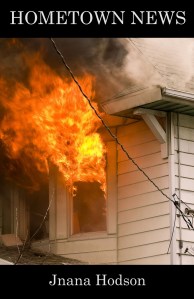
There was an adage that every newsman had a novel waiting to be born, and there was the cliché of the crusading reporter battling corruption and crime. Even Clark Kent and Lois Lane of Daily Planet renown. Mine wouldn’t be anything like those. The villains weren’t politicians or mobsters but, in the ultimate view, capitalism itself. And here I was, cheering for small, local enterprise.
For me, what emerged is the most problematic of my published novels, yet one of the most fertile. It certainly has the darkest humor and a large dose of dystopia.
I do recall one newspaper editor who candidly admitted to having taken a popular genre novel and essentially written over it to launch his own successful line of commercially published successes. Should I note that the owners of his newspaper also had one of the top book publishing houses in the world? Connections? Don’t discount them. Just don’t think of them as literary success, which I was aspiring to.
Rather than having the high drama of big bad guys somewhere outside of the newspaper company, mine were more insidious. In my experience, though, a more pervasive conflict smoldered behind the scenes within the business itself between the journalists, on one side, and the bean counters and their bottom line of obscenely rich profits, on the other. As the saying went at the time, many newspapers were a means of printing money for their owners. Not that much of it ever got down to the workers.
Let’s just say, too, that some papers were more competitive and innovative than others.
In my job of calling on editors across the Northeast, I heard personal stories that added to my own insights from working within two dailies that had undergone major transformations under inspired leadership, as well as lessons from leading a small paper in the town I call Prairie Depot and some stints elsewhere. Let’s skip the rest of the resume and get on with the book.
It was a world all its own. Or so I thought. And yes, it was set vaguely somewhere in the American Midwest.
Check it out at my Jnana Hodson author page at Smashwords.com.
National or state identity first?
If, therefore, … the people should in the future become more partial to the federal than to the State governments, the change can only result, from such manifest and irresistible proofs of a better administration, as will overcome all their antecedent propensities. … But even in that case, the State governments could have little to apprehend, because it is only within a certain sphere, that the federal power can, in the nature of things, be advantageously administered.
James Madison in Federalist No. 46
Do I really miss caffeine?
But somehow, I manage to write without it.
 Jnana's Red Barn