Acid test novelist and critic: Nicholson Baker (1957- )

You can add Baker to my elite circle of treasured novelists who began publishing after I graduated from college.

Start with his ability to look in depth where others haven’t gone – the phrase “literary microscopy” fits him to a T. Sometimes what he investigates is right in front of us, perhaps an escalator in an office building or a thermometer for a daughter’s baby bottle or a common book of matches on a sequence of icy winter mornings. Other times his focus is on portent issues in world affairs like Human Smoke in the buildup to World War II, the outbreak of Covid-19, where he was the first, in “The Lab-Leak Hypothesis,” to argue the coronavirus was manmade and spread by accident, or the destruction of paper archives in major libraries.

I like the way he generally alternates a volume of fiction with another of nonfiction before returning to fiction, works of originality and high quality in either vein. As a craftsman, he’s impeccable, whether with 250-word sentences that flow seamlessly or fiction that’s footnoted. He writes with cool passion and an irrepressible conscience, even in the three volumes of erotica that led the New York Times magazine to dub him the Mad Scientist of Smut.

My favorite novel is The Everlasting Story of Nory, where nothing seems to happen in the first 50 pages, befitting the thoughts and expectations of a nine-year-old girl spending a year with her parents in England. Brace yourself for the tension that follows, though.

Now, for some background

While we wait for the continuing renovations to catch up with these weekly reports, let’s change the focus to the history of this old house itself. Give us a better idea of what we’re working with, too.

When we bought our full Cape at the end of 2020, the real estate listing dated its origin in the 1860s. As we became familiar with the home’s bones, we saw details suggesting construction as early as the 1830s. While the pedigrees of a few neighboring houses have been catalogued by local historians, ours was not one of them. The dwelling did appear more modest in comparison.

We did have to wonder if the dwelling had been rebuilt after one of the catastrophic fires swept the downtown and its fringes in 1886, 1864, and 1839. Some of our stone foundation is 18 or more inches thick.

The house did appear on a widely reproduced 1879 map of Eastport, one that gave a birds-eye view of the city. The two dormers may have come later – it’s hard to tell from the map.

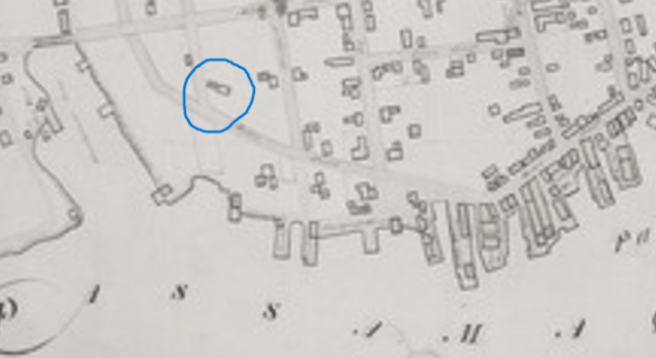
An earlier historic map of 1855 not only had a house fitting the footprint of ours on the lot, but with two wings, accompanied by an identifying script “Shackford Est.” The difficulty came in trying to figure out which Shackford that would have been — the family was prominent and prolific.

An earlier Plan of the Village of Eastport, 1835, by William Anson presented rough designations of the structures in town, including a house where ours is and only a few others in the blocks around.

Thus, we do know the house was here before 1886, as the charred rafters affirm, reflecting the great fire that destroyed the downtown. Local history dean Ruth “Ruthy” McInnis, owner of the Todd House bed and breakfast, had primed us to look for that detail when we were considering whether to bid on the place. Other dwellings, as we’re learning, share similar damage.

What I’ve uncovered is that this house is even older than we suspected, and more historic. In many ways, it tells the story of the town, too.

Ahoy, mates! It’s a small world, indeed

I’ve been caught off-guard several times while wearing my gray Louis R. French historic schooner hoodie around Eastport. (Well, one of them. I now have three, but that’s another story.)

The first encounter was at the county courthouse in Machias while researching the deeds to our home. A registrar asked what I knew about the boat and I started replying with the history. She smiled and said, “My dad worked aboard it,” back when it was a sardine carrier based in Lubec, the town just south of Eastport. During that stretch, the masts were removed and the vessel was powered by an inboard motor.

The second time was when a friend, a legendary ship pilot, smiled and said he rode many times aboard it as a kid. Bob did correct me, saying the French wasn’t a sardine carrier but a freighter carrying cat food to Canada. (“Cat food to Canada?” Sounds like a title to me.) His family did own canneries in Lubec, Eastport, Portland, and a few other places. That’s yet another history to consider.

The next incident came while leaving my dentist’s office and his wife ( a.k.a. center of operations) Mary, blurted out, “Lewis R. French? That was my family’s boat.” For 50-some years, in fact, or the time it was based on our waters, when her Burpee and Vose families possessed the vessel. From her I learned that during the Prohibition, the French was an active rum-runner. Sardine carrier? Huh? The missions do get more interesting, no?

She also said something about ghosts. Well, if they could talk.

She does have the book published later, but I do suspect some of those details are missing.

The most recent account came while watching a big cruise ship come into Eastport. A woman standing nearby saw my hoodie and then told me she used to work in the office when the French belonged to Seaport Navigation. (She confirmed that my dentist’s wife’s families were among the owners). The headquarters was on the second floor of a waterfront building that she pointed to, one where friends of ours have their gallery and apartment, and said she never got tired of the view. She remembered typing up many documents regarding  deliveries of canned sardines to the railroad line in St. Andrews, New Brunswick. Shipping them from there rather than by truck from Maine was much cheaper. By this point, the French was Seaport’s backup ship.

So sardines were still part of the story.

This may seem petty but …

Do we really have to wait another year for the new Interstate 395 leg from Maine Route 9 to I-95 itself to open?

It’s only a few miles and minutes but eliminates a lot of aggravation in getting from here at the eastern edge of the country to most of the rest of the USA. That half-hour of narrow roadway competing with Canadian tractor-trailers on icy pavement plus small-town radar speed traps is an aggravating bottleneck, believe me, even before you factor in all of the Acadia National Park seasonal crush. The new route will ultimately get us around Bangor/Brewer more swiftly and maybe save us ten minutes or so at most, but on a five-hour drive that can be huge.

As it is falls back into a Trump-era vision of what’s supposed to be good at least as the fireworks and firearms retailers along the way declare.

 What’s the biggest traffic hang-up you hate?

When an interlude becomes pivotal

Rather than being a retreat to the hills, as I initially saw the period between her future father’s leaving Daffodil after college and his return a few years later, I now see him undergoing a major slow-motion transformation amid frenetic surroundings.

For him and for me, this was a personal High Hippie time, pro and con, no longer a mere interlude to a landing somewhere in the future but a rich mix of its own.

And now, thanks to the daughter, Cassia, I had a better sense of where the larger story was headed.

Before writing and publishing my novel What’s Left, I had depicted his situation in two parallel volumes – Hippie Drum and Hippie Love – one full of near misses when it came to new love, while the other (R-rated) more often connected.

As I returned the drawing board with Cassia standing beside me, I had to admit the dual presentation was a luxury that did nothing to advance the overarching story. The two conflicting books, while beginning and ending at the same points, ultimately confused the reader. Still, it was a valuable experiment for me to file away. Thanks, Cassia.

Reuniting them into one book was a bigger challenge than you’d think. Finding the right tone, verb tense, and balance were only a start. More clearly profiling Kenzie’s country and in-town circles plus his workplace required another big effort.

If I ever do another novel, I don’t want more than four or five characters, if that. (Fat chance.)

~*~

Helpfully, What’s Left now gave me a clearer sense of Cassia’s aunt Nita as a central figure. Only a year older than Cassia’s future father, she now expanded from being his guardian angel, as she was in Daffodil Uprising, into something more of a magnet and Wise Woman who came and went as needed as he underwent crucial encounters, many of them emotionally painful.

~*~

In my revisions to what now stands as Pit-a-Pat High Jinks, I also wanted a better integration into the urban parallel to Kenzie’s life at the time, the subway novel, which would undergo its own thorough reconstruction.

My own job hours at the time would have been too constrained to allow the escapes to the Big Apple that I compress into Kenzie’s timeline. I didn’t even have a two-day weekend – only Sunday off after a late Saturday night, and then Wednesday; four of my days I had to be at the office by 5 or 6:30 in the morning, and it was brutal. In one of my later career positions, however, I did have a floating three-day weekend, which I adapted to Kenzie’s situation. Once every month he could head off somewhere, which soon became jaunts to New York City.

Another thread that I strengthened was his introduction to Tibetan Buddhism and subsequent growth in its practice, giving him a good reason to be heading off to the big city as often as possible.

~*~

In the years after moving from Binghamton, the scene of the action, and off to the ashram and beyond, I lost touch with all but one person from that period. Well, make that two, but he was an older sports editor who had nothing to do with the hippie scene. The other was a former girlfriend where the parting had been mutual.

As for the rest? I wondered where they all went, though I’ve even forgotten most of their real names. Why couldn’t I have been more snide, like calling a character “fat, stinky Frank” or “gaunt Ellen”? Nicknames were only a move in that direction.

As I revised, though, I now had the Internet at my fingertips.

Satellite maps allowed me to see that two – and maybe all three – of my housing sites there had been demolished. (I’m wondering whether I even tried driving past them in my calls on the newspaper editor when I was with the features syndicate. I don’t recall.)

And then a few ghosts from my past reconnected, first from the ashram years – I hadn’t been ostracized after all – and then my former housemate in upstate New York, the one who forms the basis for Drummer in the story.

He event came up with his wife for a visit in Dover. It was about time I met her. She was a much better fit for him that the Latina who commanded his devotion in the book. (I couldn’t invent a character like her out of thin air, by the way. She really was a center of attention in any room we shared.)

Back in the day, he had gloried in a full naturally blonde Afro back in the day, only now it was shaved bald. His smile and intensely blue Nordic eyes were the same, along with his eternally goofy outlook on life, but that chrome dome was disconcerting.

It was time to catch up.

“Did Jnana really have long hair?” my elder stepdaughter asked.

“Oh yes,” came the reply.

Somehow that was enough to get one of my younger generation to relent from their vow to kill me if mine grew out again.

“If you’re writing hippie novels, you might as well look the part,” she conceded. So I got their permission to grow a ponytail. Maybe she was just tired of what was called a combover for the balding.

He also filled me in on some of mutual friends. One was an OB-GYN in inner-city Philadelphia. Another, a federal attorney in upstate New York. Yet another was a functionary for the United Nations. And the biggest lover of the lot had settled down to raise a large family while working as a social services executive. So much for one of my hippie circles.

I even found a girlfriend, via a Chicago Tribune photo and story, who remembered very little of the time and only vaguely pictured me. She had been much more of a presence in my life, even at our distance, than I was in hers, it turned out. I had even hoped she’d be The One.

In fleshing out the characters in my pages, I now had a second Summer of Love to draw on as well as related experiences. I could ask people about their own hippie identities, and many of the thoughts filled earlier posts here at the Red Barn.

While connecting the dots for one figure whose account to me had never neatly added up, I broke out weeping. Signs of adolescent abuse were abundant. I suspect one of her teachers as a villain, but have no proof, of course. Is he even still alive?

As for the others?

Let’s be honest. We freaks weren’t as close as we’d like to think. I hate to consider that the despised fraternity brothers of college may have had the more solid connection.

So what did happen to those who shared the farmhouse? And most of the lovers?

Not that I’m thinking they’d make another novel. Not unless a unique structure surfaced, say something like postcards.
Worshiping in another Quaker Meeting

Vassalboro,
how many times I’ve driven an hour to worship,
even my own home Meeting

sunflowers outside the window
a gray morning
ten of us, now eleven

so many of the surnames from Dover
arrived here and abouts

edgewalkers
part of a message

the Zoom view of the Meeting room
shows only me
surrounded by white walls

“green walling,” a term I just learned
no, a green washing
by conniving corporations

a carpenter tells me of working on the renovations
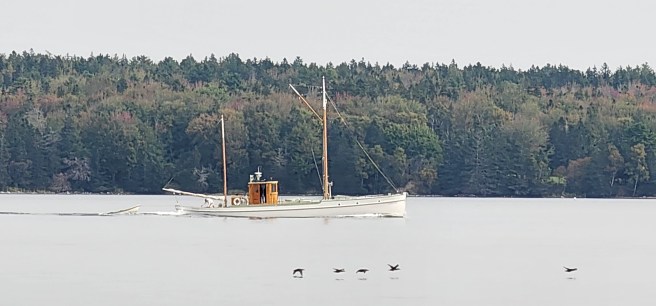
of the schooner American Eagle

all new to me
but not for long