
With winter fast approaching, what could be more comforting than these, especially on a lazy weekend morning?
Perhaps, even, waking up to the aroma of them still in the oven?
Oh, lucky me!
You never know what we'll churn up in cleaning a stall
With winter fast approaching, what could be more comforting than these, especially on a lazy weekend morning?
Perhaps, even, waking up to the aroma of them still in the oven?
Oh, lucky me!
While Reese’s will probably still be the favorite., followed by M&Ms, when it comes to trick or treaters, other top choices may vary depending on where you live.
For instance:
The rest of the country goes for more traditional brands – at least ones I’m familiar with.
I’m still not sure about that candy corn, which is supposed to be universally loved this time of year.

Also known as tamarack and hackmatack around here. It’s a conifer that loses its needles each fall.
My poetry efforts bloomed burgeoned in two periods. The first was in the decade after I left the ashram, culminating in my four years in the Pacific Northwest. The second was in my first two decades in New England.
Bly came center stage for me in that second round as I began working increasing in Deep Image directions, without yet having heard the term.
Bly, as it turned out, was a major proponent of the concept. I did find his essays very helpful, especially the idea of riding a dragon or even the dragon smoke, along with the ways we humans think with three brains and his criticism of most English poetry as being miniature sermons.
His own work and much of what he translated is infused with a darkness I hadn’t found in the Beat-based poetry of the San Francisco renaissance, including the Northwest.
The majority of the writers I’ve most admired possessed a strong sense of place, and Bly was no exception. His return to rural Minnesota after Harvard and Norway is a prime example.
While he’s also lauded as a founder of the men’s movement, I had been working in other fronts of the issue and found Iron John rather forced as an argument. Gary Snyder’s earlier Dimensions of a Haida Myth impressed the importance of folktales on me much more.
Reading that his examinations of male identity sprang from the emotional crisis he encountered after being divorced by his first wife, Carol, leads to the questions of how much she shaped his earlier work and quite possibly what followed. Her short stories are memorable. When she died in 2007, she was hailed as Minnesota’s lioness of letters.
A public reading he gave with his close friend Donald Hall in Concord, New Hampshire, remains memorable. Throughout their careers, they mailed new work to each other for critique before showing it elsewhere. Their styles were so different. The reading itself came shortly after the death of Hall’s wife, the poet Jane Kenyon, and was in her honor.
late-morning jacket-soap
this lapping water is a nagging unease
so far from a destination
you can address

do I walk as fast as we’re sailing?
a fathom is essentially an arm span
how far the sound carries
that lawnmower
I think we’re heading the wrong direction
with someone new at the helm
how can they see ahead
from way back there?

I’m freezing
ready on the down haul
island hopping
today’s cold
except in the galley
The Milanos were also short-term owners of our house. They sold the property in June 1978 to Dora and Merrill Lank junior. He was an Eastport native who served a stint as a city police officer and also enjoyed making wreaths. Both of them had grown up in Eastport — he in the north end and she in the south — and had children.
When the Lanks took ownership, our house had a slate roof, one with a pink scalloped pattern worked it. It was sided it what Dora has called ugly blue asphalt shingles. They divided the two big rooms upstairs into four, added the closets at the top of the stairs, and installed the casement window over the kitchen sink and the pass-through to the front parlor before moving in with her mother a few blocks away.
The house was then rented to Mel Soctomah, newly retired from the U.S. Army. He was Passamaquoddy in his late 40s and moved in with his wife, three children, and a dog. At liberty to make renovations, he installed the big wood and oil-fired cook stove that occupied the kitchen when we arrived. He recalled that the flue drew well, an important consideration in a place as windy as Eastport. They then left for a stint in Florida before returning to Eastport and neighboring Sipayik for good.
Dora and Merrill divorced, though, and complications emerged after she moved on. There was a sale from Bangor Savings Bank to the U.S. Department of Housing and Urban Development on October 8, 1982, with a supplementary entry on August 5, 1983. This was during a national recession that included a depressed real estate market and foreclosures. Somehow, Gordon Greenlaw reappears in this sale.
Sometime during this period and the one that followed, puzzling rough-sawn dark ceiling beams were erected in the two front parlors — “pseudo-rustic pop 1970’s kitsch,” in the words of one current resident, or “ye old Lion’s Den tavern,” in the mind of another. Those ceiling beams are distinctive, in that love- it-or-hate-it kind of way. For us, our reaction often depends on the day you might be asking. Looking closer, touches appeared in the kitchen, like the Montgomery Ward electric stovetop that came with the house when we bought it. Monkey Ward, for the record, went out of business in 2000 and probably had no outlet anywhere near Eastport well before that. I am wondering about some of the shelves, though, and considering them her Calla’s. Or now, maybe Mel’s. Nice work, either way. Particle board cabinets that also arrived at now scheduled for replacement, as are the triple-track storm windows.
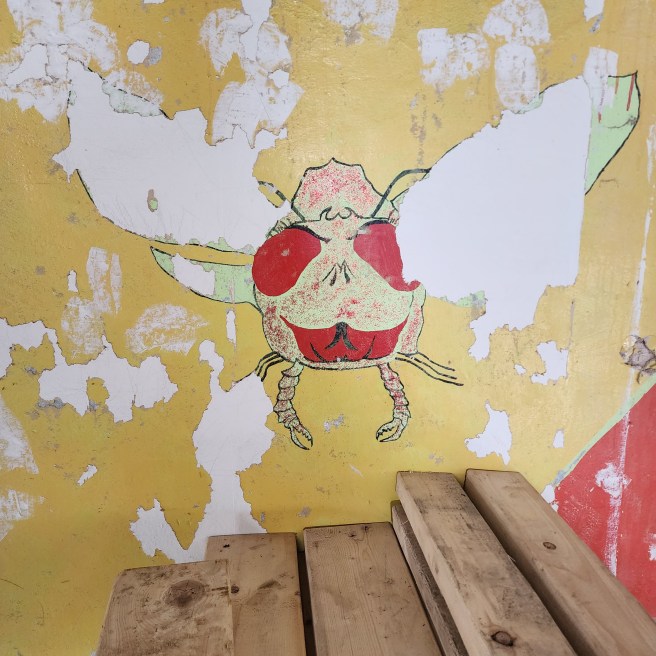
We can still ask who added the knee walls or the cosmic crab wall painting we found under the wallpaper upstairs.
As a third book involving Jaya shaped up, I reflected on ways some people perceive things most folks don’t. The angels everywhere, as Hassidic contend, perhaps matching the dakinis of Tibetan Buddhist circles. Some of my fellow yogis saw auras around people, although I’ve seen just one, quite black, surrounding the Reverend Pat Robertson when he and his handlers walked through the newsroom for a conference with the editor-in-chief and the editorial writer.
Since moving Way Downeast, I know of the small rock people some of the Passamaquoddy observe.
You might add elves or gnomes or other creatures to the list.
The concept did give me a threat to unite the three novellas into one.
~*~
What was needed was a third novella, reflecting the place Jaya lived between Prairie Depot and the Pacific Northwest. It would have With a Passing Freight Train of 119 Cars and Twin Cabooses before it and Along With Kokopelli’s Hornpipe following. It would be like an adagio in a symphony or sonata or the middle panel in a painted triptych.
I decided to draw on a wooded alcove I loved to explore during my return to Bloomington. It was a largely unknown tract that had included a city water reservoir as well as several caves and springs that had fed two gristmills.
In the years since I moved on, the site has been cleaned up into a city park that even has a stairway down one of the steep slopes.
It had inspired a set of Leonard Springs poems you can find as a free chapbook at my Thistle Finch blog. As I revisited those pieces, I realized that the hollow’s scene and history just beyond the duplex my first wife and I rented on my return to Bloomington as a research associate would transport well to the Ozarks. Especially the part about grist mills at the foot of the sharp hillsides slopes where springs poured out from cave formations.
The story took off from there, especially when I chanced upon the woman miller. I must confess being especially fond of the result. Was this Cassia from What’s Left whispering in my ear once again?
Researching details for this story was a delight. Grist mills had run for a while in my ancestry; the Hodgson Mill in the Ozarks, for one, reflects one side of my family – they even spelled their surname for a while without the G, like mine. (They descend from one William while the other William, also a miller, was my umpteen greats-grandfather.)
Caves were another thing the Ozarks had in common with southern Indiana.
And, speaking of things some people see and hear that others don’t, we had the American Shakers whose spirit drawings and writings wandered outside of the normal artistic constraints. That gave me one more element to play with, especially when I turned to the artistic projects that Jaya had relied on to replenish her own soul in her spare time. I didn’t want her to be writing poetry, as I had, but to be creating some blend of art forms beyond that. Think of Joseph Cornell’s boxes or Emily Dickinson’s bits of paper constructions as possibilities. While I touch on Jaya’s legacy on that front toward the ending of Nearly Canaan, I felt freer to explore it here.
Just what was Jaya’s off-hours creative activity and spiritual practice leading to? Or what prompted them?
Miller at the Springs became an ideal forum for their consideration. Here it was, the final piece of writing in my range of fiction, and it was the most joyous to draft, the least ambitious in its art, and perhaps the most down-to-earth.
~*~
These three novellas presented a private Jaya much different from the one in the public eye. Titling the book the Secret Side of Jaya came naturally, along with the subtitle, Three surreal and fantastic encounters.
The book rounded out my Living Dharma series.
I was ready to kick back and relax, intending to enjoy the role of an author.

To put the jack-o’-lanterns in context, let’s take a step back.

The first is, that the Convention must have enjoyed in a very singular degree, an exemption from the pestilential influence of party animosities, the diseases most incident to deliberative bodies, and most apt to contaminate their proceedings. The second conclusion is, that all of the deputations composing the Convention, were either satisfactorily accommodated by the final act; or were induced to accede to it, by a deep conviction of sacrificing private opinions and partial interests to the public good, and by a despair of seeing this necessity diminished by delays or by new experiments.
James Madison in Federalist No. 37
 Jnana's Red Barn