Some manmade problems will never go away

Bad decisions can have long-lasting consequences.

One here in Maine was the application of industrial sludge containing PFAS to nearby farmlands. At the time, it was touted as form of recycling. Today, you don’t dare drink water drawn from the wells.

The problem’s not unique to Maine.

Here’s the take.

  1. These ” perfluoroalkyl and polyfluoroalkyl substances,” more commonly known as “forever chemicals” or “forever pollutants,” have been around since the 1940s. As the nicknames suggest, they don’t break down naturally. They may take hundreds or even thousands of years to decompose.
  2. There are more than 9,000 known PFAS compounds, with 600 currently used in the U.S. in countless products to make them resistant to oil, heat, stain, or water.
  3. They’re found in everything from cosmetics and outdoor gear to firefighting foam and carpet treatments to non-stick pans and other cookware to dental floss and food wrappers and even fast food.
  4. They’re found in water, the ground, the air, the ocean floor, wildlife, and the human body.
  5. In humans, they’re seen leading to higher risk for kidney or testicular cancer, increased cholesterol levels, higher blood pressure, high cholesterol, thyroid disease, pregnancy-induced preeclampsia, and damage to the liver and immune system.
  6. The Department of Defense has allocated $1.5 billion for cleanup at its sites around the country.
  7. PFAS have been reported in thousands of private wells near military facilities, while a recent report concludes that they’re likely found in the most of the public water Americans drink. Other studies report slightly lower rates.
  8. Researchers are searching for ways to filter them out of the water supplies, but that leads to another problem: What do you do with the stuff left behind in the filter? It won’t go away.
  9. Incinerating it has similar risks. Breaking up the longer strands can result in shorter strands, that would then pollute the air, soil, and water. And some, like Teflon, can withstand temperatures of 500 degrees Fahrenheit.
  10. The use of ultraviolet radiation and possibly microbes to break down the substances is emerging as an affordable glimmer of hope.
Acid test poet: Roger Pfingston (1940- )

A high school English and photography teacher, Pfingston also found himself at the center of an off-campus poetry circle that produced the annual review Stoney Lonesome, named for a small town near Bloomington, Indiana.

His own work, often reflecting family and neighbors and the rolling wooded nature of southern Indiana, are wonders of bejeweled focus and clarity on a passing time and place.

The directness is something few others achieve. Maybe Rumi comes closest, in a different way.

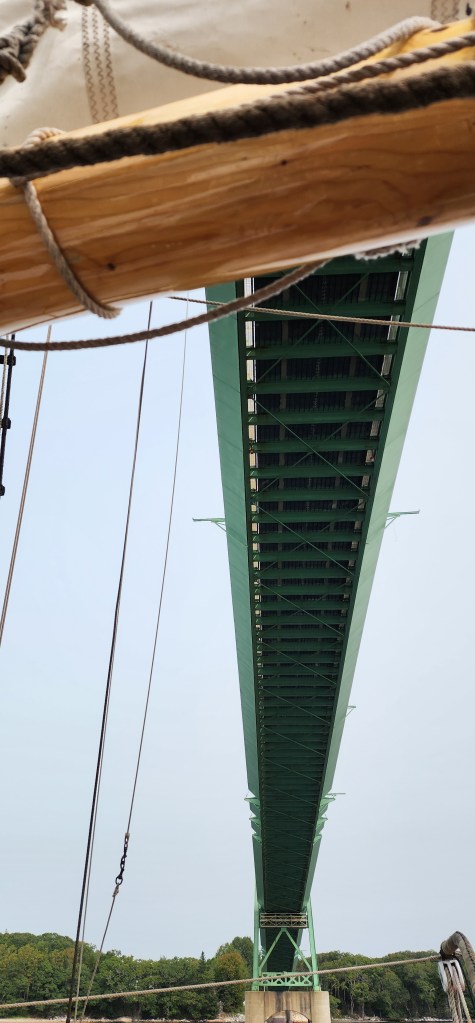
We clear the bridge by a foot and a half, if she’s read the charts right

Eggemoggin Reach
the Deer Isle bridge ahead
we’ll barely clear
six inches or sixty feet, what’s the difference?
other than a margin of error

the electronic gizmo’s
soundings in feet
at mean lower low water

I got to steer today
a feel of command
aiming for the arch of the bridge

Taking forever to get to the span
Deer Isle Bridge, as seen by vehicular traffic
Eggemoggen Reach Bridge from the water

a fixed bridge meaning
it doesn’t draw open
one more detail on the chart
(see Note B)
which I can’t find anywhere
until it’s pointed out in the margin,
same color type as the notice

we’re pushed by Greyhound
the inboard yawl

the motor behind me as a drone note
humming above lapping water

people bundled up this morning muted sun water depth 64
just gone to 72

Eggemoggen Reach broader
than Friar’s Road
where I live

A change of direction in the search

Working the line of our old house downward quickly led to a tangle. You’ve been following what I uncovered at the Washington County courthouse, but at this point, an earlier reference was not recorded in the transaction at hand. Zip, zero, nada. Without that, I was stuck at 1975, well within my own lifetime, not exactly historic in my viewpoint.

The sale to the Greenlaws, according to the record, involved Oscar L. Whalen, executor for estate of Arline F. Vaughn, of New York, and someone named Rose Lee. But there was no Book and Page mention to lead me to the next entry.

The best I could do was to try working from the earliest residents and hope to build a line to 1975.

Since the 1855 map labeled our house “Shackford Est,” looking at the Shackford family made sense. Maybe Arlene was one of them.

Revisiting the Tides Institute and Museum of Art’s online survey of the homes of Eastport, I found that they had added a notation to their photo of our house. They quoted the weekly Eastport Sentinel account of U.S. Navy Commander Albert Buck returning home after World War II. Home, of course, is the one where we’re now living.

Buck? That gave me another family to start investigating, especially since they were living across the street in the 1855 map.

Layer by layer of discovery

In preparing this weekly series about things that were behind my novels, I wasn’t expecting to see how much of what was happening in my own life during a revision could also impact a manuscript based on much earlier events. It’s not something I’ve seen mentioned in author interviews.

One of the writing adages I’ve kept at hand is this: “Steer into the pain.” I’m not sure where I found it or perhaps adapted it, but it has been helpful in reminding me not to take the emotionally easier way out when facing a situation, whether personal history or fictional abstraction. The pain is where the higher-level energy is as well as the revelation.

So add to the advices, “Write about what you’re discovering.”

In a way, it’s a reminder to write about what you don’t want to know but with the added kicker, “What you don’t want to admit.”

For those of you doing the NaNoWriMo challenge this month, may you add that insight to your energizers.

More recently, I would add to that something else that motivates me: The magic!

Or, in my case, pure wonder. Again, what do I know? And celebrate?

I’m finding they’re both essential currents in my life’s work.

~*~

Let me say I rather miss Cassia from my novel What’s Left. After prodding me to that round of big revisions of my previously published fiction, she’s gone off on her own. She was even remote when it came to my nonfiction volume that more recently demanded my fullest attention. Well, she did earn her own category here at the Barn – Cassia’s World, based on the research and many outtakes from her novel’s drafting.

As for the real-life inspiration for many of my characters, let me repeat: Where are they all now? Or more accurately, where did they go? I don’t mean the aging rockers. I can think of social activists who kept the faith and marched on, largely out of the spotlight, though they’re aging, without replacements in line. But as for the others? I’m unsure of most of their names. And let’s forget the boilerplate disclaimer regarding all persons living or dead, even for futuristic space journeys or fantasies deep into the past.

~*~

As I look back on the history underpinning my novels, I have to insist the potential was there. I must also ask, what if we had a more solid social structure and tradition, with something akin to elders? The dorm I lived in, the core of the opening half of the revised Daffodil novel, has today become something of the center I envisioned, without the radical political edge.

I suppose I could have told these stories time after time after work in a bar, but to me they seem to address a different collective experience. Besides, journalists have their own “war stories” to compare.

Just where were we gathering now, anyway? And where have we gone to get here?

A few have found a progressive faith community – church, synagogue, sangha, or perhaps a masonic order or fraternal lodge. But for the others?

Should I point back to the posts on the breakdown of community?

And here we had thought we were creating tribe.

As an extra point of emphasis, I’ll add: I’ve never returned to many of the locations where I’ve lived.