
Scandinavian modern design, all the rage back in the ‘50s. Belfast & Moosehead Lake Railroad, Unity, Maine.
You never know what we'll churn up in cleaning a stall
Scandinavian modern design, all the rage back in the ‘50s. Belfast & Moosehead Lake Railroad, Unity, Maine.
Another of the novelists to enter my elite circle of influences recently, Banks addressed the working-class lives of northern New England and upstate New York. He included also darkness, despair, and grit that feel real, rather than at a bit of distance. There’s a heft I found missing from some others, like Carolyn Chute’s Beans of Egypt, Maine or Ernest Hebert’s Darby Chronicles of New Hampshire, not that they aren’t informative.
The Sweet Hereafter is my favorite so far in that vein, though I should also mention The Darling, which shifts the action to Liberia and the focus to failed political activism.
With 21 volumes of fiction to his name, my TBR pile gets deeper.
He also has me recalling Richard Russo’s Empire Falls, which I had thought was his.
The Far Rows
of Egg Wit
Pear Amids
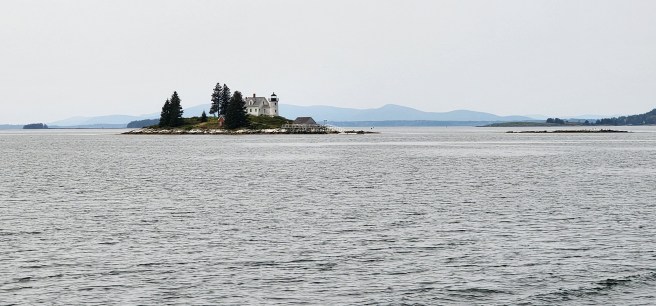
marking entry to Eggemoggin Reach
below Castine

the free lighthouse guide I brought along
2013 edition I see now
newsprint
has no mention of Saddleback Ledge light
not to be confused with Saddleback Island
other than a listing
no photo or description
nor does it list Eastport as a harbor
nor Lubec
though Calais somehow counts
buoys: green have flat tops
red, coneheads
The Buck family had its own prominence.
Several branches of the family originating in Haverhill, Massachusetts, arrived early on in Eastport.
The most celebrated and traceable line descends from Revolutionary War Colonel Jonathan Buck (1719-1795), who came to Maine and gave the Penobscot Bay town of Bucksport its name. He is best known through a questionable story of a witch he supposedly sentenced who then cursed him at her execution.
His son, Captain Ebenezer Buck (1752-1824), born in Haverhill, built the first framed house in Bucksport, but because he was captain of the local militia, the British burned it during the Revolutionary War.
So much for broader historical importance.
Ebenezer’s son Jonathan (1796-1843) brought the line to Eastport. He was a member of the Eastport Light Infantry in 1818 during the War of 1812, as was a John Buck.
Beyond that, Jonathan’s “business life was passed at Eastport, where as a merchant, he was associated with a Mr. Pillsbury, of Portland, Maine,” as one account noted, while the Eastport Sentinel in October 1839 reported,
“Died, in this town, on Wednesday last, Jonathan Buck, Esq., aged forty-three years. Mr. Buck belonged to that class of men who may well be called the creators of the wealth of a community. To an untiring energy, which enabled him to accomplish more than most men, he added an enterprise, energy, and intellect well fitted to direct the exertions of others. In every relation of life, he will be missed and lamented. To his family the loss is irreparable. Those whose labor he has for years directed will miss their guide. The community loses one of its leading men and little at this time can it bear the loss. He rests from a life of severe labor, and when such a man dies, we feel that a part of society has gone.”
The account was signed by Seth B. Mitchell, editor.
Another line in the Passamaquoddy area came through Captain Eliphalet Buck. The 1820 Census for Eastport includes an Eliphalet Buck, who wed Mehitable Vose in 1818 in Robbinston, Maine, and drowned in 1836.
None of this, though, pointed toward our house.
Only later, after learning that Fisher Ames Buck had once owned our house, could I sense a different route going back to Jacob Buck, half-brother of the Bucksport founder. Jacob’s wife was Hannah Eames, a surname that evolved into Ames. They had six sons, four of their fates unknown, as far as I can tell.
That line led through Canada and the Loyalists who left the United States at the end of the Revolutionary War. You probably weren’t taught about them in your American history classes, but they were a significant factor around here, as I’ve learned in this project.
Somebody’s telling of an event that took place – or allegedly did – and I find myself evaluating it through an either/or lens. This wouldn’t fly as fiction (nobody would believe it) or, oh yes, it would. It’s not a matter of factuality but rather whether it would fit into an acceptable mindset.
I can even listen to people’s names along the same line. First names carry an impression, OK? I’m not sure where the dividing line is on this consideration, but it’s there. Stanley is going to have a few obstacles as a lover, right?
Another viewpoint comes in looking at what’s happening through an imaginary cameraman’s lens. Have you ever found yourself framing scenes or even wondering who could be cast as one of your friends? Just look at how they move around in the picture. Cut! And splice to this …
For an artist, reality often clashes with the ideal, I’d say.
~*~
For a journalist, at least, the biggest difference in fiction is the importance of emotions rather than facts. It means asking yourself how you feel about a detail. Warm? Cool? We’d never ask that of a news story.
~*~
Revision is where we, as writers, step back from what we’ve written to view our pages from a distance, the way a film director would or later, the film editor.
Perhaps you’ve heard of how much footage winds up on the cutting room floor. Writing, it’s the same.
For me, the cut pages were rarely wasted. For example, a lode of outtakes regarding my experiences of Bloomington went from my subway novel and on to what now stands as Daffodil Uprising. Many more of those outtakes went into What’s Left somewhere off in the future. Still more relocated to the Ozarks in Nearly Canaan and the Secret Side of Jaya.
They didn’t go exactly straight, as I recall, but underwent thorough embellishment along the way.
My interactions with the Bloomington as a research associate were much different than they had been as an undergraduate. I didn’t go to as many concerts or operas. My new spiritual and writing disciplines had me rising before dawn. I was emerging as a poet, too, and I was, most of all, newly married. And then that blew up, only to land us, hallelujah, in what I thought of as our promised land, only it was in the open desert rather than the wet thick forests of the Pacific Northwest.
How could this not be material for reading? Or, more profitably, something for the Hollywood treatment?
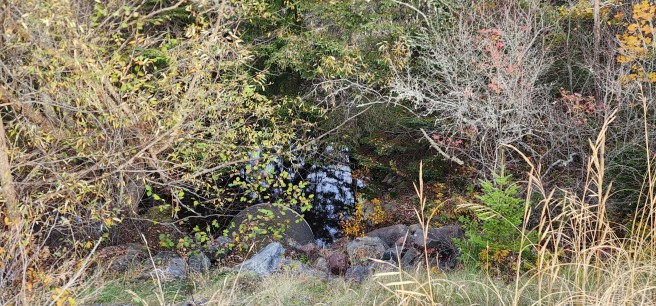
Whiting, Maine
… they have reported a plan which … may be carried into effect by nine states only. … The forbearance can only have proceeded from an irresistible conviction of the absurdity of subjecting the fate of 12 States, to the perverseness or corruption of a thirteenth; from the example of inflexible opposition given by a majority of 1-60th of America, to a measure approved and called for by the voice of twelve States comprising 59-60ths of the people …
(Rhode Island had refused to send delegates to the Federal Convention.)
James Madison in Federalist No. 40
We get our share of lousy weather. Or may everyone’s, according to one Navy Chief Officer.

Okay, he was talking only about fog.

Or was it a boneless breast? Cooking for one can still feel luxurious. This wasn’t quite piccata.
 Jnana's Red Barn