
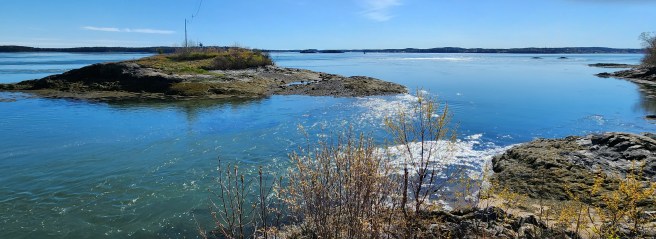
Our rocky shoreline includes sporadic pocket beaches, too. This one faces tiny Dog Island, shown below.
You never know what we'll churn up in cleaning a stall
Our rocky shoreline includes sporadic pocket beaches, too. This one faces tiny Dog Island, shown below.
In researching the history of our house, I learned about many of its earlier neighbors as well. Of note to the south was one with a rather exotic surname. Turns out he was a rather influential figure in the establishment of Eastport.
Here are a few points about him.
a shower to a bath, but indulge in hot tubs.
a hot tub to a sauna in the snow, not that I haven’t delighted in the latter.
religion that relies on questions more than answers.
discovery to fabrication. Accuracy more than cleverness.
Chocolate or candy?
White chocolate. Or dark, bittersweet.
Waffles or pancakes?
Either one, awash in melted real butter and local maple syrup. Better yet, a classic cheese omelet. Or baked pears or baked French toast.

It’s rather modest, actually, but so classy all the same, befitting the schooner Louis R. French. It was at the top of the ladder from my quarters below.
For more schooner sailing experiences, take a look at my Under Sail photo album at Thistle Finch editions.
Captain John senior and Esther had one other son, Samuel, who died in South America in 1820. His wife, Elizabeth Lincoln, had been born in Hingham, Massachusetts, and died in 1884 in Eastport, age 90.
The only child, Samuel, became a ship captain and, in 1851 in Eastport, married Mary Tinkham. He was also the one who provided the Shackford family profile in William Henry Kilby’s 1888 Eastport history volume.
Samuel junior turns out to be a remarkable figure in his own right.
As the 1895 Album of Genealogy and Biography, Cook County, Illinois with Portraits detailed, “He was, like his father, a shipmaster, which calling he followed until he came to Chicago, in November, 1853. Immediately on reaching this city, he engaged in the commission produce business, an enterprise which he carried on until the great Chicago fire, after which he removed to Winnetka.
“While living in Chicago, he was one of the early members of the Board of Trade, and served two terms in the city council during Mayor Rice’s administration. For five years he was a member of the Cook County board of supervisors, serving on several important committees, and for a time was chairman of the finance committee. During the Civil War, over two-and a-half million of dollars of soldiers’ bounties passed through the hands of this committee. He served about four years as a member of the Chicago board of education. … For many years he was a trustee of Rev. Robert Collyer’s church in Chicago, and was an exemplary churchman, never noted for extreme piety, but highly respected for his practical ideas of Christianity. He has been for years a trustee of the village of Winnetka …”
In addition, “Mr. Shackford has always been highly esteemed as a public-spirited and useful citizen. Before the Great Fire he had, perhaps, the finest and most complete records of city and county affairs ever in the possession of any one person, and his excellent memory aided him in the recollection of important transactions, which made all very valuable to the citizens. The people seemed to feel, and often expressed themselves in saying, that if he was chairman of a committee, that committee would do its full duty in advancing the interests of the city. He was indefatigable in looking after the affairs of the public in general, nor was he negligent of his own business.
“He has the best genealogical record of the Shackford family, and more interesting family records and mementoes than any other man in the state. Members of the old Shackford family are related to the first families in New England, proof of which he has in his possession. Mr. Shackford has written and left to posterity many valuable genealogical records, which have been, from time to time published. Notable among these, because of national interest, is ‘The Lineage of President Abraham Lincoln,’ as published in the New England Historical and Genealogical Register for April 1887, in which the writer, whose mother was a Lincoln, proves beyond a reasonable doubt that the brothers Mordecai and Abraham Lincoln, sons of Mordecai and Sarah (Jones) Lincoln, of Scituate, Massachusetts, were the ancestors of the Lincoln families of Pennsylvania, and that Abraham Lincoln, the Martyr President, was descended from the brother Mordecai …”
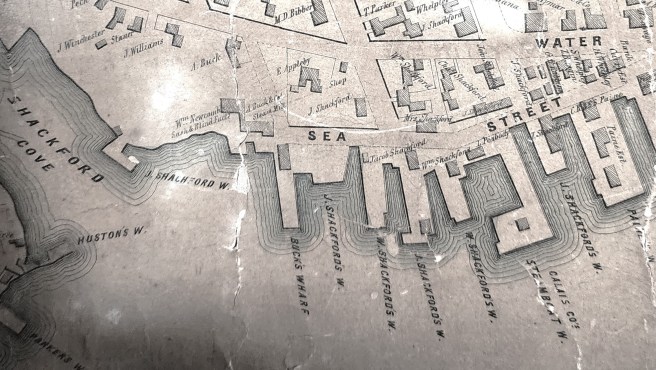
The 1855 Eastport map, produced shortly after Samuel had relocated to Chicago, illustrates how much the family had flourished. At least 13 buildings are labeled Shackford — most of them along Water and Sea Street just below our house. Many of the latter were likely warehouses and offices related to the six Shackford wharves and piers flanking the Calais Co.’s Steamboat Wharf, at the time owned by John junior.
The 1850 Census had eight Shackford households in Eastport. The 1860 Census had ten. And soon there were none.
So much for the Shackfords who grew up in the house we now own and their descendants.
Let’s celebrate the publication of my poetry ebook Mediterraneo this week.
As a series of poems, this book was a turning point for me. My earlier poetry had been mostly of the nature or love genres.
Here I focused on Western culture itself, through places around the Mediterranean Sea. It was someplace I’ve never visited, though it’s had a huge impact on my artistic and spiritual outlook. What I have known comes through artworks, literature, philosophy, operas, insights from my daughter and wife’s travels and those of my goddaughter and friends and even Greek Orthodox dancing and liturgy as well as ancient Hebrew scriptures. Put them all in the mixer, then, and see what we can distill.
It’s quite distinct from my ultimate roots in the British Isles and Germany.
When I created these poems, I had not yet relocated to a remote fishing village on an island in Maine after 20 years in the Seacoast region of New Hampshire. The climate is colder than the Mediterranean’s, for certain, but the light of the sun does reflect off the sea and back into the sky, magnifying the luminance in a way that attracts artists, as it does in many of the locations in this homage to the cradle of notable classic faiths, cultures, and cuisines. I do miss Greek dancing and related dining. The ability to see whales from shore or deer in my small-city yard do offset that.
The Mediterranean is much larger than I had supposed. It would reach from nearly one end of the United States to the other, yet also spans so much more diversity.
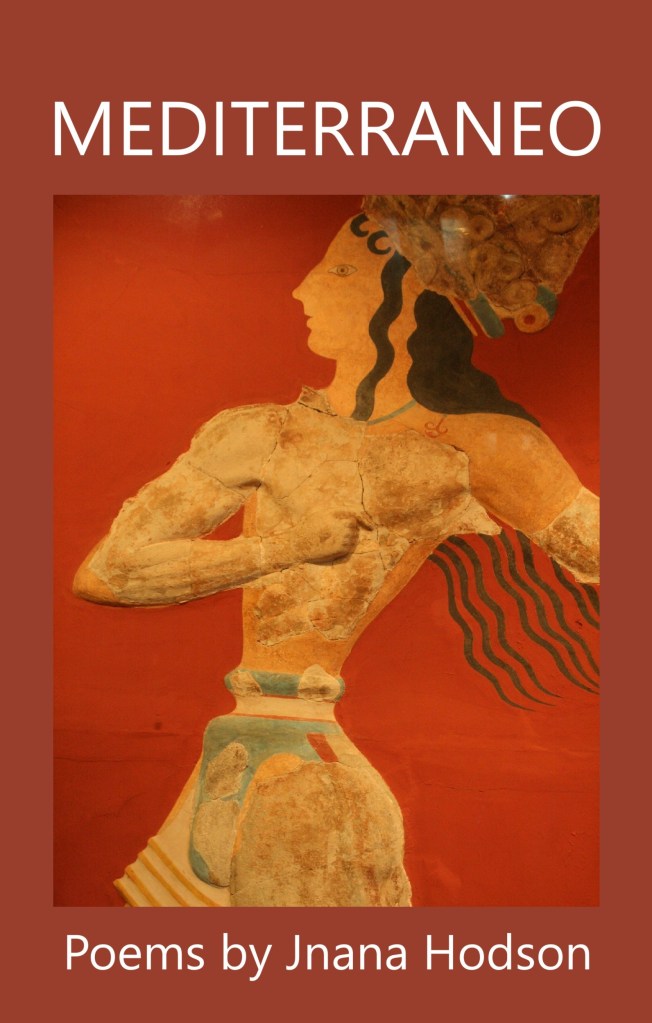
While I’ve never been to the Mediterranean, much less Egypt, and never out of the country, for that matter, excepting pockets of Canada, all the same, I’ve flown places in my imagining, and some convey some underlying kinship.
Barcelona is one of those. Seemingly far out of my northern nature, this Latin complex of sensuality, color, and Roman Catholic devotion also harbors a stubborn independence, under its ostensible domination by others. Spanish, but not Spanish. Catholic, and yet in a historic realm of heretical lay movements. A passion for the musical dramas of Wagner, accompanied by industry.
Perhaps my genetic line does run, as a marker suggests, from northern England to the border of Spain. Uncork a red wine, then, and sit in my Smoking Garden on a summer late afternoon. Muse on a line from on friend or other while listening to an opera broadcast.
Consider Pharaoh’s descent, the ways the culture of ancient Egypt anchors one corner of the Mediterranean. Was there another anything like it, in its mindset or visual conception?
Or the pervasive smell of camels with their wave-like gait as they nearly sail from the southern shore of the Mediterranean and on deep into the interior of north Africa. In many ways, it’s their land more than man’s.
Or the continuing influence of Greece and its blinding sunlight, scented with lavender and sage, spills over the the culture we inhabit, sometimes with an air of longing
So much ancient history is filled with brutality and revenge, lusts and conquests. Especially, we would venture, around the Mediterranean and its sea.
The Italian Renaissance, with its lush reds and golden adornments, leaves its mark on the imagination. What would Europe be without it?
As for Minotaur in the Ring, with strokes of Picasso, don’t overlook Barcelona, the fifth most populous metropolitan area in the European Union. Some say the port city was founded by Hercules, which would fit its fierce spirit. It even lives its own language, despite Spanish rule. And then there’s its unique style.
They’re all energies in these poems.
You can obtain the collection in the ebook platform of your choice at Smashwords.com and its affiliated digital bookstore retailers.
Rather than the big splash – the masterwork, Oscar performance, Pulitzer Prize, MVP sort of thing.
Think of a pastor, crafting sermon after sermon each week.
A woman who found housing for the homeless and then patiently worked them through their finances to point them toward independence.
The big dreams of a novelist or poet page by page that never found a readership, or the correspondent for a local weekly newspaper.
A doctor or nurse. Teacher. Carpenter. Mechanic.
Keep your eye open and the list grows quickly.
It even becomes more impressive than many who have fame.
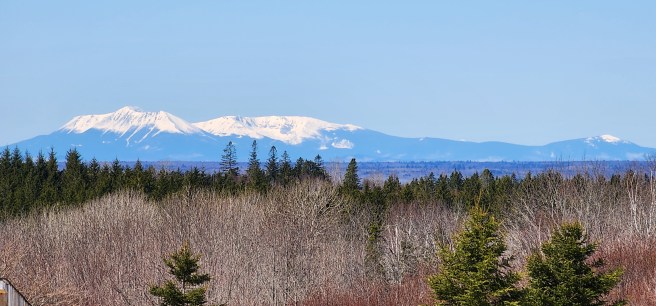
Maine’s highest mountain can be impressive even 80 miles away.
Despite our many trips to Cape Cod back when I lived not that far away in New Hampshire, I never got around to visiting tony and history-laden Martha’s Vineyard or neighboring Nantucket. It’s an oversight I don’t want to repeat when it comes to Grand Manan, an impressive Canadian island we can see from some points here in Eastport, Maine.
I am hoping to get there this year. Even if I don’t, here are some high points:
The first permanent settlement, by the way, was in 1784 by Loyalists fleeing the U.S. at the close of the American Revolutionary War, a common occurrence across New Brunswick.

