Acid test poet: Ted Berrigan (1934-1983)

Encountering a trio of his Sonnets in an issue of the Paris Review my senior year of college blew me away. First, by the fact that their iambic pentameter had been cut into lacy fragments but also that the remaining threads were made more powerful and light-filled as a result. Or, “oh, for the loving” (expletive), as he wrote. These were more like the collages of Robert Rauschenberg than the corseted stanzas of Shakespeare.

The fuller set, published in 1964, advanced the impact, especially in seeing how the collection came together as a series of essentially three poems that kept getting reassembled in new ways. Variations on a theme, as it were.

These were unmistakably urban, cigarette smoky, and not so secretly drug-infused.

They inspired my own set of American sonnets, The Braided Double-Cross.

As a reader, they also point me toward John Berryman and John Ashbery.

I love his definition of a poem as a miniature wind-up toy.

Now, for Fisher Ames Buck and his family

Born in 1837 on Campobello Island, New Brunswick, to Ames and Amy (Creighton) Buck, Fisher and his family were living in Maine by 1843.

In the 1850 Eastport Census, Ames was a blacksmith, 49, born in New Brunswick. His wife was 50; and the children were clerk George, 22; Mary E., 19; Amy, 18; blacksmith Joshua, 17; Abigail, 15; [Fisher] Ames, 13; Anna M., 11; [Adelaide] Sophia A., 10, all born in New Brunswick; and John F., 7, born in Maine.
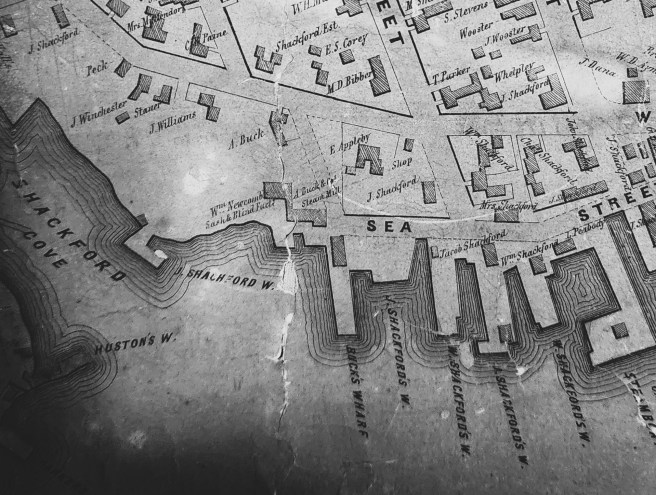
In 1855 Ames owned a house diagonally across Water Street from ours. An alley ran beside their house from Water to Sea Street, providing ready access to the Shackford wharves, as well as one labeled Buck and the A. Buck and Company steam mill attached to the William Newcomb sash and blind factory.

Ames was one of the six sons of Jacob Buck, half-brother of the Bucksport founder. Another son was Eliphalet, who landed in Eastport and is buried in neighboring Robbinston.

In the 1870 U.S. Census, his family included school teachers Mary, 29; and Ada, 25, and fish dealer John, 21. The wharf makes sense. And son Fisher Ames Buck had a household of his own.

The 1879 map shows a J.S. Buck wharf as No. 32 just below the Water Street property, presumably John S. Buck, and nothing for the Shackfords, who had previously owned multiple wharves there.

By the time of his death, Ames was described as both a blacksmith and a machinist.

Incidentally, Ames’ headstone in Hillside Cemetery gives 1796 for his birth and erroneously names daughter Amy Cory (1880-1886) as his wife. The date of his death is a year earlier than some other accounts I’ve seen.

~*~

In turn, Fisher married Clarissa Alice Bailey (1842-1922) in 1865. Their children include twins Frances F. Buck (1872-1934) and Frank Clifford Buck (1872-1950), William Edwin Buck (1875-1935), Alice M. (circa 1879-1955), and two who died in childhood, Harry C. and Jesse B.

Like his father, he was a blacksmith. Later he was an engineer. He was also a freemason, as was son William Edwin, and he served as a town selectman, 1874-1879.

He was among the subscribers underwriting Kilby’s 1888 history, along with a George N. Buck of San Francisco (his brother?).

Fisher died April 5, 1910, of pneumonia. He is buried at Hillside Cemetery in Eastport.

~*~

His son William Edwin Buck was father to Clifford Hilyard Buck (1899-1973). I do wonder whether they lived in the house or whether other family members did or whether it was rented out or even largely vacant during the period.

~*~

The Tides Institute & Museum of Art’s online photo collection of Eastport houses calls ours the Commander Albert Buck house, with the note: “He returned (after World War II) to Eastport with Rose and settled in the family house at the corner of Third and Water Streets.”

Commander Albert Clifford Buck (1886-1951), a U.S. Navy veteran of World War I and World War II, is buried at Hillside. He was 64. The headstone also names Elizabeth E. Lizzie Sears Buck (1851-1907). Who is she, other than born in Woodland, Washington County? Not Rose, obviously.

Albert, it turns out, was born to Fisher’s brother, John, the fish dealer.

So how did he wind up with the house? Forty years passed between Fisher’s death and Albert’s, and family members may have moved elsewhere for employment and other reasons. Perhaps the others simply weren’t interested. Who, in fact, inhabited the house in the interlude?

The neighborhood did have a number of Lebanese families by the early 1900s, attracted to jobs in the sardine canneries that ruled the local economy after the wooden shipbuilding industry collapsed.

Albert’s obituary mentioned that he had maintained a summer home in Eastport since the end of World War II, but neglected to note where his fulltime residence was. It also named a son, Charles S., stationed in Arizona (in 1951,) and brothers Milford in Rowley, Massachusetts, and George of New York City. (Milford R. Buck (-1952) is buried at Hillside. George is another mystery. The obituary also said the funeral service would be at the Washington Street Baptist church and that Albert was a freemason.

Just two years later, Charles, age 40, died of meningitis at the Veterans Administration Hospital in Tucson, Arizona. He was an automotive mechanic and, according to the state certificate of death, was born March 13, 1913, in Massachusetts, to Albert C. Buck, born Maine, and Rose A. Mayer, born Massachusetts. In addition, he was buried in Rowley. What was the family connection there?

I’m guessing it’s where Rose’s family was. Albert was likely at sea for extended periods. In short, he wasn’t in Eastport.

Our home, by the way, had an unobstructed view of the water.
Some writing pet peeves

Personal biases do come into play – as a novelist and as a reader. For me, some of them as pet peeves are a reflection of my preferences. Consider those as graded on a scale, one to five or ten.

For example, New York City is way overrepresented in literature – especially Manhattan and Greenwich Village. And so, even though I based one novel on an out-of-towner’s encounters with the subway and then transported part of that to another, setting a book in the Big Apple definitely costs points in my esteem. Harlem, however, is a plus, along with overlooked corners of the boroughs. See Chester Hines, for starters. Something similar happens with Los Angeles, San Francisco, Berkeley, Chicago, and Seattle. Show me someplace way, way out of the usual media spotlight.

Books celebrating novelists, poets, musicians, visual artists, actors, university professors, or celebrities in general also cost points. We aren’t a superhuman clan, OK? And way too often we’re deeply flawed in ways nobody examines. Still, a rare work, like Tar or Maestro, portraying Leonard Bernstein, breaks through my resistance.

Anything that feels contrived, rather than organic, also turns me off. It goes back to what I considered “Found” versus “Invented” when I was evaluating cartoonists and stand-up comics. Real-life discoveries are superior. How well is the author listening to what’s going on around him (or her)? Or observing in the details?

Escapist. This goes for most of the genres, actually. Off somewhere in space? Or back in a medieval court? Or even in romance and pornography. I read and write to better record the history evolving around and within me.

Factual misrepresentations are an instant turnoff. Getting a key date off, for example, often rips apart the rest of the timeline.

That points to cliché, especially in thinking. What happens when you invert it, so that winners become losers? Maybe a story is more about losers than winners, at least the ones that ring true to me.

Purple prose follows up on that. I hate being told what I’m supposed to be feeling. Will somebody please pop that balloon? But flat, conventionally viewed background also fails.

Inconsistent use of punctuation. Yes, God and the devil are both within the details. Hello, are you awake or fully there at the keyboard? Show me that you’ve mastered the basics.

Grammar and syntax mistakes. Inconsistent tenses drive me up a wall. Misuse of commas or more creates a mess. These are lines in the sand between professional writers and the wannabes. It’s quickly signaled by “towards” rather than the American “toward” or “that” where it should be “who.” Beyond that, “whom” seems relegated to those who want to seem British.

Gratuitous violence is another turnoff. It doesn’t connect with life as I’ve known it.

Dialogue is a special high-wire act. When it rings wooden, I’m gone. The attribution proves equally tricky. I long ago tired of “said” but “stated” is equally overdone.

Well, maybe that will do for starters. There’s so much more I need to start collecting. I know it’s out there.

Confessions with a few natural observations in the background

1

My own world was fracturing
when glacier-clad Mount Saint Helens erupted
and sent me in exile
to here
at the easternmost fringe of the nation
forty years later

 2

As a friend said
the other day
of piloting a warship
and noting

no seals
on their familiar outcropping

indicating
a shark
on the prowl in the waters

 3

In my case
a starched white-shirted shark
had invaded

Let’s have a few more novelists weigh in

To continue the writing advice from last week, here are ten more points:

  1. “Abandon the idea that you are ever going to finish. Lose track of the 400 pages and write just one page for each day. It helps.” – John Steinbeck
  2. “First, find out what your hero wants, then just follow him.” – Ray Bradbury
  3. “I particularly like to write characters who are bits of shades of gray, so we don’t know exactly where they’re going to go. They’re at a turning point in their lives and they’re under extreme stress, because it’s a thriller. So, will this break them? And not even just your main characters, but all the characters. And suddenly there’s something interesting, for me, to show up for in the mornings.” – Lisa Gardner
  4. “I was a lot dumber when I was writing the novel. I felt like worse of a writer … would come home every day from my office and say, ‘Well, I still really like the story, I just wish it was better written.’ At that point, I didn’t realize I was writing a first draft. And the first draft was the hardest part. From there, it was comparatively easy. It was like I had some Play-Doh to work with and could just keep working with it – doing a million drafts and things changing radically and characters appearing and disappearing and solving mysteries: Why is this thing here? Should I just take that away? And then realizing, no, that is there, in fact, because that is the key to this. I love that sort of detective work, keeping the faith alive until all the questions have been sleuthed out.” – Miranda July
  5. “If I waited for perfection, I would never write a word.” – Margaret Atwood
  6. “My biggest tip for writing is: If you get stuck, move forward to a scene that you’re looking forward to working, and that just tends to give you your joy back. And then often you’ll find that the space between them is actually a lot smaller than you thought it was, and maybe a kind of easier way to work it.” – Jojo Moyes
  7. “Don’t panic. Midway through writing a novel, I have regularly experienced moments of bowel-curdling terror, as I contemplate the drivel on the screen before me and see beyond it, in quick succession, the derisive reviews, the friends’ embarrassment, the failing career, the dwindling income, the repossessed house, the divorce . . . Working doggedly on through crises like these, however, has always got me there in the end. Leaving the desk for a while can help. Talking the problem through can help me recall what I was trying to achieve before I got stuck. Going for a long walk almost always gets me thinking about my manuscript in a slightly new way. And if all else fails, there’s prayer. St Francis de Sales, the patron saint of writers, has often helped me out in a crisis. If you want to spread your net more widely, you could try appealing to Calliope, the muse of epic poetry, too.” – Sarah Waters
  8. “Write your story as it needs to be written. Write it honestly, and tell it as best you can. I’m not sure that there are any other rules. Not ones that matter.” – Neil Gaiman
  9. “Get it down. Take chances. It may be bad, but it’s the only way you can do anything really good.” – William Faulkner
  10. “The first draft of everything is shit.” – Ernest Hemingway