The older I get, the less I know.
It’s not just a matter of recall, either.
At least it’s no longer called “absent-minded.” Or just plain “spacing out.”
You never know what we'll churn up in cleaning a stall
The older I get, the less I know.
It’s not just a matter of recall, either.
At least it’s no longer called “absent-minded.” Or just plain “spacing out.”
Two women were overheard talking about relationships.
“He said he couldn’t live without me,” one told the other. “So I said, ‘Why aren’t you dead?'”
~*~
And you wonder what happened to the traditional English love poem? Please think again.
I don’t get it. Every time I’ve opened a page at random to read, it’s been all fluff. Empty talk. No action.
And it’s a publishing sensation?
What am I missing?
(Why can’t I write that stuff, anyway?)
As I settled into my bench on a clear Sunday morning, my thoughts kept returning to a disquieting subject. Perhaps it had something to do with the Psalm facing up from the open Bible beside me, beginning with the line, “Deliver me from mine enemies, O my God,” or an acknowledgement of the city cemetery just beyond the trees outside our meetinghouse windows. Perhaps it was a continuation of a thought I’d had the night before, how the event being observed this weekend was originally called Decoration Day, conducted to commemorate the Civil War dead. The act of decorating gravestones seems to me to be superficial or even, in some perverse way, profane – and yet, as the subject kept returning in the stillness, I realized there’s one pilgrimage I would make, to leave a flower on the neglected stone.
I had uncovered much in the previous six months, delving once more into my genealogy research. There was no intention of resuming intense investigation and writing at this point when I responded to a few innocent online queries, which unexpectedly snowballed. The project itself had begun a quarter-century earlier with the surprising discovery that my Hodson ancestors had been Quaker, the faith I had also joined after a circuitous spiritual journey. The historical research later expanded into my grandmother’s Dunker (or German Baptist Brethren/Church of the Brethren) lineage, which also came as a revelation. Here, much of my fascination has been with the dynamics within communities of faith and the ways the members extended their religious practice to all facets of their lives. Crucially, both churches maintained that bearing arms and military service are contrary to the spirit and teaching of Christ, and both churches were based on traditions of lay ministry.
Once identified as a genealogist, however, I soon became the recipient of family miscellany, regardless of value. That is, one becomes the guardian of last resort, or all that stands between antiquity and the dump. Somehow, I’ve become the caretaker of a flag draped over a great-uncle’s casket for military burial, a scrapbook of a great-aunt’s post-World War I newspaper clippings, and many curling photographs of unidentified people and places – things that presently add nothing to the ancestral story. On the other hand, I took up the project just a few years too late to save a great-aunt’s correspondence with my great-great-grandparents, who remained in North Carolina after their sons moved to Indiana and Ohio. Even so, I have also come to possess a few priceless letters and photos and other bits that allow sharp insights into lives that would otherwise be unknown.
In August 1985 I received a package with a note that said, “I am also sending a copy of someone’s journal. It is either from Grandma Hodson’s or Ralph McSherry’s papers. I thought we might be able to figure out the author. Or whatever?” At the time, I transcribed the photocopy of the handwritten memoir, A Journal of My Experience in the Rebellion of 1861-2, and attempted to analyze its curiously bland text. The opening paragraphs went into almost agonizing daily detail of marching across Kentucky, setting up camp, and moving on, often with no sight of the enemy. By the time the unit moves to the Battle of Shiloh, however, the descriptions are brief, even rushed, as if the writer were embarrassed of being ill in the infirmary rather than fighting, even if that illness likely saved his life. And then the text trails off. Since this manuscript would have been from my great-grandmother Alice McSherry Hodson’s line, I tentatively thought it might have been written by her father, who would have then come home to Ohio to marry, but I could find no record of his serving in the Civil War. I identified some other possibilities in her family surnames and had to leave it at that.
Much later, when I reopened my genealogy reports, I decided also to clean up materials my mother had collected on her side of the family in Missouri. With an array of new source material available online, I found myself sifting through Census reports and death certificates and then Civil War records and Census slave schedules – the latter items things I’d never previously encountered, and many of the details troubled me. In the practice of genealogy, you build a personal history that somehow invests you in the unfolding action; sometimes it stands at odds with the general history you were taught in school, or sometimes it allows you to see individuals moving within a larger picture. As I looked at my ancestors in Civil War Missouri, I was surprised to learn that illness killed more soldiers than the fighting did; in my case, John Gilmore died in camp a month after enlisting. I had no clue of the extent of Confederate guerrillas until learning of my Gatewood kin’s clandestine ambushes of Union soldiers. Still, I’ve argued that if one undertakes genealogy, one must be prepared to accept the facts one uncovers.
But that’s not exactly where my thoughts kept returning this morning. Rather, it was to the consequences of one website I had come across while working on my mother’s ancestors’ Civil War service, which now allowed me to consider the possible authors of the memoir I’d transcribed. The movements it detailed matched those of the 1st Ohio Infantry and 2nd Ohio Volunteers, units my great-grandmother’s uncle, John Z. Bahill, served in – back on my father’s side of the family.
The Psalm describes enemies, but that morning I was not led to ponder my own potential enemies. Besides, they would be nothing like the enemies Bahill encountered. His memoirs break off on June 17, 1862, in Alabama before the actions at Battle Creek and then pursuit back to Louisville, Kentucky, the Battle of Perryville, or the march to Nashville before coming to Stones River near Murfreeboro, Tennessee – his second round in that locale. That is, his chronological narrative breaks off before the real action begins.
If you can’t identify the Battle of Stones River, you’re not alone. Neither could I, before Bahill led me to it. The fighting began in the sleet, rain, and fog of New Year’s Eve morning in 1862, and erupted into what would stand as the eighth deadliest battle of the Civil War. It was a crucial victory for the Union forces, coming half a year before Gettysburg and denying the Confederacy the essential agricultural resources of Tennessee. When the three days of fighting were over, there were 24,645 casualties – more than one in every four participants.
You can look at hour-by-hour analyses of the campaign. The opposing strategies, too: the Union plan foiled when the Confederate forces made the first move. Read the reports. As the Union flank collapsed, Bahill’s unit was part of the force that held ground at all cost. No one can imagine being in close fighting where your own death is imminent. Even the description of the deafening cannon fire is beyond comprehension.
This is what I was sitting with, in the quiet of a Sunday morning. Not the noise or the blood but an awareness of the dedication of one’s life to a larger cause.
This was also at crosscurrents with the stream of vocal ministry that morning. One Friend spoke of the importance of having all people agree on a set of basic rights for all humans. Later, another recalled the New Testament scholarship of Albert Schweitzer, which led another to speak of an uncle who gave up university prestige and security to become an inner city pastor instead, where he was murdered in murky circumstances.
I wonder if the Civil War might have been averted by nonviolent movement. The first speaker reminds us that rarely does anyone give up a position of privilege voluntarily. Not unless he sees himself gaining something better. I think of the slaveholders’ great capital wealth combined with the unequal political clout it had given them in the nation’s affairs, and their ruthless efforts to expand it. The witness of Mahatma Gandhi and Martin Luther King seem all the more miraculous in contrast. And I wonder what might have happened if Bahill’s unit had crumpled under its relentless assault. And those are the thoughts I kept circling back on in the silence.
Bahill was among the wounded. I have no idea what his wounds were, precisely, or if he underwent amputation. Still, from the title of his memoir, he apparently knew that his war service was over. The officer commanding the 2nd Ohio, Lt. Col. John Kell, had been killed in action, as had the lieutenant leading Bahill’s company.
But I had been wrong in my initial analysis of the text. I now assumed this was something Bahill undertook on his hospital bed, before the infection set in. Something he undertook, in other words, on his deathbed. He died 2½ weeks later, before he could finish his memoirs. He was 26.
From another website, I view a section of the National Cemetery in Murfreesboro, where he is buried, far from his family in Ohio. He was the last male in his Bahill line and unmarried. The memoirs have come down through my great-grandmother, born 2½ years after his death.
Decoration Day, initiated to remember people like Bahill, seems a more fitting name than Memorial Day. One conveys an action, even if it’s more ritualistic than I would embrace. Memorial Day, in contrast, feels cloudy and unfocused. Who can say if his gravestone was ever decorated by his family? A farm boy, without his garland.
Later, recovering in the hospital from surgery, I would wonder if Bahill had the strength or clarity to write on his deathbed. More likely, it seems he drafted what he did before re-enlisting, perhaps even as an exercise convincing himself to do so. We’ll never know for certain.
A reporter assigned to cover a large singles scene mixer returned to the newsroom with a telling image.
Three women had been remarking about an earnest young man who wore a tag proclaiming himself an “Incurable Romantic.”
As they snickered: “Sounds like a venereal disease.”
~*~
And you wonder what happened to the traditional English love poem? Please think again.
I hope nobody’s getting whiplash from the wide variety of my recent Red Barn postings. Much of it I’d scheduled ahead, anticipating the usual rhythm of the seasons. And then the book-length publications jumped in, along with a few other surprises.
As we bounce from one category to another, I’m feeling like somebody’s turned up the speed on a merry-go-round. Way up. As you might sense, life’s been getting chaotic around here. More than usual, that is.
But as I’ve been hearing from others, that’s not unique. Seems May, especially, has everybody on the run while much of the winter cycle wraps up and summer events start to kick in.
And we thought it was a long winter? Maybe (and I hope this isn’t too heretic) it wasn’t long enough?
Oh, and now I’m thinking of all those house painting projects still ahead. The ones I can’t put off any longer.
With the publication of my latest novel, Promise, I’ve been chancing on a number of blogs addressing the issues of dating and romance, and, to be candid, I feel so blessed to be in the relationship where I am.
From what I’m reading, the first date – usually fraught with terror – is a dinner followed by some kind of anxiety leading to either silence (usually one-sided) or a less-likely follow-up.
From my own distant past, I realize how little some things change, even when they should. There have to be better ways to interacting with potential partners in more natural, less stressful settings. Simply having fun, for starters, rather than having to put everything on the table in something that resembles big-stakes gambling. Well, if you enjoy gambling, maybe that’s fine, but it’s not something I ever would have wanted in a mate.
For contrast, Amish youths have want seems to be a far saner way of finding a suitable companion. From age 16, the kids are active in social groups that include both boys and girls, and out of their playful outings and interaction with other similar groups, they get ample time to evaluate the others before centering on the one. And then it’s pretty much a lifetime agreement.
Similarly, in my novel, Jaya and Erik build the foundation of their relationship before they go out on anything resembling a date.
Anyone else have that experience? Or, for that matter, any suggestions for those looking for ways to meet the right one?

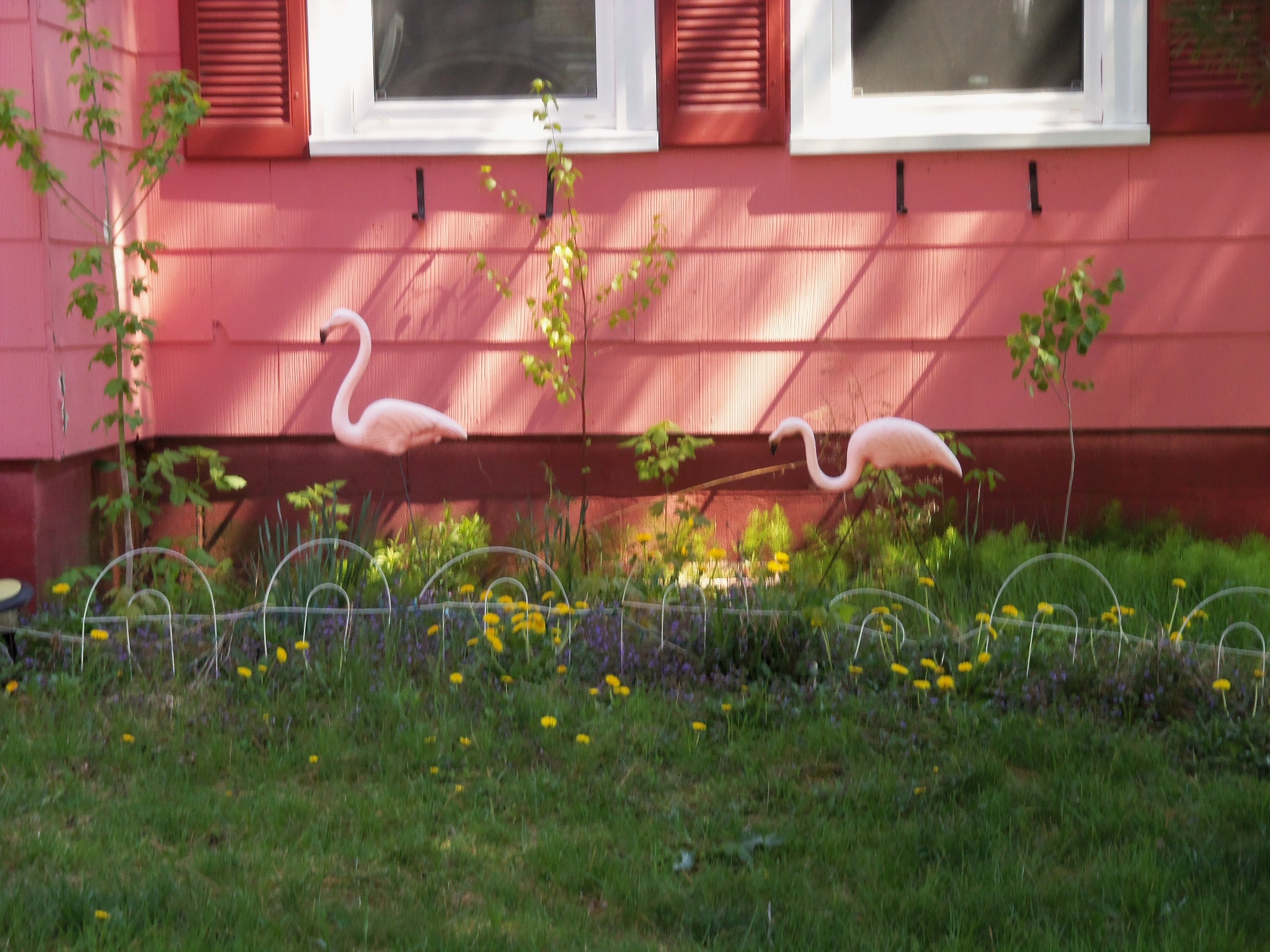
At a party one night in our Smoking Garden, a friend was telling about a fundraiser her church youth group had done back in Massachusetts.
“That’s a great idea,” I said. After all, she was a United Church of Christ pastor with all kinds of connections. “UCC,” for short.
Next thing I knew, a big sign and box appeared in our Quaker meetinghouse, warning Friends to buy flamingo insurance. This is New Hampshire, remember, not Florida.
One night after our party, our renowned sculptor Jane and her husband had come home to find her flock of pink flamingos missing from their yard and garden, but a sign stood in their place: “They needed to be quarantined.”
Uh-huh. I was as baffled as anyone that Sunday as we entered the meetinghouse and faced that big sign and its box of warning.
Here’s how it worked: you could donate any amount for insurance, but if someone else trumped that figure by offering more, you could still get flocked. And if you were flocked, there would be an envelope for another donation for their removal. In other words, you could get hit coming and going.
Then the plastic birds – and wooden cutouts – began appearing in Friends’ lawns. Folks living in apartments weren’t immune, either: the birds showed up strung around balconies or in the backseats of cars left unlocked or wrapped around cars that had been locked.
For the most part, it was great fun – even for the police officers called out to investigate rustling sounds in the night. We had no idea who was in on it, and nobody from our Smoking Garden party guest list was looking guilty.
When we were hit, one of our neighbors laughed and explained why she knew we hadn’t selected the birds as permanent decor: “You’re too organic.”
(Ouch!)
The Sunday morning the operation came out in the open, a guest to Meeting told me, “We did the same thing, down in Connecticut.”
“UCC?” I countered.
“Yes, how’d you know.”
“Just a lucky guess.”
So it had been the Meeting’s kids who were keeping the secret, along with a couple of very, very discrete adults. The money we raised went to the Heifer Project. Our children had to decide what kind of animals they’d send to the Third World – something big, like a cow, or something smaller, like a lot of chickens? And then they took a field trip to the project’s New England farm to check out all the options.
It’s a much better story than the one about my ex-wife’s two birds – the ones a friend of hers stole from my yard after the separation.
our Lady of Pink Flamingos keeps taunting
“Have you been flocked?”
where’s it going, our summer of plastic flamingos?
poem copyright 2014 by Jnana Hodson
The earth itself is set to erupt.
~*~
Thunder pealed again, and everybody packed up. Outside, Roddy and Erik danced in the eerie dusk. A soft drumming in trees sounded like drizzle, but instead of water, powder fell. Everyone appeared amazed, even elated. Weren’t we fortunate to have a volcano blow up in our face! Then Jaya recalled history: “Oh, Pompeii! Will guides conduct tours here, showing the world exactly how we victims perished? Is this the way our world will end?” Something gripped her, insisting they get home or die in the effort. She dragged Erik, protesting, to the car and raced through the grit. Autos in front of them were invisible, even their taillights, until Jaya was almost atop them. The ink blot overhead closed in on the far horizon, sealing off the last natural light. Plunging through this tar-paper snowfall on a route they knew so well, Jaya recalled the many times she had joked about being able to drive it blindfolded.
~*~
To learn more about my novel, go to my page at Smashwords.com.
Looked up as I drove by a big green lawn the other day and saw it was dotted with pink. A bright pink unlike any flowers we grow in these parts.
Then I smiled, realized the house had just been flocked – there was even a note stuck on a stick.
In a flash, even at a distance (this was the kind of place that has a small pond between the house and the highway), I sensed the two dozen flamingos were all uniform, likely brand-new, unlike the motley band we “quarantined” for our own use all too many years ago now. Why, ours even multiplied in the course of their service – some of the dads were making new ones from plywood, rather than plastic.
Flocked, you ask? Oh, I was sure I’d told that story, somewhere.

