FACING THE TECHNOLOGY

Shifting to the world of epublishing has stimulated a gentle learning curve for me. Maybe because my to-do list has always been much longer than I can manage or maybe because I felt I already had too much detailed work at hand, I’ve tried to avoid becoming a computer geek who spends all his time in the technical minutia. Actually, it’s the same way with my cars – I don’t want to spend my mornings, afternoons, or weekends under the hood or on my back under the chassis; I just want to get in and drive. As for high tech, I’ll wait for all the bugs to get worked out before I buy the updated version, thank you, especially since I’ve always been on a very limited budget. And for the record, I hate Windows 8, which is always interrupting my work by blowing its apps in my face or requiring me to log on again throughout the day.

On the other hand, keyboarding on a computer has been a vast improvement over a typewriter, at least for klutzes like me, and the ability to correct and revise as I go or rewrite and edit later is, well, divine. Sometimes progress really is progress.

And sometimes it isn’t, as we seemed to discover at the office each time we moved on to a new system whether we wanted to or were instead forced to when our current equipment was declared obsolete. (I’ll let others relate those nights of terror when they pulled the plug on what was finally working as promised.)

Participating in the small-press literary scene has been another matter. When I first ventured into email, thanks largely to my now-wife, well, let’s say broadband’s been a huge improvement over those telephone connections and leave it at that. Still, cutting and pasting poems into the email and having them accepted within hours rather than be rejected months later was quite an eye-opener. These days, with most of the liveliest literary action happening in online journals, the process has taken leaps forward; typically, you use a submissions program, upload your file, insert your cover letter, and follow the pieces through the editorial process, if you wish. For a long time, I tried to maintain two sets of files – one for journals that still used, or even required, submissions via the Postal Service, and those that took them online. This year, finding that too complicated, I decided to drop the postal-only journals altogether. (That move, let me add, was hastened by problems with our computer printer as much as the much higher rejection rate on the envelope entries.)

The 2005 publication of my second novel, Ashram, as an ebook was another eye-opener. I was surprised by how easy its preparation was, how quickly it went from acceptance to general availability, and how pleasurable reading a long work on my computer screen could be (even if the work was issued only in PDF format). Unfortunately, we were also a bit ahead of the ebook reading trend and many would-be readers told me of their difficulties in downloading the volume. The other snag was getting the work reviewed at all – even online critics stuck solely to paper editions.

Blogging has revolutionized much of this world, probably more than we realize. For me, avowed neo-Luddite that I am, WordPress has been heavenly. It’s allowed me to take a model “out of the box” and run with it without modification, even if I do admire the customized tweaks many of the rest of you add apparently without hassle. The Blogs That I Follow, searching by topical tags, and Freshly Pressed streams have introduced me to many wonderful voices around the globe for my daily perusal. In fact, I’m still struck that in its first year, the Red Barn had readers in 72 countries. Amazing.

These days I’m learning again. The opportunity to publish my novels to be distributed across a variety of platforms (as they say) has meant following a new set of directions to strip out all the hidden codes (we hope; some of mine go back to the first versions on WordPerfect4.0) and set up the work to flow smoothly in a reading device. (I started to say “reader,” but for me, that will always be a person, not a machine.) I’ll admit that adjusting to the concept of considering a long work as a continuous text, rather than pages, has been major, as has the matter of inserting hyperlinks. Remember, I’m someone who loves the art of printing from its very origins. (How many Gutenberg Bibles have you seen?)

Even so, I’m excited by the new opportunities and the new visual dimensions.

Here we go, again.

WRITING LONG

Even as a cub reporter, I loved writing long pieces. It’s what I prefer to read, really read, when I have time. By long, I don’t mean pointless minutia or the trivia of, say, a public hearing, but rather the probing look at how and why a thing has happened and maybe even what to expect as a consequence. Add to that the human dimension, especially from the point of view of those most impacted by the action rather than those at the top of the pyramid.

One model of this style of news writing came in the three stories on the front page of the Wall Street Journal each day – what they called their “leaders,” back in the era before Murdoch. If you looked closely, you’d see how each one was composed of several smaller stories, each one telescoping into the next. The reporters could joke that their work was so heavily edited they no longer recognized the finished version, but for those of us reading, the result was rewarding, the way a good meal is.

As a journalist, the irony has been that I spent much of my career crafting headlines and photo captions … short, short, short … and that was even before I relied more and more on news briefing columns to get the day’s world and nation reports into the paper at all.

Not that I lost my love of long writing. My “shelf” of ebook novels is proof of that, including my most recent, which delves into the news business itself.

As a blogger, though, I’m also admitting pleasure in composing shorter postings like the ones that appear here at Jnana’s Red Barn. Apparently, from the stats, they must be connecting.

My other four blogs provide venues for the longer writing, and the results to date are mixed.

To my surprise, my genealogy blog, The Orphan George Chronicles, has drawn far more hits than I’d anticipated. I figured its appeal would be to a few dozen fellow researchers, and having the results online would be much easier to find than if the files were archived in a few libraries somewhere. As for publishing them in paper editions, the likely audience would never cover the expenses.

My Quaker blog, As Light Is Sown, has shifted from the two book-length presentations that appear as the initial postings to a year-long Daybook of short postings, so I must admit that trying to analyze the results there can be inconclusive.

Thistle/Flinch exists to present book-length PDF editions of poetry and fiction, so I guess you can say that’s writing long.

And the remaining blog, Chicken Farmer I Still Love You, is still taking shape, as the numbers show. The first part, Talking Money, presents essential material for addressing the material sides of life … income, spending, wealth, possessions, labor, time, goals, and the like … followed by a close look at New England’s famed foliage. These days, it’s taken on a new focus in reconsidering the hippie outbreak and its renewal. Again, many of its postings are chapters for book-length presentation.

What I am finding in general is that even without the demands of daily employment, time is still the most precious commodity in my life. There just ain’t enough of it for what I hope to accomplish these days – including reading or writing, much less in any length.

So I guess that’s the short of it, for now.

 ~*~

Hometown News
Hometown News

To find out more about Hometown News or to obtain your own copy, go to my page at Smashwords.com.

SWEPT OUT TO SEA

The stupidity of some people never fails to impress. You hear of those who refuse to leave the path of disaster or see pictures of families standing by an ocean churned by an approaching hurricane. You know, the foolish ones who then expect emergency personnel to come to their rescue (at personal risk and public expense).

I’ve learned to respect the moodiness of the ocean and its quick changes – the summer thunderstorms that come out of nowhere, for starters. If the Coast Guard or lifeguards say “Get out of the water,” just do it rather than ask questions. If the captain of the boat says “Get down under,” just do it.

Even before the hail or power outages.

How quickly it all passes, too, and everything looks perfectly serene again, with no hint of what just happened.

My wife and I once watched a deluge approach, strike, and return to normal all in the course of a seaside lunch. Fortunately, we were indoors, our table beside the window.

One of my first lessons came a few months after the 1991 Halloween nor’easter now known as the Perfect Storm. In New England, a nor’easter is akin to a cold-weather, slow-moving hurricane. One moonlit night three or four months after this one, I was driving along Cape Ann in Massachusetts and was awed by the depth of sand still piled along the roadway – like plowed snow, in fact – up on ridges out of view of the ocean. Such was the impact of the Perfect Storm.

But this was a calm night and coming to an overlook, I pulled over, got out of the car, and walked out on a ledge a good 20 or 30 feet above the water. I was still back from the edge when a large wave crashed up behind me and swirled off just to my side. I realized the current could have knocked me off my feet and into the brine below. I’m a good swimmer, but fully clothed in icy water driving into rocks would be a fatal combination.  

Yes, I’ve learned to respect the ocean and be wary.

SHOOTING THE SAME SPOT AGAIN

We could be considering writing or painting and drawing as much as the photography that prompts today’s line of thinking. Specifically, I’m reflecting on the tension between trying to capture everything I see everywhere versus the reality that one needs limits.

For starters, I reach a point in shooting where I begin to weary. Push hard enough and everyone hits a wall. When it comes to photography, I just stop seeing images of interest. When I’m writing, my words go flat. Folks in other endeavors can relate their own versions.

A second fact of life comes in trying to arrange and manage what I already have. Accumulate too much and I’ll never find anything when I want or need it.

I find a similar tension in a writing project, where I can hope for a tightly focused, crystalline work even as it begins to expand into a complex baroque construction. Or the other way around.

As I’ve been shooting over the course of the Red Barn, I’ve found myself increasingly resisting an urge to range more widely from my base in Dover. I’m sticking more and more to what’s at hand here and in a few other familiar places like Sandwich, to the north, and Fort Foster in Kittery Point, Maine. We’ll see how that evolves in the future.

For now, what fascinates is seeing how much new keeps appearing to me in our yard or while I’m walking to meeting for worship on Sunday. Perhaps that’s why working on pieces in a series hold so much appeal as more and more keeps surfacing from the depths.

The other aspect of the series is the desire that somewhere in there is the one iconic piece that rises above the rest, can stand on its own, deserves its own place.

Oh, what would Monet say to all this? Or Matisse? Or any of a host of others!

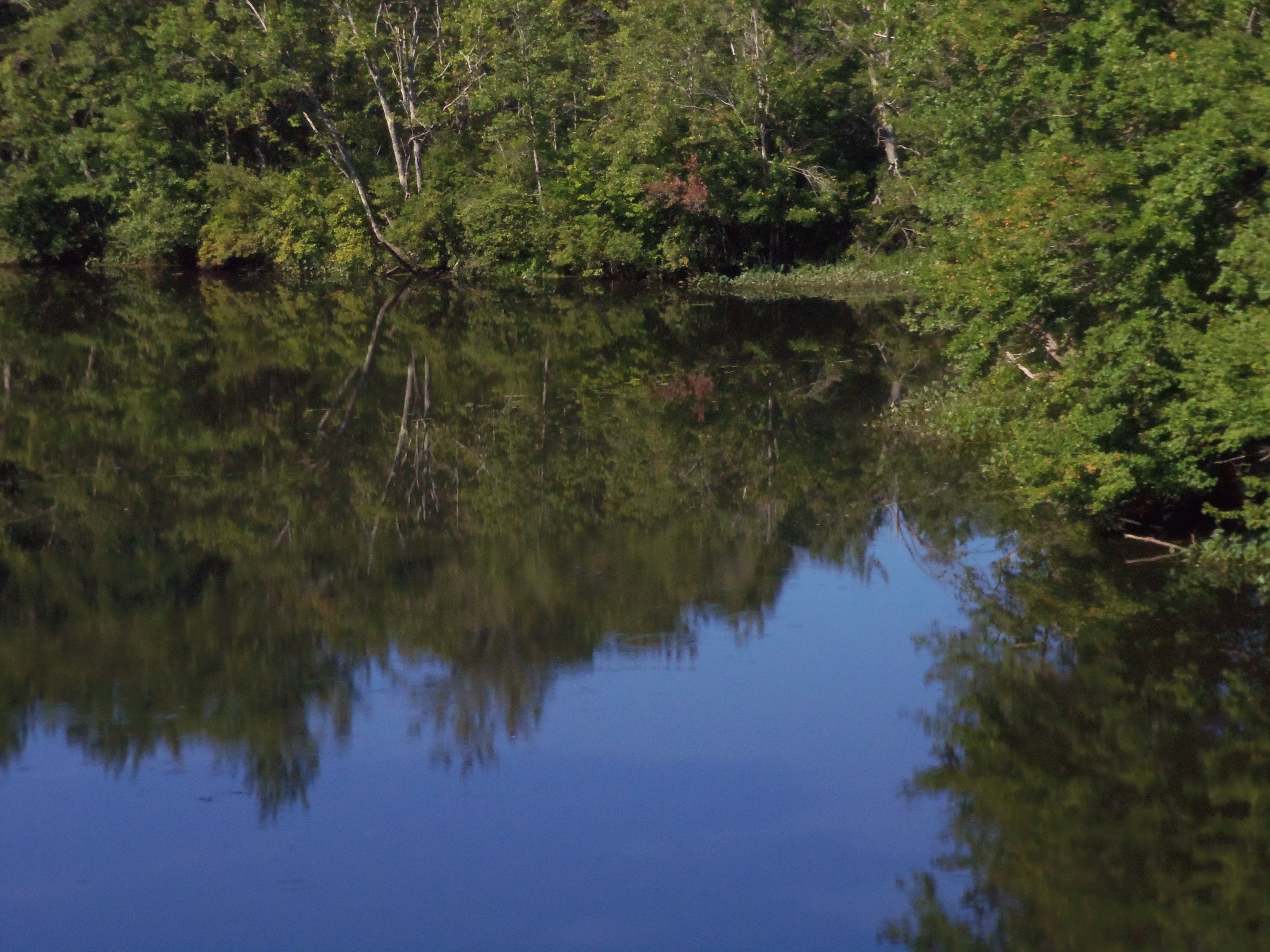
The Cocheco River viewed from the footbridge on the community trail has become a favorite spot for my camera. Here's part of the scene as I was walking to meeting for worship on Sunday morning.
The Cocheco River viewed from the footbridge on the community trail has become a favorite spot for my camera. Here’s part of the scene as I was walking to meeting for worship one Sunday morning.

ON THAT COMMITTED JOB, TOO

You can name those who jump in quickly, volunteering to tackle any new task their supervisor proposes. (“Sure, Boss, we can do it.”) And you can name those who are more cautious, evaluating the time commitment and resources.

I’m thinking, too, of all the people who join a committee and then fail to follow through.

Or the coworker who’s muttering under his breath once we’re overloaded with the additional project. Or all the other tasks that get slighted.

How many others do you know?

PHILISTINES AND AMERICAN SOCIETY

Before my graduation from college, back in my social activist period, I wondered how American society could possible afford High Art while so many went hungry and homeless – domestically as well as internationally. Then I began to see everywhere a desire for expressiveness even in every ghetto – for that matter, ranging from ghetto blasters to Playboy. There were murals and blues bands. To say nothing of the infusion of professional sports, to which every poor youth, from the inner city to the mining company towns, seems to aspire. So opera and museums and other “Establishment” operations came to lose their exclusivity in my mind. Indeed, over the years I’ve heard that the real classical music lovers are the ones in the cheaper seats, the ones they can afford. Mankind, after all, has a need to reach to the higher realms of thought and the imagination of the spirit; anything less reduces our existence to nothing more than economics, impoverishing everyone in the society.

Look closely, and you’ll also see that in America, Art has become the state religion, no matter the level of state and federal funding exists. In this country, at least, there’s also been a long recognition of the fine arts as an adjunct to wealth, for whatever reasons. Many sense an abstract “goodness” in the products of art chamber music, art museums, Shakespeare festivals, opera, poetry, the “book” that so many people dream of writing even if the artist himself/herself remains (often with good reason!) somewhat suspect, a shady character. Perhaps that’s why these big institutions stand between us and the rest of ourselves, as artists and audiences. Something abstractly “good” even when they themselves admit they don’t know much about the field. Contrast that to the related state religions in America: collegiate and professional athletics, Hollywood movies, and rock concerts, wherein no one actually advocates any common wealth. (The High Priests are paid handsomely, after all.)

Art as the semi official State Religion of today? Or should that be entertainment and its host of celebrity worship? The stamp of approval. The aspiration.

Art as commodity, too. “How much did it sell for?” What was the box office?

At heart, all art is, primarily, either spiritual/religious or secular/amusement in intent and execution. Take Milton or Pepys. Today, the overwhelming materialism of our society reflects an insatiable hunger.

Even as starving artists we’re enmeshed in materialism, one way or another. It’s so easy to hold the artist up in some idealized light or the product itself as the object of worship, an idolatry, totally forgetting to turn to the Source of All. The worship of living genius, from Beethoven and the Romantic era on. Or the pretty faces of mostly Hollywood celebrity today.

As an editor on newspapers where nearly everyone was giving totally (many unpaid hours of overtime, etc.) in an attempt for excellence, I was always appalled by the charge of “elitism,” which comes to mean “give me mediocrity not the truth” or “mere pleasantry” from the same people who would not accept such standards in their professional football team or new automobile.

The shift in the meaning of “culture” from learning and aspiration to the mundane lowest common denominator of daily life. Culture, as in a petri dish of mold or germs, rather than a rare book library or new opera.

Still, if you want to comprehend the view from the top of the mountain, you need to climb it. And be warned: driving, if a road’s an option, loses a lot in the translation. From a religious point of view, at least, we can’t settle for anything less than the best in the end.

HIGH-TECH CONSTRUCTION

Everything that’s transpired in the 28 years since I first drafted my novel Hometown News has made me feel prophetic.

Now, of course, you have an opportunity to judge for yourself. I just wish it hadn’t taken this many years to become public.

One thing I’d like to point out involves the initial experiment I used in constructing the novel. Quite simply, I wondered if I could build a computer-generated story – no matter how distasteful the premise itself strikes me in my self-identity as a neo-Luddite and fussy literary type. Maybe it was just some of the vestige of the scientist wannabe in me?

So I created a master day-in-the-life chapter, made multiple copies to repeat throughout the story, and included up to 120 variables for search-and-replace functions. And away I went, allowing the S&R efforts to produce their own pace and variations. Not that it quite worked as I’d hoped. I found myself going back over those pages and adding new layers, softening some of the edges, adding shadows and highlights. As they say in the visuals arts, it’s quite “painterly.”

Be that as it may, one thing I’ve observed over the years is how little we typically know of many of our coworkers. There might be a favorite phrase they repeat or a piece of clothing or a distinctive quirk. And that’s it, sometimes year after year. So that part was agreeable to the S&R structuring.

As a technique, though, I’m afraid to report – or maybe more relieved – that the S&R by itself was insufficient. It did provide the core “bones” for the novel, but I did have to paint over much of it to make it more pliant and, well, human.

All the same, I’m feeling vindicated. Maybe it’s a high tech revenge for what high tech is wreaking on the workplace and surrounding community.

To check out my Smashwords ebook story, go to Hometown News.

Hometown News

AN IDEA NOTED EARLY

Not long ago, I came across this note to myself:

“Story idea: paragraph or two, repeated … one or two words changed each time, till the end provides an entirely new view.”

It’s old, probably from the mid-’70s, and yet has become the basis of several series of my poems from the last decade.

In a way, it’s also the basis of my novel Hometown News, although the repeated sections and their variations are much longer than single paragraphs.

Works for me. Wonder what else I’ll turn up.

~*~

To learn more about my novels and poems, go to my page at Smashwords.com.

GREETINGS FROM THE PAST

Back when I was living in the townhouse apartments “on the hill,” the preschool tot next door was learning he could manipulate me presumably, any grown up into waving to him. All he has to do is wave first.

At first, he was pretty shy, wondering whether he should wave at all when I wiggled my hand or arm in his direction before driving off to the office or the grocery. In time he became more intrigued, hovering at their open front door or staying close to his mother if she were sitting at their stoop.

And then he became bolder. One morning, he parted their upstairs blinds and cried out from the window to me, just so I could see his smile and wave.

The next day, he told me as he rode his bike around the parking lot, “I runned into your car.”

“Oh, where’d you hit it,” I replied, not the least worried, not with all the rust spots that are appearing simultaneously on my well worn vehicle.

“On the tire!” he piped up as I performed a mock inspection.

And finally, he came charging out the door just as I was about to drive off, grinning and hailing me in huge motions. “Welcome!” he cried out. “Welcome to Walmart!”

“Well, say `hi’ to Sam for me!” I chuckled.

His father, a few steps behind, shrugged as they set off on their errands.