NOT MINE

New Hampshire has more than its share of vanity license plates, a practice that often provides amusement in the thick of traffic or parking lots. For a number of years, mine said QUAKER, which spurred some lively conversations — to say nothing of what happened when parked next to Bob McQuillen’s QUACKER plate. (His goes back to his days of teaching high school shop classes — the result of one day when a student I will not name accused him of sounding like a duck when he got angry.)

So we were driving through downtown the other day when we noticed this plate:

We need to talk.
We need to talk.

Only in the photo do I notice the second D rather than O — representing another variant on the root surname Hodgson. Still, it can be unsettling when you have a rather uncommon one to see another around.

A LITTLE TRASH TALK

The SUV pulls out from in front of a neighbor’s house and tosses a plastic iced-coffee cup, straw, and lid onto the elderly woman’s driveway across from me as I’m weeding.

I retrieve it, put it in our recycling bin.

So they want a clean interior?

It’s not their vehicle that needs purging.

Oh, Lord, help us!

DESERT DANCES

Appealing to the heavens for rainfall was only one of the reasons for dancing. Your feet could pray as well as your hands in this landscape.

~*~

Somehow, the novice begins dancing, if only in his head. Something simple, at first, until familiarity gains ground. Feet, legs, torso, arms, and hands eventually follow. A reel leads into a jig. Thought and emotions balance. Head and heart dialogue. With confidence comes freedom. More and more, the aspirant concentrates on partners or the group or motion itself, rather than his own next step or position. The music becomes more textured, until the hornpipe stands as the liveliest structure. So it’s been in this landscape. This is not just any desert, for there’s nothing generic about any detail encountered closely. With both people and places you come to know dearly, you find nuances and subtle contradictions will blur any sharp image. It’s easier to describe someone or something you meet briefly than what you know intimately. To say desert is dry and sunny misses the point, especially if you arrive in winter. At first, like so many others, we didn’t even consider this valley as desert, for it has no camel caravans or mounds of shifting sands with Great Pyramids on the horizon. One word or phrase can be misleading. Even the Evil Stepmother from folklore and fairy tales must have possessed some redeeming qualities. Could we be more specific than “evil”? Simply selfish? Or was she mean, jealous, domineering, afraid of whatever, from the wrong party? Suppose she was really a victim of some deep abuse? The portrait changes. Has anyone detailed how she dances? In the end, it’s either entertainment or worship, depending on the individual’s orientation.

~*~

Kokopelli 1For a free copy of my newest novel, click here.

URBAN AND OTHER WILDLIFE

As I said at the time …

We had enjoyed a glorious summer afternoon of swimming and canoeing at Pawtuckaway and, leaving the state park, we stopped by a tranquil reflecting pond to take photographs of a large beaver lodge. With my girlfriend behind me as while walked the frequently used trail at the edge of the woods, I heard her voice just as we were coming upon a grassy stretch: “Hey, this is a marshy area and that’s where SNA …” I half turned to reassure her that she wouldn’t see a snake, it happens very rarely in the outdoors, unless you’re really looking for them; consider how few times I’ve seen them in the wild and how far I’ve explored. But when I caught her expression the same moment I heard a slithering in the grass ahead of me and whipped my head about to see the last half of a vigorously moving reptile flash across the pathway a half dozen feet ahead, I wasn’t surprised when I heard her say, “I’m getting out of here. I’ll meet you at the car.” Actually, my biggest surprise was in how rational see was being, considering the depth of her fear. This is the same woman who, several weeks earlier, had nearly ripped another friend’s arm in half with her paralysis when a similar situation arose at Walden Pond. I’ve never before been with anyone who can call snakes from their lairs.

A week or two later, as we were walking about, looking for a restaurant in Boston’s Back Bay, I noticed two little critters playfully wrestling on an ivy-lined entryway to a church. Thinking they were chipmunks, I said, “Oh, look,” and as she turned her head, I saw in that fearful slow motion that they had long tails. Rats! Before I could divert her attention …

END OF THE EARTH

The mythologies of Greece are easily countered by those of India, China, Tibet, and Japan in the Native tales of the Olympic Peninsula and the coastal tribes of the Pacific Northwest.

Sit down by the fire, then, and listen. Some of the voices are millennia old.

~*~

For a free copy of the complete American Olympus, click here.

Olympus 1

NO, HISTORY CANNOT BE ERASED

“Fellow citizens, we cannot escape history,” Abraham Lincoln wrote to Congress in December 1862.

Wednesday night, in her impassioned and reasoned impromptu plea to her colleagues in the South Carolina House of Representatives, fellow Republican Jenny Anderson Horne broke through a logjam of tactical delays so that her state – and the entire South – might finally address history.

We’ve long heard the argument that the War Between the States (there was nothing civil about it) was over states’ rights rather than slavery – a bogus case, at best, when one considers the 1857 Dred Scott v Sanford Supreme Court decision that stripped Northern states of their right t0 defend the human liberty of escaped slaves. No, the South decisively denied states’ rights. Or at least its powerful slaveholders did, when they wanted.

Like Horne, I have Southern roots – not as many or as distinguished as hers, but enough to make me aware of the complications Southern whites faced. On my father’s side, the North Carolina Quaker identity long meant opposing both slavery and the bearing of arms. Theirs was a difficult witness, long before the war and in its destructive aftermath. And I have a copy of the memoirs of another family member, my great-great-grandmother’s uncle, an Ohio farm boy who died from wounds in the Battle of Stones River, one of the deadliest outbreaks in the war. My mother’s side included slaveholders and soldiers, mostly Confederate, along with a wealthy individual not enlisted who gunned down isolated Union troops he ambushed as a guerrilla – one who was apparently hanged, not that we ever heard that story. Instead, it was always my great-great-grandfather’s long walk to deliver the last message of a comrade to his family – the journey that planted the family in Bowling Green, Missouri.

Still, I’ve long been offended by the flying of the Confederate flag. Its intention has been all too blatant … and racist. Period.

If you want another view of the cost of slavery on the South, black and white, look up Wendell Berry’s essay, The Hidden Wound, arising in his own childhood in Kentucky. He saw through any pretense of honor masking at least one prominent citizen.

Most remarkable in Horne’s speech was her readiness to move beyond family identity. As she told the Washington Post after the vote, “It’s not about ‘Oh, my great-grandfather was killed in the Civil War and he gave his life.’ That’s not what we are here to talk about. What we’re here to talk about is what’s in the here and now. And in 2015, that flag was used as a symbol of hatred.”

As she emphasized, “We’re not fighting the Civil War anymore. That war has been fought. It’s time to move forward and do what’s best for the people of South Carolina.”

All the people.

What a contrast to Rep. Michael Pitts, a white Republican, who had told the House earlier in the debate: “I grew up holding that flag in reverence because of the stories of my ancestors carrying that flag into battle.”

Maybe he should have heard the “into battle” part more clearly – battle against freedom for all. Battle, however indirectly, against his black neighbors, as well, and not just the North. And often in battle against the poor.

More telling for me was Rep. Eric Bedingfield, also a white Republican and defender of the flag, in his declaration: “I have wept over this thing. I have bathed this thing in prayer. I have called my pastor to pray for me,” before adding, “You can’t erase history.”

No, you can’t. The history is the war’s over – and the Confederate flag lost. Put it away. Look at the full history, then, black and white, rich and poor. As much as I love genealogy, it fits into a larger story — and rare is the family chart without shame or guilt or human failure somewhere.

History? The Confederate cause has been accurately described as a rich man’s war fought by the poor. I still wince reading of the brutal torture of pregnant women or the elderly at the hands of the Home Guard – in North Carolina, at least, comprised largely of men owning 20 or more slaves and thus exempted from Confederate Army service. We need to break out of the prevailing mythology or fairy tales and instead open out on the wider story stripped of its masks.

As for the prayers, you and your pastor weren’t listening – Moses could tell you about slavery in Egypt and the way Pharaoh’s losing army was swept away in the Sea of Reeds (or Red Sea). Maybe there are good reasons Cairo never bothered with its side of the encounter. Later prophets in the Hebrew Bible could tell you about slavery in Babylon and its emotional burden. It’s all there in the open to be read.

If anything, the decision to remove the rebel battle flag from the state capitol dome can be seen as a response to the flood of prayers in the aftermath of the Charleston church massacre. In the eyes of many, a photo of the accused killer and the flag said everything. In contrast to my fellow citizens — or my fellow Christians.

The reality could no longer be ignored. It was all about racial hatred.

The Post report continues: “Some call it the war between the states, some call it the Civil War,” Pitts said, defending the Confederate flag. “Growing up, in my family, it was called the war of Northern aggression; it was where the Yankees attacked the South, and that’s what was ingrained on in me growing up.”

Hidden in that defense is a slap at the rest of the country. Black and white. Along with a denial of what the North experienced as escalating Southern aggression in the decades building up to Fort Sumter.

You can’t erase history. You can’t escape history. You can get trapped in it, when it’s distorted, the way propaganda does.

You can, however, make history. And break free.

The way Jenny Anderson Horne has, for us all.

REGARDING THE LATEST GREEK TRAGEDY

Vanity Fair magazine’s October 2010 article, Beware of Greeks Bearing Bonds, by Michael Lewis may still be the best perspective we have on the events finally crashing along the sunny Aegean and sending shock waves through the rest of the continent.

Events? Do we call them economic? Financial? Political? Social? Moral? Cataclysmic? Truly tragic, as in “taking on the gods and bearing the consequences”?

The Greeks aren’t alone in trying to make sense of money issues. Apart from monetary policy itself – a highly esoteric field – any discussion of money soon wades into emotionally laden assumptions regarding wealth, possessions, time, labor, even food or family or religion. These are the grist of my ongoing Talking Money series at Chicken Farmer I Still Love You. I hope you join in — the category can be found under the Contents tab.

One of the easily overlooked realities about money is that it is essentially an elaborate IOU – one that allows us to store excess productivity or labor over time and space. Eventually, though, any promises come due, and you better have something that will back the debt up. That’s as true for nations that print the bills or banks that move them about as it is for individuals. And that’s what we’re seeing in Greece.

As I write this, I have no way of anticipating what will play out. The lack of a single nation to enforce the necessary regulations that would back the euro had me skeptical of its success from the very beginning, though I’ve long admitted to being a neo-Luddite. Still, the history of state-issued currencies in the United States in the aftermath of the Revolutionary War illustrates the pitfalls of currency that is insufficiently backed up. Prudent Pennsylvania proved to be the big exception to the trend and maintained its value.

We watch the present drama, then, hoping the action remains confined to the stage in the amphitheater. There are no guarantees – no double your money back – for anyone as the plot thickens.

Any predictions? Or counsel? We’re all eyes and ears.

NEWMARKET

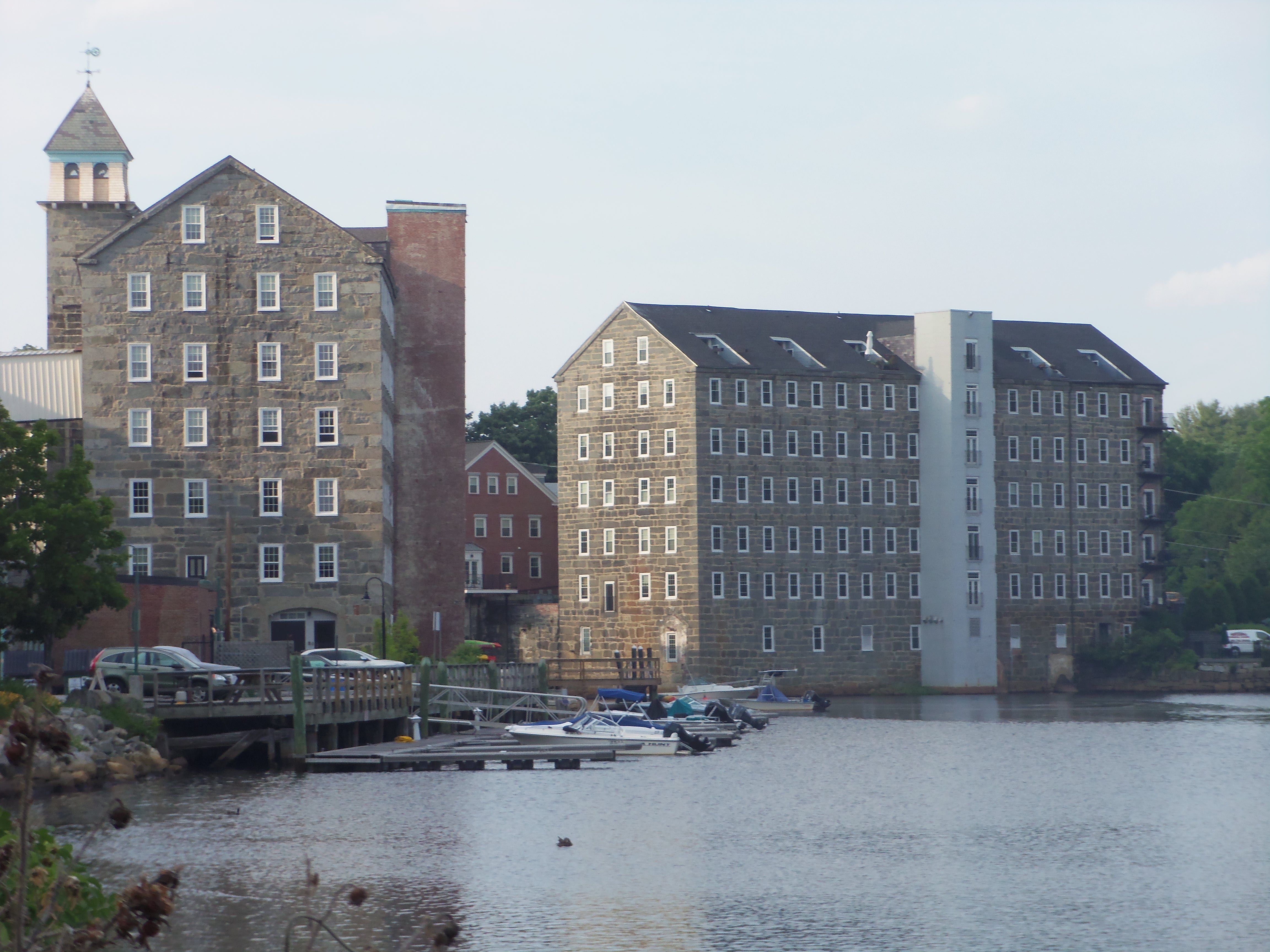
Like Dover, the town of Newmarket flanks Durham and its state university campus, and as a former textiles mill town, it, too, is home to a number of University of New Hampshire students and the kinds of businesses one would expect as a consequence – small restaurants, bars, pizza parlors, bookstores, yoga studios, nightspots, and so on. The Stone Church Meeting House has long been a venue for emerging musical acts.

The Stone Church Meeting House sits atop a steep street downtown.
The vibe says it all.

The town of approximately 9,000 also has a strong blue-collar side, which also feeds into a distinctly funky feel.

But to me there’s always been a sensation that the place isn’t fully New England. It somehow reminds me more of small cities in central Pennsylvania or even Galena, Illinois, near the Mississippi. I think that has to do with the way the central street twists through downtown and the prevalence of stonework rather than the traditional brick in the mills and a few prominent houses. It’s picturesque, all the same.

Key to its industrial development was a large inland saltwater estuary that allowed extensive shipping. In generic usage, Great Bay also encompasses Little Bay and a host of small-town waterfronts where humble rivers fall to sea level. These include Durham and its Oyster River; Exeter and the Exeter/Squamscott; and Newmarket, with the Lamprey River, before passing Dover Point and emptying into the Piscataqua River on its way to the Atlantic. It’s a major breeding ground for fish populations all along the East Coast, and the current at Dover Point is always intense.

Hope you enjoy this quick tour.

100_1331

100_1342

100_1284