Dreaming of literary success versus the reality

Working in the thralls of daily newspaper journalism in the heartland was not my dream. Literary fame was. Of the critically acclaimed sort, as if bestseller status would follow.

Whoa, expressing that so boldly feels harsh, yet true. Even so, I did plod away on both fronts.

And now? I’m a survivor wondering what would have resulted if I had narrowed my focus.

I had no idea how crassly market-driven the shrinking book-publishing world was. So much for idealism.

~*~

Still, I pursued, working on my own into the wee hours.

These days, I have the luxury of revisiting my earlier work and wondering just who wrote it. The pages are so unlike what I’d venture today – wilder, for sure, and more profuse, often leading to an Oh-Wow! of admiration. The dross, fortunately, has been stripped away.

That’s been my reaction in presentations at our monthly open mic night here in town even when I’ve veered toward the edge of embarrassment yet still being warmly applauded.

Passages in both my prose and poetry make references I no longer understand but trust to leave untouched, perhaps for others to reconnect.

Writing? It’s like talking to yourself, ‘cept sometimes you have to get up to allow the rest of you to reply.

~*~

Another recent experience has come in assisting a friend to create a remarkable novel, one he finally presented to a literary agent whose thoughtful response seemed quaint, actually – the perspectives of three people in the agency, even though no. Somebody actually has time these days for such reflection?

It really did feel like an earlier era. I was rather envious.

~*~

I’m also recalling another experience after I had returned “back east” and was reading an essay about Snyder, Whalen, and Kerouac in the North Cascades, I felt sharp pain, knowing the lookout stations and High Cascades were so far behind me and the rest of my generation.

~*~

Add to that the fear of being discovered once your early book approaches publication. How strong are you in its potential storm?

Except, that you instead encounter indifference.

~*~

It can lead to bitterness, considering all the years and lost potential.

As for inscriptions at book signings?

Keep the faith!

Share your Light, too!

I don’t remember his name

Or much else, for that matter.

He was my introduction to philosophy professor, and then a semester of logic.

I expected to learn pithy bits of wisdom but discovered that philosophy is mostly about bottomless questions. I did find symbolic logic enticing, akin to geometry a few years earlier.

He was young, apparently Greek, as I recognize today – that curly hair and beard resembled any of a slew of statues. Rumors were that he was madly in love with his girlfriend and spent most of his nights talking long-distance to her in Europe.

What fascinated us was his clothing, the same cheap gabardine suit and tie and pair of scuffed brown oxfords every time he showed up for class. We assumed it was the same pair of socks and same shirt, too.

The next semester he wore a different suit but only that one to every class.

Later, hearing of his finals question from the previous year, I was grateful I hadn’t had him then.

The question he assigned for the blue-books scribbles was just one word:

“Why?”

Nothing else.

Most of the students labored away, hoping to chance across an acceptable answer.

The “A” grade went to the one who wrote a one-world answer:

“Because.”

And the “B” went to the one who used two: “Why not?”

Applying the Tao of food

The Chinese mystic Lao Tsu, the founder of Taoism, once said, or I think he did, that when it comes to food, we should eat what’s in season and from the region where we live.

Living in a so-called temperate climate, as I have, makes the adage difficult to maintain day to day through a full year, but as a guideline, I’ve appreciated its merits. Besides, it’s not a bad concept to keep in mind when sitting down to ponder seed catalogs and ordering, and then getting the mailings and planting the seeds under grow lights, as many folks do at this time of the year.

Here are some foods as I see them applying. Many but not all are items foodies pay dearly to obtain. Others are the basic reason for gardening – or is the practice itself the reason and any harvest arrives as one more blessing?

  1. Asparagus: I came to love this herald of spring when I was living in an apple orchard. The sprouts grew wild, free for the taking, and glutting out for the month they sprang forth was a delightful challenge. I repeated the celebration with a bed or two in Dover, and do miss those.
  2. Fiddleheads: These ferns are another herald of spring and well worth the expense. We’re hoping to raise our own, as well as asparagus, as we get better settled in here.
  3. Strawberries: Just in time for a few birthdays in June …  
  4. Crabmeat: It’s available if you know where to look, but Betty’s (the best) is available only from late spring to early autumn. Fresh is definitely the tastiest.
  5. Lobsters: Again, year-‘round, but the price does drop as the waters warm. Not that they’re ever cheap.
  6. Blueberries, raspberries, currants, and cranberries: Our county leads the nation in the harvest of wild, low-bush blueberries. Cranberries are a more recent addition at a few farms. Raspberries and currants are whatever we can keep from the deer.
  7. Summer garden abundance: lettuce, sugar snap peas, parsley, basil, cucumbers, tomatoes.
  8. Potatoes: The skins are so tender when fresh, and the insides haven’t yet turned starchy. My, they are sweet and creamy, definitely worth the excuse to head up to Aroostook County, where culls can be a bargain.
  9. Garlic and leeks: We do store these, so the “in season” doesn’t always apply. But they do brighten up what we’re eating through the winter months.
  10. Scallops: Speaking of winter, getting these straight from the fishing boats is heavenly. Those you buy at the market or in a restaurant aren’t quite the same.

Fresh cider and pick-your-own apples, peaches, and pears were things we enjoyed in Dover but haven’t yet located here in Way Downeast Maine. We’re lookin’, though.

Castine peek

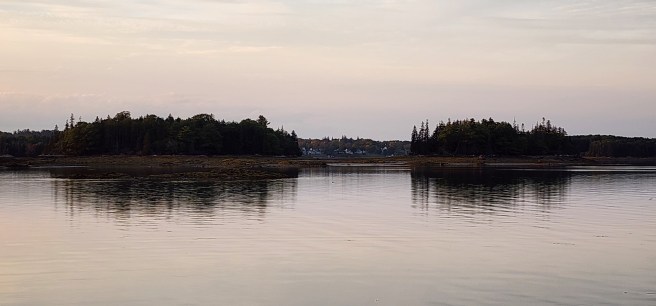
A gap between two islands presents a quick glimpse at the town of Castine beyond. A landscape explored from the water connects places in a much different sense than you get from land.

That’s one of the lessons I savored aboard the historic schooner Louis R. French last summer.

Remember, so much of Maine is water.

Confirming our house as Captain John’s homestead

The Shackford children had their joint holdings surveyed in January 1833, with Hannah Shackford’s husband, Darius Pearce/Pierce, performing the task. A flurry of real estate transfers followed, formalizing their agreements.

By 1820, according to the Census, the sons were heads of household.

Trying to follow the transactions gets rather confusing.

William and Jacob had even gone into business together in 1833, turning their attention away from seafaring. Their dealings included waterfront between the high-tide and low-water stretches as well as bands of shorefront below our house that would be developed into wharves.

From what I see, the boys weren’t getting a family discount. In 1830, John junior paid his father $1,000 for one parcel next to his brother William’s. In a transaction dated December 30, 1831, John senior specifies a band of waterfront “partially in front of my own dwelling house,” with the sellers being himself and “my wife Elsie.”

Among the deals were one on the easterly side of Water Street “to the fence of my homestead” and then westerly to Water Street, confirming that his homestead included both sides of the road.

Of special interest to me in confirming that our house was the one John senior occupied are the two deeds conveying adjoining land along Water Street. First was a sale to Myrick Bibber, a furniture merchant, on June 13, 1839, for a lot on the southwest corner of Water and Shackford streets, and then on July 10, to Daniel Aymar for the lot between the two.

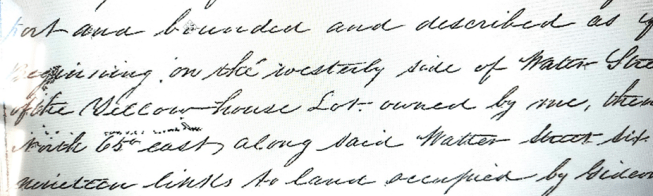
Each of them is measured to the line of “the yellow house lot owned by me.”

Here’s how the description appeared on the two deeds recorded at the Washington County courthouse.

I was surprised to see that he signed the deeds with his mark, X, as did his wife in several instances. New England was noted for its nearly universal literacy, both men and women.

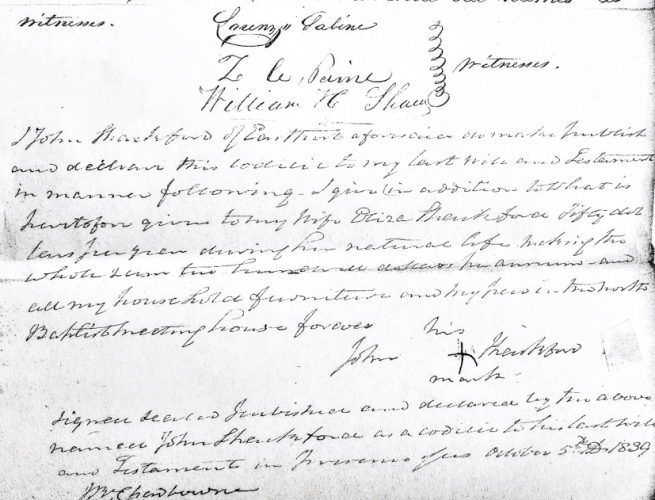
Here’s his X on his will.

Grandson Samuel Shackford said Esther, John’s first wife, “had been well reared and was a woman of superior intelligence” and that her children “were indebted to their mother for nearly all the educational advantages they ever enjoyed.” Unlike her husband, she signed some of the documents, as noted in the record, “her seal.” “School-teachers were rarely obtainable, in those days, in this then out-of-the-world. For a brief period, the services of William Lloyd Garrison’s [future] mother were secured to teach in the family” when she lived on neighboring Deer Island, Canada..

The real estate transactions indicate the children were all literate.

Esther died June 21, 1830. His second wife enters the picture rather obliquely soon thereafter.

His will of June 14, 1832, bequeathed “to my beloved wife Elsie the use during her life of my homestead or the house in which I now live, together with the lot and privileges thereto.”

Further down, it directs his six children and grandson Samuel to pay “to my wife Elsie the aforementioned annuity of one hundred & fifty dollars. And on my demise the homestead on house in which I now live with the lot come privileges pertaining thereto, and the one of which I have willed I am bequeathing to her during her life, I am bequeathing to them, my six children … in the same proportion of my other property.”

A harder to read codicil of October 5, 1839, raises the amount of the annuity to “my wife Eliza Shackford” to $200 during her natural life and “all my furniture and my pew in Baptist meetinghouse forever.”

After Captain John’s death, as Samuel Shackford confirmed, Elsie (or Elise, in his account) obtained the Revolutionary War veteran’s pension based on his service.

Elsie was later recorded in the 1850 Eastport Census as Eliza Shackford, 70, living in a household headed by Abigail Winslow, 37, along with four children — Anna E, 12; Lucy M., 6; James F., 4; and Mary A., 2; as well as Ethel Olmstead, 37, with his occupation as “gold digger” in the metal mining industry. An index to that Census listing placed Ethel as the head of household, even though he was at the bottom in the family. I am perplexed by the Winslow identity.

All of it, of course, has relevance on the house we bought.

Like a boat, a book is launched

That image seems especially appropriate as we celebrate the appearance today of my newest collection of poems, Ocean Motion, now available in the ebook platform of your choice. Yes, let’s envision a book floating on the water like a boat.

For much of the first half of my life, the concept of an ocean was incomprehensible, even more so than mountains.

As I’ve noted earlier, I grew up far from the seashore or even craggy ranges like the Rockies or Alps. The Great Smokey and other Southern Appalachian glories were a bit closer. I didn’t encounter the ocean until I’d reached adolescence and we visited Florida on a camping trip with some of Dad’s old Army Air Force buddies. I next saw surf my senior year of college, with my then-girlfriend and her parents. From there, my encounters went to a few times on the Staten Island ferry or other points in New York City or Long Island, and then the ferry rides in Washington state, a few days camping along the Pacific (recorded in my American Olympus book), a jaunt along the Oregon coast, and then Maryland, New Jersey, and ultimately New England, plus a few returns to the Gulf Coast of Florida.

In all of those, I faced an enigma, a recognition that I didn’t quite grasp its appeal. Something was missing. It was like a gray Lake Erie looming with whitecaps I had seen around age seven, except that there was something else called tides. It was water with nothing else but sky on the horizon.

The pace of my encounters picked up, especially once I moved to New England, nearly half of my life ago now. Having a boss who owned a 32-foot sailboat fostered some of that, especially when we ventured forth once or twice each summer from Newburyport, Massachusetts, or once from Portsmouth, New Hampshire – both notoriously treacherous harbors.

As I describe in one poem, my first time of being in a sailboat was also my first time out on the Atlantic and my first time of seeing whales (including a minke that surfaced only feet away from me) and my first time of setting foot on an island, one that was now a Unitarian and Congregationalist churches summer retreat.

Those experiences all infuse these poems.

Moving to Dover, as I remarried, picked up the pace. The tides reached downtown, after all, and Great Bay along one side. Plus, with the kids, we got to visit Maine beaches and Cape Cod at their grandfather’s. And later, picking up one after her work at a coastal motel, I had repeated exposures to the ocean at midnight, another world altogether. I wouldn’t say it was romantic, even with a full moon.

The resulting poems eventually appeared in small-press literary venues around the globe as well as a series of PDF chapbooks at Thistle Finch editions.

As these poems demonstrate, the more I’ve gotten to know ocean as the North Atlantic along New England, the more in awe I am. Other writers can express the ocean from their own locale and nuances.

Still, I have come to love lighthouses and do treasure opportunities to climb up within them to savor the view from the top. But don’t get too romantic, it was a harsh, often dangerous, life for the keeper and his family. I hope these poems reflect that reality and more.

Do note that New England thrived on seafaring, designing and building distinguished vessels along its forested shores and sailing them around the globe to Asia and elsewhere and then back or out to hunt whales. The memories are imprinted in the muscle and soul of its people.

Remember, tides rise and fall dramatically in New England. You learn to be alert, even wary. And, do note, I’ve learned so much more since I first expressed that.

One of the ocean chapbooks included in the final collection was titled “Land Overlaps Sea,” an outlook that still impresses me, considering that it’s actually the other way around. The poems in the collection reflect places close to where I lived at the time and ways they interact with the Atlantic. It has been quite instructive over the years, even for an old landlubber like me.

Meanwhile, bits of sea shanties – the chanted or sung work ditties of sailors over the years – muffled and muted by the wind, flit through background, even if you don’t quite catch their words.

While the poems reflect a period of my life before moving to a remote fishing village at the far end of Maine, what I’ve encountered since confirms my impressions.

Maritime historian and sea chanter Stephen Sanfilippo and his wife, Susan, have definitely added much to my comprehension, as have my new friend, Captain Robert J. Peacock, and my times out on the waters, especially week-long cruises aboard the historic schooner Lewis R. French, as you’ve been seeing here.

~*~

So here we are, with my thought that each new volume is akin to the space within a vessel:

a book launch
rather than release

BOOK
BOAT

the connection floats for me
my experience on the water flows everywhere

For my poems of the sea, check out Ocean Motion at Smashwords.com. You can find also find it at the Apple Store, Barnes & Noble’s Nook, Scribd, Sony’s Kobo, and other fine ebook retailers. Or ask your public library to obtain it.