Ten facts about the Jenny Thompson outdoor pool

Since my indoor pool pass is good year-’round, I don’t spring for an extra pass to use the city’s outdoor pool each summer. Instead, I get to go there for free during the final two weeks of the season, when the indoor pool is closed for annual maintenance and upgrades.

The outdoor pool, though, can be a glorious experience. Here are ten points to consider.

  1. Though a Massachusetts native, Jenny Thompson calls Dover her hometown. She’s among the most decorated athletes in Olympic history, having won eight gold medals among her 12 despite numerous setbacks. On top of that, she became an anesthesiologist is Boston and now works as a pediatric anesthesiologist up the road in Portland, Maine.
  2. It’s the only 50-meter swimming pool for miles around. The closest neighbor is the Raco Theodore pool in Manchester, New Hampshire, an hour to our west. The only one to our east is at Colby College in Waterville, Maine, three hours up the Interstate. And to our south, it’s the Beverly, Massachusetts, YMCA on Boston’s North Shore or, further south, at the Massachusetts Institute of Technology in Cambridge or at Hanscom in Lincoln. In other words, ain’t many of ’em around.
  3. It feels endless. A half-mile is eight laps, meaning round-trips up and back. I love hearing the rippling banners overhead in the distance, meaning I’m getting close to turning back in the other direction.
  4. It has a 10-foot-high diving board. Kids love it. Insurance companies hate anything so risky.
  5. It’s heated, except on the hottest days. Evaporation cools the water. Somehow, though, it seems to warm enough once I’m in it but still refreshingly brisk. Talk about a fine balance.
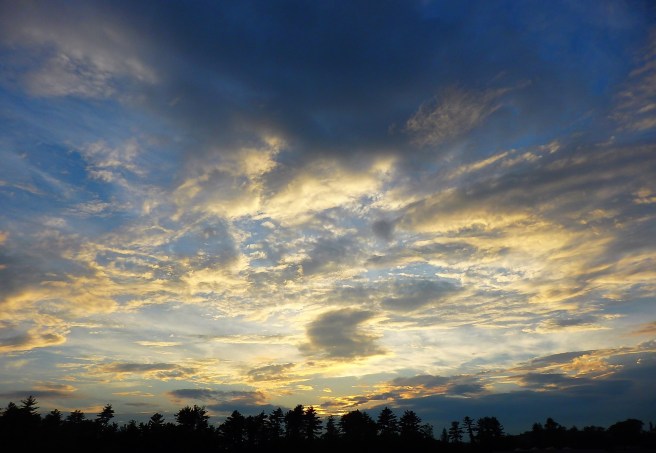
  6. Overhead, contrails of jetliners heading into Boston’s Logan airport often come a minute apart. That’s in addition to some gorgeous clouds I love to watch on my backstroke, along with the occasional bald eagles in the distance.
  7. As I just said, keep an eye open for bald eagles soaring in the distance.
  8. The Seacoast Swimming Association, which drew Thompson and her mother to Dover in the first place, is its biggest supporter – as they also do for the city’s smaller indoor pool through the rest of the year.
  9. Big swim meets take place here. Why not? From a distance, it always looks like a mob scene.
  10. The pool is 41 years old and has maintenance issues. Which leads to the next matter. Efforts are under way to replace it with a 10- to 22-lane indoor 50-meter pool. Dr. Thompson is solidly behind the effort and promises to come down often to test its waters.
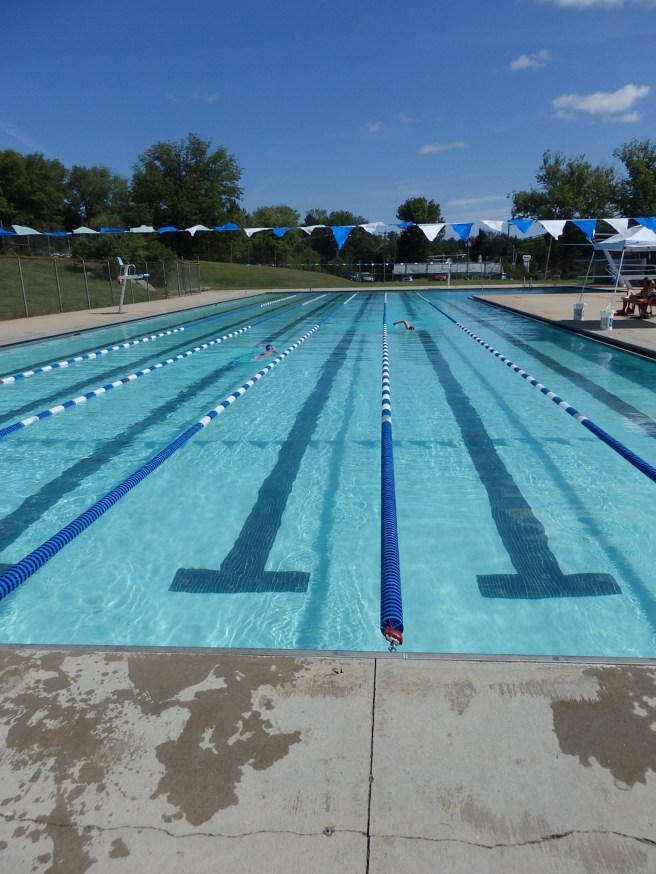
It’s longer than it looks. See the swimmers?


Did I jinx the Camry?

Not long ago, or so it seems, I posted a Tendril on 10 cars I’ve had in my life. (I was going to say “owned,” but one was a company car.)

Guess I’ll have to make that 11 now.

My 2002 Toyota Camry fell victim to rust damage, which would have kept it from passing state inspection. It also needed new tires and an oil pan or some such. Besides, the key worked only on the driver side – not the trunk or passenger door – and the costly air conditioning coolant disappeared after a month or so of summer and, oh yes, the ignition did freeze up several times in recent winters. I know I’m overlooking other defects.

Still, it was paid for and I was hoping to hit 300,000 miles.

Alas, I bit the bullet and agreed to let go now at 283,000 miles. Gee, 17,000 short – I wanted just one more year.

In its place is a 2016 Chevy Sonic. I’m downsizing, for sure, but I no longer have a long daily commute or kids and their gear at home, and my wife’s Prius is what we’ll use when there’s more than one passenger.

I’ll spare you the calculations and experiences of used-car shopping, but will say that maybe if I’m lucky, this will be my last car purchase. Who knows?

Or by then we may just be into the revolutionary era of self-driving vehicles.

In the meantime, I still have a long way to go in catching up with all the new technology on the dashboard.

Dover’s new riverfront appearance and hilltop park access

Downtown Dover grew around the falls on the Cocheco River, where the mills could channel the current to produce world-famous calico and much more.

Below the falls and the dam atop them, tides from the Atlantic Ocean downstream rise and fall eight to ten feet every six hours or so. Boats from the ocean made their way the 14 miles upstream to pick up or deliver goods.

As pollution in the river has been cleaned up and the city itself become more of a center of the Seacoast Region, planners have been looking to develop an open stretch of unpaved parking lot and weeds across the water from downtown.

For years, the site was the public works yard – not the best use of potentially valuable real estate. That has since been relocated elsewhere. I’m guessing it was tannery and warehouses before that.

A proposal to build anew there fell through in the real estate collapse of the great recession at the end of the George W. Bush administration but now, a decade later, it’s emerging in new form.

Key to the design is the extension of Henry Law park along the river as a walkway with added attractions such as kayak and canoe landings. A hillside has already been carved back to allow moving an existing street away from the river to open the space for more pleasant picnicking or the strolling public.

Further on there will be room for new housing and small stores or offices. Done right, it should be quite welcoming and attractive.

Just as important, in my eyes, is the way this will open up access to an existing city park at the top of the hill. Rather than running into a dead end as it does now, Washington Street will rise up the slope to become the entrance to Maglaras Park. It will be an easy walk from downtown, rather than the convoluted route it’s replacing. Even for drivers, it’s a huge improvement.

Continue reading “Dover’s new riverfront appearance and hilltop park access”

Ten facts about the Romani

The more she learns about her great-grandmother in my novel What’s Left, the more reason Cassia has to be curious about her roots.

  1. Romani or Roma: The preferred terms for “Gypsies.” They are ethnically and genealogically different from other Europeans. They originated in northern India and migrated about 1,500 years ago as a group.
  2. Roma subgroups differ in language and variations of customs: These hold social distance from each other.
  3. They are a dispersed population: They have significant concentrations in Egypt, Turkey, Romania, southern France, Spain, and Hungary.
  4. Population in U.S.: Estimated at one million. Largely centered in southern California, the Pacific Northwest, Texas, and the Northeast./
  5. Population in Greece: Between 200,000 and 300,000.
  6. Population in Brazil: 800,000.
  7. Roma slaves: They were shipped with Columbus in 1492. Spain sent Romani slaves to Louisiana, 1762-1800.
  8. Romania: Abolished Roma slavery in 1864.
  9. Marriage: Couples generally wed within their tribe. The parents of the boy customarily select his bride, and a bride price would be paid to compensate her father for his loss.
  10. Community: When a Roma male marries a non-Roma, she may in time be accepted by the community, if she accepts their way of life. For a Roma female to marry a gaje, however, is a serious violation of marime or marimhe code originating in Hindu purity laws.

The clock’s running down – Don’t miss this deadline

Time’s running out. The one-month-only sale where three of my novels are available for free is coming to a close. Remember, that’s FREE. And two more titles are half-price.

They’re designed for Kindle, Nook, laptop, tablet, or smartphone – any digital device where you’re reading.

All you need to do is hop on down to Jnana Hodson at Smashwords.com.

I think you’ll be happy you did.


They sound like happy fireworks

The street drum band aNova Brazil joined us last fall to help celebrate the cleanup of the Charles River two decades earlier. Here they are warming up for the Boston Revels’ equinox RiverSing last fall at the Herter Park amphitheater along the Charles River in Allston. They later fired up the procession down to the stage and performed several unbelievably complex and infectious numbers. They’re a hard act to follow, but we did it. Boston Revels hosts events throughout the year to enhance community through folk traditions.

The changing face of downtown Dover

My small city is the seventh oldest settlement in the continental United States, not that there’s a lot left from its first century, when the place was largely on the sometimes troubled frontier of English dominion.

As a working-class mill town, it developed more modestly than more prosperous harbor towns like Portsmouth to the south or Portland to the northeast or Newburyport to the southwest.

Our downtown is catching up, though. A small but significant building boom is under way.

Continue reading “The changing face of downtown Dover”

Filling shelves with cookbooks and food perspectives

In the expansion of the family restaurant in my novel, What’s Left, her father proposes an office for her uncle Barney that includes a wall-length bookshelf for his cookbooks.

At this point, of course, I could have been led to page after page of a bibliography! My wife would have Anthony Pellegrini’s pioneering volumes right up there. And I’d go for Julia Child, not that I’ve ever followed one of her recipes to a T. I just love her descriptions.

Now let me ask, what food books would you put on Barney’s shelves? And why?

~*~

Waitress in unidentified diner, Pike Place Market, Seattle, Washington, 1981. Photo via Wikimedia Commons.

In my novel, the family restaurant could have been like this.