Practicing excellence in modest work

Rather than the big splash – the masterwork, Oscar performance, Pulitzer Prize, MVP sort of thing.

Think of a pastor, crafting sermon after sermon each week.

A woman who found housing for the homeless and then patiently worked them through their finances to point them toward independence.

The big dreams of a novelist or poet page by page that never found a readership, or the correspondent for a local weekly newspaper.

A doctor or nurse. Teacher. Carpenter. Mechanic.

Keep your eye open and the list grows quickly.

It even becomes more impressive than many who have fame.

To add the word ‘island’ to Grand Manan would be redundant

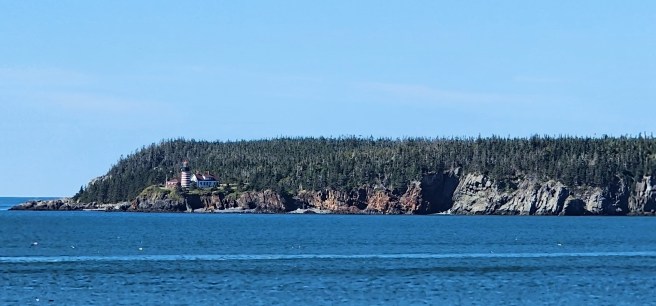
Despite our many trips to Cape Cod back when I lived not that far away in New Hampshire, I never got around to visiting tony and history-laden Martha’s Vineyard or neighboring Nantucket. It’s an oversight I don’t want to repeat when it comes to Grand Manan, an impressive Canadian island we can see from some points here in Eastport, Maine.

I am hoping to get there this year. Even if I don’t, here are some high points:

  1. Its closest point on the mainland is the town of Lubec Maine, nine miles across the Grand Manan Channel. For mainland New Brunswick, it’s Blacks Harbor, 20 miles over the Bay of Fundy. Yet if you look at most maps of Maine, it doesn’t show up at all, despite its proximity. That part
  2. As the largest of the 25-plus Fundy Islands, Grand Manan is 21 miles long and has a maximum width of 11 miles, covering 53 square miles in all. (Campobello and Deer Island, which border Eastport, are the second and third largest, respectfully.) It’s home to 2,595 year-round residents.
  3. The principal way of getting there is by a 90-minute ferry ride from Blacks Harbour. Reservations are recommended, both ways.
  4. For comparison, Martha’s Vineyard is 20.5 miles long, covers 96 square miles, takes a 45-minute ferry jaunt, and has 20,530 full-timers; Nantucket covers 45 square miles, is a 2¼-hour commute by traditional ferry, and has 14,444 residents. Both of the Massachusetts towns are much wealthier than Grand Manon, where most folks eke out their living “on the water.”
  5. The economy is based primarily upon commercial fishing – lobster, herring, scallops, and crab – plus ocean salmon farms and clam digging.
  6. For the traveler, the island is largely a step back in time, with a single highway along the eastern half, where most of the modest residents live. That leads to the rest of the Grand Manan archipelago of nearby smaller islands such as popular White Head (reachable by a second ferry ride), Ross Cheney, and the Wood islands, plus countless surrounding shoaling rocks. Meanwhile, the rugged and forested western side, with 300-foot-high cliffs, high winds, numerous passages, coves, and rocky reefs, incorporates wildlife-rich preserves.
  7. Tourism, the second source of income, provides unspoiled ocean views, whale-watch cruises – rare right whale breeding grounds adjoin its waters – as well as kayaking, hiking, camping, photography, painting, and bird-watching with more than 240 species, including nesting puffins in season.
  8. Among the lighthouses to check out are Gannet Rock, Swallowtail, Southwest Head, Long Eddy Point, Long Point, and Great Duck Island. Not all of them are what you would call picturesque or prime condition. Not to slight them.
  9. Linguistically, “Manan” is a corruption of mun-an-ook or man-an-ook, meaning “island place” or “the island” in the local First Nations’ language. The suffix ook, meanwhile, means “people of.” French explorer Samuel de Champlain recorded the place as Manthane on a 1606 map and later changed it to Menane or Menasne – close enough in sound. So if Manan already means “island,” why be redundant? You don’t need to add “island” to the Vineyard or Nantucket, either – everybody knows what you mean without it.
  10. Grand Manan’s not for everyone. As one review said, “A long way to travel for nothing. Nice rocks but you can see those in Maine. Sea glass was hard to find and sparse. Very poor, depressed area. Lighthouses are ugly and there is nothing to really do other than hiking, which you can also do in Maine. Ferry stunk and was disgusting. Never saw any whales or seals. Nothing on the island except rundown shacks. All the online promotions are just hype. Waste of a day. … Go to Campobello island, it’s 100% better.” In short, sounds right up my alley for adventure.

The first permanent settlement, by the way, was in 1784 by Loyalists fleeing the U.S. at the close of the American Revolutionary War, a common occurrence across New Brunswick.

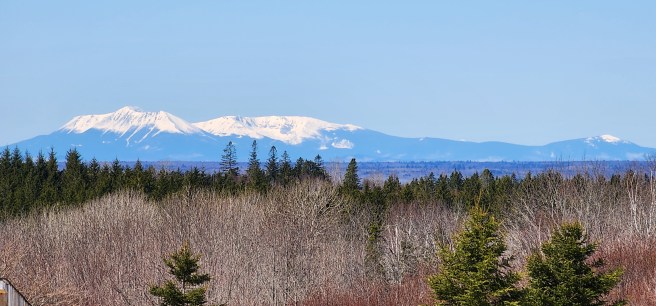
When elk move through my mind these days

They are a memory, more as an emblem and ideal than creature. I never tasted elk flesh, though I heard praises. Nor have I stroked the fur. What I’ve known has appeared only on the forest floor as track and scat – no ticks on the neck or patchy summer skin like the moose where I now live. That, and winter encounters viewed from a distance.

The deer who frequent our yard these days are so small by comparison.

Will I ever revisit the Pacific Northwest where I lived? Would I even recognize most of it?

Or was it all gone in the divorce?

Now for a touch of scandal in the family

The house at the corner of Water and Key streets came into the ownership of Jacob’s nephew, John Lincoln Shackford, who had married Elizabeth S. Clark in 1838 and, following the occupation of his father and siblings, became a mariner.

In 1847 Captain John Lincoln Shackford he was advertising freight and passage aboard the brig Carryl, traveling for Saint Marks and Newport and from Pennsylvania to the Isle of Lobos and Havana.  He also was reported as rescuing members of the crew of the bark Cambria and conveying them back to New York.

The 1850 Census recorded him living in Eastport with his parents, his wife Elizabeth, and three children. In 1860, they were with her parents and two children, presumably while he was at sea. Shortly after that, the family moved to New York, where he was recorded in Brooklyn at 111 Adelphi.  In 1863 he was listed on the Brooklyn Civil War draft registration, and in 1864, he was at Hamilton north of Fulton Avenue.

Among their children was Abby, who died at age seven in Cuba — suggesting that Elizabeth and the children had accompanied him on his voyages as a captain — and her twin Esther, who died in Brooklyn at 21, and sister Fanny, who died as an infant.

Shortly before February 1871, John’s wife returned to Eastport, where she filed for divorce, dower, and alimony, asking for all right title and interest in any and all real estate he had in the County of Washington, Maine. Before the case was settled, he died, December 20, in the Virgin Islands.

As the case was submitted, “To the Honorable the Justices of the Supreme Judicial Court next to be Holden at Calais, within and for the County of Washington in said state on the fourth Tuesday of April AD 1871.

“Elizabeth S. Shackford of Eastport in said County, respectfully represents that she was married to John L. Shackford now of St. Thomas, at Eastport in said County on the tenth day of December AD 1838 and had by him two children now living to wit; Joshua C. Shackford & Regina T. Shackford. That after her said marriage she cohabits with said Shackford in said State of Maine, and always conducted herself as a true and faithful wife.

“That the said John L Shackford unmindful of his marriage vows and covenants, and the duty affection and respect he owed her, deserted her more than three years ago, and has not supported her for the last three years.

“That he has been living with another woman to your Libelland Unknown in St. Thomas.

“That he has been married to said woman as he has declared in letters to others.

“That he has a daughter by said woman and committed adultery with said woman.

“Wherefore, because a divorce from her said bonds of matrimony would be reasonable and proper, conducive to domestic harmony and consistent with the peace and morality of society, she humbly prays your Honors such divorce accordingly …”

Additional documents listed John L. Shackford’s estate value at five thousand dollars (the number is crossed out and rewritten).  The court ordered payment to Elizabeth and ensured that the United States Consul to St. Thomas delivered a copy of the document to John L. Shackford (misspelled Schackford on the document).  The court then allowed Elizabeth to sell land to include property at the corner of Water and Key streets (formerly Greenwich Street), land on the northerly side of Shackford’s Cove, along with other property valued at $1,471.02.

Curiously, widow Elizabeth returned to New York, where she died in 1882.

The Eastport Sentinel reported, October 2, 1889, “Mr. T.M. Bibber moved last week from the Shackford house at the corner of Water and Key Streets to the Chapman house on Boynton St.” The Bibber connection may have been thicker than I’ve uncovered so far.

Obviously, Shackford descendants were ranging far from Eastport, never to return.
What’s left after ‘What’s Left’

Every writer has to face the question of knowing when a particular work is done, as in finished and ready to release.

The problem is that there’s always more that could be added or refined. Writing is, by definition, imperfect. In fact, the vaster the ambitions of a novel, for instance, the more imperfect it will be. Visit the critical examinations of the great novels Huckleberry Finn and Moby-Dick as prime examples.

The decision finally comes down to the line where the work releases the writer. The obsession burns out. You’re exhausted and feel you need to move on. You’ve said all you can say. You’ve discovered just about everything of relevance you can on the subject. For some writers, I suppose, it’s like the end of an affair.

For luckier ones, it’s when the editor or publisher demands the manuscript, ready or not.

~*~

I’ve previously posted on how my novels percolated over time. There was the sabbatical year I gave myself in Baltimore, where I lived off my savings and armed myself with a new personal computer with 5½-floppy disks (for you high-tech geeks with a knowledge of now ancient systems) as I poured myself into keyboarding rambling manuscripts in the search of publication.

When my savings ran out and I returned to the workaday world, I kept picking at those seminal drafts, usually on vacations and holidays. Other efforts at more marketable books also got attention and even a few nibbles, but in the end, none of them panned out. Working full-time, I simply didn’t have the additional open periods required for successful self-promotion.

I’m glad I didn’t wait until retirement, as so many others I’ve known did, to start writing those novels. The details and intensity would have evaporated. Instead, retirement played out in a different way and the novels did finally find publication.

My one fully new book was the one that grew into What’s Left, though it did start with piles of outtakes from the earlier novels as well as other material.

As I’ve also previously posted, it did eventually lead me to thoroughly revise and reissue those earlier novels.

The result is that I have eight books of fiction available today, and I am proud of them, even if they haven’t found wide readership or critical acclaim. Not that I wouldn’t welcome either.

~*~

I am struck by how much has changed for me in the seven years since then, some of it a consequence of the shift to digital writing and publishing. I don’t require as much space for files, for one thing, or for research materials and correspondence. What can be found online with little effort is amazing, as I discovered while writing Quaking Dover. I hate to admit I no longer keep a dictionary or thesaurus at hand.

Downsizing to our remote fishing village at the far end of Maine four years ago meant that I no longer needed a studio in the attic. A corner of a bedroom sufficed for some pretty heaving writing and revision.

It’s a far cry from the dream I once had of remodeling the top of the red barn into a year-‘round studio that included a custom-build semi-circular desk with me sitting in its center – something like the copy desks that were common to many newsrooms.

No need for that now, not even at newspapers.

~*~

The task for me now turns to cleaning out remaining files, both digital and physical, that are no longer needed. I don’t want to leave that mess to my wife and kids later.

One thing I’ll confess is that I doubt I have another novel up my proverbial sleave.

~*~

You can find my novels in the digital platform of your choice at Smashwords, the Apple Store, Barnes & Noble’s Nook, Scribd, Sony’s Kobo, and other fine ebook retailers. They’re also available in paper and Kindle at Amazon, or you can ask your local library to obtain them.

If you’re dreaming of  a vacation in Maine, please consider …

The weather can be iffy, even in summer. Your week by the beach may be mostly rain and or fog. Plan accordingly. There’s nothing wrong with hunkering down with a good novel when you’re away from everyday distractions.

Where I live the ocean is too cold for swimming. Period. Even before factoring for the currents. Further south and west, this can be iffy.

Black flies. They’re early summer, to mid-July. Inland, especially. You’ve been warned. They’re even worse than swarms of mosquitoes.

As for your expectations? A more laid-back lifestyle perhaps with antiquing is one thing. If you have kids in tow? That’s another. Hope they enjoy the outdoors.

If you go for a whale-watch anywhere, what you wind up seeing is what you are given that day. The best part may be simply the cruise out and back from the prime ocean. There are no other guarantees.

In many destination locations, retailers are faced with a six-week business model. Restaurants, lodgings,  and stores have to cover most of their year’s expenses in those few intense weeks and then hold on through the rest of the year, if they stay open at all. Prices will be higher than you might like.

Nightlife may very well mean looking at stars.