So much past under one roof

I never suspected our humble cottage would hold so many stories and twists. A sea captain’s home should have a widow’s watch, right?

Ours, as you’ve noticed, doesn’t.

Still, a single house like ours can be a miniature version of the whole island’s history.

There are still so many unanswered questions to work around in this puzzle, along with points that will require clarification and correction. Consider this, like the house itself, a work in progress.

Besides, we’re living out the next chapter, including the renovations and restructuring that’s occurring as I write this.

Journaling over the years

Prodded by a crusty newspaper editor-in-chief to keep a personal journal, I started the practice 55 years ago using spiral-bound notebooks. At the time, I was largely in quest of exploring “my problem,” meaning the deep depression and loneliness that followed the breakup with my first lover and my inability in social circles to find another. Long story to pick up later.

What I found instead was the manic upside in my funky settings during the hippie outbreak. Many of those entries, some of them in my favored 8½-by-14-inch notebooks – an option that disappeared all too soon from the market – found their way into my eventual fiction and poetry, though much of the rest is dross. At their best, they do have a sense of Richard Brautigan. Look him up, if you must.

As for the banal run of most of the entries, people who snooped into my journals and then voiced their disappointment in what they found told me as much. Note to those of you who consider doing something similar, it is an invasion of privacy and will likely bruise your relationship. It is an abuse.

Entries were rarely a daily thing for me, more likely weekly or, of late, even monthly. When I sat down to do so, I was more likely to record what was going on around me than I was to delve into my emotions or underlying perceptions. Those latter elements might appear whenever I had more time at the project. The big lesson was that my life was much richer than I had suspected, and I was too prone to lose the connecting threads without these times of reflection. In some ways, they were like Lewis and Clark’s explorations across the continent, I suppose. Who knows who might need the maps later.

In earlier returns to these, I did find I had duly noted details of unfaithfulness and other impending disasters that I was denying to myself, yet there they are in clear daylight when we return.

Among my goals this year is a thorough revisiting of the 200-plus volumes to date, the latter half mostly  in hardbound 8½-by-11 artist sketchbooks. Most of what I review will be discarded, harsh as that sounds, but I the act will release emotional burdens as well. My novels and poems distill and carry much of that journey, thank you.

The ones beginning in 2000, though, retain so many details of my current situation, I really can use the reminders of things I don’t recall when they’re raised by others. I’ll let you guess who, especially.

~*~

My practice has definitely changed since I began blogging. Much of the recording of events, personal observations, and reflections has deflected from the hardbound journals to these online entries. Well, so has much of what would have gone into long letters to friends and colleagues now has vanished online as well. Emails and texts fall far short of real correspondence, OK?

The journaling on paper continues, though at my age, life feels more routine, less worthy of intense recording. So much of it I’ve already said, even to myself.  Still, as a practice, it’s one more thing I can see as prayer, too.

You’ll likely be seeing more of what I turn up in those yellowing pages.

My favorite radio program at the moment

It’s called “My Music,” a Saturday morning staple on the CBC Music FM radio network.

For two hours each week, a notable Canadian classical musician is invited to share his or her favorite music. Not all of it’s classical, either. Sometimes it’s a pianist or a violinist or even a conductor or composer. Some are quite famous in musical circles, while others are fairly obscure. Organ, clarinet, harp, percussion, and varied ethnic instrumentalists have hosted as well. And there are some amazing singers, not all of them opera.

Sometimes they stick to their particular niche, but I especially enjoy the ones who venture far beyond that.

It’s quite touching when they honor their parents, siblings, teachers, and friends with their selections, and quite enlightening why they explain what makes someone they admire stand out. As I said, it’s not always classical. Canadian jazz pianist Oscar Peterson turns out to be a huge influence.

I do wish classical stations in the U.S. had a similar program. To attempt this on a national level would be too overwhelming. Part of its joy is a small-town feel. Basing one in Boston or Los Angeles or Chicago might even be too big.

Bloomington, Indiana, would be a natural, or San Francisco, or even a whole state like Minnesota.

Whaddya think?

Meet patriot Lewis Frederick Delesdernier

In researching the history of our house, I learned about many of its earlier neighbors as well. Of note to the south was one with a rather exotic surname. Turns out he was a rather influential figure in the establishment of Eastport.

Here are a few points about him.

  1. He was born as Louis Frederic DeLesdernier in Halifax, Nova Scotia, in 1752 to Gideon de les Dernier and Judith Marie Madelon Martine. As for that French surname? The precise location at that time could have been under either French or English rule – the conflicts are quite tangled. He was, however, a generation removed from Geneva, Switzerland, by then. French-speaking, all the same, however anyone wound up spelling it.
  2. His uncle Moses was the first Protestant to farm among the French Acadians.
  3. When the American Revolution broke out, Lewis enlisted in an effort to bring the American Revolution to Canada. The attack on British Fort Cumberland in Nova Scotia was defeated and then, in retreat, Lewis ultimately wound up in Machias, Maine, where he was charged with maintaining good relations with the local Passamaquoddy to assure that they didn’t defect to the British. During this time, in 1779 he married Sarah Brown, the daughter of a fellow garrison member. For a Frenchman, attacking the English makes sense.
  4. After the war, he resettled on an island in the waters either in today’s Lubec or Eastport, Maine, one called variously Fredrichs or De Les Dernier island. There he was appointed as the first customs collector for the district, possibly encompassing both today’s Lubec and Eastport, and, in 1789, when the first post office was established, was named postmaster. Could that island have been what emerged as Moose Island, today’s Eastport?
  5. In Eastport, he was not only the first postmaster but also the first collector of customs. Case closed?
  6. The first owner of our house did have a ship named after him. In those days, naming a ship after someone often obligated them to buy a share in it. Did this present a conflict of interest for the custom’s collector?
  7. After Delesdernier’s first wife’s death in 1814, he married the widow Sophia Fellows Clark in 1817. Trying to determine the number of children remains elusive, but I’m finding no descendants in the region today.
  8. When he died in December 1838 at his son’s home in today’s Baileyville, Maine, a warm friend, Alfred A. Gallatin, the fourth U.S. Secretary of the Treasury (1801-1814) under President Thomas Madison, said, “He is to me of all Americans I have seen, the most zealous and full of enthusiasm for the Liberty of his country.”
  9. An 1803 arrival in Eastport of Harvard graduate Jonathan D. (the initial for you can guess what) Weston was auspicious. Shortly before his death, provided details on much of the early settlement of Eastport in a history published in 1834 and later woven into William Henry Kilby’s 1888 volume. He also hosted famed ornithological artist John J. Audubon at his 1810 home at the corner of Boyden and Middle streets. I’m not finding any direct relationship, but will venture that the middle name was in honor of Lewis, perhaps even hinting at the reason for Jonathan’s moving to Eastport.
  10. Lewis’ circa 1807 house was eventually moved from down on the water to higher ground. The only remaining evidence of its original location is in the naming of Customs Street, far from the later custom’s offices. Today, the Delesdernier home on the south end of the island is proudly owned by symphony conductor and cellist Dan Alcott, who anticipates moving into it year-round. We can’t wait!

I prefer, should you wonder …

a shower to a bath, but indulge in hot tubs.

a hot tub to a sauna in the snow, not that I haven’t delighted in the latter.

religion that relies on questions more than answers.

discovery to fabrication. Accuracy more than cleverness.

Chocolate or candy?
White chocolate. Or dark, bittersweet.

Waffles or pancakes?
Either one, awash in melted real butter and local maple syrup. Better yet, a classic cheese omelet. Or baked pears or baked French toast.

Regarding Samuel Shackford and son Samuel

Captain John senior and Esther had one other son, Samuel, who died in South America in 1820. His wife, Elizabeth Lincoln, had been born in Hingham, Massachusetts, and died in 1884 in Eastport, age 90.

The only child, Samuel, became a ship captain and, in 1851 in Eastport, married Mary Tinkham. He was also the one who provided the Shackford family profile in William Henry Kilby’s 1888 Eastport history volume.

Samuel junior turns out to be a remarkable figure in his own right.

As the 1895 Album of Genealogy and Biography, Cook County, Illinois with Portraits detailed, “He was, like his father, a shipmaster, which calling he followed until he came to Chicago, in November, 1853. Immediately on reaching this city, he engaged in the commission produce business, an enterprise which he carried on until the great Chicago fire, after which he removed to Winnetka.

“While living in Chicago, he was one of the early members of the Board of Trade, and served two terms in the city council during Mayor Rice’s administration. For five years he was a member of the Cook County board of supervisors, serving on several important committees, and for a time was chairman of the finance committee. During the Civil War, over two-and a-half million of dollars of soldiers’ bounties passed through the hands of this committee. He served about four years as a member of the Chicago board of education. … For many years he was a trustee of Rev. Robert Collyer’s church in Chicago, and was an exemplary churchman, never noted for extreme piety, but highly respected for his practical ideas of Christianity. He has been for years a trustee of the village of Winnetka …”

In addition, “Mr. Shackford has always been highly esteemed as a public-spirited and useful citizen. Before the Great Fire he had, perhaps, the finest and most complete records of city and county affairs ever in the possession of any one person, and his excellent memory aided him in the recollection of important transactions, which made all very valuable to the citizens. The people seemed to feel, and often expressed themselves in saying, that if he was chairman of a committee, that committee would do its full duty in advancing the interests of the city. He was indefatigable in looking after the affairs of the public in general, nor was he negligent of his own business.

“He has the best genealogical record of the Shackford family, and more interesting family records and mementoes than any other man in the state. Members of the old Shackford family are related to the first families in New England, proof of which he has in his possession. Mr. Shackford has written and left to posterity many valuable genealogical records, which have been, from time to time published. Notable among these, because of national interest, is ‘The Lineage of President Abraham Lincoln,’ as published in the New England Historical and Genealogical Register for April 1887, in which the writer, whose mother was a Lincoln, proves beyond a reasonable doubt that the brothers Mordecai and Abraham Lincoln, sons of Mordecai and Sarah (Jones) Lincoln, of Scituate, Massachusetts, were the ancestors of the Lincoln families of Pennsylvania, and that Abraham Lincoln, the Martyr President, was descended from the brother Mordecai …”

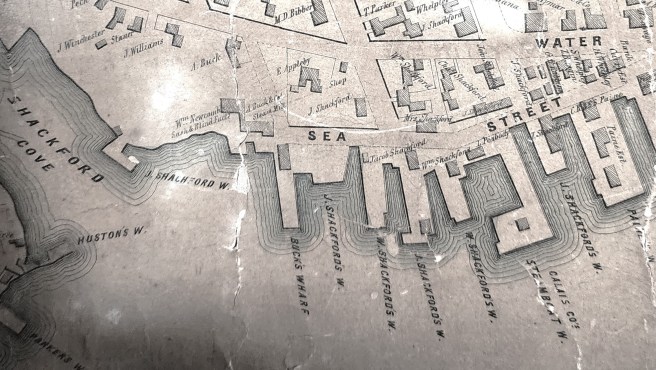
The 1855 Eastport map, produced shortly after Samuel had relocated to Chicago, illustrates how much the family had flourished. At least 13 buildings are labeled Shackford — most of them along Water and Sea Street just below our house. Many of the latter were likely warehouses and offices related to the six Shackford wharves and piers flanking the Calais Co.’s Steamboat Wharf, at the time owned by John junior.

The 1850 Census had eight Shackford households in Eastport. The 1860 Census had ten. And soon there were none.

So much for the Shackfords who grew up in the house we now own and their descendants.

Embracing my sunny side

Let’s celebrate the publication of my poetry ebook Mediterraneo this week.

As a series of poems, this book was a turning point for me. My earlier poetry had been mostly of the nature or love genres.

Here I focused on Western culture itself, through places around the Mediterranean Sea. It was someplace I’ve never visited, though it’s had a huge impact on my artistic and spiritual outlook. What I have known comes through artworks, literature, philosophy, operas, insights from my daughter and wife’s travels and those of my goddaughter and friends and even Greek Orthodox dancing and liturgy as well as ancient Hebrew scriptures. Put them all in the mixer, then, and see what we can distill.

It’s quite distinct from my ultimate roots in the British Isles and Germany.

When I created these poems, I had not yet relocated to a remote fishing village on an island in Maine after 20 years in the Seacoast region of New Hampshire. The climate is colder than the Mediterranean’s, for certain, but the light of the sun does reflect off the sea and back into the sky, magnifying the luminance in a way that attracts artists, as it does in many of the locations in this homage to the cradle of notable classic faiths, cultures, and cuisines. I do miss Greek dancing and related dining. The ability to see whales from shore or deer in my small-city yard do offset that.

The Mediterranean is much larger than I had supposed. It would reach from nearly one end of the United States to the other, yet also spans so much more diversity.
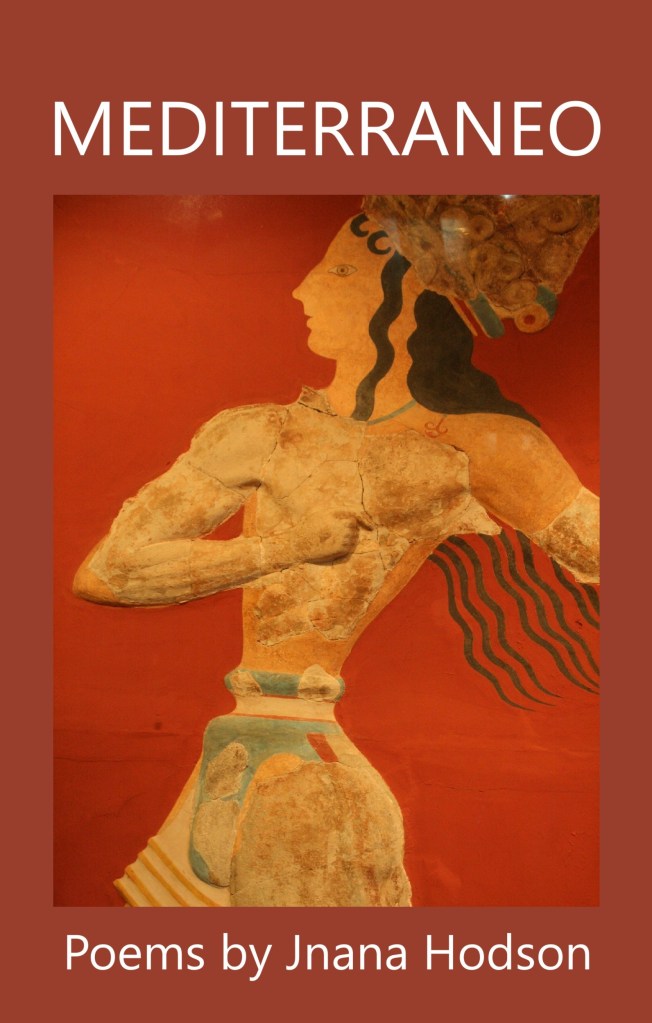
While I’ve never been to the Mediterranean, much less Egypt, and never out of the country, for that matter, excepting pockets of Canada, all the same, I’ve flown places in my imagining, and some convey some underlying kinship.

Barcelona is one of those. Seemingly far out of my northern nature, this Latin complex of sensuality, color, and Roman Catholic devotion also harbors a stubborn independence, under its ostensible domination by others. Spanish, but not Spanish. Catholic, and yet in a historic realm of heretical lay movements. A passion for the musical dramas of Wagner, accompanied by industry.

Perhaps my genetic line does run, as a marker suggests, from northern England to the border of Spain. Uncork a red wine, then, and sit in my Smoking Garden on a summer late afternoon. Muse on a line from on friend or other while listening to an opera broadcast.

Consider Pharaoh’s descent, the ways the culture of ancient Egypt anchors one corner of the Mediterranean. Was there another anything like it, in its mindset or visual conception?

Or the pervasive smell of camels with their wave-like gait as they nearly sail from the southern shore of the Mediterranean and on deep into the interior of north Africa. In many ways, it’s their land more than man’s.

Or the continuing influence of Greece and its blinding sunlight, scented with lavender and sage, spills over the the culture we inhabit, sometimes with an air of longing

So much ancient history is filled with brutality and revenge, lusts and conquests. Especially, we would venture, around the Mediterranean and its sea.

The Italian Renaissance, with its lush reds and golden adornments, leaves its mark on the imagination. What would Europe be without it?

As for Minotaur in the Ring, with strokes of Picasso, don’t overlook Barcelona, the fifth most populous metropolitan area in the European Union. Some say the port city was founded by Hercules, which would fit its fierce spirit. It even lives its own language, despite Spanish rule. And then there’s its unique style.

They’re all energies in these poems.

You can obtain the collection in the ebook platform of your choice at Smashwords.com and its affiliated digital bookstore retailers.