Put me in the top circle
You never know what we'll churn up in cleaning a stall
When she sets out in the task that’s become my novel, What’s Left, she doesn’t expect to be creating a family genealogy going back through her great-grandparents. But there’s no avoiding it.
As I explained in an earlier draft:
Theirs is a unique odyssey – one where the final homecoming is far from its point of origin. As a tragedy, the suffering comes at unmapped turns in the quest for the American dream. As a comedy, well, there are hot dogs, hippies, Hoosiers, and hope. Take your pick.
She gets insights on her parents’ generation:
Thea Nita notes that children in her generation grew up hearing of the woes of the Great Depression as a staple of conversation at big family dinners. In our case, that included the diner shooting.
A good genealogist doesn’t turn back when the details get disturbing:
By now I’m rather astonished at the events Thea Nita’s uncovered. Every family has things it wants to keep secret, but as a journalist, she’s driven toward disclosure. What did I tell you about listening closely to arguments? The dirt that comes up, even years later? Or even in what might transpire in mother-daughter confabs.
~*~
Does it work for the reader? I certainly hope so.
One reason, I suspect, is because Cassia is part of a family that holds many experiences in common. They live close to one another, work in the restaurant or related enterprises, play and grow up together, worship in one of two streams they’ve blended. Whatever they have flows from a shared source.
~*~
Speaking of family, Cassia’s oldest cousin, Alex, would be quite a catch. Where would you want to dine with him – romantically or just as a friend?
~*~

So here we are, spending too much time online digging for the latest in the Covid-19 deluge. I know I’m not alone there. The mere fact that so many sources for updated reports from around the globe are available only a few keystrokes away feeds our obsessive googling and scrolling – for many, a morbid fascination, for sure.
Having pretty much self-quarantined (in part at my wife’s nudging), I’ve been trying to continue generally as much life-as-usual as possible, which you’ve seen reflected in the posts here at the Red Barn. Admittedly, my life since retiring from the newsroom and turning my attention fulltime to a writer’s discipline has meant generally limited face-to-face social interaction anyway, but even I’m getting a bit antsy without my Quaker gatherings or daily swims at the city’s indoor pool or even dashes to the bank or grocery.
Still, I sympathize with those who have never undergone a discipline of doing without – as in fasting, leaving electronics behind for a backpacking or camping expedition, or even enduring an extended power outage. (As for the toilet paper, don’t get me going. That’s truly a First World problem!)
So while I’m treating these restrictions as an opportunity for reflection and renewal, here are ten things to make the best of it. And remember, if you’re sharing this hunkering down with a mate and/or children, try these together.
Here’s hoping you and yours aren’t showing any virus symptoms.
~*~
What would you suggest adding? What are you discovering … or rediscovering?
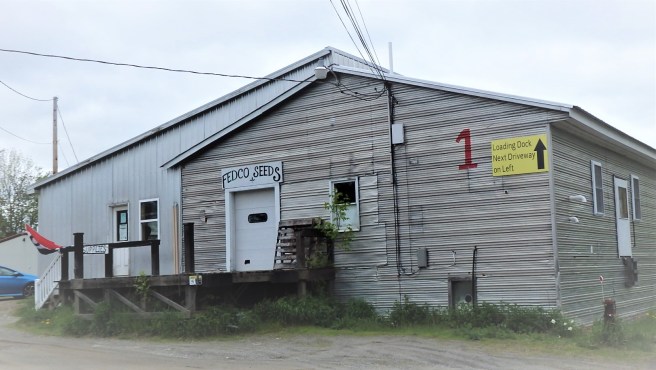
It doesn’t look like much, this former chicken barn at 688 Bellsqueeze Road up in Clinton, Maine, but it and a larger shed behind it are the operations center for Fedco Seeds, a seed and garden supply co-op geared toward the Northern New England climate. (I had to get that name in, Bellsqueeze, it’s a real, longstanding country road.) Members vouch for its high quality, low prices, and range of selections.
In my novel Nearly Canaan, their neighbor Todd is a geologist. You know, a rocks guy. The Ozarks is where he and his wife Lucy meet Joshua and Jaya.
The place is a mineral-rich geological wonder.
Here’s part of the attraction he’d have where they are in Arkansas.
~*~
~*~
What do you know about rocks?

Gertie Stein: Every writer wants to be told how good he is, how good he is, how good he is.
It retrospect, it seems a cruel irony that the protagonist of my novel Subway Visions would die in an avalanche a quarter-century later in What’s Left – that is, underground. Here he was on the Roof of the World when it happened.
I never intended the parallel, really.

