rooots
caroots
You never know what we'll churn up in cleaning a stall
rooots
caroots
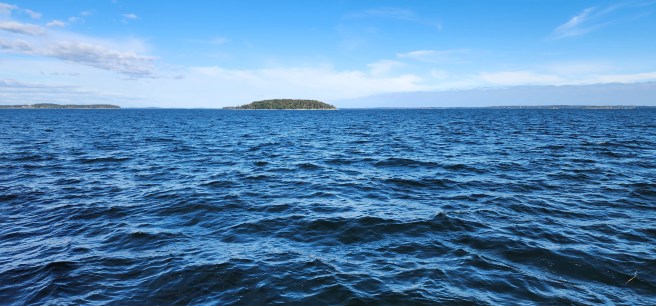 As seen from a cruise aboard the historic schooner Louis R. French on Penobscot Bay last summer.
For more schooner sailing experiences, take a look at my Under Sail photo album at Thistle Finch editions.
While the 100-acre Shackford holdings along Water Street underwent subdivision and real estate development, the 100 acres at Shackford Head remained intact. So far, I’ve been unable to locate the original title that would have been bestowed by the Commonwealth of Massachusetts to Captain John Shackford senior, but the documents for the adjacent Coney or Cony Farm repeatedly refer to the land held by John Shackford, during his life, or later, “land formerly of John Shackford.”
In 1837, when Joseph Coney leased his 40-acre farm to his son, Samuel May Coney (1812-1895), the rent was recorded as one cent a year.
Samuel soon came into full possession. By the time of his death, he had added the Shackford property, too, as was noted in the sale from the estate (attorney John H. McFaul) to Charles O. Furbush in 1896. That transaction included an 1895 Plan of Shackford Head by surveyor H.R. Taylor.
All of this would become part of the controversial attempt of Pittston Company’s attempt to build a massive oil terminal and refinery on the site in the 1970s.
I can see why Shackford heirs living in Eastport would have held onto the rugged land. A house could go through 40 cords of firewood in a year, and with seven homes or more at times, having a large wooded reserve would have been useful. Depending on the proximity of a sawmill, the wooded land could have also supplied the Shackford shipyard or even the wood in our house.
While these weekly Arts & Letters postings have been focusing on the writing life, at least as I’ve known it, some of the insights do spill over into regular life more generally. (I’ll leave that redundancy for emphasis.)
I am visually oriented, more so than many writers, and I did have four intense years of art training in high school. As a newspaper editor, I was regarded for my design layout skills and photo editing and presentation. I credit my high school teacher for much of that.
As a writer and designer, I’ve collected magazine photos, art books, postcards, and stray photos that happened my way. Use of a personal camera was more sporadic and problematic.
And then came digital photography, for me about the same time I started blogging.
But first, to back up.
Memory can carry you only so far, and even good notetakers miss much at the time. A story or poem can become vivid through a detail that pops a character or a scene. A sensitive writer might find that specific in a scent or a taste or motion or a particular word that’s voiced or sensed, but in many more instances, it’s something visual, the sort of thing you might find in examining a photograph or a painting. I’ve learned how those saved magazine photos as well as later images found online can be valuable that way. You or I can even build memory boards to support certain characters or locales, even a room in their house, to assist in our thinking. Some might use a website like Tumblr to do that, too, though I’ve found much more’s available more openly.
Much of my revision of the novels Daffodil Uprising and Nearly Canaan greatly benefitted from such prompts, as did the drafting of “Miller at the Spring” in The Secret Side of Jaya, and especially some books I won’t tell you about.
Some of these photo archives have become albums I’ve posted at Thistle Finch editions, should you be interested. Others you’ll find there, more recent, are images I’ve been taking in my new setting at the easternmost fringe of the continental USA. They’re more of what I’m considering an adjunct kind of journaling – impressions that might have spurred poems back when I was without a camera. I’m even finding a similar stream in what I’ve posted on my Facebook profile, where the images are more likely to be video. (Yes, today’s author is supposed to be active hustling everywhere.)
I hate to admit this, but the ubiquitous digital camera is greatly reducing my on-paper journaling.
Besides, just what are all of those people out there holding up their cell phones wherever they go planning on doing with all of those digital shots? It’s like they’re trying to confirm their own existence. Note the selfies. Or that what’s in front of them is actually happening.
Not that I’m trying to say I’m somehow nobly above that. (Well, maybe?)
As for photo inspiration? In my household, the collected images are impacting our thinking in the ongoing renovation of our historic old house. At this point, the kitchen, especially.
I am trying to be more selective in what I post here at the Red Barn, even if the subsidiary blogs are picking up some of the overflow. Maybe you’ll enjoy them there, too.
~*~
You’ll find my novels in the digital platform of your choice at Smashwords, the Apple Store, Barnes & Noble’s Nook, Scribd, Sony’s Kobo, and other fine ebook retailers. They’re also available in paper and Kindle at Amazon, or you can ask your local library to obtain them.
Everything is theoretical until it happens to you.
Usually, everyone I see with a tattoo made a mistake.
In my eyes, my grandparents were always old. But now I’m so much beyond where they were.
Everybody’s fucked up. At least consider that as a starting point of observation.
Trying to deal with death before you’re really beginning to understand the mystery of life is out of sequence.
In the meditation of Quaker worship, a place I call the deep water. Only these days, I would also be concerned about sharks below.
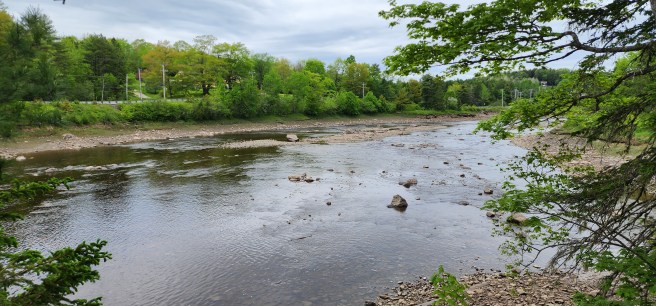 I just missed a shot of two eagles. A week later, with the water higher, I watched two harbor seals at play. Cobscook Bay is less than a mile downstream.
Well, the sport does figure prominently in the movie The Big Lebowski and the TV series Surreal Estate, a device that slyly dates the both stories.
That said, here are ten factors to consider.
I am one of the few poets and novelists who has spent the bulk of his career editing daily newspapers, rather than teaching literature or creative writing. Still, when it came to creating a contributor’s note for a literary journal, I had to think of myself in the third-person.
Here are some of those contributor’s notes I don’t think were published … until now.
SUCCESSFUL
STRESSFUL
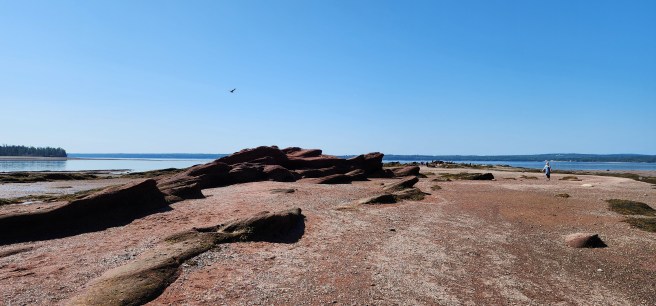
St. Andrews, New Brunswick, is an hour-and-a-half drive from our home, but it does strike us as a Providence, Cape Cod, kind of place in a somewhat more respectable vein. Get away from the tourist strip downtown and you’ll find this at low tide.
The land beyond is Maine, USA.
 Jnana's Red Barn