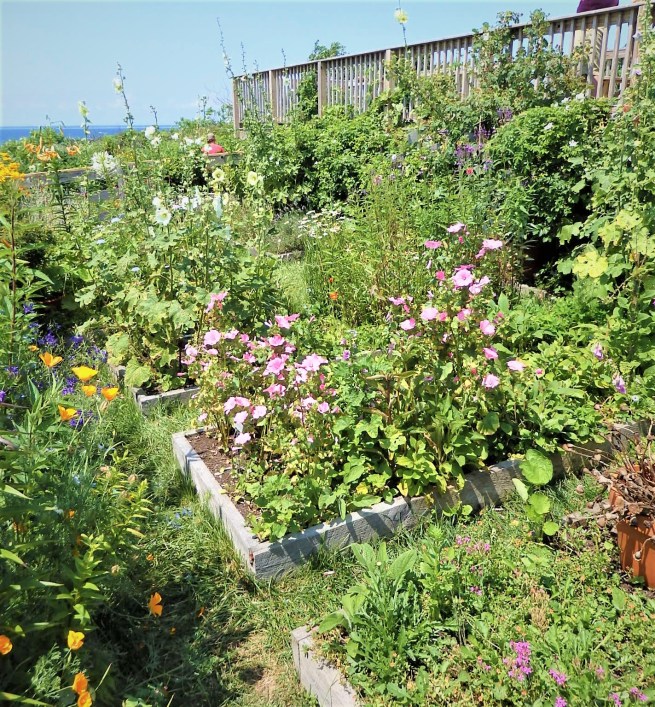
The garden today tries to be faithful to the original. The railing is where the cottage porch once stood.
Celia Thaxter (1835-1894) is an intriguing character in New England history. An important figure in New England poetry, she was also a pioneering hotelier, flower gardener, and catalyst in the fine arts.
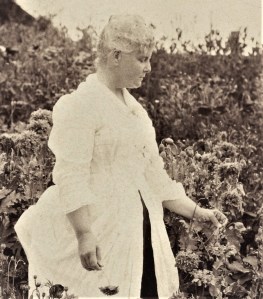
Celia in her garden, 1899
While turning her family’s hotel on Appledore Island in the Atlantic into what was probably the leading summer resort in the Northeast, she also created a famed artists’ colony with salon events featuring a who’s who of America’s leading artists, poets, novelists, and painters. There were likely more, including actors and dancers.
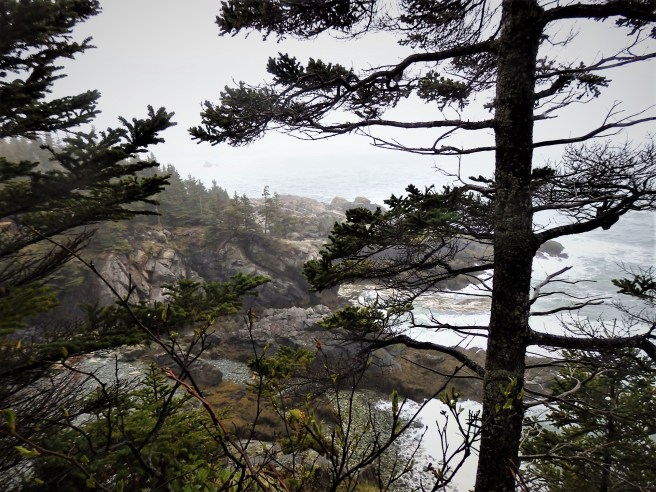
With its 95 acres, Appledore is the largest of the nine islands that comprise the Isles of Shoals about nine miles off the coast of Maine and New Hampshire. It was known as Hog Island until Celia’s family decided to build the hotel and turned to an earlier name for the shoals, one drawn from the Old English word for apple tree. How romantic.
The shoals also include tidal ledges.
Celia’s flower garden in front of her cottage became legendary, celebrated in her lovely book An Island Garden, with glorious illustrations by Impressionist master Childe Hassam. I treasure my reproduction copy. She’s the one who convinced Hassam to use his middle name rather than Frederick as an artist.
The hotel itself burned in 1914, and today the island is privately owned, much of it by the Shoals Marine Laboratory run by the University of New Hampshire and Cornell University. Visits are strictly controlled.
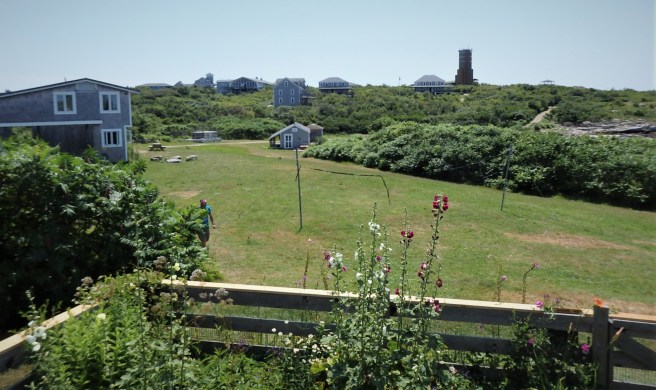
Today Appledore Island is the home of the Shoals Marine Laboratory. The tower was a bunker used to watch for German submarines approaching Portsmouth Harbor during World War II. The hotel sat in the open space from 1847 to 1914. A corner of her resurrected garden is at the lower left.
Last summer, my wife and elder daughter and I indulged in a tour of the island. Among its highlights was walking through the grounds of the long-gone hotel and a replication of Celia’s garden, which is much smaller than we’d expected and less carefully tended. The fact that it needed such constant care is a lesson in humility for those of us who expect similar results on much larger tracts.
And, for those of you who have read the garden book, I’m told that garden slugs are no longer a problem.
Nearby is her grave.
Celia is buried with her parents and siblings on the island.
I relied on writing poetry and fiction in my spare time as a discipline to counteract the conventions of newspaper editing, my professional career.
The job could feel quite dulling of any aesthetic awareness, and quite confining.
Still, some of the qualities between my vocation and avocation overlap, including an insistence on factual observation.
And now I’m free to focus more fully on my literary aspirations. Surprisingly, my focus has been on the fiction, rather than poetry. Could it be that without that dual tension of before, I can now steer a route between them?
For me, poetry springs from quietude and meditation. I began to resonate with what I was reading and then started writing poems seriously only after I had taken up yoga and eventually moved to the ashram. My Quaker practice in the decades since has sustained the practice, even while working in chaotic newsrooms or dealing with passionate relationships.
If you’re “into” poetry, either as a poet or reader, what’s the prompting for your own interest?
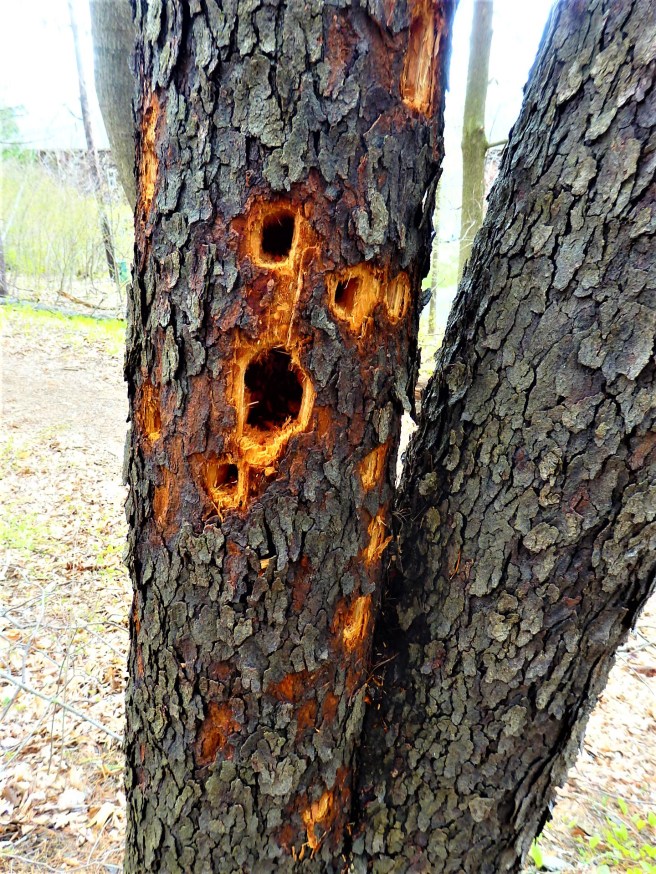
We caught flashes of the big woodpecker a few weeks earlier, but it kept escaping our cameras. And then, a few weeks later while pausing along the old carriage road to the top of Garrison Hill, I saw this.
The central hole is big enough to put your hand in.
Back in April, Smashwords co-founder Jim Azevedo presented a six-hour writers conference via Zoom for ebook authors newbie and long-standing. I found it a rich experience and must applaud his stamina in sitting in front of his computer screen camera that long.
From this to …
His candid advice about rival Amazon prompted me to bite the bullet and look into reformatting my novels for Kindle Direct Publishing as one more digital retailing site for my work. I am, after all, fiercely loyal to Smashwords. Still, with Amazon, the most exciting thing is that I can now offer my work in print-on-demand paperback editions as well. I’ve come to love ebooks, but paper is, well, a special world to me.
Amazon has cleaned up many of its earlier formatting issues, and I can say my maiden foray went surprisingly smoothly. The one hiccup came with the paperback cover – my existing one was too small to run full-size. I compromised by reducing it within the glossy black background field.
I recently posted about tweaking that cover, which I did back before the online conference. Fortunately, it holds up to the new twist that’s been added to my thinking.
Azevedo spent some time covering the importance of covers, something I’ve previously blogged on. Frankly, from a design point of view, I find most book fronts to be cluttered and unfocused, combined with artwork that often strikes me as soft.
The making of a hippie
Maybe it’s all my years in journalism, but I’ve long leaned toward photographs as having more impact than paintings or drawings, and I want a strong graphic element other than type. Ebooks have an additional challenge of appearing, as Azevedo said, like postage stamps at the digital retail sites. That means any cover graphics have to pop if they’re going to catch your attention at all. You can’t be the least bit subtle.
What really struck me in Azevedo’s pitch was his insistence that a good book cover makes a promise.
What? The cover doesn’t mirror the story?
No, a promise.
As I started pondering potential new fronts for my paperback releases, his point kept kicking in. The result is a slew of new ebook covers already. Here I thought I’d be keeping what I had, but instead felt a need for improvement.
There was no escaping the necessity for a cover to have an emotional appeal, a gut-level reaction from a potential reader. Just who am I trying to entice? I’m not a famous writer, like Tolstoy or Stephen King or even Kurt Vonnegut, whose name alone could sell copies.
Still, thanks to an earlier project, I have a clearer concept of my ideal reader than I had in the past. So I’m not simply trying to stop a shopper for a moment’s reflection, as I might with a “literary” appeal. No, I’m trying to connect with her soul and spirit. Whew! So much for that calm bookish repose.
From this to …
Let’s jut say I’m aiming for real readers rather than schoolteachers or librarians. You know, the kind of readers who just might turn into not just fans but superfans, as Azevedo touts, the ones who tell everybody they know about the hot unknown book they’re devouring.
Flash forward and look what’s happened to my Subway Visions cover. The previous one set the underground urban tone, but just what’s the promise? It looks pretty static. Waiting for a train to somewhere, but what then?
The new cover, though, gives a totally different impression. Its brightly tagged subway car goes careening into the depths. We’re not just standing around, waiting, but off into the action. The typeface and solid color provide a retro take on old-fashioned paperbacks. Whoopie! As a reader, I expect to be entertained. We’re in for a wild trip. Well, there’s the promise. Come along with me.
Finding the right image, of course, is a challenge. I lucked out on this one, even though it required a long search and then winnowing down the other options. One where the photos all ultimately lost out.
Along the tubes to nirvana
I do hope that big piece of graffiti doesn’t say something truly embarrassing.
Daffodil Uprising was a bit more wrenching.
I’m quite fond of the clean appearance of that single bloom, but as I came back to the question of promise, I didn’t see the cover suggesting anything. It just stands there, like a monument.
The new cover, though, suggests a row of daffodils blazing into full bloom. It’s colorful and happy, reflecting much of the hippie expectation, without getting caught in the time warp. Yes, the story includes Flower Power but it’s more about youth and shared discoveries rather than Sixties. I’m surprised how fresh this new cover feels.
That’s appropriate, since my extensive revisions of these works sought to move them into being more about NOW than exclusively back THEN, even when the tale is full of what has become ancient history to most of the populace.
As I hunted for the new image, I wound up sorting through thousands of MsMaya’s mesmerizing abstract flower creations before finding one that captured something resembling daffodils. But then it blooms into something much more. Once again, the photos failed to make the final cut.
Some of my novel What’s Left, has her revisiting her memories of early childhood.
Later revisions made this passage redundant, and so it’s been scratched out:
By then even Papou Ilias and Yiayia Maria are long gone. Only the wisp of Yiayia Athina remained. But we still had our own little gang — Barney and Pia’s kids, and Tito and Yin’s, plus my brothers. By then we even have Rinpoche and his presence.
~*~
The final version of the novel has many sharp details, including some prompted by the photos she turns up. It is surprising, though, how powerful some of these memories can be, sometimes triggered unexpectedly from deep recesses. When I was 12, I ran into two brothers from my old neighborhood, my pals up to my fifth birthday. I hadn’t seen them in over seven years, and people do change a lot in that time. Still, I recognized them immediately at the Boy Scout event where we were.
Tell me one of your earliest memories from childhood, good or bad.
~*~
Cassia’s roots included inspiration like this. Church of St. Pantaleon in the village of Siána on the Greek island of Rhodes. Photo by Karelj via Wikimedia Commons.
In my novel Nearly Canaan, Joshua and Jaya find themselves surrounded by orchards. They quickly appreciate apples as much more than an orb to eat alone daily.
Here are ten popular uses.
~*~
Pies or turnovers.
Sauce.
Butter.
Stuffing.
Fritters.
Waldorf salad.
Candied or caramel.
Juice, cider, or cider vinnegar. Let’s not overlook hard cider, either.
Dried.
Baked.
~*~
That’s all pretty basic, before we get to create ways to use ’em with other ingredients.