You’re not the artist you thought you were.
Or musician.
Often, you were much better.
Or my standards were too low.
You never know what we'll churn up in cleaning a stall
You’re not the artist you thought you were.
Or musician.
Often, you were much better.
Or my standards were too low.

We were passed by this sailboat. It still looks breathtaking and even scary.
Seen from a cruise aboard the historic schooner Louis R. French last summer.
For more schooner sailing experiences, take a look at my Under Sail photo album at Thistle Finch editions.
Real estate transactions did use the lot at the corner of Water and Third streets as a referent for other lots. We’ve already seen examples of John senior’s mention of “land owned by me” and the like. Later, we encounter “the homestead of my late father John Shackford” and “the old homestead of my father the late John Shackford.”
Yes, homestead.

After considering the 1806 Samuel Wheeler house at 9 Washington Street and the Federal-style 1805 Hayden (the oldest two-story dwelling in town), the circa 1807 Lewis Frederick Delesdernier on Franklin Street, the 1810 Jonathan Weston, 1820 Daniel Kilby, and 1821-1822 Stetson-Starboard houses on Boynton Street as well as an 1812 Cape on Washington Street, the 1816-1818 Dr. Micajah C. Hawkes on Shackford Street, 1819 Jonathan Venzim-E.E. Shead on Middle Street, and 1821 William Bucknam and Captain Joseph Livermore houses on Key Street, I’m confident that ours predates them and may indeed be older than 1803, as the routing of Water Street route proposed.
I’m willing to venture 1780s. Feel free to argue otherwise.

As for time? An Eastport Sentinel article on the Wheeler house, March 29, 1882, mentioned that under the ownership of Bion Bradbury, the home “was changed by the substitution of a pitch roof,” among other modernizations. I hadn’t really considered the pitch of our roof until this but now realize it is lower (or was, before our own modernizations) than many of the later structures in town. The Federal-style houses, of course, are an exception.
Fictional characters don’t come out of thin air, as far as I’ve seen. Instead, they’re prompted by real people the author has known and then, to whatever extent, abstracted. Better yet are the figures who emerge when two or more of these prototypes are crunched together.
Not uncommonly, over the years between the initial events and the revisions leading to the published book, I’ll even lose the original names (in part or in full) of individuals who prompted the eventual characters.
Still, I’ll venture that all the people in the worlds of fiction, cinema, and television were somehow inspired by real people. Forget the obligatory denial you view in the credits.
The writer’s job is to abstract that into something more universal and eternally new.
That said, I was recently startled to get a message relating that one inspiration was now 87. Here I had thought him “older” as Wes in Nearly Canaan, but now see he was in his early 40s at the time. And riding high, as I recall with admiration.
Photos of colleagues in the newsrooms that prompted Hometown News or in the Workshop in Political Theory and Policy Analysis at Indiana University – details that infuse Nearly Canaan, The Secret Side of Jaya, What’s Left, and likely more – have all elicited the shocking realization of how young we were at the time. Even our leaders.
Ditto for the ashram that inspired Yoga Bootcamp or the ghetto and hippie farm of Pit-a-Pat High Jinks.
The events that propelled the novels came in times of great upheaval in my own life. Like me, I think you would be surprised to learn that most of the Pacific Northwest is desert – that the famed rainy landscape occupies merely a narrow band around the ocean and its inlets. Yet the desert is where the apples – and much more – are grown. It’s a remarkable region, with four distinct seasons and cowboys, Indians, miners, and much more in the mix.
In the broader scene, my professional relocations meant that personal connections from one locale to the next soon ceased, meaning that individuals from one to the other became frozen in time. For me, everybody in high school was frozen in time, as were others in the later leaps.
Reconnecting with a few has felt strange and yet invigorating. As more than one has exclaimed, it’s like nothing has lessened in the gap.
~*~
You can find my novels in the digital platform of your choice at Smashwords, the Apple Store, Barnes & Noble’s Nook, Scribd, Sony’s Kobo, and other fine ebook retailers. They’re also available in paper and Kindle at Amazon, or you can ask your local library to obtain them.
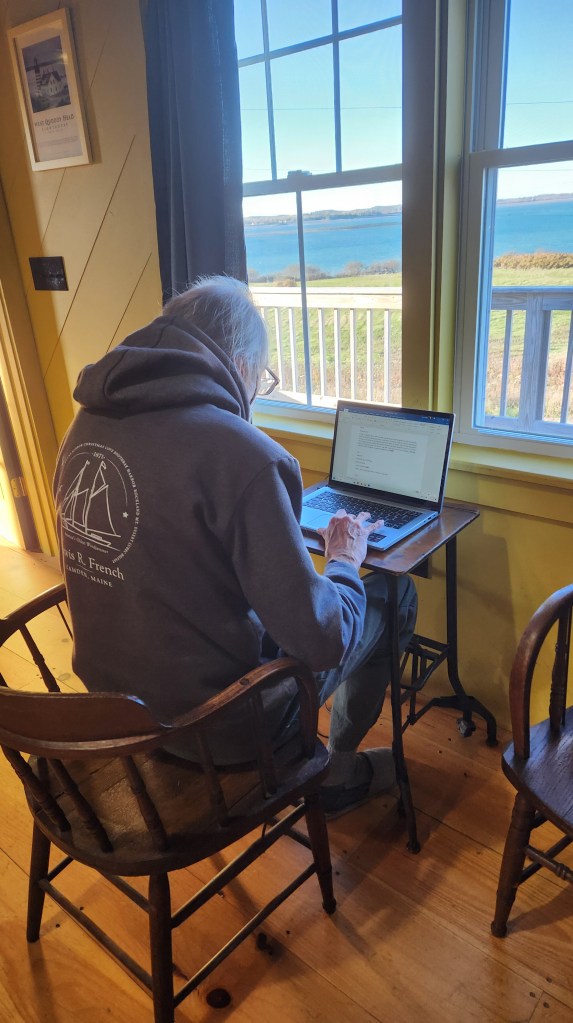 Here I am at the keyboard while overlooking Lubec Channel from a rented cabin at West Quoddy Station, a former U.S. Coast Guard lifesaving post. We needed to vacate our home for two days during its renovation, and we settled on this, still in sight of Eastport on the water to the north and yet a world away.
Lighthouses do stir the hearts of many coastal residents and tourists, though foghorns have long provided at least as much foul weather warning for seafarers along the coasts. These horns do get overlooked, though.
Do note:

How about ten memorable quotes from the popular Peanuts comic strip character created by Charles “Sparky” Schultz? That kid really was a master of angst.
And here I had long dismissed him as somehow shallow, coming up with sappy lines like “Happiness is a warm puppy.”
Do kids today even know what a comic strip was?
My question was only, “What’s going on with someone who has” a certain sun sign with these rising and moon signs.
The astrologer, Hollywood actress, then told me, “Let her go. She’s trouble. You love her very much, don’t you.”
I had witnesses who were astonished. My question had been gender-neutral.
 Jnana's Red Barn