The backstory’s beginning to look presciently ominous for today

In my revisions of the novel Daffodil Sunrise into a more sweeping Daffodil Uprising, I added backstory involving Indiana politics and efforts to extract personal wealth from one of its state universities.

Considering the current effort of the governor to seize control of the school’s board of trustees has me realizing my dark imaginings were all too naïve.

We know what one-party rule did in Germany and also in the Soviet Union.

In my book, the administration had little interest in listening to the students, much less in responding to their needs.

You can bet that will be a renewed breakdown ahead.

As for my spiritual quest from yoga (or before) to here

As I reflect on the many facets of my life to this point – including the zig-zag route that has led me to here – I realize what draws them together is the two central metaphors I’ve found in the early Quaker movement: divine Light and the corresponding Seed. One, as spirit, draws forth; the other, as physical matter, responds. These two, however abstractly, are embodied in both my writing and spiritual practice.

Not that anything’s been quite that easy or direct, even before our current dark times.

At least I haven’t been alone.

~*~

In my fiction, they’re most prominent in Kenzie’s Tibetan Buddhist discoveries in the novels Pit-a-Pat High Jacks and Subway Visions and in Jaya’s practices in Yoga Bootcamp, Nearly Canaan, and the Secret Side of Jaya.

Not to be dogmatic in any of this. What I have now is what I found missing in both the Protestant circles where I grew up and the Eastern practices later. The second, as the ashram, was a step that taught me to sit in silent meditation as well as to live in community, lessons that flowered in relation to my Quaker, Mennonite, and Brethren circles that followed.

Trying to live in the “real world” of employment and a partner and family definitely thickened the plot as these have unfolded. As I’ll concede, a spiritual life needs to be grounded. That is, the gritty realities.

~*~

Trying to be faithful to the Way as it has opened before me was hardly the path I would have expected. It has, though, been blessed with mutual irradiation, in Douglas Steere’s brilliant term, including a Greek Orthodox infusion.

More recently, attempting to get back to some of the basic hatha yoga exercises, has inflicted the humbling blunt recognition of what 50 years of neglect can do to the physical body.

And cutting through the platitudes and BS of the literature remains a challenge.

~*~

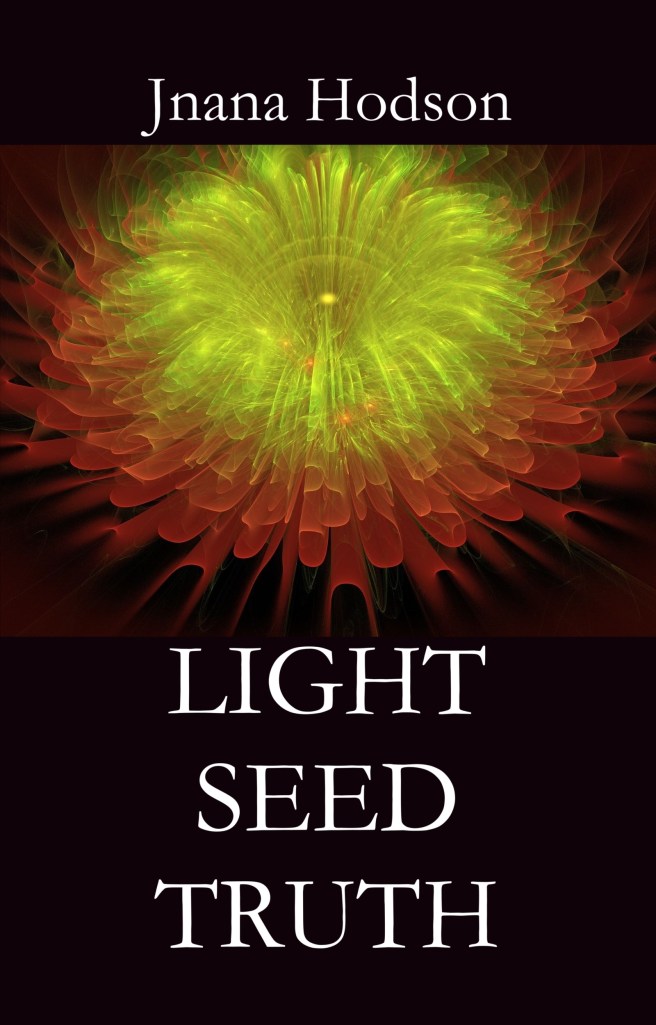
These elements drive the essays of my book Light Seed Truth, examining the three central metaphors of Quaker Christianity. It really becomes a different way of thinking.
Here are some of the things I’ve noted along the way.

I’ve been a Quaker for nearly four decades now, coming to the faith of my ancestors by chance after living and working on a yoga farm in Pennsylvania. Lately, I’ve been uncovering a revolutionary understanding of Christ and Christianity – one the early Quakers could not fully proclaim in face of the existing blasphemy laws but experiences they couched in metaphors of the Light, Seed, and Truth. As I systematically connect the dots 3½ centuries later, I’m finding a vibrant alternative to conventional religion, one full of opportunities to engage contemporary intellectual frontiers, individual spiritual practice, and societal crises. As an established writer – a professional journalist, poet, and novelist – I’ve organized these insights into a book-length manuscript. Would you like you to see it?

What I’ve found is an astonishing course of religious thought no one else has previously presented systematically. Reconstructed, their interwoven metaphors of the Light, the Seed, and the Truth provide a challenging alternative to conventional Christianity, one full of opportunities to engage current intellectual frontiers ranging from quantum physics and Asian spiritual teachings to psychology and contemporary poetry.

Embedded under the conventional interpretation of the scriptures and teachings about Jesus is an alternative definition of Christ and Christianity.

When early Quakers in mid-1600s Britain experienced this as their “primitive Christianity revived,” they were forbidden by the blasphemy laws from proclaiming their understanding openly. Instead, they couched it in overlapping metaphors of the Light, the Seed, and the Truth.

Embracing holy mystery, I’ve found the Hidden Path emerges.

Forget everything you’ve heard about Christianity. Let me show you an alternative portrait of Christ, and a much different practice that results. It can change your life. For starters, you need to realize that Christ is bigger than Jesus.

I can introduce you to the Universal Christ, which is quite distinct from Jesus. It can transform your spiritual understanding and make your life deeper and richer.

This can revolutionize your experience of Christ and what it means to be Christian.

This is not simply an intellectual exercise, but a visceral awareness

The results will startle and provoke, not just across the spectrum of today’s Society of Friends, but among Christians everywhere.

Sometimes I experience the act of writing as prayer. Neither is done for outward compensation, much less any guarantee of results, but rather to open one’s heart and mind to what is eternal and true – and attune oneself to that, regardless.

Culling my collection of photography and tearsheets, I’ve recognized I no longer desire to travel many places I haven’t been, but would rather revisit places I have. Either in person or, in the case of Tibet or Japanese temples, in my thinking and study. I also recognize that could change, given different economic circumstances and an influx of free time.

I now seethe early Quaker vagabonds were Dharma bums, too. The itinerant ministry proffers its own humor.

Quakers are still around, all right. And more relevant than ever. Just listen.

You can find it in the digital platform of your choice at Smashwords, the Apple Store, Barnes & Noble’s Nook, Scribd, Sony’s Kobo, and other fine ebook retailers. You can also ask your public library to obtain it.

Among the advances in human society, don’t overlook toilets

Ever wonder how they work? No electricity, motors, or anything like that? Flush toilets are taken for granted by half of the world’s population, except when there’s a malfunction.

For perspective, check this roll. Well, actually two rolls today – it’s a Double Tendrils occasion.

  1. You visit a toilet about 2,500 times a year. And that’s under normal conditions.
  2. The bathroom is a leading cause of arguments among couples. As for other family members or housemates?
  3. In a public restroom, the first toilet cubicle in a row is the least used and thus the cleanest of all. Not the last one?
  4. The more features your smart phone has, the longer you sit on the can.
  5. More than 7 million people in the U.S. admit to dropping their cell phones in the bowl.
  6. The average kitchen chopping board has twice as the fecal bacteria than a toilet seat. And mobile phones have 18 times more bacteria than do toilet handles.
  7. When it comes to replacing the toilet paper, three out of four people put the flap in front, away from the wall.
  8. For the latest in modern comforts, high-tech toilets can lift their lids when they sense you approaching or instantly warm the seat to your body temperature. Some will wash your rear and blow warm air to dry it, a feature of note for mobility-limited people.
  9. Some high-tech toilets even clean themselves. I assume that would ease some of those arguments back in item 2.
  10. Much of the other half of the world population relies on dry privies such as outhouses, pit latrines, port-a-potties, composting or incinerating toilets, and “treebogs” surrounded by nutrient-absorbing plants.

Now, for some historical and global angles.

  1. The ancestor of the modern porcelain john was created by Sir John Harington, a godson of Queen Elizabeth I. Banished from the court on account of his bawdy verses and humor (how appropriate), he wound up in Bath in southwest England and devised a flushing toilet in 1596. Its system of handles emptied water from a tank at the same time the user opened levers to flush the toilet contents down the drain to who knows where. Allegedly, the contraption brought him back into the queen’s good graces.
  2. The modern household throne typically relies on two developments. The first is the ballcock, the bobbing mechanism inside a toilet tank, which prevents water from overflowing in a storage tank. Invented by Mexican priest and scientist Jose Antonio de Alzate y Ramirez around 1790 and early applied to steam engines, it eventually provided toilets with the flush of water that generates a siphon that sucks the toilet bowl contents up and over a trap and then away. Thus, the second breakthrough development, the S trap by Scottish mechanic Alexander Cumming in 1775, collects water in the bowl and prevents sewer gases from escaping into the bathroom. Further advances soon followed, largely in England.
  3. Contrary to legend, plumber and businessman Thomas Crapper did not invent the flush toilet. Versions of that were already widespread in water-closets in middle-class homes, especially in London once a sewage system was constructed. He did refine the throne and obtained appropriate patents but is best known for popularizing toilets in Victorian England. In 1870, he opened the first showroom and even allowed customers to try out the merchandise before purchase. With his name emblazoned on the overhead tanks, he soon became synonymous with the product. For the record, though, the slang term “crap” traces back to Middle English.
  4. Flushing toilets appear as early as settlements in the Indus Valley of 2,500 B.C.E., though antecedents have been found back to the Neolithic period. For that matter, the oldest toilet is still functioning about 4,000 years after it was built. It’s Knossos, Greece, in a small castle.
  5. Toilet paper may have been invented in China in the 6th Other early wipes included pebbles carried in a sponge on a stick common among ancient Romans; a small bag of pebbles carried by Jews; wool, lace, or hemp for the wealthy or – catch your breath – rags, wood shavings, leaves, dry grass, moss, sand, ferns, plant husks, seashells, corncobs, and, of course, water, by the general populace.
  6. Modern commercial toilet paper originated in the 1800s, although Joseph Gayetty is widely credited with introducing the product in the United States in 1857 Gayetty’s Medicated Paper was sold in packages of flat sheets, watermarked with the inventor’s name.
  7. A patent for roll-based dispensers was awarded in 1883, and its application extended to toilet paper in 1890 the Scot Paper Company was the first to manufacture what would become the long strips of perforated paper wrapped around a paperboard core found within reach of the majority of toilets.
  8. Toilet paper also comes folded as interleaved sheets in boxes, or in bulk for use in dispensers.
  9. Colored toilet paper, popular from the 1960s, has largely faded from the marketplace, replaced largely by embossed patterns or color designs. And, as a selling point, “softness” or “fluffiness” is a bonus.
  10. The average American uses 141 rolls a year, double the rate in other Western countries or Japan. One factor for the difference is that folks elsewhere use bidets or spray hoses to clean themselves.

A surge of activity after seemingly nothingness

In the renovation, we had periods were seemingly nothing was happening but then, BLAM!, things suddenly moved on all fronts.

This was especially true when we were at the mercy of other tradesmen and their schedules – plumbers, high on the list.

One of those involved the crew that would do the sprayed foam insulation on the front half upstairs. We decided to go with a different company than the one that had done the back, in part because the new one got back to us with a bid promptly, unlike the other. Not only that, they could get to work for us sooner than later.

That did put some pressure on Adam to get the electrical wiring and outlets in the framing before the crew showed up, so it was crunch time there.

But then the electrical panel in the basement blew out.

We were without power going into the weekend. And without heat.

Adam did have an amazing storage battery that we plugged the refrigerator into while he patched the old system.

As he said, the only thing holding the panel together was rust and spider webs.

This came only months after he had rewired the pretty much the whole house, everything but the panel and circuit-breaker box. They were scheduled for later.

And then, the whole town lost power for a few hours, all just before the weekend and the foam-spray guys on Monday.

As a further complication, we had to be out of the house for 24-hours after the foam application. We got a two-night reservation near West Quoddy State Park, in a delightful cabin overlooking Lubec Channel and all the way up to a corner of Eastport. We were so close to home and yet a world away.

The bad news came when we determined the extent of damage done by the power surge. Four of our surge protectors were fried, as was the outlet to our washer (for a while, we thought it was gone), and then a unit in our furnace was also kaput – requiring a night call for service.

It was quite a whirlwind for us.

That sprayed-in foam insulation also covers the wiring. It’s amazing.

We still needed a new electrical panel and, while they were at it, a new circuit-breaker box, too. Adam called in some allies to tackle that, and they got to us quicker than usual. The problem was getting the electric company to come promptly to cut off the power to the house and restore it.

Whew, it did happen, though the utility forgot to include a ladder with the first truck it sent out.

~*~

Perhaps this is the time to explain why we passed on the Generac backup when we moved to town. You might get a charge out of this.

Most of us, at least in the industrialized world, take reliable electrical wiring for granted. An old house, especially if you’re updating it, can remind you otherwise.

I’ve already mentioned the hot topic that Maine is prone to widespread electrical power outages. The state does have some arcane accounting details that likely abate the problem, but I’ll spare you the common rants about our utility companies and their higher-than-average rates.

One upshot is that many houses around here have emergency generators emplaced to kick in at the outbreak of an outage. Sometimes we hear that before we realize our lights and other conveniences are out.

We nearly got one ourselves, despite the high price. The tripping point turned out to be where to put the unit itself, its concrete pad etc., but especially the propane tank – a much bigger one than we thought necessary. The only viable site in our yard was in the heart of our best full sunlight, a spot we deemed more valuable as a future garden bed.

That didn’t rule out a smaller portable Honda generator in the future, though it wouldn’t go into service automatically and requires attention for the duration of an outage.

Better yet, the portable battery Adam lent us looked like the ideal solution for us, especially after we found one on sale.

We’re thinking between that and our wood stove we can ride out the typical outage.

We’ll see.

How much of my story is not directly my story?

Rather, so much arises in the intersections with so many others. It’s part of the role of the artist as a witness.

We could consider the death of my ex-spouse’s second husband, for example, or the death of my current spouse’s first. Some hit closer to home than others.

Even the activities of others in our own households that aren’t exactly ours individually.

Add to that the ways others would see us, in contrast to our own versions.

These are typical of things that still impact our own individual life stories. Our lives could have led to so many other possible outcomes, after all.

Let me admit that my life is enriched by what others do around me, even when I’m not actively engaged. I want to share in their glory … or whatever. The way a sports fan does.

A writer is ultimately an observer, not just a participant.

For example, as a poet and professional journalist, I found that the police radio scanner in the newsroom more accurately reflected romantic relationships in America today than any collection of English love poems. You didn’t have to sit next to a police scanner to perceive how sexual relationships had taken a peculiar turn.

Or, from another perspective, growing up in Ohio, I had thought our family had no colorful traditions or legacy. Only after moving on to both coasts and, by chance, embracing the faith of my ancestors did I come to see how much Grandpa and Grandma were discarding the very things I was reclaiming and how thoroughly they were adapting to a changing urban environment. Despite all the time my sister and I spent with them, I came to realize I really didn’t know them, after all. Just who are grandparents, anyway? Does anyone’s fit our idealized image? Only recently, learning that Grandpa proudly advertised himself as Dayton’s Leading Republican Plumber, did I find the key to unlocking their story and its place in history.

I had no idea Grandpa’s lines had been Quaker through North Carolina, Pennsylvania, Northern Ireland, and Cumbria, England. There was nothing of the pirate attack that left an orphan to arrive in the New World, where he eventually settled on the frontier of Pennsylvania and later the Carolina Piedmont. Nothing of our gold mine or the pacifism in the face of the Confederacy, either. Grandma’s lines, meanwhile, had been Dunker – another pacifist denomination – and a pioneer family settling a corner of Montgomery County, Ohio, that up until the First World War was as Pennsylvania Dutch as the Lancaster and York counties it had left. These are not the American histories we typically see.

What kind of person would describe himself as Dayton’s Leading Republican Plumber? My grandfather did, though it was only years after his death that that tidbit finally allowed me to know who he really was. It’s really a remarkable story.

As for the others who crossed my path in college or the upheavals after?

I have no idea where most of them have gone.

Of the others, the results aren’t always what I anticipated.

I do know that none of what I see around me is being faithfully examined on television or the movies, something I’ll argue is cultural impoverishment.

In the larger span of time

Being a classical music fan induces a peculiar sense of history. If you love fine paintings or theater or literature, you may encounter something similar.

I found some of this being stirred up while sitting through a concert where Debussy was the oldest music performed. He was still considered “modern” when I began attending concerts in 1959 or so. He died in 1918, shortly before my parents were born. Not that far back, then.

For additional perspective, some major Romantic-era composers like Tchaikovsky, who died in 1893, or Saint-Saens, 1923, or Puccini, 1924, weren’t all that distant from me at the time, though it seemed they were much more ancient, say closer to Mozart. The span between them and me at the time would fit into my own life now.

I do recall hearing a live performance of the Tchaikovsky fourth symphony under Lukas Foss and the Buffalo Philharmonic and during the rapturous applause afterward have the gentleman sitting beside me lean over and say, “You should have heard it under Reiner in Cincinnati, as my wife and I did.” That would have been only 50 years after its composition, and this was 30 or so years later.

What is striking me is how much harder it’s been for new music to catch on since then. I don’t think it all has to do with the attempt to write in more original – and often strident – styles.

There’s also a looping of generations, as would happen when a ten-year-old heard something from someone who was 80 relating something he or she had heard at age ten from an 80-year-old’s encounter at age ten with an 80-year-old from age ten. It wouldn’t be hard to have two-century span at hand.

Now, as for naming compositions from the last 50 years that have entered the standard repertoire, it would be a shockingly short list.